Statue of Liberty Tickets Guide: Crown, Pedestal or Grounds?
By the AllTrips Editorial Team · Updated · 18 min read

Here is the thing nobody tells you about the Statue of Liberty: you can see it for free from half a dozen places in New York, but you cannot actually visit it without one specific company's ticket. Statue City Cruises is the only authorised public ferry service carrying ticketed visitors to Liberty and Ellis Islands. Other sightseeing cruises — including the speedboats and the "skip-the-line" sellers on the street — normally pass the islands without landing, leaving you on the wrong side of the water.
This guide covers the three ticket types and what each one actually gets you, realistic 2026 prices, how far ahead to book, which departure point to choose, and how to fit Ellis Island into the same morning without rushing either.
Official-ticket warning: Statue City Cruises is the only authorised public ferry service carrying ticketed visitors to Liberty Island and Ellis Island. Other sightseeing cruises may offer excellent views but normally pass the islands without landing.
Which Statue of Liberty ticket should you buy?
All official tickets are sold by Statue City Cruises, the National Park Service's authorised concessioner. Every ticket — even the cheapest — includes the round-trip ferry, Liberty Island, Ellis Island and the excellent Statue of Liberty Museum.
| Visitor | General ferry | Pedestal Reserve | Crown Reserve |
|---|---|---|---|
| Adult 13+ | $26.00 | $26.30 | $26.30 |
| Senior 62+ | $23.00 | $23.30 | $23.30 |
| Child 4–12 | $17.00 | $17.30 | $17.30 |
| Under 4 | Free | Free | Crown restricted |
Prices checked September 2026 against the National Park Service and the official operator. Rates change — confirm on statuecruises.com (City Experiences) before booking.
Pedestal and crown access add only a small reservation charge. Availability, rather than price, is the main difference. The crown and pedestal have strict daily capacity limits, so the real currency is how early you book: popular morning departures can sell out, particularly in peak season, Pedestal Reserve typically goes two to four weeks ahead, and Crown Reserve can sell out around 90 days ahead, though inventory is sometimes released earlier.
Official crown booking restrictions
- Maximum four crown tickets per order.
- One crown reservation per person in any six-month period.
- Identification must match the named ticket holder.
- Time inside the crown is limited to about ten minutes.
- Children must be at least 42 inches (about 1.1 m) tall; 377 steps in total from the ground.
Rules summarised from the National Park Service crown guidelines. Crown Reserve also advertises priority entry into the screening-facility queue — that is not a security bypass or a guaranteed ferry departure.
What “General Admission/Reserve” means: the islands and their museums do not charge separate admission — the National Park Service charges no park entrance fee. Almost all of the base price is the required ferry transportation, which is why every tier costs nearly the same.
Which ticket should you pick?
- Crown Reserve — if climbing inside the statue is your priority.
- Pedestal Reserve — for elevated views without the crown staircase.
- General Admission — if reserved interior access is unavailable.
- A harbour cruise — if you only want skyline photographs and do not need to land.
- Staten Island Ferry — for a completely free distant view.
Crown, pedestal or grounds only?
- Crown Reserve is the bucket-list option: 162 steps up a narrow, double-helix staircase from the pedestal into the crown, with small windows looking out over the harbour. It is hot, cramped and genuinely thrilling. Bags are not allowed (lockers on site), children must be at least 42 inches / about 1.1 m tall, and you need a second security screening at the statue. Worth it if you can get it.
- Pedestal Reserve gets you to the observation deck on top of the stone pedestal — roughly halfway up, with a wide-open view and none of the claustrophobia. The best value upgrade and the right choice for anyone uneasy about the crown stairs.
- General Admission still gives you the island grounds, the museum (with the original torch), and the classic photo from the base. If crown and pedestal are sold out, take this — you lose surprisingly little.
Where to buy tickets
Start with the official ferry — the only authorised public service carrying ticketed visitors to the islands. If official crown or pedestal access is unavailable, third-party packages may still offer guided visits with standard island ferry transportation. They normally cannot provide sold-out reserved interior access.
OfficialStatue City CruisesThe authorised public ferry to Liberty and Ellis Islands. Crown and pedestal reservations are sold here.Official Tickets PartnerTiqetsGuided packages that may include official ferry transportation. Check carefully whether a package includes only island access or also reserved pedestal access; crown access is normally booked through the official provider.Check PricesThe Tiqets link is an affiliate link — if you book through it we may earn a small commission at no extra cost to you. The official Statue City Cruises link is not monetized.
Where should you buy Statue of Liberty tickets?
Buy only from Statue City Cruises or at the Castle Clinton box office in The Battery, commonly called Battery Park. This matters because the approach to the park is one of New York's oldest scam ecosystems: sellers push "Statue of Liberty tickets" that turn out to be harbour cruises that never dock. Statue City Cruises is the only authorised public ferry service carrying ticketed visitors onto Liberty and Ellis Islands. Some legitimate third-party tours bundle a Statue City Cruises ferry ticket, but many harbour cruises merely pass the statue without landing.
Your ticket is tied to a departure point and a security-screening time slot. Allow at least 30 minutes in quiet periods and 60–90 minutes during summer, weekends and holidays. Your ticket time is when you may join the security queue — not a guaranteed ferry departure time. The screening at Castle Clinton (or Liberty State Park) is airport-style and the queue is the main delay of the day, not the boat.
What is the history of the Statue of Liberty?
The statue began as an idea at a dinner party in France in 1865: a gift from the French people to the United States to mark the centenary of American independence and the two countries' shared ideals. Sculptor Frédéric Auguste Bartholdi spent more than a decade designing and building it, with the internal iron framework engineered by Gustave Eiffel — the same Eiffel who would later give Paris its tower. The copper skin is barely 2.4 mm thick, about the width of two coins stacked together, and it is that thin shell flexing on Eiffel's skeleton that lets the statue survive harbour winds.
The completed statue was dismantled into approximately 350 pieces, packed into 214 crates and shipped to New York in 1885. The Americans, meanwhile, had to fund the pedestal themselves — and it nearly didn't happen until newspaper publisher Joseph Pulitzer ran a fundraising campaign that drew donations from more than 120,000 people, most of them giving less than a dollar. The statue was finally dedicated on 28 October 1886. The sonnet on the pedestal, Emma Lazarus's "The New Colossus" — "Give me your tired, your poor" — was written for that fundraising effort and only became inseparable from the statue decades later, when the arrival halls of Ellis Island had made its words literal.
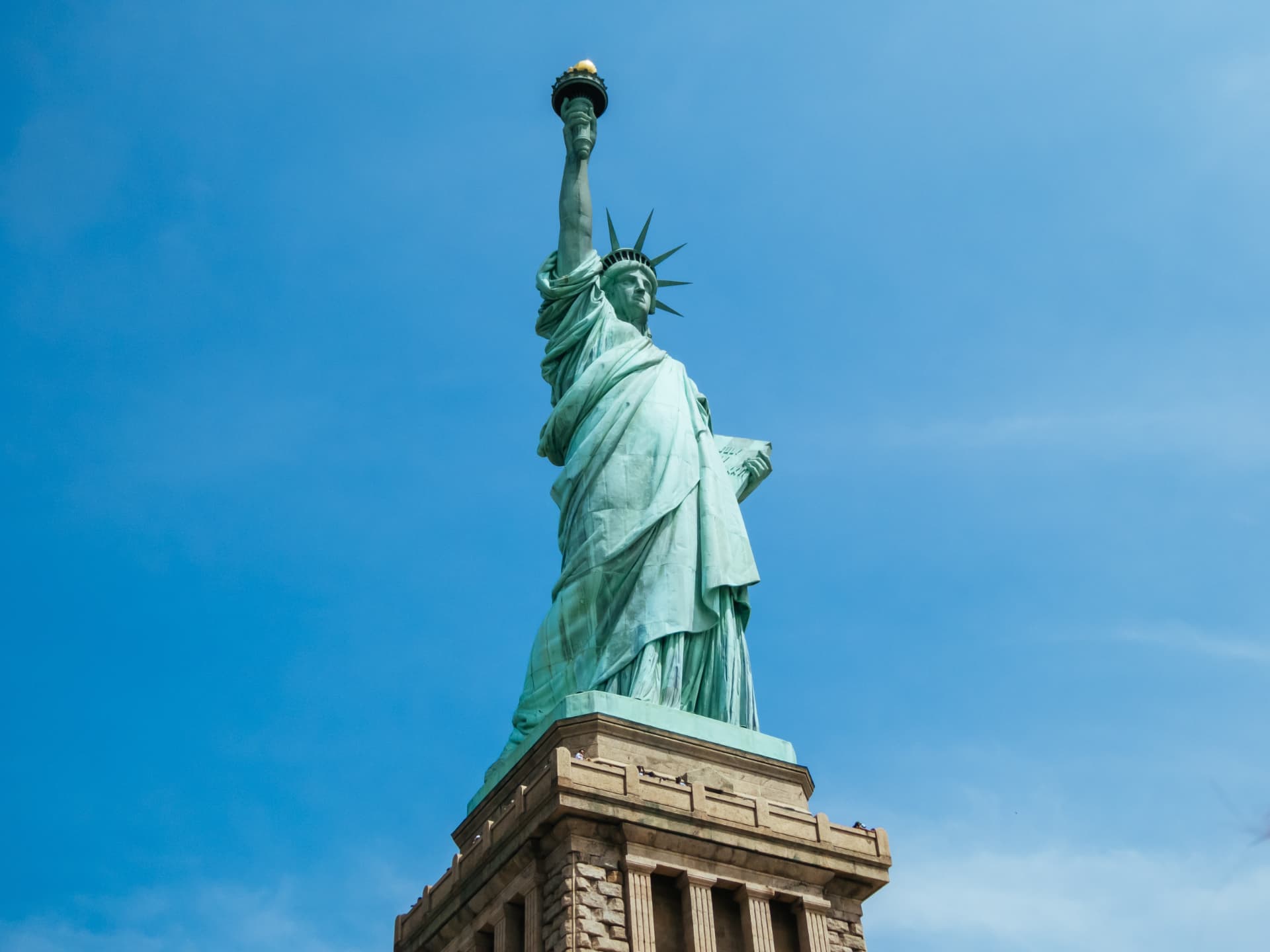
A few numbers worth knowing before you go: from the ground to the tip of the torch the statue stands 93 metres; the tablet in her left hand reads "JULY IV MDCCLXXVI" (4 July 1776); the crown's seven rays are commonly interpreted as representing the world's seven continents and seven seas, though that reading is an interpretation rather than a documented design statement; and broken chains lie at her feet — hard to make out from ground level, and the detail most visitors walk straight past. The green colour is not paint: the copper was a dull penny-brown when it went up and oxidised gradually over the following decades into its familiar sea-green patina. That patina now protects the metal, which is why it will never be cleaned off.
Map: Liberty Island, Ellis Island and the best viewpoints
Everything on this trip clusters around the harbour. Use the map to plan the ferry departure, the free Staten Island Ferry view and the easy add-ons for the rest of the day.


 📍
🏺
🏺
📍
📍
📍
📍
📍
+− Leaflet | © OpenStreetMap contributors
1. Statue of Liberty (Liberty Island)
The statue itself, pedestal and crown. Reachable only on the authorised public ferry — reserve ahead.
2. Statue of Liberty Museum
Free with every ferry ticket. The original torch lives here, plus the full-scale face replica.
3. Ellis Island National Museum of Immigration
Included in every ferry ticket. The Great Hall where 12 million immigrants were processed.
4. The Battery, commonly called Battery Park (Manhattan departure)
Castle Clinton is where you go through airport-style security and board the ferry.
5. Liberty State Park, CRRNJ Terminal (New Jersey departure)
The quieter departure point with free skyline views — often the better choice at weekends. Ferries leave from the historic CRRNJ Terminal at 1 Audrey Zapp Drive.
6. Staten Island Ferry (free view)
The free commuter ferry gives a clear harbour view of the statue from roughly a kilometre away — one of the best free views in the city.
7. Brooklyn Bridge
An easy add-on after the ferry returns — walk the promenade for harbour views.
8. One World Observatory
The best aerial view of Liberty Island if you skipped the crown. Book a sunset slot.
How does a Statue of Liberty visit work?
- Security screening at Castle Clinton (Manhattan) or Liberty State Park (New Jersey), then board. Ferries run roughly every 20–30 minutes.
- Island order depends on where you board. From Manhattan, ferries normally visit Liberty Island before Ellis Island. From Liberty State Park in New Jersey, Ellis Island comes first. Check the current schedule because services vary seasonally.
- Liberty Island. The crossing takes about 15 minutes. Walk the perimeter path for the classic upward shot, then the museum, then your pedestal or crown time slot if you have one.
- Ellis Island. Re-board the ferry for the five-minute hop. The Great Hall of the immigration museum is genuinely moving — 12 million people passed through it between 1892 and 1954, and the American Immigrant Wall of Honor outside lists hundreds of thousands of their names.
- Return to your original departure point. From Battery Park, the Brooklyn Bridge and One World Observatory are an easy walk for the afternoon.
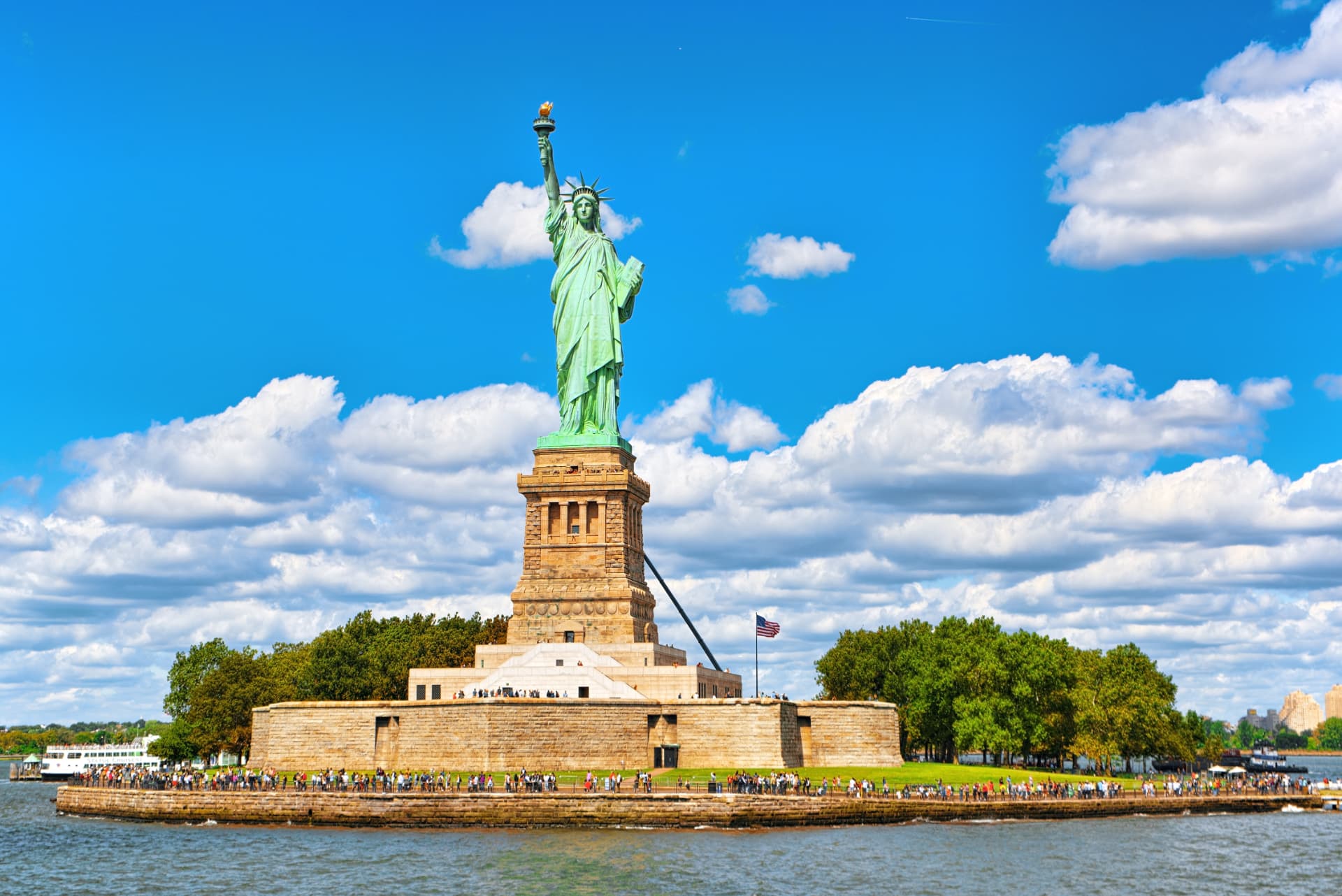
Time needed: half a day is realistic — about four to five hours with Ellis Island, three without. The first ferries of the morning (before 9:30) are noticeably quieter than midday departures.
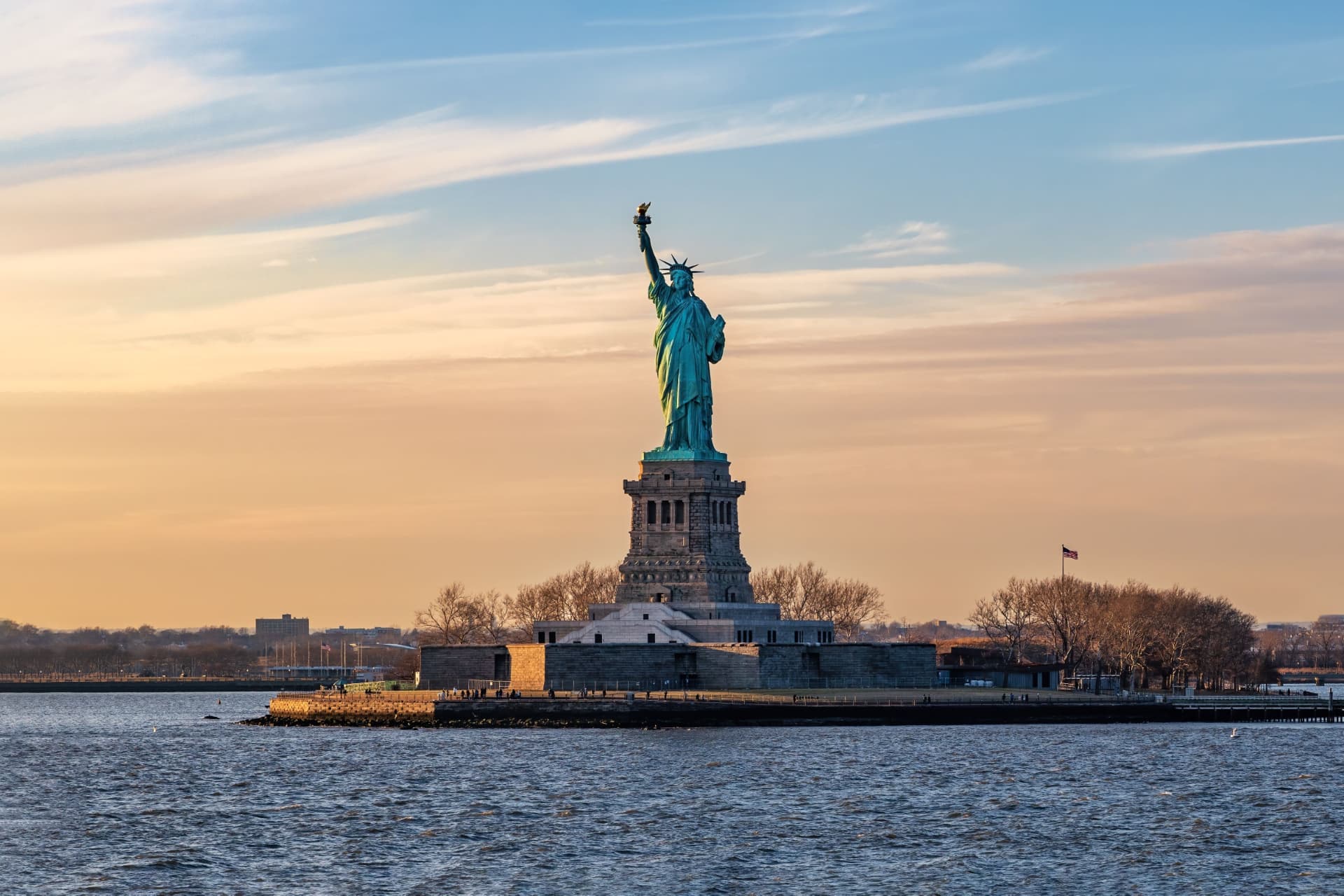
The free alternative: the Staten Island Ferry runs 24 hours a day, costs nothing, and offers a clear harbour view of the statue from roughly a kilometre away, depending on the vessel's route and position. Stand on the right side of the boat going out. It is one of the best free harbour views in New York, though the statue stays small in phone photographs.
What is inside the Statue of Liberty Museum?
The museum opened in 2019 and is included with every ferry ticket — no reservation needed. Three things make it worth your time. First, the original torch: the glass-and-copper flame the statue held from 1886 until it was replaced during the 1980s restoration, now displayed at eye level so you can appreciate how enormous it really is. Second, the full-scale replica of the statue's face, which is strangely moving up close. Third, the roof terrace, which has one of the best framed views back to the Manhattan skyline and costs nothing extra.
Inside you'll also find exhibits on how the statue was designed, funded and built — including plaster models showing Bartholdi's working process — and an immersive theatre film that runs about ten minutes. Allow 45 minutes to an hour; most people who skip the museum to "save time" end up with time to kill at the dock anyway.
How long should you spend on Ellis Island?
Every ferry ticket includes Ellis Island, and it deserves at least an hour — two if anyone in your family arrived in the United States by ship. Between 1892 and 1954 some 12 million immigrants were processed here, and the museum tells their story inside the very rooms where it happened. The Great Hall on the second floor, with its vaulted tiled ceiling, is where new arrivals queued for medical and legal inspection; standing in it empty is one of the most quietly powerful museum experiences in America.
Don't miss the free ranger-led tours (check the schedule board in the main entrance), the "Through America's Gate" exhibit that walks you through the inspection step by step, and the American Immigrant Wall of Honor outside, which lists over 700,000 names. The American Family Immigration History Center lets you search ship passenger records — if you have ancestors who arrived through New York, bring their names and approximate dates and the staff can often find the manifest.
How do you get to the ferry departure points?
Battery Park (Manhattan): the closest subway stops are Bowling Green (4, 5 trains) right at the park's edge, South Ferry (1 train) and Whitehall Street (R, W trains). From anywhere in Manhattan it's a straightforward ride; from Midtown allow 30–40 minutes door to gate. Castle Clinton — the round stone fort where security and boarding happen — is at the park's southern tip, impossible to miss once you're inside the park.
Liberty State Park (New Jersey): take the Hudson-Bergen Light Rail to Liberty State Park station, then walk approximately one mile along Audrey Zapp Drive to the CRRNJ Terminal — allow around 20–25 minutes. If you're driving, this is the departure you want — there's a large paid parking lot right by the terminal, something Battery Park simply doesn't offer.
When is the best time to visit the Statue of Liberty?
The sweet spots are May–June and September–October: mild weather, long light and crowds that are manageable rather than crushing. July and August bring the biggest queues and a humid, windless harbour; November through March brings emptiness, cheap hotels and a bitter wind off the water — dress for a temperature about 5°C colder than Manhattan proper. Whatever the season, the first ferries of the morning are the insider move: you'll clear security in minutes, share Liberty Island with a fraction of the midday crowd, and get your photos before the light goes flat and harsh.
Late-afternoon slots have their own magic in autumn and winter, when the return crossing lines up with golden hour behind the skyline — but in peak summer the last ferries are as busy as the midday ones, and you risk having to rush Ellis Island.
Is the Statue of Liberty accessible?
The ferries, both islands' grounds, the Statue of Liberty Museum and the Ellis Island museum are wheelchair accessible, and wheelchairs are available to borrow on both islands on a first-come basis. An accessible elevator-and-lift route reaches the interior top level of the pedestal. However, the historic exterior observation balcony is too narrow for wheelchairs; Fort Wood's lower observation level provides an accessible outdoor alternative. The crown is the hard exception: 162 narrow, steep steps with no elevator access, and the National Park Service recommends against it for anyone with heart or respiratory conditions, vertigo or claustrophobia. Strollers must be left outside before the crown climb. Service animals are permitted throughout.
What can you bring to the Statue of Liberty?
- Bring: your booking confirmation, photo ID matching the reservation name, a refillable water bottle (fountains on both islands), sunscreen and a hat — the island is fully exposed — and layers, because the harbour wind cuts even in summer.
- For crown/pedestal holders: bring as little as physically possible. Only your phone, camera and essential medication can go up; everything else goes into paid lockers at the base, and locker queues eat into your time slot.
- Leave behind: large backpacks, suitcases, drones (strictly banned over the islands), selfie sticks for the crown, and any weapon-like items — the airport-style screening is real and will confiscate them.
- Good to have: a portable charger (you'll take hundreds of photos), and downloaded tickets as backup since cell signal on the water can be patchy.
Can you buy food on Liberty and Ellis Islands?
Food and drinks are available on both islands — cafés serving the expected burgers, sandwiches, salads and coffee at attraction prices. Security and monument-interior restrictions differ between the ferry screening, the island grounds and the secondary screening for the pedestal and crown, and they can change, so travel with minimal baggage and check the official prohibited-items list rather than assuming a particular bottle or snack will pass every point. Back on the mainland, the options improve fast: Stone Street's pub-lined cobblestones are a ten-minute walk from The Battery, and the food halls at Brookfield Place and Eataly Downtown near the World Trade Center cover everything from quick pizza to a proper sit-down meal.
Common mistakes
- Buying from street sellers near Battery Park. Their boats never land on Liberty Island. If the seller can't explain which security building you go to, walk away.
- Expecting to buy crown tickets on the day. They sell out months ahead in peak season. Check availability before you plan the rest of your itinerary around them.
- Skipping Ellis Island. It's included in your ticket and, for many visitors, ends up being the highlight of the day.
- Bringing a big bag for the crown. You'll need a locker and the queue for them eats into your slot. Bring as little as possible.
- Booking a midday summer slot. The security queue is longest between 11:00 and 14:00. Early morning or late afternoon is calmer and the light is better.

FAQ
Do I need to buy Statue of Liberty tickets in advance?
Yes. Popular morning departures can sell out in peak season, Pedestal Reserve tickets often go weeks ahead, and Crown Reserve can sell out around 90 days ahead. Statue City Cruises is the only authorised ferry landing ticketed visitors on Liberty and Ellis Islands; other cruises normally pass without landing.
When are crown tickets released, and what are the rules?
Crown tickets are released on a rolling basis, roughly 90 days ahead. Rules: up to four per order, one crown reservation per person every six months, ID matching the ticket, extra security screening, children at least 42 inches tall, and about ten minutes inside. Expect 162 narrow steps above the pedestal.
How much do Statue of Liberty tickets cost?
In 2026 the general ferry ticket is $26.00 for adults 13+, $23.00 for seniors 62+ and $17.00 for children 4–12; under-4s travel free. Pedestal and Crown Reserve add a small charge ($26.30, $23.30, $17.30). Availability matters more than price. Confirm current rates on Statue City Cruises before booking.
What is the difference between General Admission, Pedestal and Crown tickets?
All three include the round-trip ferry, Liberty Island, Ellis Island and the Statue of Liberty Museum. General Admission covers the island grounds only. Pedestal Reserve adds the pedestal observation deck. Crown Reserve adds 162 narrow steps from the pedestal into the crown, a small, hot staircase with a separate security screening.
Is Ellis Island included in the ticket?
Yes. Every official ferry ticket includes a stop at Ellis Island and entry to the National Museum of Immigration. You can skip it and stay on the boat, but allow at least an hour if you go — it is one of the best museums in New York.
Can I see the Statue of Liberty for free?
Yes. The free Staten Island Ferry runs 24/7 from Whitehall Terminal in Lower Manhattan and passes roughly a kilometre from the statue, one of the best free harbour views, though it looks small in phone photos. You can also see it from The Battery, Brooklyn Heights Promenade and Governors Island.
Which departure point is better: Battery Park or Liberty State Park?
Battery Park in Manhattan is more convenient for most visitors and has far more frequent departures, but it is busier. Liberty State Park in New Jersey is usually quieter, has parking, and gives a better view of the Manhattan skyline on the way over. Tickets are interchangeable only if you booked for that departure point, so choose when you buy.
How long does the whole visit take?
Plan on half a day. Security screening, the ferry crossing, Liberty Island, the museum and Ellis Island add up to four to five hours at a comfortable pace. If you skip Ellis Island you can do it in about three hours, but most visitors who skip it end up wishing they hadn't.
Is the Statue of Liberty accessible for wheelchairs and strollers?
Mostly. The ferries, Liberty Island grounds and both museums are wheelchair accessible, and a lift reaches the pedestal's interior top level, though its exterior balcony is too narrow; Fort Wood's lower level is the outdoor alternative. The crown is the exception: 162 narrow steps, no elevator, unsuitable for wheelchairs or strollers.
Can I bring food and water?
Food and drinks are sold on Liberty and Ellis Islands. Large coolers, big backpacks and luggage are not allowed, and pedestal or crown visitors must put almost everything except phone, camera and medication in a paid locker. Screening rules can change, so travel light and check the official prohibited-items list first.
What is the best time of year and day to visit?
Late spring (May–June) and early autumn (September–October) give the best mix of decent weather and manageable crowds. Whatever the season, take the first ferry of the morning — before about 9:30 — for the shortest security queues and the emptiest island. Summer weekends are the busiest, and winter weekdays are the quietest but cold and windy on the water.
Official sources
- Statue City Cruises — official tickets and departure times
- National Park Service — Statue of Liberty visitor information
- National Park Service — ferry fees and ticket prices
- National Park Service — crown access rules and restrictions
- National Park Service — pedestal access
- National Park Service — Ellis Island
Prices and booking lead times checked September 2026. Ticket availability and opening hours change — always confirm on the official site before you go.
Planning the rest of New York? The Brooklyn Bridge walk, One World Observatory and the Lower Manhattan food halls all sit within twenty minutes of Battery Park — pair them with this ferry morning for a full day downtown. Meanwhile you can browse all travel guides.