Venice Weekend Escape: A 3-Day Plan and Where to Stay
Updated · 14 min read · By the AllTrips editorial team
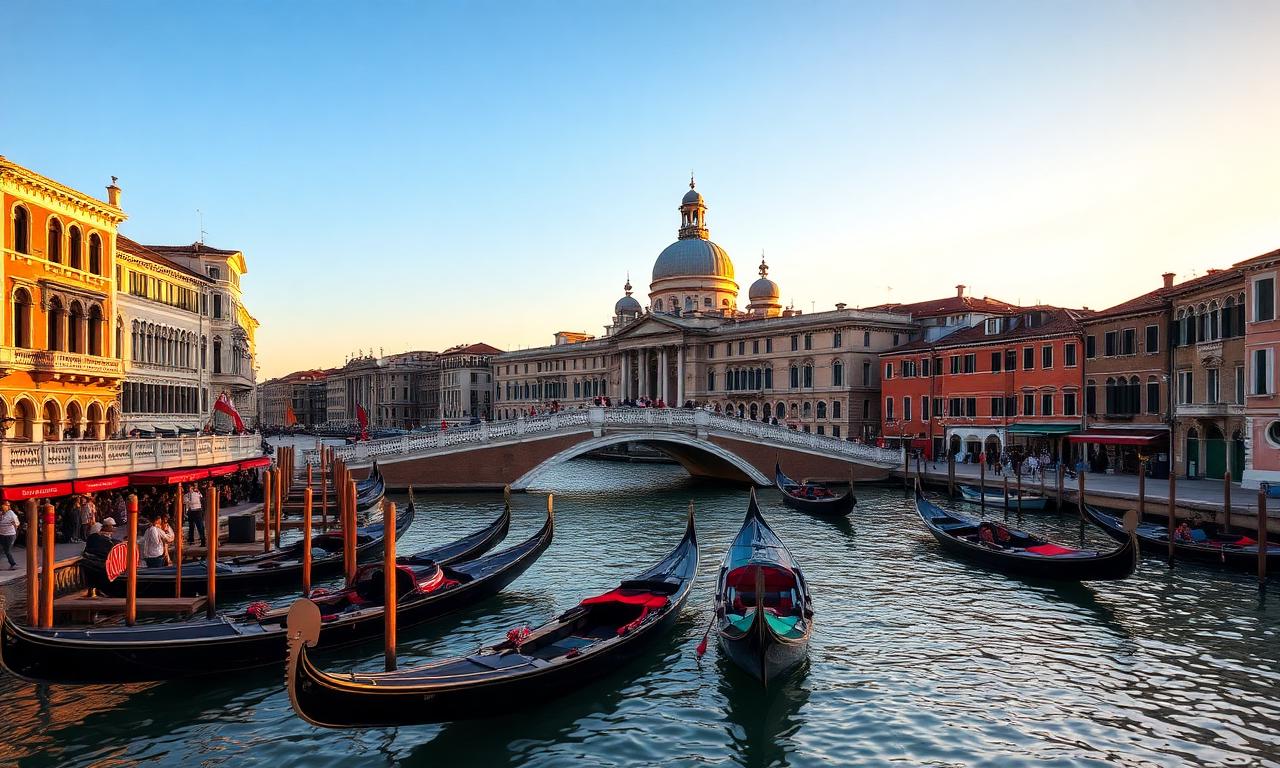
Short answer: give Venice two or three nights, stay in the historic centre, and split your time between the famous sights in the morning and the quiet canals in the afternoon. Here is a ready-made weekend plan you can book in minutes.
Why go to Venice now?
Autumn and winter bring softer light, cooler walking weather and fewer crowds than summer, and hotel prices are often lower outside peak events. Venice also hosts a busy cultural calendar through the year — check the official city events listings for what is on during your dates.
Which airport should you fly into?
Venice has two main airports. Marco Polo is the easy choice for most visitors; Treviso is worth it only when the flight is much cheaper. Travel times below are typical estimates — check the official operators for current schedules and fares.
Venice Marco Polo Airport (VCE)
About 13 km from the historic centre on the mainland edge of the lagoon. Most international flights land here.
- Airport bus to Piazzale Roma — roughly 20–30 minutes. Cheapest and fastest for most travellers; Piazzale Roma is the city's road entrance.
- Alilaguna water bus — about 60–90 minutes depending on the line and your stop. Slower, but takes you by boat directly to stops such as Rialto or San Marco.
- Private water taxi — about 25–35 minutes, straight to (or near) your hotel. The most memorable option and the most expensive; agree the price before boarding.
Treviso Airport (TSF)
About 40 km away. Used mostly by low-cost airlines.
- Airport shuttle bus to Piazzale Roma or Mestre — roughly 60–75 minutes. Buses are timed around flights.
- Taxi or local bus to Treviso station, then train to Venezia Santa Lucia — usually slower overall.
Other options
Some travellers fly into Verona, Bologna or Milan for cheaper fares.
- From these cities, high-speed and regional trains run to Venezia Santa Lucia; Bologna is roughly 1.5 hours and Milan roughly 2.5 hours by fast train.
Official info: Venice Marco Polo Airport, Treviso Airport, Alilaguna boats and ACTV buses and waterbuses.
How do you get into Venice itself?
By train: Get off at Venezia Santa Lucia, not Venezia Mestre — Mestre is on the mainland. Santa Lucia opens straight onto the Grand Canal, with waterbus stops right outside.
By bus or car: Everything road-based ends at Piazzale Roma. Cars are parked there or on Tronchetto (large garages, booking recommended in summer). From there you walk or take a waterbus.
Getting around: Inside Venice you walk or use the ACTV waterbuses. Most central journeys on foot take 10–30 minutes; the city is small but the lanes twist, so add time for getting a little lost.
The 3-day Venice plan, hour by hour
Each stop shows how long to allow, typical lines and how long it takes to reach the next place. Lines and times are our estimates for busy months (April–October); they are often shorter in winter and much longer during Carnival and major events.
Day 1: Arrive, settle in and see the Grand Canal
Keep the first day light. Most of it goes on getting into the city and finding your hotel, which takes longer than people expect in a car-free city of bridges.
Arrival – 15:00 · Hotel check-in
Time needed: 30–60 min including finding the hotel · Lines: None · To next stop: 5–20 min walk to the nearest waterbus stop
Drop your bags first. Dragging luggage over bridges is the hardest part of a Venice trip.
15:30 · Grand Canal by waterbus (vaporetto Line 1)
Time needed: About 40–50 min end to end · Lines: 5–20 min at Piazzale Roma or Ferrovia in busy months · To next stop: Get off at Rialto
Line 1 is the slow line that stops everywhere — that is the point. Try for an outside seat at the front or back.
17:00 · Rialto Bridge and market area
Time needed: 45–60 min · Lines: None; the bridge is free and open · To next stop: 10–15 min walk to dinner areas in Cannaregio or San Polo
Sunset on the bridge is crowded; the canal-side walkways on either side often give a calmer view.
19:30 · Dinner
Time needed: 1.5–2 hours · Lines: Book ahead on Friday and Saturday nights · To next stop: Walk back to the hotel
Before dinner, try a few cicchetti (small bar snacks) with a drink — it is how many Venetians start the evening.
Day 2: St Mark's early, quiet districts later
This is your big sightseeing day. The trick is simple: do the famous interiors first thing, before the cruise and day-trip crowds arrive mid-morning.
08:30 · Piazza San Marco
Time needed: 20–30 min to walk around the square · Lines: None — it is a public square · To next stop: On site
Early morning is the only time the square feels calm in high season.
09:30 · St Mark's Basilica
Time needed: 45–60 min (more with the museum and terrace) · Lines: With a timed ticket: usually 10–20 min; without one it can exceed an hour in peak months · To next stop: 2–3 min walk
Shoulders and knees must be covered and large bags are not allowed inside. Check the official basilica website for current rules.
11:00 · Doge's Palace
Time needed: 1.5–2.5 hours · Lines: With a timed ticket: about 10–30 min for security; longer without · To next stop: On site, then a 10 min walk
The Bridge of Sighs is crossed inside the palace route. The secret itineraries tour needs separate booking.
13:30 · Lunch
Time needed: About 1 hour · Lines: Usually none away from the square · To next stop: Waterbus or 20–25 min walk to Dorsoduro
Walk five minutes away from St Mark's before choosing a place; prices drop quickly.
15:00 · Dorsoduro: Accademia Galleries or the Zattere waterfront
Time needed: 1.5–2 hours for a gallery, or an hour strolling · Lines: Usually short outside peak events; check the gallery's site · To next stop: 10–15 min walk
Prefer modern art? The Peggy Guggenheim Collection is also in Dorsoduro — book online.
17:30 · Santa Maria della Salute and Punta della Dogana
Time needed: 30–45 min · Lines: Rarely any · To next stop: Short walk or waterbus back
One of the best sunset spots in the city, looking back over the lagoon to St Mark's.
20:00 · Dinner and an evening walk
Time needed: 2 hours · Lines: Book ahead at weekends · To next stop: Walk to hotel
Venice is at its most atmospheric after dark, once day visitors leave.
Day 3: Murano and Burano, or a slow final morning
If you have a morning or more before leaving, the islands are the classic choice. If your departure is early, skip them and stay in the centre.
09:00 · Waterbus from Fondamente Nove to Murano
Time needed: Ride about 10–15 min · Lines: 5–15 min in busy months · To next stop: —
Leave your bags at the hotel; most hotels will store them after check-out.
09:30 · Murano (glass island)
Time needed: 1–1.5 hours · Lines: None for the streets; furnace demonstrations vary · To next stop: Waterbus to Burano about 35–45 min
Ignore people offering a 'free' boat ride to a furnace — it usually ends in a sales room.
11:30 · Burano (colourful houses)
Time needed: 1.5–2 hours including lunch · Lines: Return boats can have 15–30 min lines in the afternoon · To next stop: Waterbus back to Fondamente Nove about 40–45 min
Eat lunch here; it is a pleasant pause before travelling home.
14:30 · Back to the city and your hotel
Time needed: — · Lines: — · To next stop: Waterbus or walk to the station / Piazzale Roma
Allow at least 1.5 hours from Burano to the train station or airport bus.
Check current hours and dress rules on the official St Mark's Basilica and Doge's Palace websites.
When do people eat in Venice?
Plan your day around these windows — arriving between them can mean closed kitchens or only snacks.
- Breakfast (07:30–10:00): Usually a coffee and pastry standing at a bar. Hotel breakfasts are often included.
- Lunch (12:30–14:30): Many kitchens close mid-afternoon. A quick lunch takes about 45–60 minutes.
- Cicchetti and aperitivo (18:00–20:00): Small snacks with a glass of wine or a spritz at a bar — easy to make into a light dinner.
- Dinner (19:30–22:00): Kitchens close earlier than in Rome; arriving after 21:30 can limit choice. Book ahead at weekends.
Want the inside of the Doge's Palace or St Mark's without queuing? Compare Venice tickets and tours.
Where to stay in Venice
San Marco — best for first-time visitors who want to walk everywhere. Most central and usually the most expensive.
Cannaregio — best for train arrivals and better-value dinners. Close to the station, livelier in the evening with locals.
Dorsoduro — best for couples and art lovers. Quieter, near the main galleries and the Zattere waterfront.
See Venice hotelsPractical tips before you go
- Pack light: there are many bridges and steps, and few places where wheels roll easily.
- Buy a multi-day waterbus pass if you plan several boat rides; single tickets add up quickly.
- Check the official access fee rules for your dates on the City of Venice access fee website.
- Book major interiors ahead in busy months.
Not your destination?
- Rome — ancient history and ready-made day plans.
- Paris — art, viewpoints and classic boulevards.
- Amsterdam — canals, museums and easy cycling.
- Venice as a day trip from Rome — if you only have one day.
Frequently asked questions
How many days do you need in Venice?
Two to three nights is ideal for a first visit. One full day covers St Mark's and the Rialto, a second lets you explore quieter districts in the evening, and a third gives time for Murano and Burano. Staying overnight also means seeing Venice early and late, when day-trip crowds are gone.
Do you have to pay to enter Venice?
Venice has charged an access fee to day-trippers on selected peak dates, while visitors staying overnight in the city are generally exempt but may still need to register. Rules and dates change each year, so check the official City of Venice access fee website before you travel.
Where is the best area to stay in Venice?
San Marco is the most central choice for first-timers, Cannaregio suits train arrivals and travellers looking for better-value food, and Dorsoduro is quieter and close to the main art galleries. All three are walkable to the main sights, so choose based on budget and the atmosphere you prefer.
What is the best airport for Venice?
Venice Marco Polo (VCE) is the closest and most convenient: an airport bus reaches Piazzale Roma in roughly 20–30 minutes, and boats go straight into the lagoon. Treviso (TSF) is used by low-cost airlines and is about an hour away by shuttle bus. Check the airports' official sites for current schedules.
How long are the lines at St Mark's Basilica and the Doge's Palace?
With a timed ticket, waits are usually short, often 10–30 minutes for security. Without one, lines in spring and summer can exceed an hour, especially from mid-morning. These are typical estimates rather than guarantees, so book ahead and arrive early for the shortest waits.
What time do people eat in Venice?
Lunch is usually served from about 12:30 to 14:30 and dinner from around 19:30 to 22:00, with many kitchens closing earlier than in Rome. Between them, 18:00 to 20:00 is the time for cicchetti, small bar snacks with a drink. Book dinner ahead on Friday and Saturday nights.
Is Venice worth visiting for a weekend?
Yes. Venice is compact and car-free, so a weekend is enough to see the highlights without rushing. The key is to stay at least one night in the historic centre, book the major interiors ahead and leave time to wander, which is where much of Venice's charm is found.
Some links on this page are affiliate links. If you book through them we may earn a commission at no extra cost to you.