Paris · 19th arrondissement · Free
Parc des Buttes-Chaumont: Paris's Cliffs, Temple and Red Bridge
Cliffs, a temple on a rock, a red suspension bridge and one of the best free views in Paris — the Buttes-Chaumont is the city's most theatrical park, built on top of an old quarry and a much darker past.
By the AllTrips Editorial Team ·
Parc des Buttes-Chaumont at a glance
Area: East Paris, 19th arrondissement. Allow: 1–2 hours. Entry: free; gates open from about 7:00 to evening, with seasonal closing times. Nearby: Canal Saint-Martin to the south-west, Père Lachaise to the south-east, Belleville just east.
With about 25 hectares, the Buttes-Chaumont is the largest park inside Paris proper, drawing some six million visitors a year. It is also the hilliest: an English-style garden designed to imitate a mountain landscape, with rocky cliffs, torrents, waterfalls, a grotto, belvederes and a lake — all engineered on the site of a former gypsum quarry and rubbish dump.
From gibbet and quarry to park
The hill's name — roughly "bald hill" — hints at what it long was: a bare, unloved mound whose underground was quarried for gypsum, the mineral that gave Paris its plaster and its old nickname "Lutèce la blanche". The gibbet of Montfaucon, where the bodies of hanged criminals were displayed for centuries, stood nearby, and the slopes later served as a dumping ground.
Baron Haussmann picked this unpromising spot for one of the Second Empire's great parks, and the transformation was a genuine engineering feat: under the direction of engineer Adolphe Alphand, with architect Gabriel Davioud and landscape designers Jean-Pierre Barillet-Deschamps and Édouard André, the old quarry was blasted into cliffs and hills, planted over 25 hectares with 130,000 cubic metres of topsoil, and crowned with a lake. The park was inaugurated on 1 April 1867, in the closing years of Napoleon III's reign and just in time for that year's Universal Exposition.
The Temple de la Sibylle
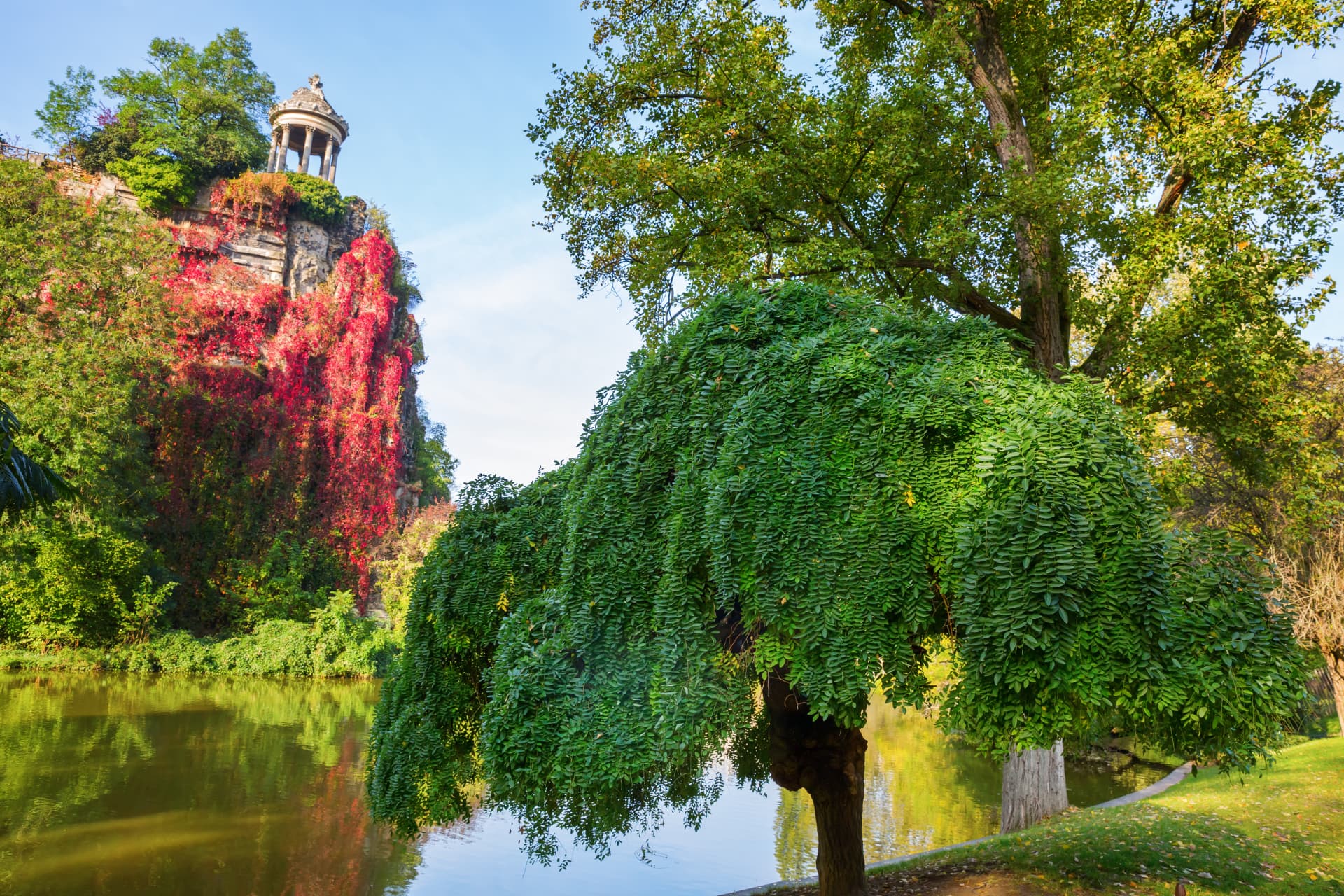
The park's signature view is the little white colonnaded temple perched on top of a 30-metre rocky island in the lake. Built by Davioud in 1866 and inspired by the Temple of Vesta at Tivoli in Italy, the Temple de la Sibylle deliberately sends the stroller on an imaginary journey to the Roman countryside — the same trick the park plays everywhere, transplanting mountains, cliffs and torrents into north-east Paris.
Important for 2026: the island and the temple itself are currently closed to visitors. The City of Paris has shut access to the island, the temple and both waterfalls because of unstable ground and rockfall risk above the old quarry. The temple is still the park's great photo subject — admired, as in the picture above, from the paths and belvederes around the lake.
The red bridge, the grotto and the waterfall
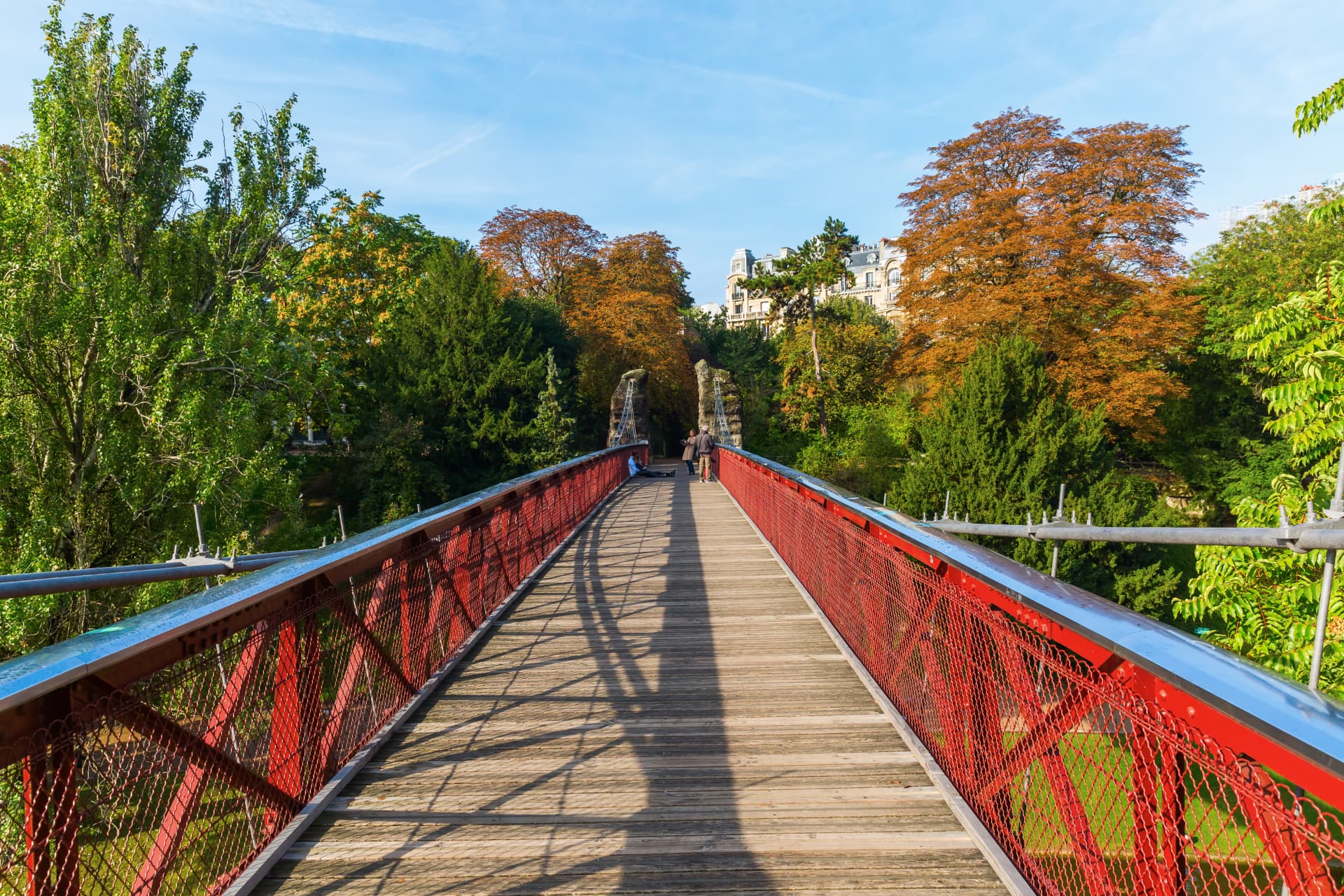
Two bridges connect the island's cliff to the park: a masonry bridge about 22 metres high, and the red iron suspension bridge with a span of 65 metres — the one in the photo below, probably the most photographed structure in the park after the temple. Below the cliff, a grotto carved into the old quarry face is decorated with concrete stalactites, some reaching 8 metres, and a waterfall drops into the lake in a single dramatic fall of around 30 metres.
For the classic sequence, climb to the temple's belvedere for the panorama over Montmartre, cross the suspension bridge, then loop the lake past the grotto — the circuit involves some of the steepest stairs in any Paris park, which is exactly why locals love it.
The park today
The Buttes-Chaumont is a living neighbourhood park as much as a monument. On any fine day you will find runners on the hills, picnickers on the lawns, children at the playgrounds and puppet shows at the two Guignol theatres. The park also has a café culture of its own: the Rosa Bonheur in the upper park, the Pavillon Puebla tucked by the lake, the Pavillon du Lac restaurant and a waffle chalet. Plant lovers should look out for the Japanese pagoda tree (Sophora japonica) planted in 1873 by the lake, labelled a "Remarkable Tree of France" in 2015.
The renovation works
The park is in the middle of its biggest renovation since it was created. The central area around the temple sits on the fragile remains of the old gypsum quarry, and after studies began in 2023 the City of Paris launched a multi-year restoration of the whole central zone, with an initial six-million-euro envelope for works and further studies — on top of twelve million already invested in maintenance over the years. Practical consequences: the island, temple and waterfalls are closed, and part of the circular path around the lake is fenced off. Check the City's park page before your visit for the current state of access.
Getting there
The main entrance is at Place Armand-Carrel in front of the 19th arrondissement town hall, served by métro Laumière (line 5). Other gates open onto rue Botzaris (métro Botzaris or Buttes-Chaumont, line 7bis), rue Manin (Bolivar, line 7bis), rue de Crimée and avenue Simon-Bolivar (Pyrénées or Jourdain, line 11). Buses 26 and 71 stop nearby, and there are Vélib' bike stations at the entrances.
The Buttes-Chaumont in photos
What is nearby?
Walk 20 minutes downhill to the south-west and you reach the Canal Saint-Martin; in the other direction, the tree-lined avenues of Père Lachaise start at the bottom of the hill. Eastwards lies Belleville, one of Paris's most characterful and least touristy neighbourhoods. See how it all fits together on our Paris attractions map.
Frequently asked questions
Is the Parc des Buttes-Chaumont free to visit?
Yes. It is a public park run by the City of Paris, free to enter, with gates open roughly from 7:00 in the morning until evening — closing times follow the seasons, so check the City of Paris page for the current hours.
Can you go into the Temple de la Sibylle?
Not at the moment. Access to the island and the temple — and to both waterfalls — has been closed by the City of Paris because of unstable ground and rockfall risk above the old quarry, as part of the park's renovation. You can still admire the temple from the viewpoints around the lake, which is where the classic photos are taken anyway.
How long should I allow for the park?
An hour or two. It is the hilliest park in Paris — the City counts about 5.5 km of roads and paths over roughly 25 hectares — so expect stairs and slopes, and reward yourself with the views from the belvederes.
How do I get to the Parc des Buttes-Chaumont?
The nearest métro stations are Buttes-Chaumont and Botzaris (line 7bis), Laumière (line 5) and Pyrénées or Jourdain (line 11). The main entrance is at Place Armand-Carrel, with other gates on rue Botzaris, rue Manin, rue de Crimée and avenue Simon-Bolivar. Buses 26 and 71 also stop nearby.
Is there anywhere to eat or drink in the park?
Yes. The park has several well-known spots: the Rosa Bonheur café, the Pavillon Puebla, the Pavillon du Lac restaurant and a waffle chalet, plus two Guignol puppet theatres and playgrounds for children.
Official sources
- Ville de Paris — Parc des Buttes-Chaumont (hours, entrances, access closures)
- Ville de Paris — La rénovation historique du parc des Buttes-Chaumont
- Ville de Paris — Parcours biodiversité des Buttes-Chaumont
- Ville de Paris — Visite guidée : Histoire des Buttes-Chaumont
Reviewed September 2026. The island, temple and waterfalls are closed during the renovation; check the official park page for current access before travelling.