Paris · 10th arrondissement · Free
Canal Saint-Martin: Paris's Canal-Side Stroll
Iron footbridges, working locks, plane trees and quayside cafés — the Canal Saint-Martin is the one Paris sight that costs nothing and asks for nothing but an hour of slow walking.
By the AllTrips Editorial Team ·
Canal Saint-Martin at a glance
Area: East Paris, running from the Bassin de la Villette (19th arr.) to the Seine near Bastille (10th, 11th, 12th arr.). Allow: 1–2 hours for the scenic stretch. Entry: free, open at all hours. Nearby: République, the Bassin de la Villette and the Marais a short walk south.
The canal is 4.5 kilometres long, about 2 kilometres of it underground, and links the Bassin de la Villette to the Seine with a 25-metre drop handled by nine locks and two swing bridges. It is still a working waterway: barges and cruise boats pass through the locks daily, and the quaysides on both banks have become one of the most relaxed free things to do in Paris.
A canal built by Napoleon
At the start of the 19th century Parisians drank from a polluted Seine, and epidemics followed. Napoleon Bonaparte, then First Consul, revived an old idea of channeling drinking water from the Ourcq river more than 100 kilometres to the north-east; the plan became law on 19 May 1802. Wars and money problems slowed the work until Louis XVIII restarted it, the first stone was laid on 3 May 1822, and Charles X inaugurated the canal on 4 November 1825 — which made it exactly 200 years old in 2025.
The canal's biggest near-miss came a century and a half later. In the car-obsessed 1960s there was a serious plan to cover the canal and run a six- to eight-lane motorway along its course — a scheme that would have required thousands of expropriations before it was finally abandoned. Today the idea sounds almost unthinkable, which tells you how much Paris has claimed the canal back.
Walking the canal
The postcard stretch runs between Place de la République and the Bassin de la Villette, roughly 30 minutes one way along the water. On the banks you pass:
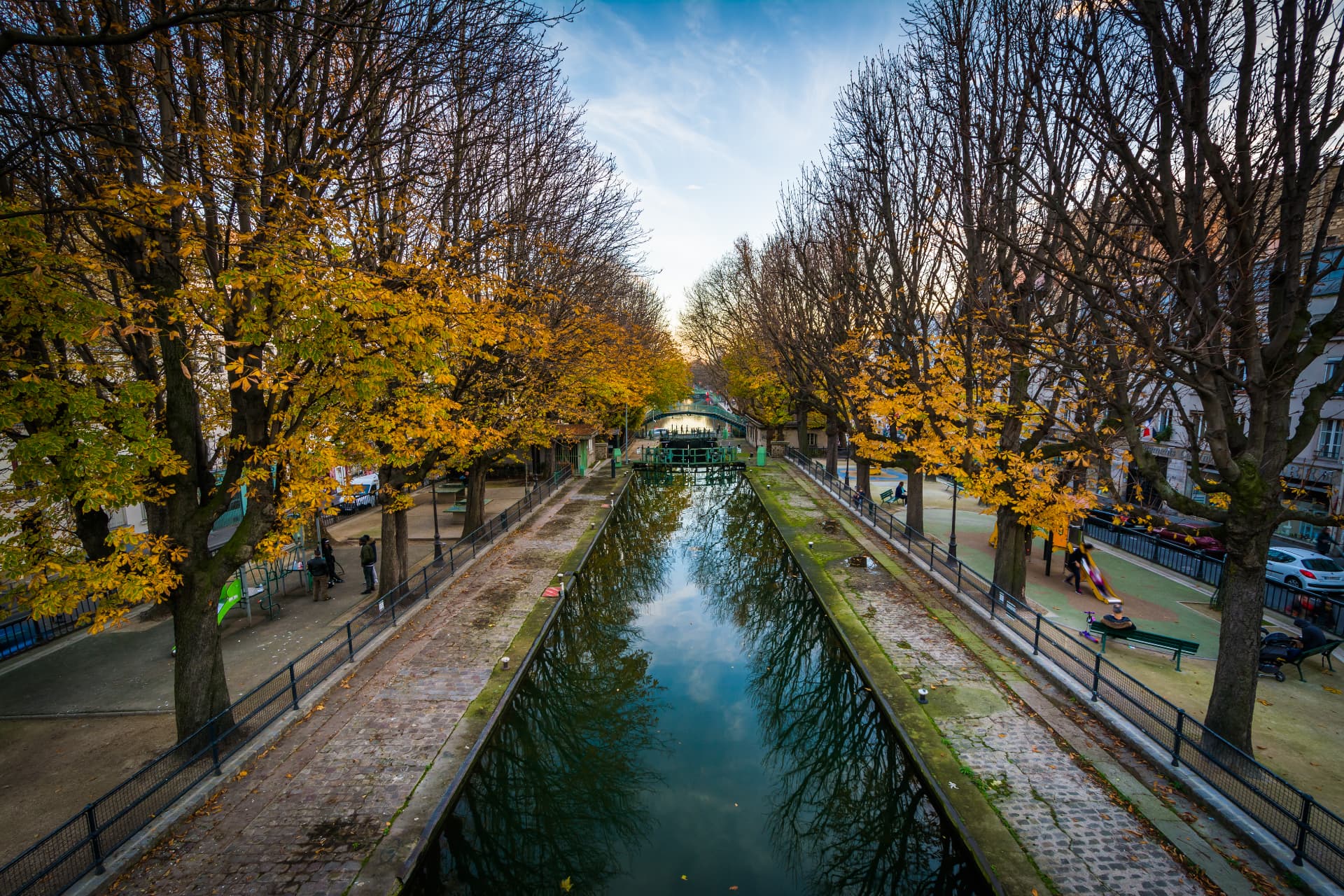
- Quai de Valmy and Quai de Jemmapes — the two canal-side quays, lined with century-old chestnut and plane trees and, on warm evenings, crowds picnicking on the edge of the water.
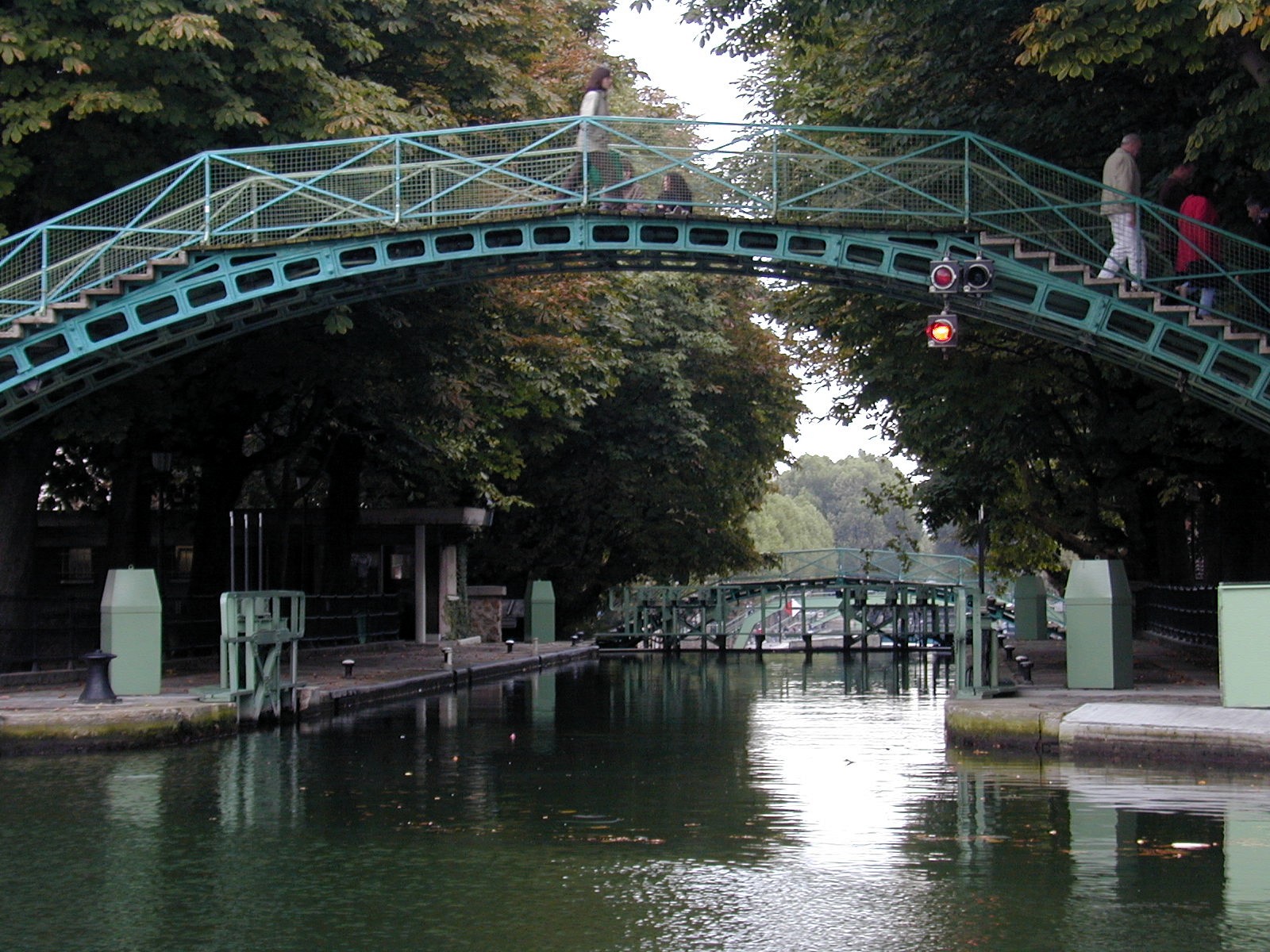
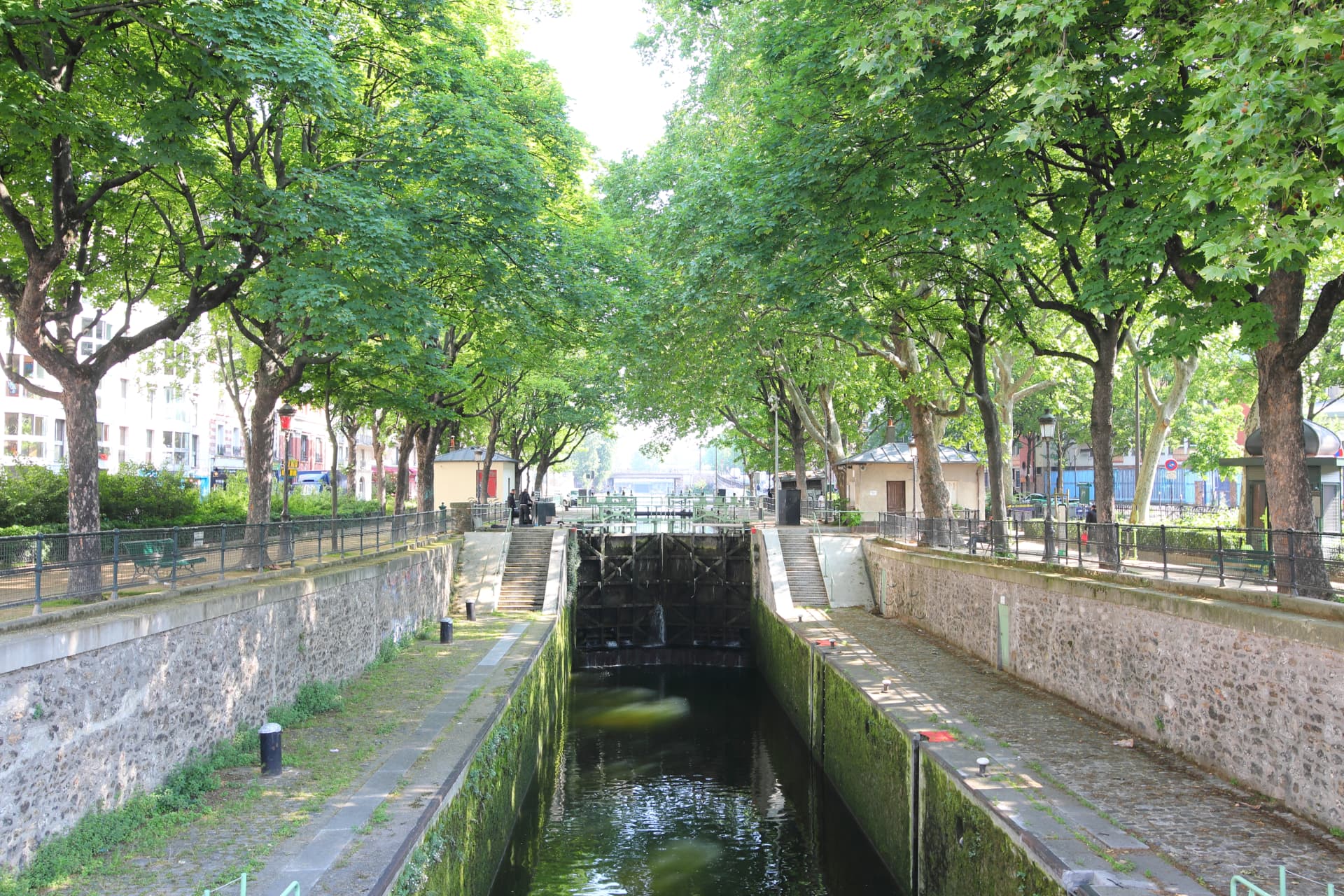
- The locks and swing bridges — watch a lock fill or empty as a barge passes, and see the green swing bridges pivot open.
- Le Marais to the south — walk down past République and you are soon at the Place des Vosges and the Musée Carnavalet.
- The Bassin de la Villette to the north — the canal widens into a basin with waterside cafés and cinemas, continuing towards the Parc de la Villette.
Cross back and forth over the footbridges rather than following one bank — the light and the bridge views are the point. Early morning is quiet and good for photos; sunset in autumn, when the trees turn yellow, is the canal's best hour.
The footbridges and locks
The canal is crossed today by two swing bridges, two fixed bridges and six pedestrian footbridges, most of them built between 1860 and 1890 and several listed as historic monuments. The City of Paris has owned the canal and its structures since 1861. Film fans know the footbridges from the opening of Amélie, in which the heroine skips flat stones across the water from one of them.
Boat cruises and the tunnel
You can see the canal from the water: private companies run cruise boats that thread the locks between the Seine, Bastille and the Bassin de la Villette, including the two kilometres of vaulted tunnel between Bastille and République where the canal slides under the city. Departure points and schedules change by season, so check the operators' current timetables before planning your day around a sailing.
Summer swimming
Each summer the City of Paris opens a supervised swimming spot in the canal at 116 Quai de Jemmapes — free, with collective showers, lockers and a solarium. For 2026 the listed season runs from 5 July to 6 September, open Wednesday to Sunday, 14:00–18:00, closed Mondays and Tuesdays, with last-minute closures possible. Swimming anywhere else in the canal is not allowed; the water is non-potable canal water, not a pool.
Getting there
The easiest entry points are République (lines 1, 5, 8, 9, 11) at the southern end of the open stretch, Jacques Bonsergent (line 5) or Gare de l'Est / Château-Landon (lines 4, 5, 7 and suburban trains) in the middle, and Jaurès or Stalingrad (lines 2, 5, 7) where the canal meets the Bassin de la Villette. Vélib' bike stations line both quays.
The Canal Saint-Martin in photos
What is nearby?
South of République the walk connects naturally with the Marais: the Musée Picasso, the free Musée Carnavalet and the arcades of the Place des Vosges. To the north, the Bassin de la Villette leads towards the Parc des Buttes-Chaumont. See how it all fits together on our Paris attractions map.
Frequently asked questions
Is the Canal Saint-Martin free to visit?
Yes. The canal, its quays, footbridges and locks are public space, open at all hours and free to walk. The only paid extras are optional boat cruises run by private companies.
How long should I allow for the Canal Saint-Martin?
A relaxed walk along the most scenic stretch between République and the Bassin de la Villette takes about 1–2 hours, longer if you stop at cafés or picnic on the quays.
Can you swim in the Canal Saint-Martin?
Only at the official summer swimming spot at 116 Quai de Jemmapes. For 2026 the City of Paris lists the season as running from 5 July to 6 September, open Wednesday to Sunday from 14:00 to 18:00 and closed on Mondays and Tuesdays. Swimming elsewhere in the canal is forbidden.
What is the Amélie scene on the Canal Saint-Martin?
The opening scene of the film Amélie (2001), where Amélie skips stones across the water, was filmed at one of the canal's footbridges. The six cast-iron footbridges, built between 1860 and 1890, are among the canal's most photographed features.
Does the canal really run underground?
Yes. Of its 4.5 kilometres, about 2 kilometres run through a vaulted tunnel between Bastille and the Rue du Faubourg du Temple near République. Boat cruises pass through it, which is one of the more unusual experiences on the canal.
Official sources
- Ville de Paris — Les canaux de Paris
- Ville de Paris — Le canal Saint-Martin fête ses 200 ans
- Ville de Paris — Les passerelles du canal Saint-Martin
- Ville de Paris — Baignade estivale, Canal Saint-Martin
Reviewed September 2026. Cruise timetables and swimming dates change by season; check the official pages before travel.