One Day in Vienna: A Complete First-Timer's Itinerary
Updated 14 August 2026 · 10 min read
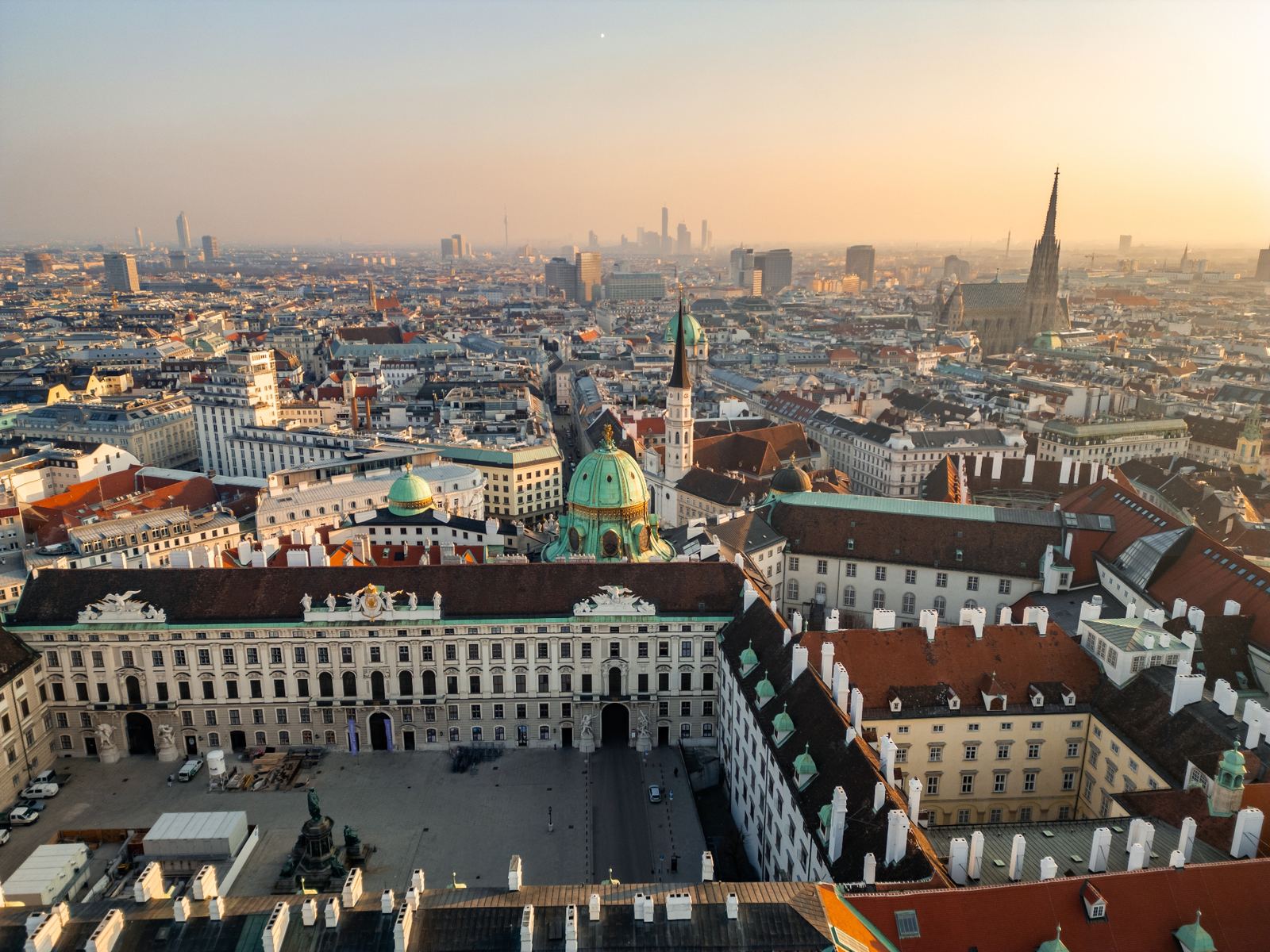
Vienna is not a city you rush through. It rewards slow walking, coffee breaks and long looks at imperial architecture. But if you only have one day, you can still cover the major highlights without making the day feel like a marathon.
This itinerary is designed for first-time visitors who want to see the essential Vienna experience: palace grounds, cathedral, imperial squares, a famous boulevard, one major museum, opera-house architecture and a proper coffee house. You cannot do every museum in Vienna in one day, and this plan does not try to.
Before you commit to these times
- The timings assume the gardens-only version of Schönbrunn and one paid interior (the Upper Belvedere). Adding a Schönbrunn palace tour means dropping either the Hofburg and Ringstrasse block or the Belvedere.
- They also assume pre-booked timed entries and no unusual queues. With walk-up tickets, expect to lose one stop.
- Minimum walking: roughly 12–15 km. If that is more than you want, ride the Ring by tram and skip the Naschmarkt-to-Belvedere walk.
- Prices, opening hours and tour times change. We checked the sources behind this plan on 14 August 2026; confirm on the official sites the week you travel.
If you are also planning other European cities, compare this with our guides to Barcelona, Prague, Paris and Rome.
Map of the itinerary
All 8 stops of the one-day Vienna route, numbered in visiting order. Click any pin for the time and details.


 📍
⛪
📍
📍
📍
🏺
⭐
📍
+− Leaflet | © OpenStreetMap contributors
📍
⛪
📍
📍
📍
🏺
⭐
📍
+− Leaflet | © OpenStreetMap contributors7:30 AM— Quick breakfast before you head out
Grab a fast breakfast near your hotel — a bakery pastry and coffee, or a hotel buffet if it opens by 7:00. Keep it short (20–30 minutes). Schönbrunn opens early and you want to be at the gates when the first big tour buses arrive so you can get in and out before the mid-morning queue builds.
Queue check: If you did not pre-book Schönbrunn, buy your timed-entry ticket online the night before. The on-site ticket window is busiest from mid-morning onwards in spring and summer, and a pre-booked slot removes that variable from a one-day plan.
8:30 AM— Start at Schönbrunn Palace
Getting there: Take the U4 metro (green line) to Schönbrunn station, then walk about 5 minutes to the main gate. From most central hotels the whole ride is 15–25 minutes. A taxi/Uber costs roughly €15–20 and is only faster very early.
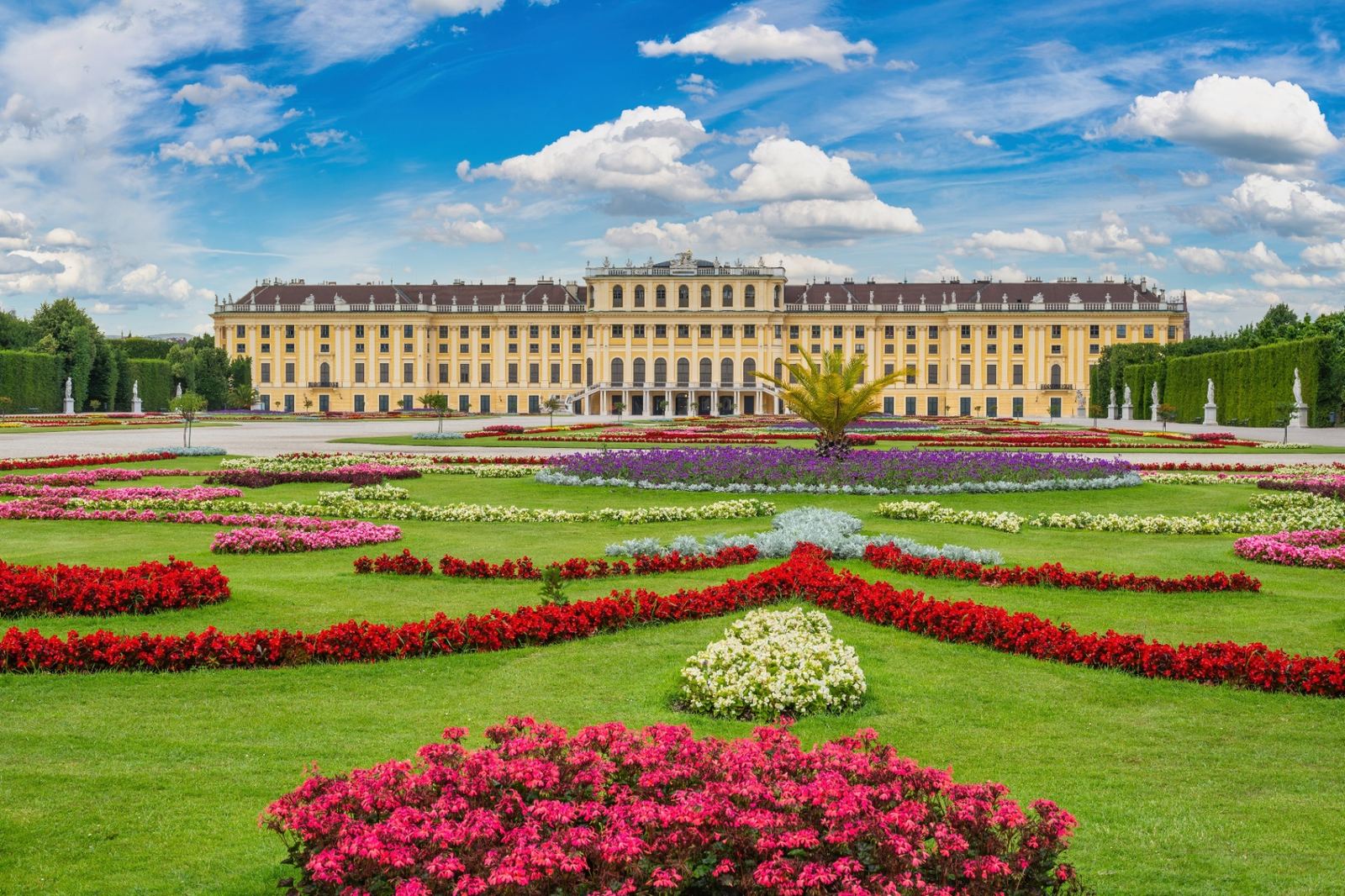
Begin at Schönbrunn Palace, the former summer residence of the Habsburg dynasty. The enormous Baroque complex is one of Vienna's major imperial landmarks. The palace itself contains 1,441 rooms, while the surrounding park includes formal gardens, fountains and the famous Gloriette. The palace opens at 8:30 AM throughout the published 2026 schedule, including winter, which is why an early start pays off. Closing times do change with the season, so check the official Schönbrunn opening times before you go.
With only one day, you have a decision to make — and our default is the gardens.
Option A (our default): Explore the gardens only. The main Schönbrunn park is free to enter, though several individual attractions inside the wider grounds are ticketed. Walk up to the Gloriette, look back at the palace, and keep your one paid interior for the Upper Belvedere later. This is the version of the day the timings below assume.
Option B: Add the palace interior. Choose this if Habsburg history is one of your main reasons for coming. The Imperial Tour takes about 35 minutes, the Grand Tour about 50 — plus entry queueing. If you do this, drop either the Hofburg and Ringstrasse block or the Belvedere interior from the plan; the day does not hold all three.
Walk toward the Gloriette for one of the classic views back toward the palace. Then head into central Vienna.
Time here: Around 1.5–2 hours (leave by 10:15 AM).
10:45 AM— St Stephen's Cathedral
Getting there: U4 metro from Schönbrunn to Karlsplatz(~15 min), then either walk 8 min through the old town or hop on the U1 one stop to Stephansplatz. Total: ~25 minutes door to door.
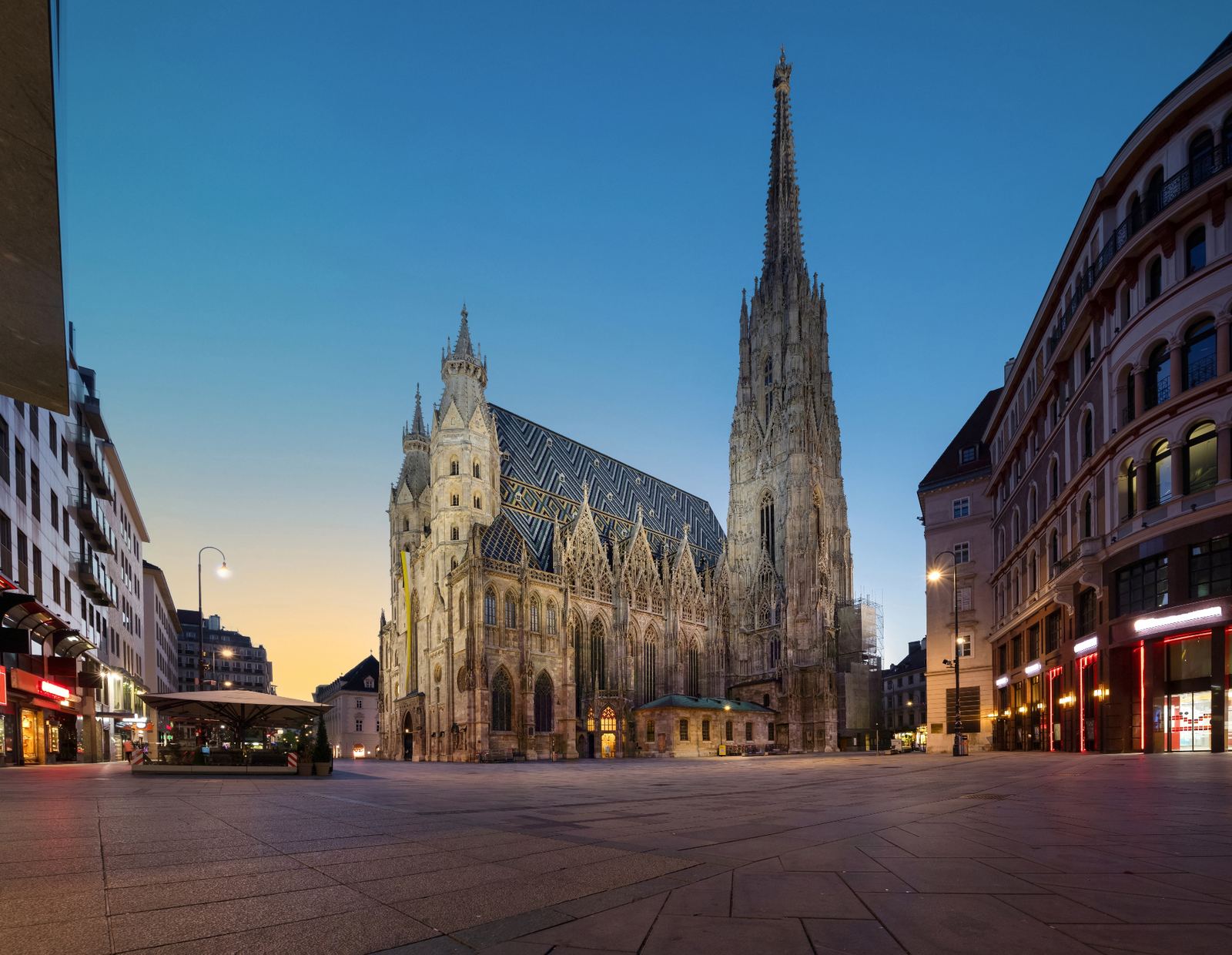
Stephansplatz is the heart of Vienna. The cathedral's history stretches back to the 12th century, and its 136-metre south tower makes it Austria's tallest church. Visitors looking for a panorama can climb 343 steps to the south-tower viewing room; there is also a lift to a viewing platform in the north tower.
With one day in Vienna, don't feel obligated to climb. Stand outside. Look at the extraordinary tiled roof. Step inside — entry to the rear of the nave is free and usually walk-in. The streets around Stephansplatz (Graben, Kohlmarkt) are some of the best for just experiencing central Vienna.
Queue check: Tower climbs can queue 15–20 minutes at midday. If you want to go up, buy the tower ticket at the small booth inside the cathedral first, then queue.
Time here: 30–45 minutes.
11:30 AM— Hofburg and Heldenplatz: Vienna's Imperial Palace Complex
Getting there: On foot from Stephansplatz down Graben and Kohlmarkt to Michaelerplatz — about 8–10 minutes. This is one of the most atmospheric walks in the old town, so don't rush it.
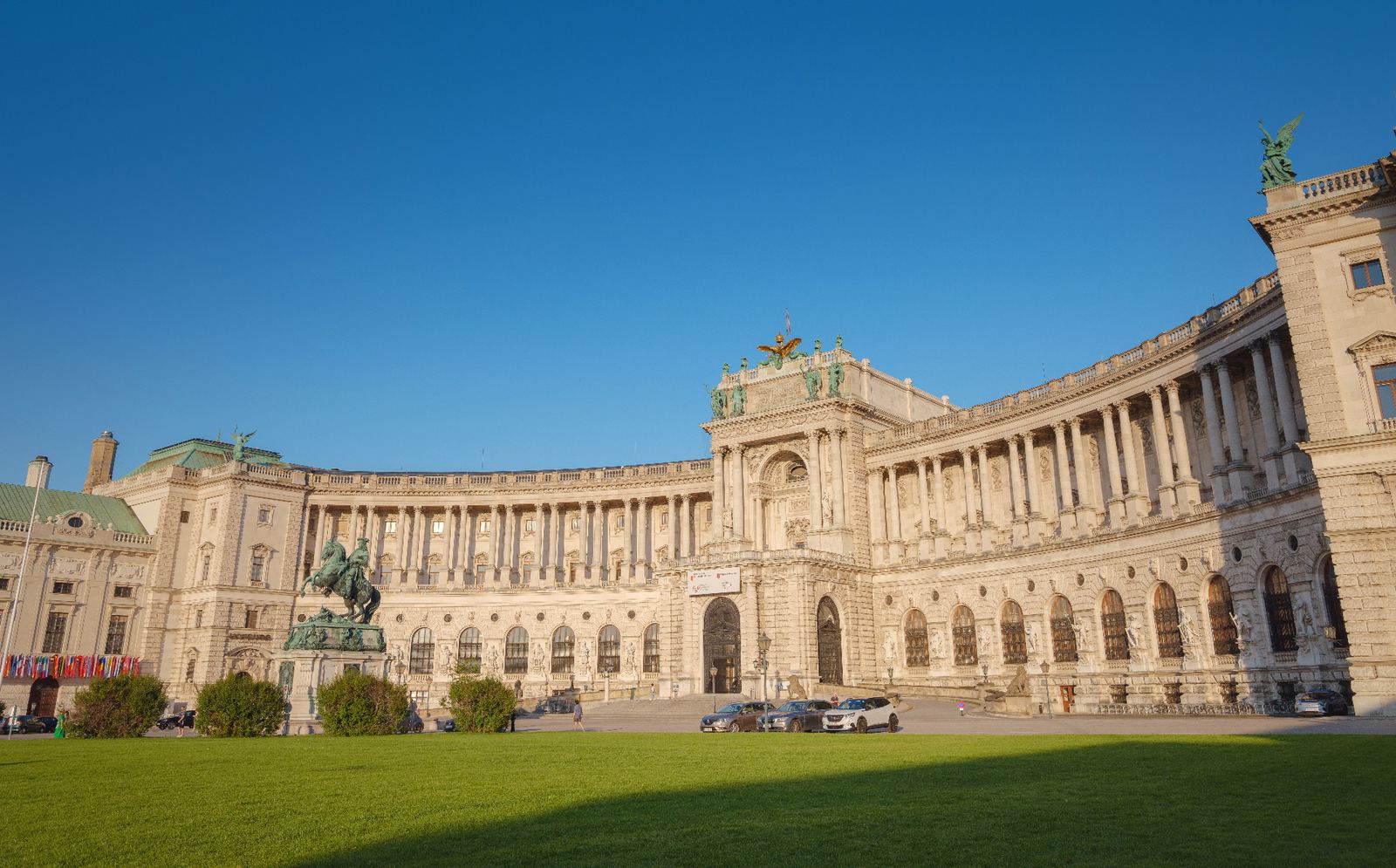
The Hofburg is the former imperial palace complex of the Habsburgs — a sprawling group of courtyards, wings and museums that served as the seat of Austrian rulers for centuries. The large square in front of it is Heldenplatz, a ceremonial plaza framed by the palace's most imposing Neoclassical facades and two bronze equestrian statues.
You could spend hours exploring the interiors. Don't. Not today. Walk through the courtyards and around Heldenplatz instead. Save the Sisi Museum and Imperial Apartments for your next trip unless there is one particular collection you desperately want to see.
This part of Vienna is where the scale of the former imperial capital really becomes apparent — the squares, the palaces, the monuments. Even walking feels ceremonial.
Time here: About 45 minutes.
12:15 PM— Ringstrasse stroll
Getting there: On foot — the Hofburg opens directly onto the Ring at Heldenplatz. Prefer to save your legs? Trams 1, 2, D and 71 each run along different sections of the Ringstrasse — none of them circles the whole boulevard, so check the stop board for the section you want before boarding.
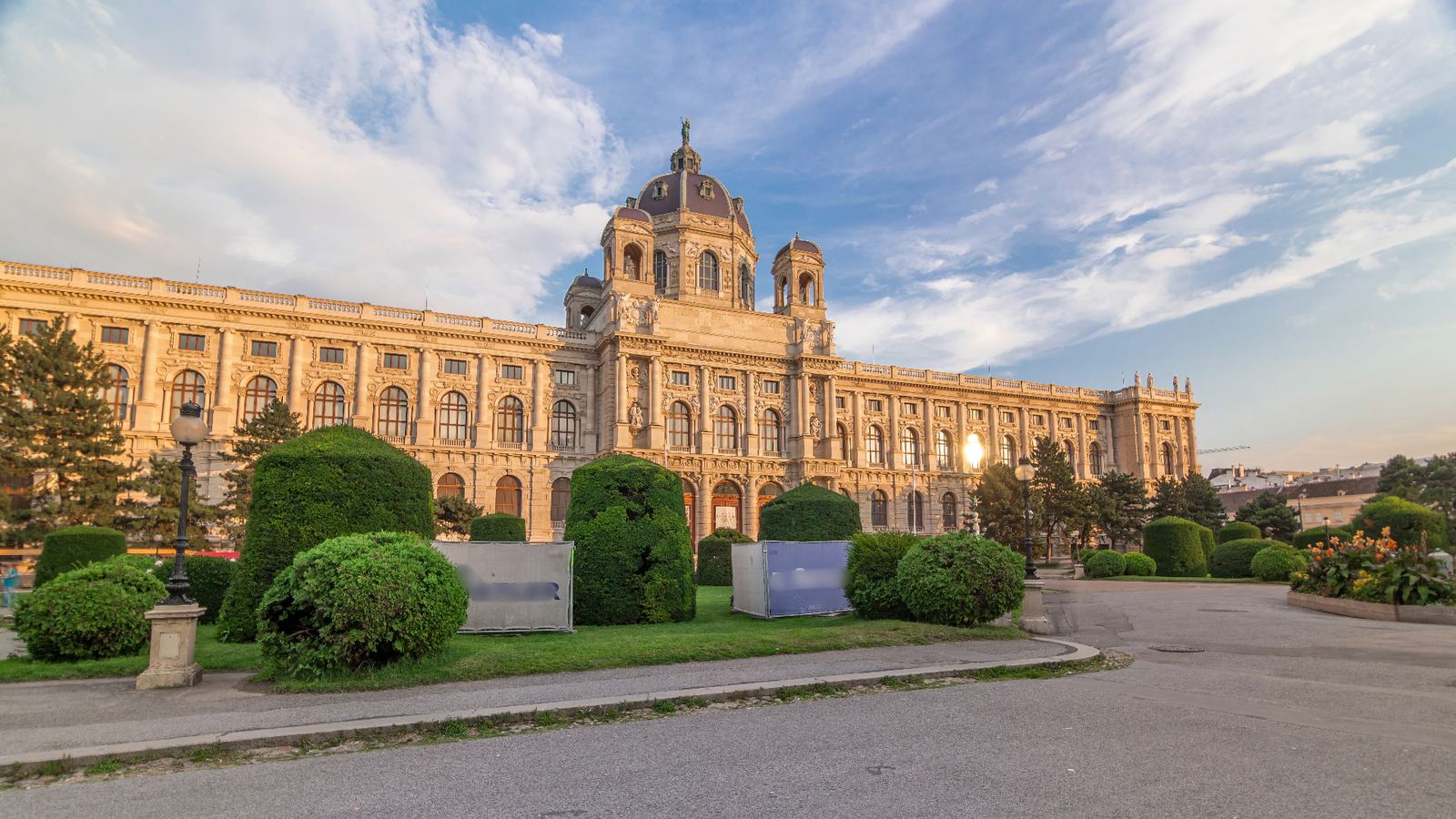
The 5.3-kilometre Ringstrasse was developed after Emperor Franz Joseph ordered its creation in 1857. Many of Vienna's monumental 19th-century buildings sit on or near it — the State Opera, Parliament, Rathaus, Burgtheater and the twin Kunsthistorisches and Naturhistorisches museums.
You don't need to walk all 5.3 km. From Heldenplatz, stroll past the museums toward Parliament and the Rathaus and then back down towards the Opera. Walking that loop takes around 45 minutes with almost no stopping time, so if you want to actually look at the buildings, either allow an hour or ride one section by tram and walk the other.
Time here: 45–60 minutes. The lower figure is walking pace with no pauses.
1:00 PM— Lunch around Naschmarkt
Getting there: On foot from the Opera — about 7–10 minutes down Operngasse — or one U-Bahn stop on the U4 from Karlsplatz to Kettenbrückengasse.
By now you've earned lunch. Naschmarkt has around 130 stalls plus dozens of restaurants — Viennese classics (Wiener Schnitzel, sausages, goulash), Middle Eastern, Vietnamese, seafood. Walk the length once, then double back to whatever looked best.
Two easy picks: Neni am Naschmarkt (Middle Eastern mezze, sit-down) or Zum Schwarzen Kameel nearby in the old town for a more classic Viennese lunch. Budget: €15–30 per person.
Queue check: Main market stalls are closed on Sundays — restaurants stay open but the vibe is much quieter. If it's Sunday, lunch on Graben or in the 7th district instead.
Time here: ~1 hour, 15 minutes.
2:30 PM— Belvedere — Klimt's The Kiss
Getting there: Tram D from the Ring/Opera area to Schloss Belvedere, the stop directly beside the Upper Belvedere. Alternatively, walk from Karlsplatz in roughly 20–25 minutes. A taxi is €8–10.
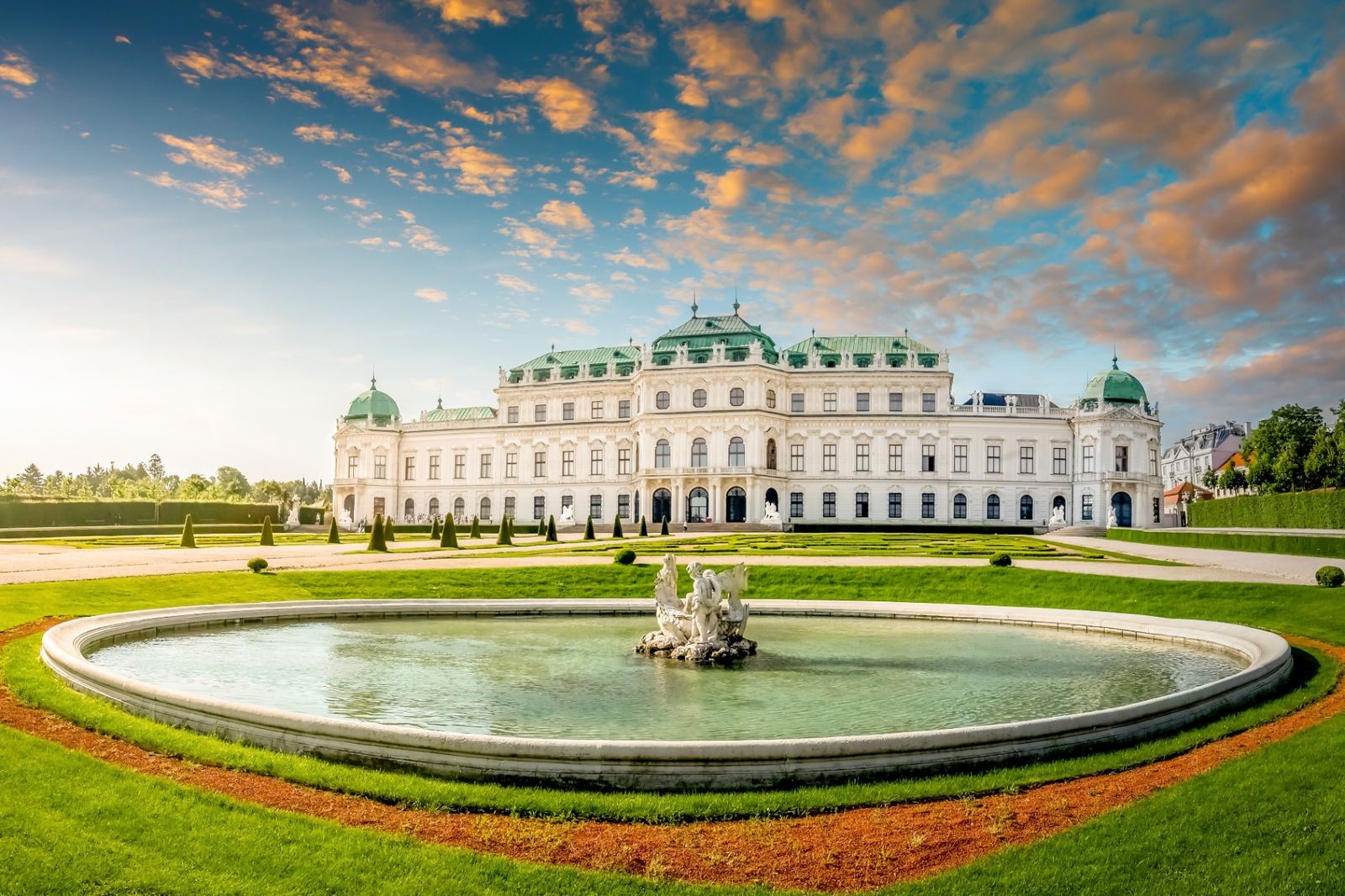
With one day in Vienna, visit one major museum, not three. For most first-time visitors, that museum is the Upper Belvedere. The Baroque complex consists of Upper and Lower Belvedere and houses major collections of Austrian art. The Upper Belvedere is particularly famous for its Gustav Klimt collection, including The Kiss. Even if you skip the interior, the palace and its formal gardens are worth the walk-through.
Queue check: Upper Belvedere uses timed-entry tickets. Buying online in advance lets you skip the ticket window and walk straight to the entrance scan, which matters most on afternoons in high season. Check the last-entry time on the official Belvedere site when you book.
Time here: ~1.5–2 hours (leave by 4:30 PM).
Book Belvedere tickets in advance to avoid queuing during the afternoon.
4:45 PM— Coffee & cake break
Getting there: From the Belvedere, take tram D or 71 back towards the Opera — roughly 10–15 minutes including waiting. The walking times below are measuredfrom the Opera, not from the Belvedere: Café Sacher is directly opposite the Opera, Café Central is about 10 minutes on foot towards the Hofburg, andCafé Landtmann about 12 minutes towards the Rathaus.
Sit down. Vienna's traditional coffee houses aren't places where people quickly drink caffeine and leave — coffee-house culture is part of the city's identity, built around lingering over coffee, conversation, newspapers and cake. Viennese coffee-house culture was added to Austria's intangible cultural heritage list in 2011.
This is your afternoon snack: order a coffee and a slice of cake and don't worry about whether you're being productive. After a day racing between palaces, cathedrals and Klimt paintings, it may become your favorite hour in Vienna.
Queue check: Café Sacher and Café Central are the two most visited coffee houses in the city and often have a wait at peak times. Café Landtmann or Café Museum usually seat you faster with equally good atmosphere.
Local tip: A classic Wiener Melange and a slice of Sachertorte or Apfelstrudel is the standard order.6:00 PM— Vienna State Opera
Getting there: On foot from your coffee stop. Café Sacher is directly opposite the Opera. From Café Central or Café Landtmann it's a 10–12 minute walk back toward the Ringstrasse.
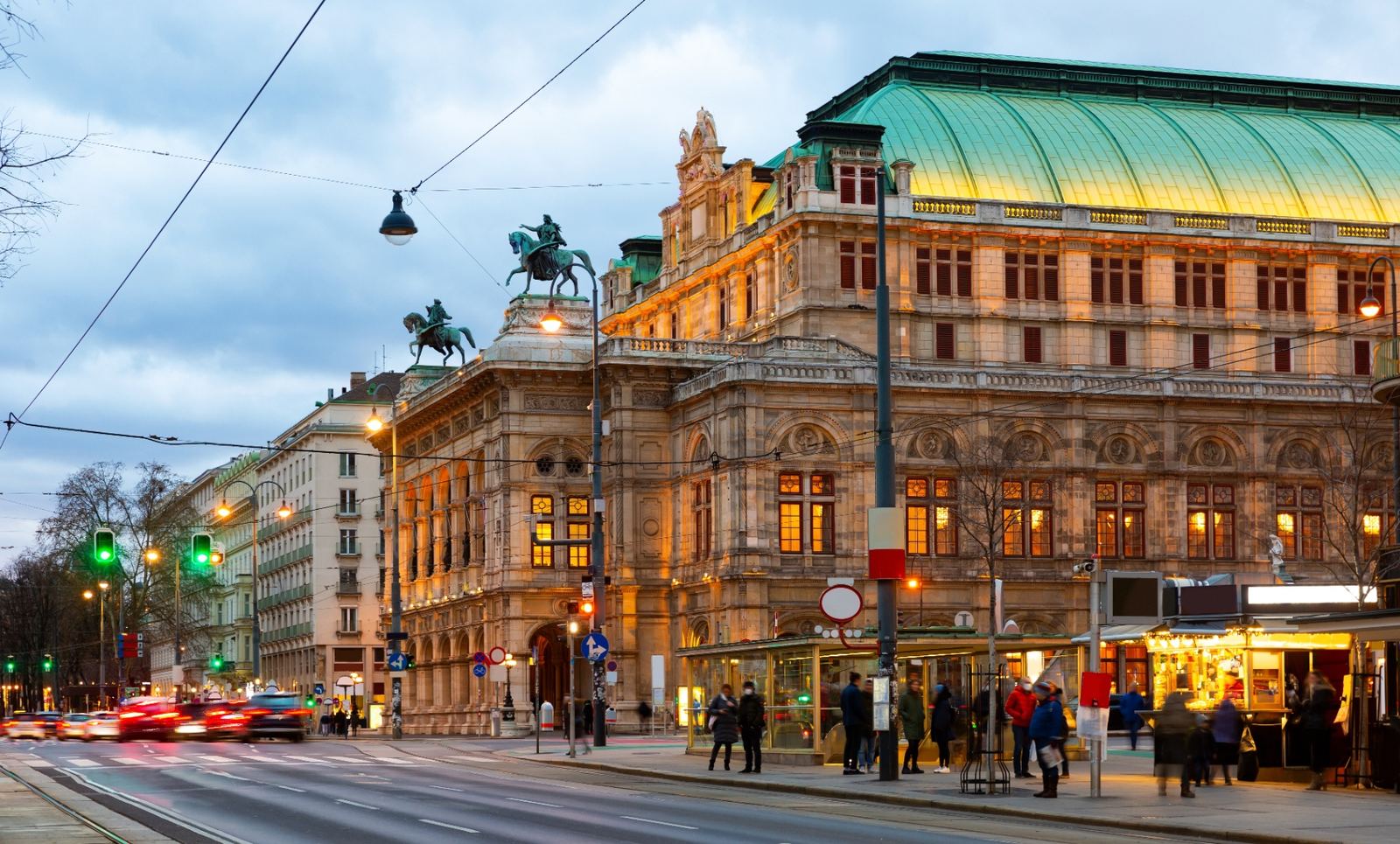
The Vienna State Opera (Wiener Staatsoper) is one of the world's leading opera houses and one of Vienna's defining buildings on the Ringstrasse. Opened in 1869 in Renaissance Revival style, it hosts a large annual program of opera and ballet. Even if you are not attending a performance, the grand facade and illuminated front make it worth a stop.
Depending on your budget and schedule, you have three options:
- Admire it from outside.
- Take a guided interior tour. These run at fixed times set around the rehearsal and performance schedule, and the last tour of the day is normally well before 6:00 PM — so treat this as something to book earlier in the day, not as a 6:00 PM walk-in. Check the day's tour times on the official Wiener Staatsoper site.
- Attend a performance. Standing-room tickets are sold shortly before curtain at a low fixed price; the exact price and sale time are published by the opera house for each performance.
With only one day, simply seeing the building and surrounding Ringstrasse area at dusk may be enough — then head to dinner in the old town. At 6:00 PM the practical option is the exterior; the interior tour and a performance both need to be planned around their own published times.
7:00 PM— Dinner and an evening walk
Getting there: On foot back into the 1st district. Everything mentioned below is within a 10-minute walk of Stephansplatz.
For dinner, stay central. A few reliable picks:
- Figlmüller (Wollzeile) — the classic oversized Wiener Schnitzel. Book ahead or arrive by 6:30 PM.
- Plachutta (Wollzeile) — the go-to for Tafelspitz.
- Zum Schwarzen Kameel — historic, more upscale, small plates and wine.
- Bitzinger Würstelstand Albertina — a proper Viennese sausage stand next to the Opera if you want quick and cheap (€6–8).
After dinner, walk again through the historic streets around Stephansplatz. Places feel different at night. Crowds thin, buildings are illuminated, and because you're no longer checking your map for the next attraction, you finally start looking around. That's usually when a city becomes memorable.
Your One-Day Vienna Itinerary at a Glance
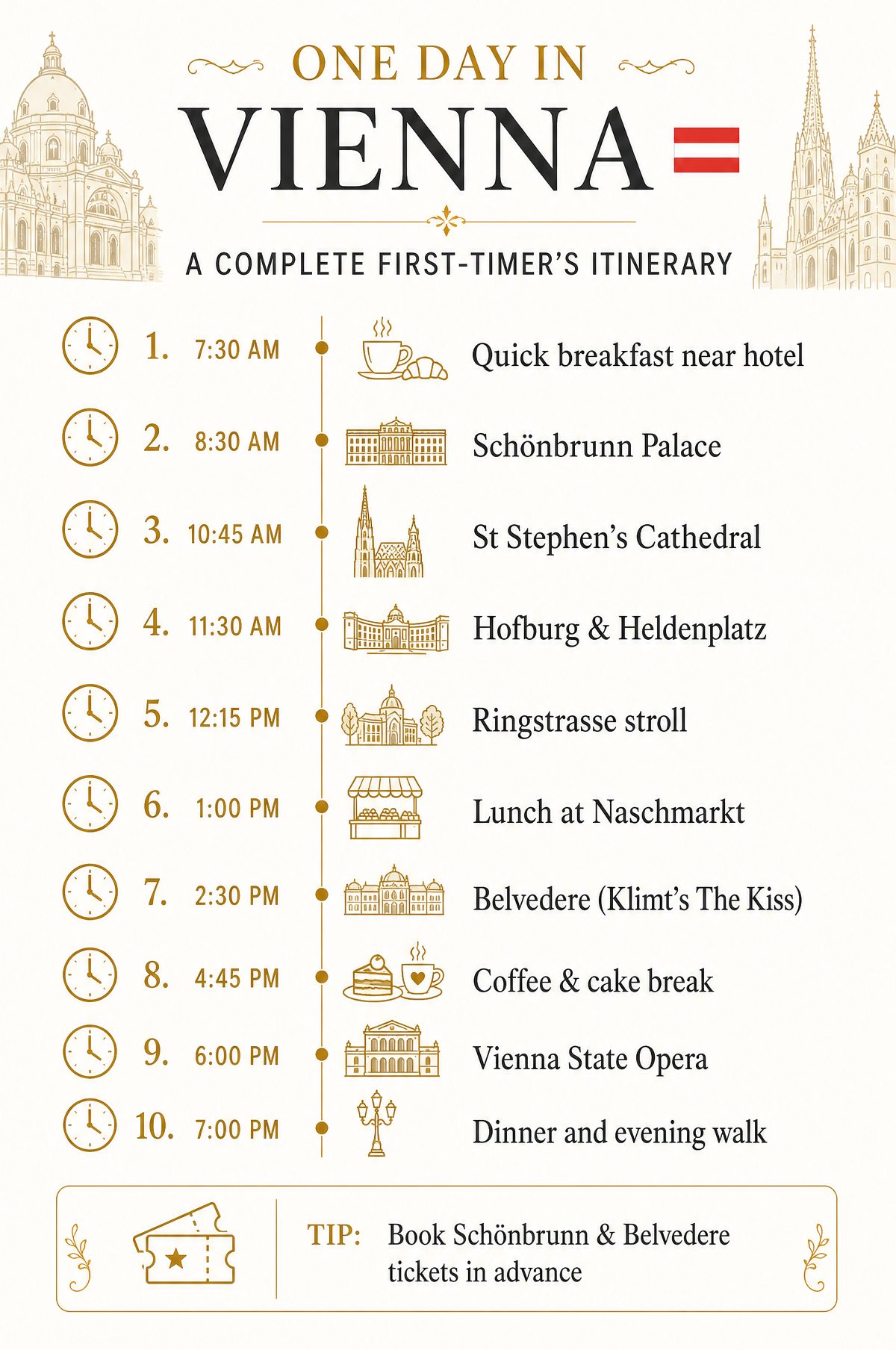
- 7:30 AMQuick breakfast near your hotel
- 8:30 AMSchönbrunn Palace and Gardens
- 10:45 AMSt Stephen's Cathedral
- 11:30 AMHofburg and Heldenplatz: Vienna's Imperial Palace Complex
- 12:15 PMRingstrasse stroll
- 1:00 PMLunch at or near Naschmarkt
- 2:30 PMBelvedere (Klimt's The Kiss)
- 4:45 PMCoffee & cake break
- 6:00 PMVienna State Opera
- 7:00 PMDinner and evening walk
One important tip
Don't tour both the interior of Schönbrunn Palace and the full Belvedere museum unless you enjoy a very fast-paced day. For a more relaxed itinerary, choose one major paid interior:
- Imperial history → Schönbrunn
- Art → Upper Belvedere
Then experience the other from outside. Vienna is far too elegant a city to spend your entire visit running.
FAQ: One Day in Vienna
Is one day enough for Vienna?
One day is enough to see several of Vienna's major highlights, but not enough to explore the city in depth. Two to three days is much more comfortable if you want to visit multiple museums and imperial attractions.
Should I visit Schönbrunn with only one day in Vienna?
Yes, particularly if Habsburg history interests you — but treat the gardens as the default and the palace interior as a deliberate trade-off. Schönbrunn sits outside the historic centre, so a palace tour costs you roughly an hour of the day; visitors who prefer a slower pace can skip it entirely and focus on central Vienna.
Can you visit Schönbrunn Gardens for free?
The main Schönbrunn Palace park is accessible free of charge, although certain attractions and special garden areas within the complex require tickets.
Do I need to book Schönbrunn and Belvedere tickets in advance?
Both use timed-entry tickets, and booking online a few days ahead is the safer choice in high season: it fixes your entry time so the rest of the day stays on schedule and avoids the on-site ticket window. Availability varies by date, so check the official Schönbrunn and Belvedere booking pages rather than assuming either is sold out or wide open.
Is the Belvedere worth visiting?
For art lovers, yes. The Upper Belvedere houses an important collection of Austrian art and is particularly famous for Gustav Klimt's The Kiss.
What is the best way to get from Schönbrunn to central Vienna?
Take the U4 metro from Schönbrunn station directly to Karlsplatz, then walk to Stephansplatz. The journey takes about 20–25 minutes and is much faster than walking or a taxi during the day.
Should I buy a Vienna public transport pass?
For this itinerary, yes. A 24-hour Wiener Linien ticket covers the U4 from Schönbrunn, the tram or U-Bahn to Belvedere and any evening rides, and it usually pays for itself after about three single journeys. Fares change, so check the current price on the official Wiener Linien tariff page (wienerlinien.at) before you travel — we last checked it on 14 August 2026.
Where to Eat Dinner in Vienna
A single day in Vienna is not complete without a proper dinner. Whether you want a sit-down classic or a quick sausage before the opera, these places are reliable choices near the historic centre.
- Figlmüller (Wollzeile) — the classic oversized Wiener Schnitzel. Book ahead or arrive by 6:30 PM.
- Plachutta (Wollzeile) — the go-to for Tafelspitz.
- Zum Schwarzen Kameel — historic, more upscale, small plates and wine.
- Bitzinger Würstelstand Albertina — a proper Viennese sausage stand next to the Opera if you want quick and cheap (€6–8).
After dinner, walk again through the historic streets around Stephansplatz. Places feel different at night. Crowds thin, buildings are illuminated, and because you're no longer checking your map for the next attraction, you finally start looking around. That's usually when a city becomes memorable.