How to Travel to Rome from the US in 2026
From travel documents to must-see attractions — everything a U.S. traveler needs to plan a trip to Rome in 2026.
··12 min readPassport, EES & ETIAS
Good news — U.S. citizens do not need a visa to visit Italy. You can stay up to 90 days within any 180-day period for tourism or business. Italy requires a passport valid at least 3 months beyond your planned departure from the Schengen Area; the U.S. State Department recommends having 6 months remaining.
EES — biometric border checks (active since April 10, 2026)
The EU's Entry/Exit System (EES) started progressively in October 2025 and became fully operational on April 10, 2026. On your first Schengen entry you'll do a short registration recording your travel document, a facial image and fingerprints.
- • Registration usually happens at the first Schengen airport — if you connect through Paris, Amsterdam or Frankfurt, expect EES there rather than at Fiumicino.
- • EES registration may add some time to passport control on your first entry; keep your passport handy.
- • EES replaces manual passport stamping for short-stay travellers.
ETIAS — not yet required (status checked August 2026)
ETIAS is not operating and applications cannot be submitted. The EU has said the exact start date will be announced before launch, so no action is needed today. Check the official EU website before departure, because implementation is expected later. A transitional grace period is planned once ETIAS goes live.
- • Fee (once applicable): €20 — under-18s and over-70s are exempt from the fee
- • Valid: up to 3 years, or until your passport expires
- • How: apply online at the official ETIAS site — beware of unofficial paid websites
- • When to check again: closer to your departure date, as launch timing may change
Official sources: EU official ETIAS website · U.S. Embassy in Italy — visa information · Italian Ministry of Foreign Affairs visa portal

Checklist before you go
- Passport valid at least 3 months past your Schengen departure (State Department recommends 6 months)
- Travel insurance (not mandatory but strongly recommended)
- Proof of return or onward travel
- Proof of sufficient funds (rarely asked, but have it)
- Re-check ETIAS status on the official EU site before departure — it is not required as of August 2026
Finding Flights to Rome
Rome has two airports: Fiumicino (FCO) — the main international hub — and Ciampino (CIA), used mostly by budget carriers. Most transatlantic flights from the U.S. land at Fiumicino.
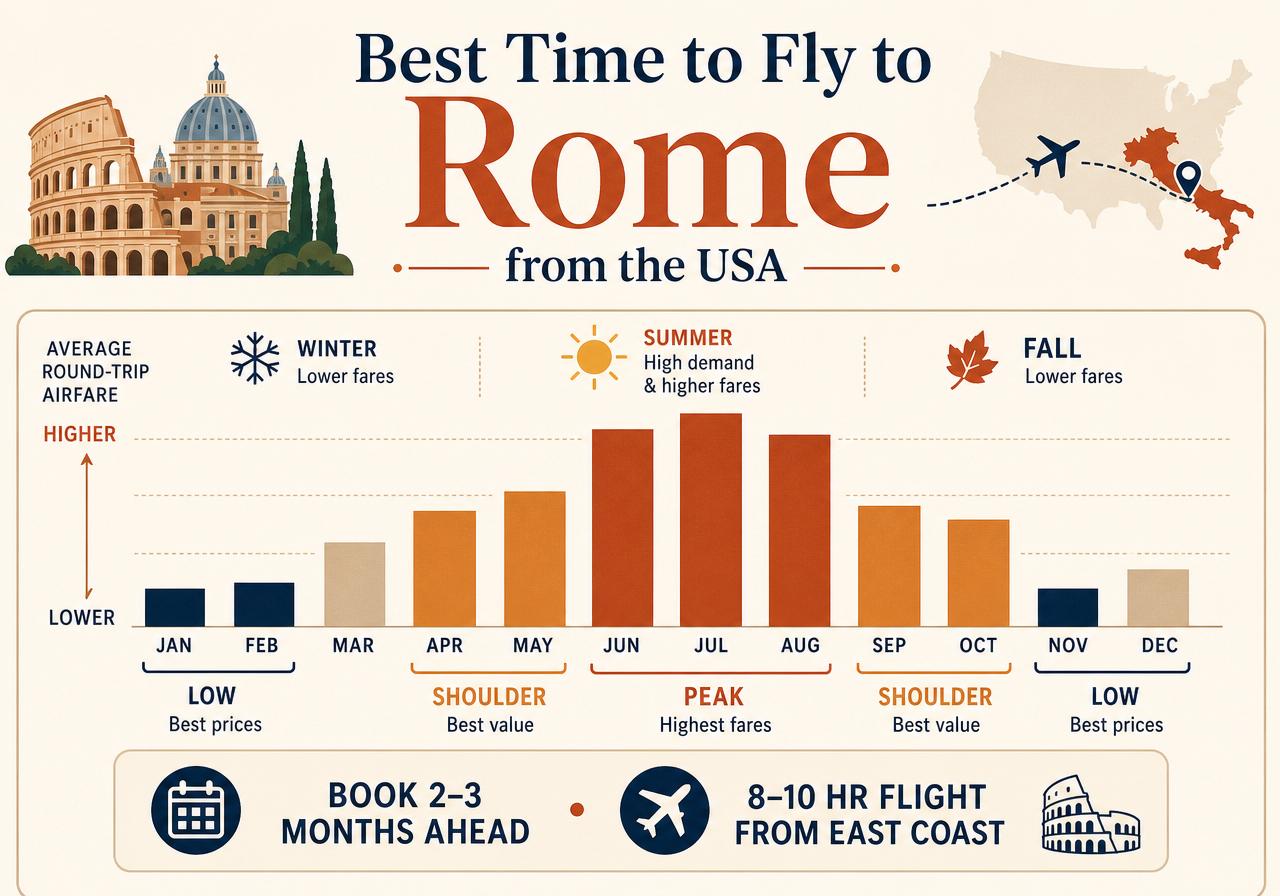
Major carriers like Delta, United, American Airlines, and ITA Airways fly direct from JFK, Newark, LAX, Miami, and other hubs. Nonstop flights from the U.S. East Coast are typically around 8–9 hours; West Coast flights are substantially longer.
Pro tip: Search flexible dates and compare several weeks around your preferred trip — prices swing significantly by day of week and by carrier. Shoulder seasons (April–May and September–October) typically bring lower fares and lighter crowds than mid-summer.
Where to Stay in Rome
Rome's best neighborhoods for first-time visitors are Centro Storico (historic heart), Monti (trendy & walkable), Trastevere (charming & lively), and Prati (near the Vatican, quieter). Budget travelers will find great deals near Termini Station.
Hotel rates in Rome vary dramatically by season, neighbourhood and events — compare live prices once your dates are fixed. Summer (June–August) and holiday weeks book up first, so lock in a refundable room early and re-check closer to travel.
Find Hotels in RomeTop Rated HotelsNear Termini StationFamily-Friendly Hotels📖 Also check out our Best Hotels in Rome and Best Hotels Near the Colosseum guides.
Getting from the Airport to Rome
From Fiumicino (FCO), the fastest option is the Leonardo Express train — 32 minutes to Termini for €14, usually every 15 minutes. The official fixed-rate taxi to destinations within the Aurelian Walls is €55. From Ciampino (CIA), the official fixed-rate taxi within the Aurelian Walls is €40, and airport buses to Termini cost around €6.
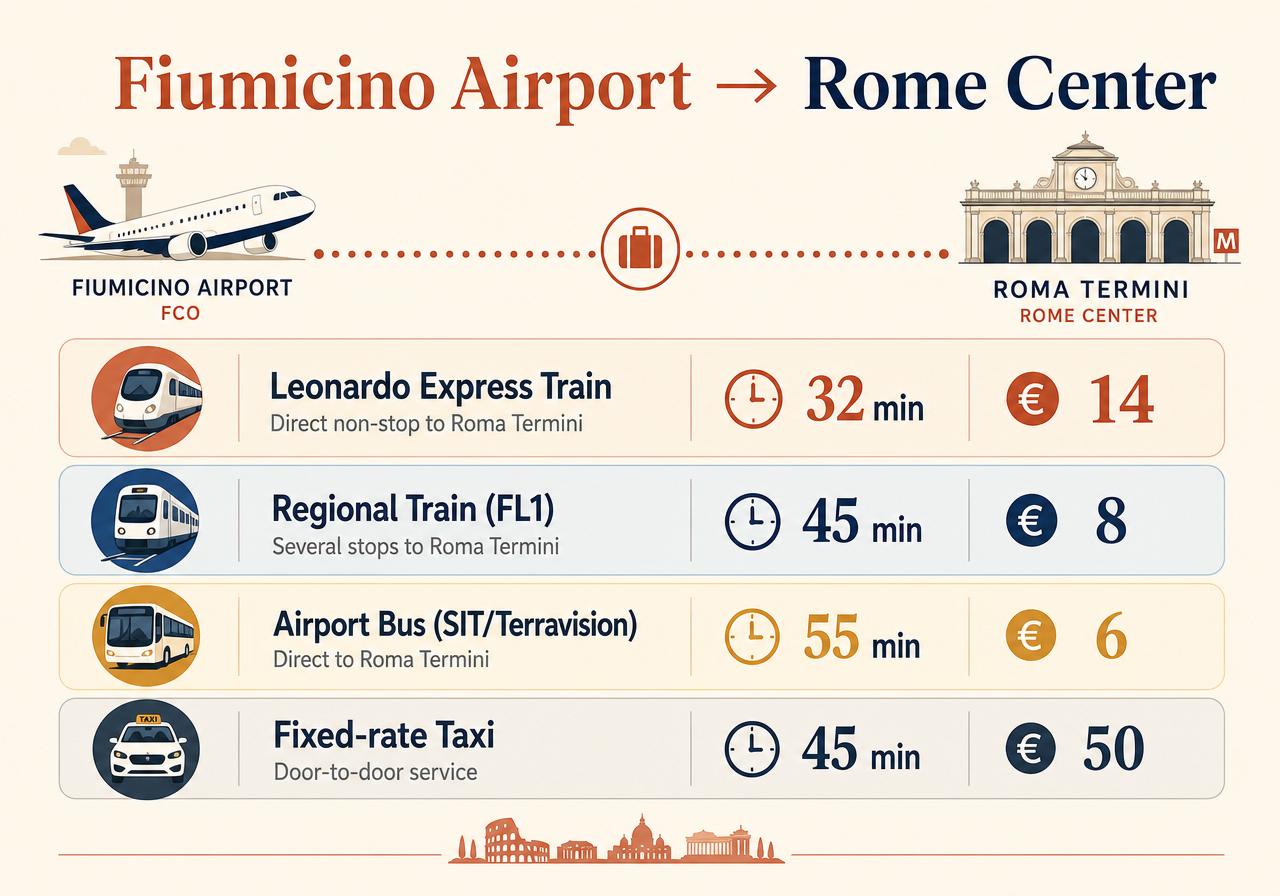
We have a detailed guide comparing all options with prices, schedules, and booking links:
📖 Complete Airport Transfer GuideWhat to See & Do in Rome
Rome is packed with history at every corner. The must-sees include the Colosseum, Roman Forum, Vatican Museums & Sistine Chapel, St. Peter's Basilica, Pantheon, Trevi Fountain, and Spanish Steps. But that barely scratches the surface.
We have detailed guides for 150+ Rome attractions — each with opening hours, ticket prices, tips, and honest reviews.
Browse All 150+ AttractionsOur Rome Itineraries
Don't want to spend hours planning? We've built ready-to-follow itineraries from 1 to 5 days — each one is a complete guide with detailed descriptions, insider tips, and an interactive Google Map.
What's inside every itinerary:
- 📖Detailed attraction guide — descriptions, history, what to look for, and pro tips for every stop
- 🗺️Interactive Google Map with all main attractions, dozens of additional hidden gems, and curated, well-reviewed restaurant recommendations along the route
- ⏱️Walking times between stops so you know exactly how your day flows
- 💰Budget breakdown with ticket prices and money-saving tips
📋 See all itineraries on our Itineraries page.
Practical Tips for Americans in Rome
💶 Currency & Payments
Italy uses the Euro (€). Credit cards (Visa, Mastercard) are widely accepted, but carry some cash for small shops, gelaterias, and tipping. ATMs ("Bancomat") are everywhere — avoid airport exchange booths.
🔌 Power Adapters
Italy uses Type C, Type F and Type L plugs at 230V. Most modern phone and laptop chargers are marked 100–240V and just need a plug adapter — a small "Europe" adapter is enough. Any U.S.-only 120V appliance (hair dryers, curling irons) will also need a voltage converter, or better still, leave it at home and buy or borrow a 230V version.
📱 Phone & Data
Get a European eSIM or prepaid SIM at the airport (TIM, Vodafone, WindTre). Compare eSIM and prepaid-SIM prices before departure. Free Wi-Fi is common in hotels and cafés.
🚰 Tap Water
Rome's tap water is safe and excellent — even the public drinking fountains (nasoni) are drinkable. Bring a refillable bottle and save money.
⏰ Best Time to Visit
Spring and early autumn often offer comfortable walking weather, while summer is hotter and usually busier. Winter generally brings shorter attraction hours and can offer better accommodation availability.
🎫 Book Tickets in Advance
Popular dates and limited-capacity products can sell out. Check the current release window for each attraction and book timed tickets once your dates are fixed. See our Colosseum Tickets Guide for the current windows.
Ready to Book Your Rome Trip?
Find the best deals on flights, hotels, and tours — all in one place.
Flights Hotels Tours & Tickets