Table of Contents
- 1. What to look for
- 2. The ceiling: how it is arranged
- 3. The Last Judgment (altar wall)
- 4. The rules inside
- 5. Where to stand
- 6. Timing your visit
Where to buy Vatican Museums tickets
Try the official Vatican Museums site first, then compare Tiqets, Klook, and Trip.com — trusted booking partners — if official slots are sold out.
OfficialVatican MuseumsFace-value timed tickets from the Vatican's official ticketing site.Official TicketsPartnerTiqetsSkip-the-line tickets and guided tours when official slots are gone.Check PricesPartnerKlookCheck alternative ticket and tour availability.Check PricesPartnerTrip.comBundle Vatican tickets with hotels and city passes.Check PricesWhat to look for
On the ceiling: the nine Genesis scenes along the central spine, the Prophets and Sibyls enthroned around them, the corner pendentives with scenes of salvation, and the ignudi.
On the altar wall: Christ at the centre of the Last Judgment, St Bartholomew holding a flayed skin, and Charon driving the damned from his boat.
Do not ignore the side walls: the fifteenth-century fresco cycles by Perugino, Botticelli, Ghirlandaio and Rosselli are easy to walk past and reward a few minutes.
The ceiling: how it is arranged
Michelangelo painted the ceiling between 1508 and 1512, working standing on scaffolding rather than lying on his back. The narrative runs from Creation near the altar toward Noah near the entrance — that is chronological biblical order. Michelangelo painted broadly in the opposite direction, beginning with the Noah scenes at the entrance end and working back toward the altar, which is why the later, altar-end figures are larger and more freely handled.
1. Separation of Light from Darkness
Above the altar, and among the last painted. The handling is broader and more confident than at the entrance end.
2. Creation of the Sun, Moon and Plants
God appears twice in the same field, front and back — a device for showing successive acts in one image.
3. Separation of Land from Water
God rushing toward the viewer, one of the most strongly foreshortened figures on the vault.
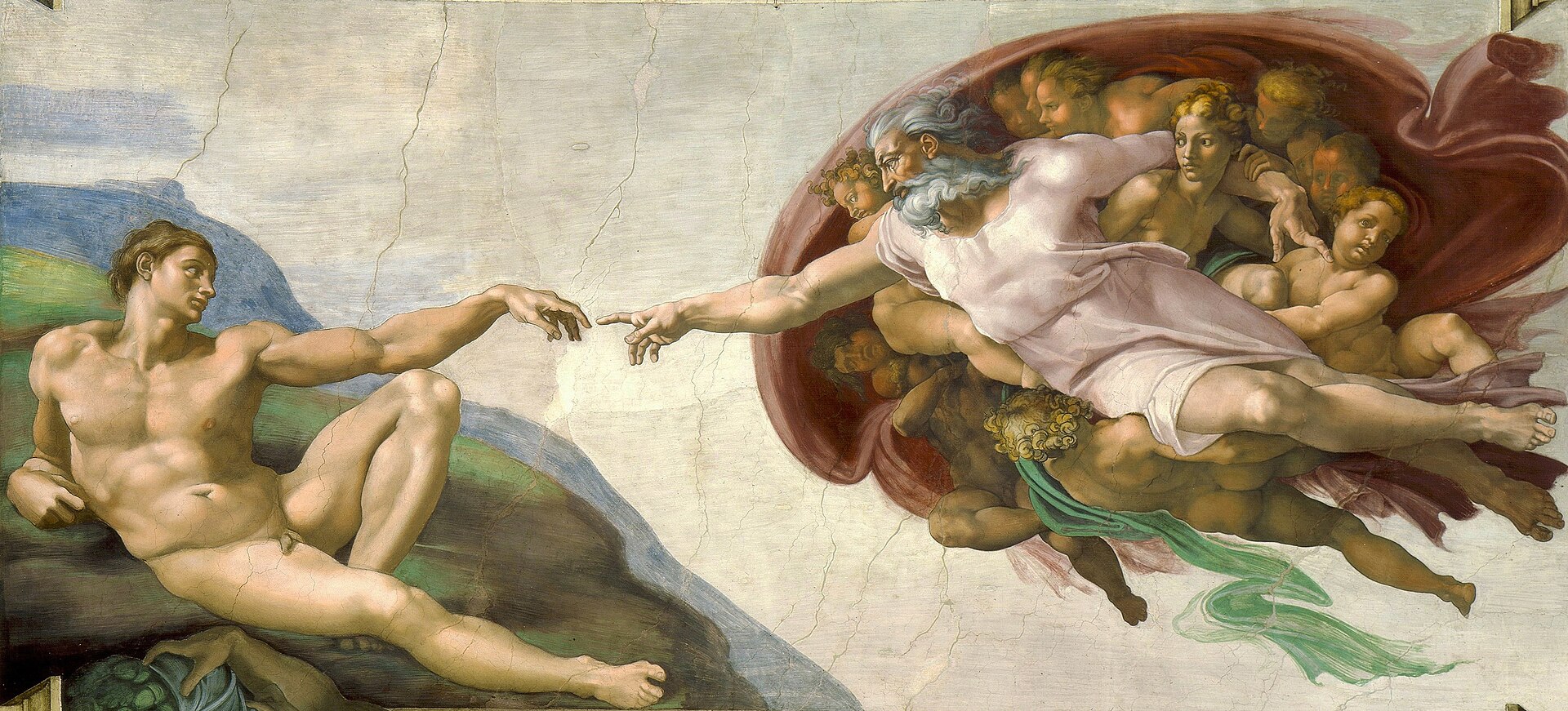
4. Creation of Adam
The famous one. The gap between the fingers carries the whole image. The female figure under God's arm is variously identified as Eve or as Wisdom.
5. Creation of Eve
Eve rises at God's command beside the sleeping Adam. It sits next in sequence along the central spine, at the midpoint of the cycle.
6. Fall and Expulsion
Two moments in one field: the temptation at the tree, and the expulsion driven by the angel's sword.
7. Sacrifice of Noah
Placed before the Flood in the sequence on the vault, though it follows it in the biblical text.
8. The Great Flood
The largest and among the earliest of the nine, with many small figures — the composition is denser than the later scenes.
9. Drunkenness of Noah
Nearest the entrance, and the human low point that closes the cycle.
Around the narrative: seven Prophets and five Sibyls sit on monumental painted thrones flanking the central scenes — Jonah above the altar is the largest. The ancestors of Christ occupy the lunettes above the windows and the triangular spandrels, and the four larger corner pendentives carry scenes of the salvation of Israel. The twenty ignudi, the seated nude youths framing the smaller panels, have been read as everything from angelic figures to purely formal invention; their meaning is still debated.
The Last Judgment (altar wall)
Painted between 1536 and 1541, roughly a quarter of a century after the ceiling, the altar wall is darker and more turbulent. It shows the second coming and the separation of the saved from the damned.
Christ in judgment
Centre-top, beardless and powerfully built, with the Virgin beside him. The raised arm is part of the movement that drives the whole composition rather than a single coded sign; readings of the gesture vary.
St Bartholomew's skin
Below Christ, the martyr holds a flayed human skin. The face on the skin is widely interpreted as a self-portrait of Michelangelo, though that identification is an interpretation rather than a documented fact.
Charon
Lower right, driving the damned from his boat with an oar — an image drawn from Dante's Inferno rather than from scripture.
Minos
Beside Charon, the serpent-wrapped judge of the underworld. Early biographers, notably Vasari, recount that Michelangelo gave him the features of the papal master of ceremonies Biagio da Cesena after he criticised the nudity; the story is traditional biography, not independent documentation.
Added draperies
Loincloths were painted over some figures after the Council of Trent, work begun by Daniele da Volterra. The twentieth-century restoration removed some later additions and retained others as part of the wall's history.
The rules inside
- No photography or filming in the chapel.
- Silence, or quiet voices at most — the chapel is a consecrated space and guides do not commentate inside.
- Hats off. The Vatican's visitor rules prohibit hats in the visitor areas generally, not only in the chapel.
- Covered shoulders and knees. Dress requirements may be checked at admission or before entry to sacred areas.
- Limited wall benches may be available; sitting on the floor is not permitted.
- Behave as you would in a place of worship — this is the substance of the decorum rule, rather than a list of separate offences.
Where to stand
Side wall benches (best, if free)
Seating is limited and often taken. If a place frees up, sit, lean back and look straight up — the most comfortable way to work through the ceiling scene by scene.Entrance end
Standing under the Noah scenes and facing the altar lets you read the narrative in biblical order, from Creation at the far end toward you.Mid-room, for the altar wall
Step back toward the middle of the chapel; very close views distort the composition. Small binoculars help with the upper figures.Leaving
If you are with a guided group that has been directed toward St Peter's, follow the guide. Independent visitors follow the normal museum exit route; that connection is not open to everyone.Timing your visit
Standard opening is Monday to Saturday, 08:00–20:00, with last admission at 18:00. Within those hours:
- The first standard slots after 08:00 are generally less pressured than the late-morning peak.
- Later afternoon, well before last admission, is often calmer again.
- Low-season months are easier than high summer and holiday weeks.
- No general Friday-night or evening opening is published for 2026.
These are tendencies, not promises. We do not publish head counts for the chapel by hour: no verifiable source exists for such figures, and an earlier version of this page contained a crowd table that has been removed.
Frequently Asked Questions
Can you take photographs in the Sistine Chapel?
No. Photography and filming are not permitted in the chapel, and staff enforce the rule. Photography is allowed in most other parts of the Vatican Museums without flash.How long should you spend in the Sistine Chapel?
Fifteen to twenty-five minutes is enough for most visitors to sit, look up and work through the ceiling and the altar wall. Guides usually explain the paintings in earlier rooms, because commentary is not given inside.Where is the best place to stand?
The benches along the side walls. Sitting and leaning back is the only comfortable way to study the ceiling, and it keeps the central floor clear.Why must you stay quiet in the chapel?
It is a consecrated space still used for papal liturgies and conclaves, and silence is part of the published visitor rules. Staff periodically remind visitors.Is the Sistine Chapel included in a Vatican Museums ticket?
Yes. Standard admission (€20 full-price admission, plus the €5 optional online reservation fee when booking online) includes the chapel, which sits near the end of the main visitor route.Related Vatican guides
Vatican Museums Tickets Guide 2026
Official prices, the reservation fee and booking.
Vatican Museums Highlights
The wider collection around the chapel.
Are the Vatican Museums Open at Night?
What the official 2026 schedule actually says.
Vatican Museums vs St. Peter's
How the two visits connect.
Full Vatican Museums attraction guide See Rome attractions by area on the map