Table of Contents
- 1. What you're looking at
- 2. The statue's story
- 3. The 'ideal beauty' era
- 4. The Paris years
- 5. How to find it
Where to buy Vatican Museums tickets
Try the official Vatican Museums site first, then compare Tiqets, Klook, and Trip.com — trusted booking partners — if official slots are sold out.
OfficialVatican MuseumsFace-value timed tickets from the Vatican's official ticketing site.Official TicketsPartnerTiqetsSkip-the-line tickets and guided tours when official slots are gone.Check PricesPartnerKlookCheck alternative ticket and tour availability.Check PricesPartnerTrip.comBundle Vatican tickets with hotels and city passes.Check PricesWhat you're looking at
The Apollo Belvedere is a Roman marble of roughly 2.24 metres, made after a lost Greek bronze traditionally associated with Leochares. It shows the god of light, music and prophecy mid-stride, the right arm extended after releasing an arrow. For around three centuries it was among the most admired sculptures in Europe and a reference point for Neoclassical taste.
Quick facts: Apollo Belvedere · about 2.24 m marble · Roman workshop of the first decades of the 2nd century AD · after a Greek bronze of the 4th century BC · Octagonal Court (Cortile Ottagono), Pio-Clementino Museum, Vatican Museums.
The statue's story
The Vatican Museums record the statue as found in Rome in 1489, among the ruins of an ancient domus on the Viminal Hill. It entered the collection of Cardinal Giuliano della Rovere, who became Pope Julius II in 1503, and was placed in the Belvedere Courtyard around 1508 — the same pope who commissioned the Sistine ceiling and the Raphael Rooms. Together with the Laocoön, the Apollo anchored the early papal display of antiquities in that courtyard; the Belvedere Torso entered the papal collection separately and was not part of that original courtyard arrangement in the same way.
The 'ideal beauty' era
From roughly 1760 to 1830 the Apollo Belvedere was treated as the supreme surviving example of classical sculpture. Johann Joachim Winckelmann described it as the highest expression of ideal beauty, and plaster casts stood in art academies across Europe. Its unrivalled status then declined for several reasons at once: a much wider first-hand knowledge of Greek sculpture, the shift in taste that came with Romanticism, and a scholarly understanding that the Apollo is a Roman work made after a Greek original rather than a Greek masterpiece itself. Today it is studied as an important Roman marble and as a document of Europe's changing ideas about beauty.
The Paris years
Under the Treaty of Tolentino the papacy surrendered a long list of its most valued works, and the Apollo Belvedere was transferred to Paris along with the Laocoön. The statues were displayed at the Louvre until Napoleon's defeat, after which they were returned to Rome. That list is itself a historical document: it records what the Vatican regarded as its most important treasures at the end of the 18th century.
How to find it
- From the Pinecone Courtyard, follow signs into the Pio-Clementino wing.
- The Cortile Ottagono is a few minutes further on, though one-way flows and route changes are possible.
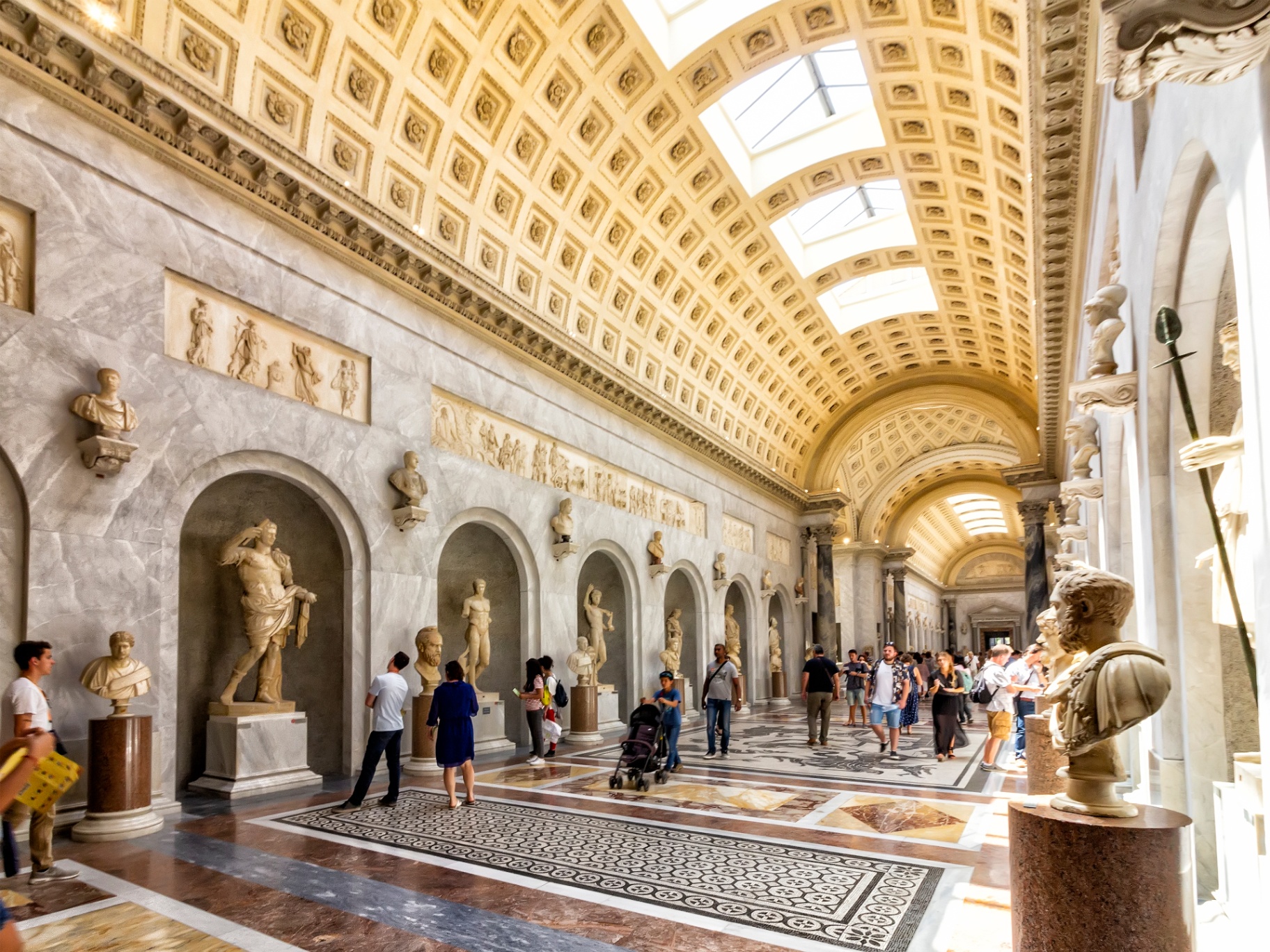
- The Apollo stands in a niche on one side of the court; the Laocoön is in another niche nearby, and Canova's Perseus is also in the courtyard.
- Allow about five minutes. Because the statue sits in a niche, view it from the angles the courtyard allows rather than expecting to circle it.
Frequently Asked Questions
How old is the Apollo Belvedere?
The Vatican Museums attribute it to a Roman workshop active during the first decades of the 2nd century AD, working from a lost Greek bronze traditionally associated with Leochares.Where was it found?
According to the Vatican Museums' own record, it was found in Rome in 1489, among the ruins of an ancient domus on the Viminal Hill — not at Anzio, as older popular accounts claim.Where does the name come from?
From the Belvedere Courtyard, where Pope Julius II had it placed around 1508.Is it worth seeing after the Laocoön?
Yes — both stand in the same Octagonal Court, in niches on different sides.Why was it once considered the greatest statue?
From Winckelmann in the 1750s through the mid-1800s it was treated as the peak of classical beauty. Changing scholarship, Romantic taste and far greater first-hand knowledge of Greek sculpture later reduced that unrivalled status.Did Napoleon really take it?
It was transferred to Paris under the Treaty of Tolentino and displayed at the Louvre until it returned to Rome after Napoleon's defeat.Related Vatican guides
Laocoön
The Apollo's Octagonal Court neighbour.
Pio-Clementino Museum
The wing that houses the Apollo.
Vatican Masterpieces
The don't-miss list.
Vatican Route
Where the Apollo fits.
Full Vatican Museums attraction guide See Rome attractions by area on the map