Table of Contents
- 1. What it is
- 2. The rooms in sequence
- 3. Sculptures to prioritise
- 4. Nearby but not part of it
- 5. How to see it well
Where to buy Vatican Museums tickets
Try the official Vatican Museums site first, then compare Tiqets, Klook, and Trip.com — trusted booking partners — if official slots are sold out.
OfficialVatican MuseumsFace-value timed tickets from the Vatican's official ticketing site.Official TicketsPartnerTiqetsSkip-the-line tickets and guided tours when official slots are gone.Check PricesPartnerKlookCheck alternative ticket and tour availability.Check PricesPartnerTrip.comBundle Vatican tickets with hotels and city passes.Check PricesWhat it is
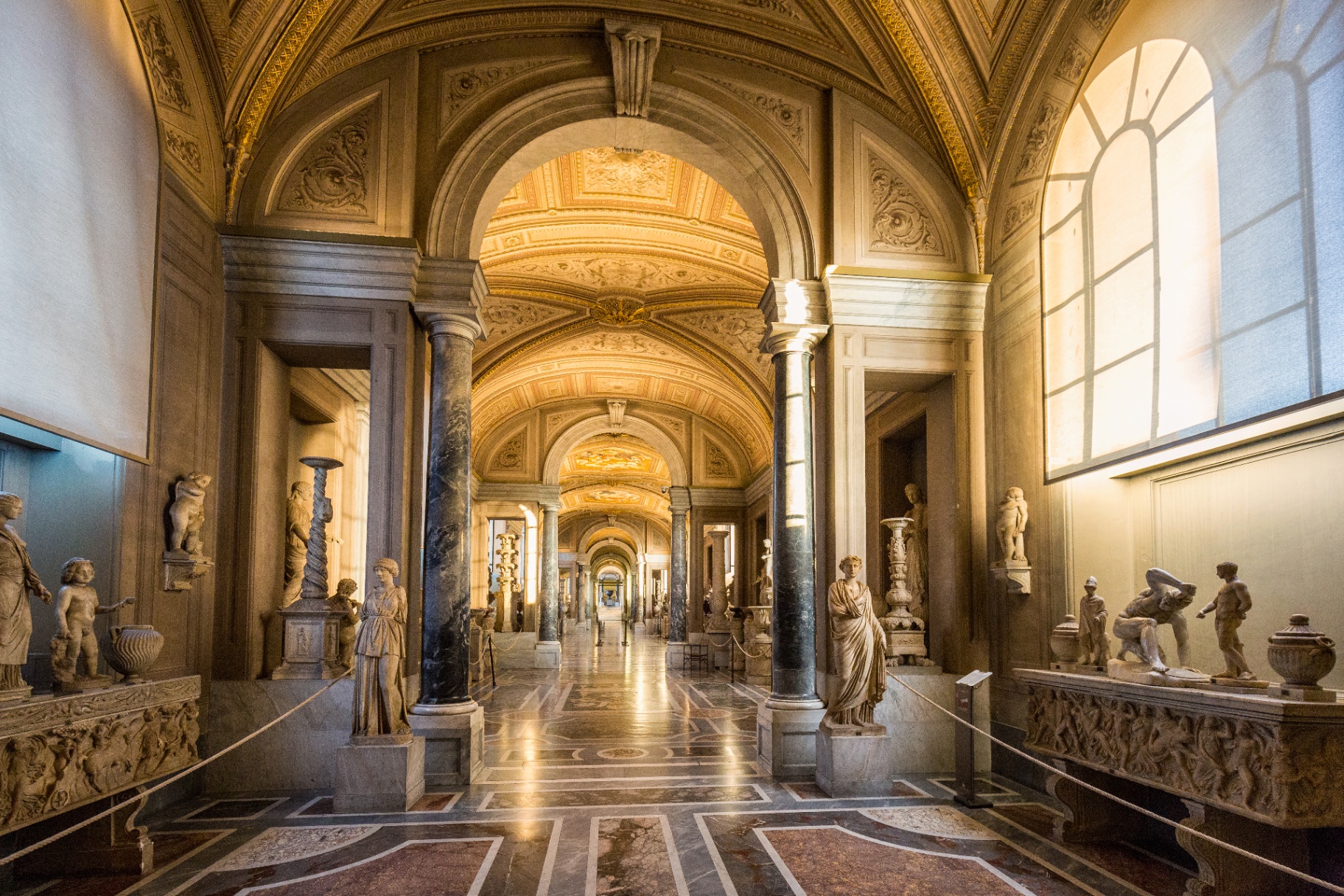
Developed from the 1770s under Popes Clement XIV and Pius VI to display the papal collection of ancient sculpture. Its heart is the Cortile Ottagono (Octagonal Court), where the Laocoön has stood since 1506 and where the Vatican's account documents the Apollo Belvedere by 1508 — decades before the museum itself took shape around them.
The rooms in sequence
The official structure of the Pio-Clementino includes the following sections. Visiting order depends on the direction of travel and on the one-way flows in force on the day.
Square Vestibule and Cabinet of the Apoxyomenos
Entrance spaces to the wing, with the Roman marble Apoxyomenos — an athlete scraping oil from his skin.
Cortile Ottagono (Octagonal Court)
The Laocoön, the Apollo Belvedere and Canova's Perseus, each in a niche around the courtyard.
Sala degli Animali
Ancient marbles of animals, extensively restored and recomposed in the 18th century.
Galleria delle Statue
A long hall of standing figures and Roman portraits.
Galleria dei Busti
Portrait busts of emperors, private citizens and divinities.
Cabinet of Masks
A small room named for its ancient floor mosaic of theatrical masks.
Sala delle Muse
The Belvedere Torso, surrounded by statues of Apollo and the Muses.
Sala Rotonda
A circular hall inspired by the Pantheon, dominated by an enormous red porphyry basin.
Sala a Croce Greca
The Greek-cross hall, with the porphyry sarcophagi of Constantina and Helena.
Hall of the Chariot (Sala della Biga)
A circular hall built around a marble chariot group reassembled in the 18th century.
Gallery of the Candelabra
The long corridor of ancient candelabra and coloured columns that continues the itinerary.
Sculptures to prioritise
- Laocoön Group — Octagonal Court. Among the most influential ancient sculptures in Western art.
- Apollo Belvedere — Octagonal Court. Held up as the model of ideal beauty for roughly three centuries.
- Perseus with the Head of Medusa — Canova, Octagonal Court. The Neoclassical response to the ancient marbles beside it.
- Apoxyomenos — Cabinet of the Apoxyomenos. A Roman copy after a Greek bronze by Lysippos.
- Belvedere Torso — Sala delle Muse. Studied intensively by Michelangelo.
- Colossal head of Zeus (Otricoli Zeus) — Sala Rotonda.
- Porphyry basin — Sala Rotonda. An enormous single-block basin, one of the largest surviving worked porphyry objects.
- Sarcophagus of Constantina — Sala a Croce Greca. Early Christian imagery carved in porphyry.
- Sarcophagus of Helena — Sala a Croce Greca. Massive porphyry with battle scenes.
- Marble chariot group — Hall of the Chariot. Reassembled in the 18th century from ancient fragments and restorations.
Nearby but not part of it
Two works visitors regularly file under the Pio-Clementino actually belong elsewhere: the Augustus of Prima Porta and the personification of the Nile are displayed in the Braccio Nuovo, which forms part of the Chiaramonti complex, not the Pio-Clementino Museum. Both are worth seeing, but plan them as a separate stop.
How to see it well
- • Take the Octagonal Court slowly — it is the artistic core of the wing.
- • Don't walk past the Belvedere Torso in the Sala delle Muse; it is easy to miss.
- • Look up in the Sala Rotonda: the coffered dome and the floor mosaic both reward attention.
- • Check the museum's own signage for the current itinerary, since sections can close and flows can be reversed.
- • 30–45 minutes is a realistic target for the highlights.
Frequently Asked Questions
What is the Pio-Clementino Museum?
The Vatican's museum of ancient Greek and Roman sculpture, named after Popes Clement XIV and Pius VI, who developed it in the later 18th century.How long do you need?
30–45 minutes for the highlights, about an hour for a proper visit.Is it included in the ticket?
Yes. It normally lies between the entrance area and the corridors leading to the Sistine Chapel, though route availability and one-way flows can change.Can I take photos?
Yes, without flash.What's the most famous sculpture here?
The Laocoön Group. The Vatican Museums indicate that a dating of approximately 40–30 BC appears to prevail, though authorship and its relationship to earlier Greek traditions remain debated.Since when have the Laocoön and Apollo been here?
The Laocoön arrived in 1506; the Vatican's account documents the Apollo Belvedere in the Belvedere by 1508 — both well before the museum was built around them.Related Vatican guides
Laocoön Statue
The most famous ancient work in the wing.
Apollo Belvedere
Its Octagonal Court neighbour.
Masterpieces List
The full don't-miss list.
Route Guide
Where the Pio-Clementino fits.
Full Vatican Museums attraction guide See Rome attractions by area on the map