Assisi Day Trip From Rome: Independent Trip vs Tour
Published · Updated · 12 min read · By the AllTrips Rome editorial team
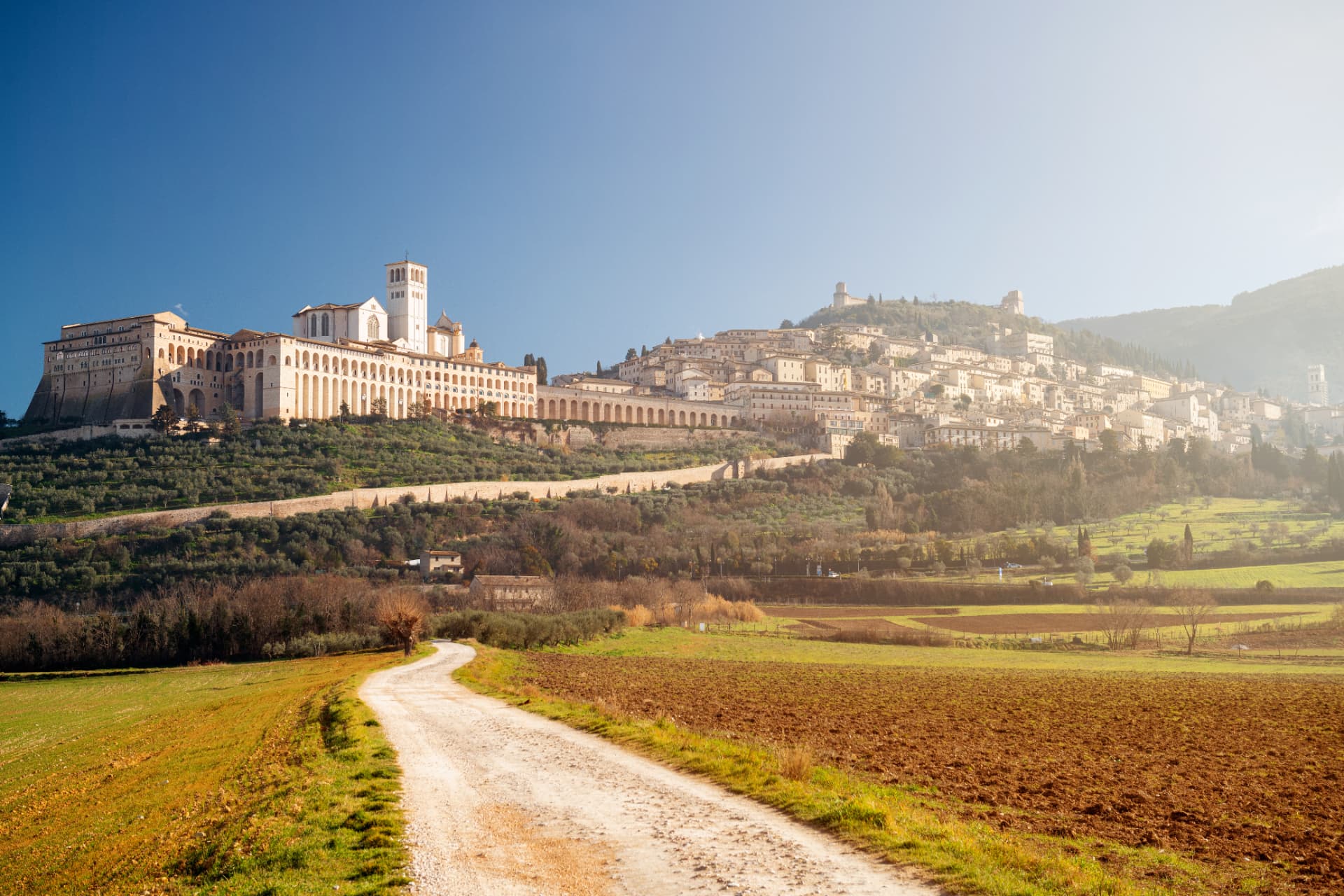
Verdict: Assisi is an excellent day trip from Rome, but it is not a simple one. The train takes around two hours and only some departures are direct; the station is in Santa Maria degli Angeli on the plain, so you finish the journey with a local bus or taxi up the hill. Go independently if you are confident with connections and want unhurried time in the Basilica of Saint Francis. Take a tour when you want Assisi combined with Orvieto, or when you would rather not manage trains, buses and a return buffer in one day.
Is Assisi worth a day trip from Rome?
For religious and historical travellers: unquestionably. Assisi is the birthplace of Saint Francis and one of the major pilgrimage destinations in Europe, and his tomb lies beneath the lower basilica. Even setting faith aside, the Saint Francis fresco cycle in the upper church — traditionally attributed to Giotto and his workshop — is a pivotal moment in Western painting.
For lovers of medieval towns: also yes. Pale stone streets, a Roman temple facade converted into a church on the main square, arches, staircases and long views over the valley from almost every terrace.
For casual sightseeing: think carefully. Four hours of travel for a town whose highlights take three or four hours is a long day, and the last stretch is on a local bus. If you want the fastest satisfying escape from Rome, Orvieto or Castel Gandolfo cost less time.
For slower travellers: stay overnight. Assisi often becomes quieter later in the afternoon as some day groups leave, and the evening — quiet streets, lit basilica, valley lights below — is an atmosphere day visitors often miss.
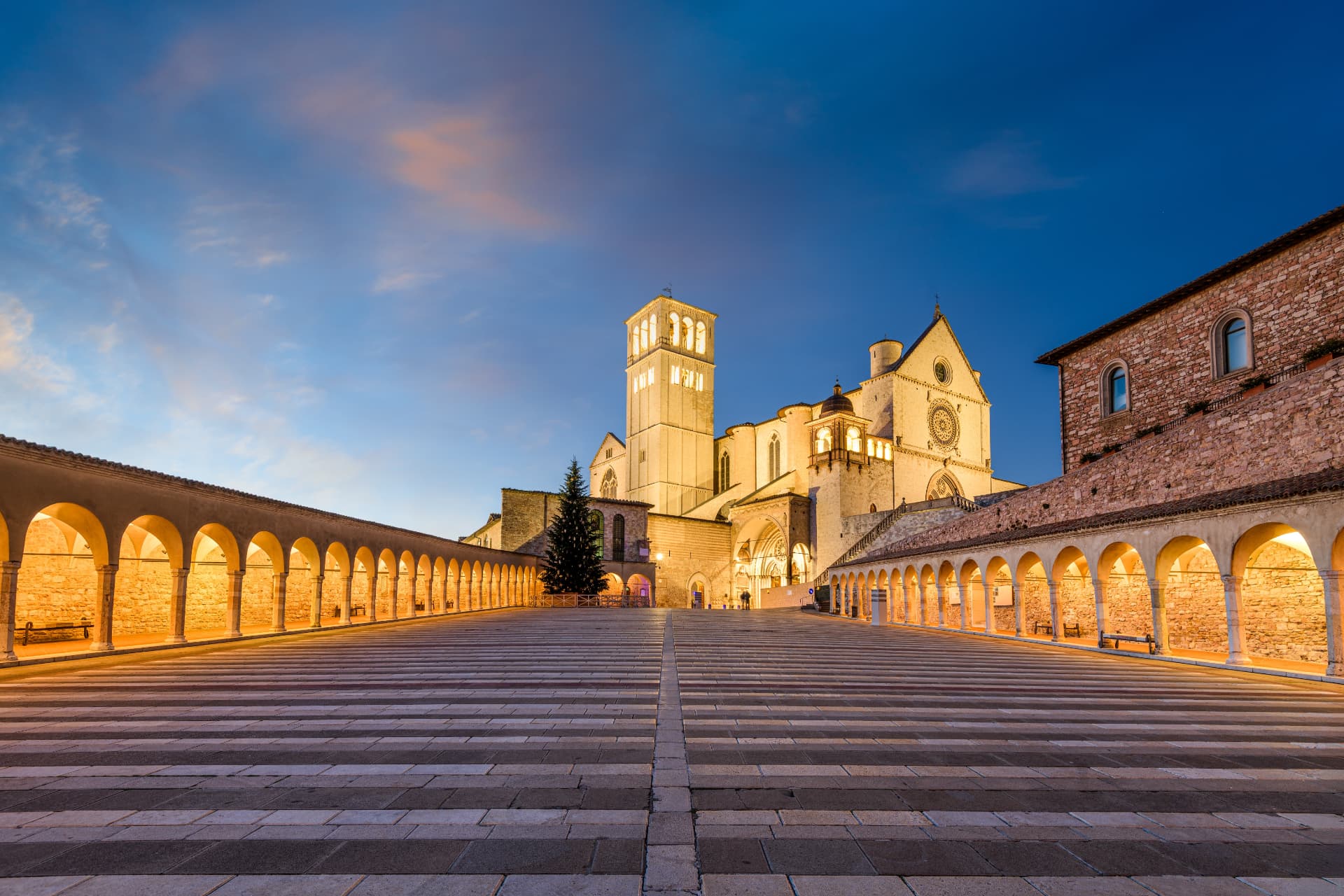
Assisi from Rome at a glance
| Option | Changes | Flexibility | Trip length | Best for |
|---|---|---|---|---|
| Independent train | Several stages — train, then local bus or taxi; sometimes a rail change | High | Full day | Confident travellers |
| Guided tour | Managed transport door to door | Lower | Usually 11–13 hours | Easiest logistics, often with Orvieto added |
| Overnight stay | Flexible | Highest | Two days | Slow travel, evenings and early mornings |
Checked September 2026. Confirm timetables with Trenitalia and tour durations with the operator.
How to get from Rome to Assisi by train
- Depart from Roma Termini. Some travellers can also board at Roma Tiburtina depending on the service. Check which of your options is direct before buying.
- Direct or connecting. Some trains run directly from Rome to Assisi in around two hours. Other practical itineraries require a change, usually at Foligno. There may be a useful direct morning departure, but direct services are limited and should not be assumed — search your exact travel date before buying, and take a direct outbound if one exists because it protects the whole day.
- Arrive at Assisi station, Santa Maria degli Angeli. This is the modern town on the plain, about 4 km below the hill town. The Basilica of Santa Maria degli Angeli, with the little Porziuncola chapel inside it, is about a 10-minute walk from the station. Allow at least 35–45 minutes for the walk, a short visit and the return, and do not add it before going uphill unless your train and bus connection leave a comfortable gap.
- Take the Assisi Link bus or a taxi up. The Assisi Link (line C) connects the railway station with the historic centre in approximately 10–20 minutes depending on the stop, traffic and waiting time, with stops near Piazza Matteotti and Porta Nuova. Buy or activate the ticket using an authorised retailer, the official digital channel or another method stated by Busitalia; check the current validation rules before boarding, because buying onboard, where permitted, may cost more. Taxis wait outside the station and make sense for a group.
- Plan the return backwards. Decide your Rome train first, then work back through the bus down. Aim to reach the railway station at least 30 minutes before your train, and preferably 40 minutes before an important final direct connection. Busitalia's 2026 timetable lists the station link roughly every 20 minutes Monday to Friday and every 15 minutes on Saturdays and holidays, but evening departures are fewer, so confirm the last useful connection and keep a taxi number to hand. Trenitalia also sells combined train-and-bus tickets for this route.
Independent trip or organised tour?
| Factor | Independent | Guided tour |
|---|---|---|
| Price | Two regional/Intercity fares plus a bus ticket — clearly cheaper | Higher, but transport, guide and often lunch are bundled |
| Journey complexity | Train, possible change, then bus at both ends | Coach from central Rome, no connections to manage |
| Time in Assisi | Typically 5–6 hours if you take an early train | Often 2–3 hours when Orvieto is also included |
| Guide | None unless you book one locally | Included — most valuable inside the basilica |
| Flexibility | Total: linger, eat properly, change plans | Fixed schedule and meeting points |
| Extra destinations | Hard to add by public transport | Orvieto, Umbrian hill towns and wine stops are common |
Best Assisi tours from Rome
Assisi and Orvieto in one day
The standard product, and the strongest reason to take a tour at all: two towns on different lines that are awkward to link by train. Expect roughly two to three hours in each, which is enough for the Basilica of Saint Francis and the centre of Assisi, plus Orvieto's cathedral — but not for a slow lunch in both.
Assisi with transport and guide
A single-destination coach day with a guided walk. You gain commentary in the basilica and lose the connections. Time on site is longer than on a two-town tour, typically most of the middle of the day.
Tours including lunch
Some Umbria excursions add a set lunch, occasionally with a wine tasting. Useful if you want the day fully handled; check whether the meal eats into sightseeing time rather than replacing a coach transfer.
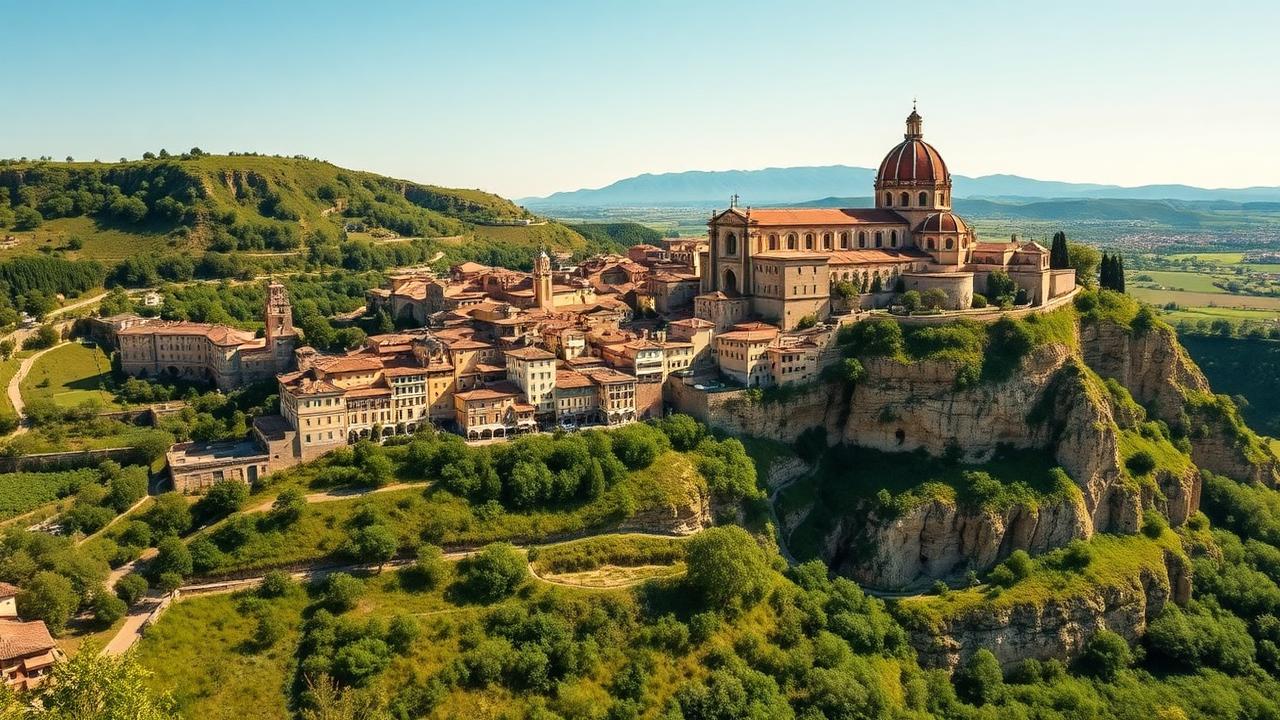
Affiliate link. You pay the same price and we may earn a small commission, which funds this site's research.
Best for simpler transport: a tour with round-trip travel included
Compare guided Assisi visits and day tours from Rome, including Assisi and Orvieto combinations, with live prices and departure dates. Entry to the Basilica of Saint Francis is free, so check what a tour actually includes: transport, guide, time on site and any extra stops.
Compare guided Assisi visits and day toursOne-day Assisi itinerary
This is a planning framework, not a timetable. Select the outbound and return trains first, then fit the Assisi itinerary between them.
| Stage | Suggested timing |
|---|---|
| Depart Rome | Approximately 07:00–08:00, direct if available |
| Reach Assisi station | Approximately 09:15–10:15 |
| Reach the historic centre | About 30 minutes after rail arrival, by Assisi Link bus or taxi |
| Basilica of Saint Francis | Allow 1.5 hours: lower church, the tomb, then the upper church frescoes |
| Via San Francesco and Piazza del Comune | 45 minutes, including the Temple of Minerva facade |
| Basilica of Saint Clare and valley terrace | 45 minutes |
| Lunch | About 1.5 hours — Umbrian pasta, lentils, torta al testo |
| Medieval lanes, San Rufino cathedral | 45 minutes if time allows |
| Optional: Rocca Maggiore | 60–90 minutes including the climb and ticket queue |
| Start the return to the station | 40–60 minutes before your train |
| Back in Rome | Usually early evening |
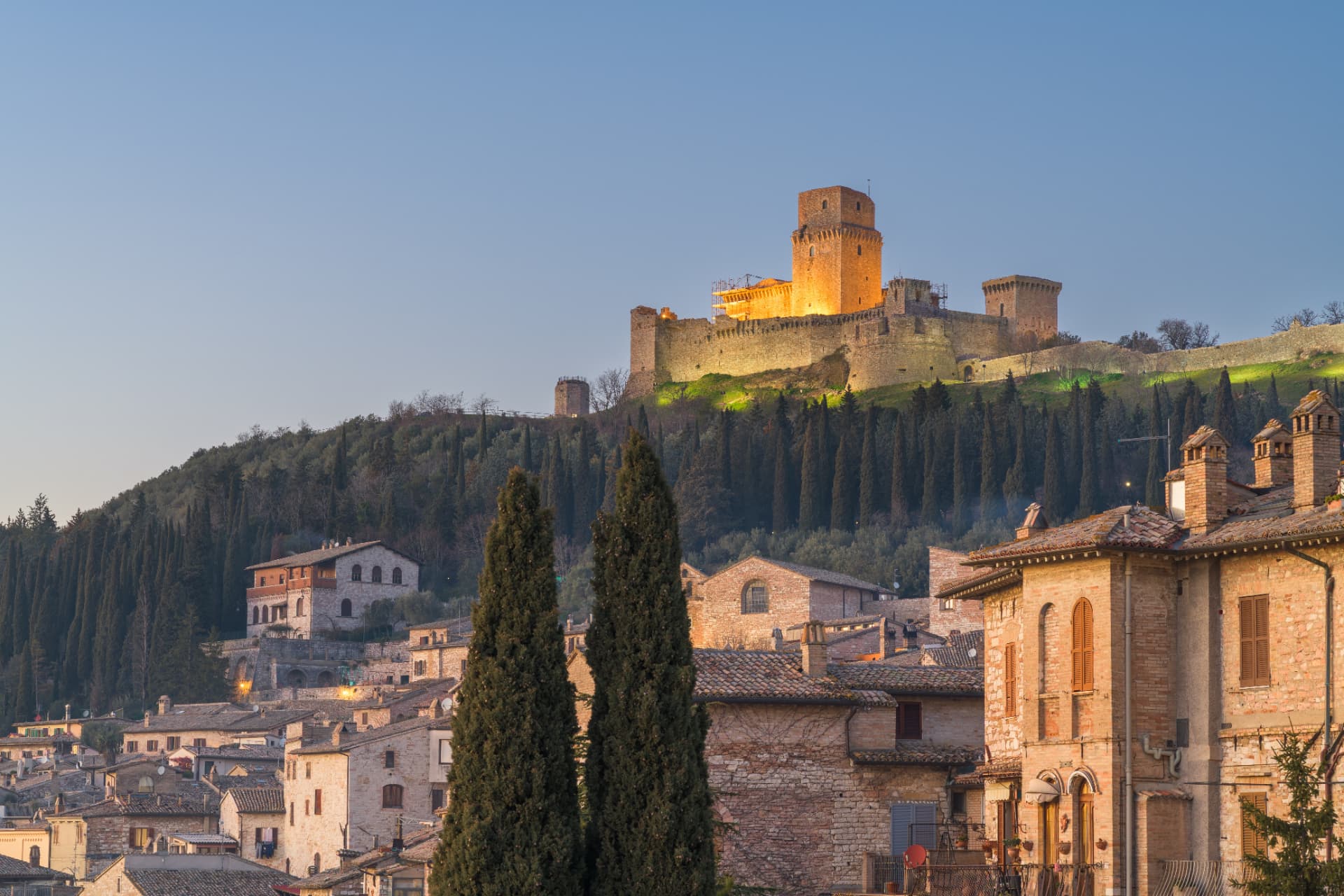
Rocca Maggiore: treat the fortress as an optional 60–90 minute addition. It is roughly 550 metres uphill from Piazza Matteotti, it is not accessible, and the ticket office closes well before the fortress itself. Skip it if your return bus leaves within the next 90 minutes, or swap it for a nearby terrace viewpoint.
Sundays and religious holidays: this schedule is easiest on an ordinary weekday. On Sundays and major religious holidays, Masses can significantly restrict tourist access to parts of the churches. Church opening hours and guided-visit or audio-guide hours are listed separately on the official site, so check both. 2026 is also a Franciscan centenary year, with special celebrations that can change access on particular dates. Check the basilica's official calendar for your exact date before fixing the itinerary.
Basilica of Saint Francis visiting information
Admission. Entry to the basilica is free — it is a working church and a pilgrimage site, not a museum. Donations are welcomed, and paid guided tours or an audio guide can be arranged separately if you want the frescoes explained.
Dress and behaviour. Shoulders and knees covered, hats off, phones silent, voices low. Pilgrims pray at the tomb of Saint Francis in the crypt throughout the day; keep moving there and do not treat it as a photo stop.
Security. Expect bag checks at the entrances, and note that large rucksacks may not be admitted. Allow a few extra minutes in high season.
Services. Mass and other liturgies take place daily, and parts of the church close to visitors during them. Quieter periods are often found early or later in the day, but liturgies take priority and can restrict visitor access.
Photography. Photography and filming rules are strictly controlled and can vary by area. Follow the current signs and stewards; do not use flash or tripods, and be prepared for photography to be prohibited.
Opening hours differ between the upper church, lower church and crypt and change seasonally — verify before travelling; checked September 2026.
Can you combine Assisi and Orvieto independently?
Technically yes, practically no. The two towns sit on different lines — Orvieto on the Rome–Florence route, Assisi on the Umbrian line through Foligno — so linking them by rail in a day means a long cross-country connection, and both towns require a further climb from the station once you arrive.
By the time you had done all that, you would have perhaps 90 minutes in each place and no margin for a delay. This is precisely the gap an organised coach day fills, which is why Assisi with Orvieto is one of the commonly offered combined excursions from Rome. Independently, choose one and do it properly.
Assisi or Orvieto: which should you choose?
| If you care about… | Choose | Why |
|---|---|---|
| Religious significance | Assisi | Tomb of Saint Francis and a major pilgrimage destination |
| Art and architecture | Both — Assisi for the Giotto-associated frescoes | Orvieto's cathedral facade against Assisi's fresco cycles |
| Simple transport | Orvieto | Direct train, then a short ride up; Assisi needs a bus from the plain |
| Relaxed pace | Orvieto | Smaller, flatter on top, easy to finish in a day |
| Food and wine | Orvieto | Its own wine region and a strong lunch culture |
| Views | Assisi | Terraces and the Rocca Maggiore over the whole Umbrian valley |
Read the alternative in full in our Orvieto day trip guide.
Frequently asked questions
Is there a direct train from Rome to Assisi?
Some trains run directly from Rome to Assisi, typically taking around two hours. Other practical itineraries require a change, usually at Foligno. There may be a useful direct morning departure, but direct services are limited and should not be assumed — search your exact travel date on Trenitalia before building the itinerary.
How much is the train from Rome to Assisi?
Regional and Intercity fares vary by service, date and booking conditions, and cheaper advance fares are sometimes available on faster services. Check the exact journey on Trenitalia rather than relying on a permanently quoted price.
How do you get from Assisi station to the old town?
The station is in Santa Maria degli Angeli on the plain, about 4 km below the hill town. The Assisi Link bus (line C) connects the railway station with the historic centre in approximately 10–20 minutes depending on the stop, traffic and waiting time. Buy or activate the ticket using an authorised retailer, the official digital channel or another method stated by Busitalia, and check the current validation rules before boarding; buying onboard, where permitted, may cost more. Taxis wait outside the station and are the fastest option if a group splits the fare.
Where does the station bus stop in the old town?
The usual stops for visitors are near Piazza Matteotti at the top of the town and near Porta Nuova at the eastern end; some services also stop near Largo Properzio. Our itinerary starts at the Basilica of Saint Francis and climbs east through the town, so ask for the stop nearest the basilica if your service has one. If you would rather walk downhill all day, get off at Piazza Matteotti and follow the same stops in reverse order.
What is the last useful train from Assisi to Rome?
Late services exist but the practical last departure depends on your date, whether it is direct and how late the local bus down from the hill town runs. Choose your return train first, confirm the last bus connection that reaches the station comfortably before it, and keep a taxi number to hand as a fallback.
Is one day enough for Assisi?
One day covers the Basilica of Saint Francis, the Basilica of Saint Clare, Piazza del Comune and the medieval streets in between with time for lunch. That is the town's core. What you lose is the evening, when most day groups have gone — which is why many travellers who care about the place stay overnight.
Is Assisi accessible for people with limited mobility?
Partly. The lower town, the basilica precinct and the main squares can be reached by bus or taxi, and the basilica itself has step-free routes to parts of the church, but the town is built across a steep hillside with cobbles, steps and continuous gradients between sights. Rocca Maggiore is not accessible. Plan short bus or taxi hops between the main points rather than walking the full length of the town.
Is Assisi very hilly?
Yes. The town is built across a hillside and almost every street either climbs or descends, with steps and steep cobbled lanes between the main sights. The walk from the Basilica of Saint Francis up to Piazza del Comune is a consistent climb. It is manageable at a slow pace, but not flat in any part.
Can you visit Assisi and Orvieto in one day?
Not comfortably by public transport — the two towns sit on different lines and both need a further climb from the station. An organised coach day is the realistic way to combine them, and even then you should expect roughly two to three hours in each town rather than a relaxed visit.
Do you need a guided tour for Assisi?
Not for the transport if you are a confident independent traveller — the train and local bus work. A guide adds most value inside the Basilica of Saint Francis, where the Saint Francis fresco cycle traditionally attributed to Giotto and his workshop rewards explanation, and an organised tour makes real sense when you want Assisi combined with Orvieto in one day.
Can non-religious travellers enjoy Assisi?
Very much so. The Basilica of Saint Francis holds one of the most important fresco cycles in European art, the medieval hill town is beautifully preserved, and the views across the Umbrian valley are the reason many people remember the day. Treat the churches as active places of worship and you will be entirely welcome.
Sources and further reading
- Basilica of Saint Francis — official site
- Basilica visitor and audio-guide information
- Assisi official tourism information
- Busitalia — Assisi Link bus, tickets and validation rules
- Trenitalia journey planner and fares
- Comune di Assisi — Rocca Maggiore visitor information
Fact-checked by the AllTrips Rome editorial team against official visitor information. Timetables, fares and basilica hours change — confirm your exact date before travelling. Checked September 2026.