Civita di Bagnoregio Day Trip From Rome Without a Car
Published · Updated · 12 min read · By the AllTrips Rome editorial team
Sundays and public holidays
Do not attempt this trip independently until you have confirmed an outbound and return Cotral bus. The Orvieto–Bagnoregio connection generally operates Monday to Saturday, and a regular Sunday service may not operate at all rather than simply running less often. A tour, rental car or private transfer is usually safer on Sundays and public holidays.
Verdict: yes, you can reach Civita di Bagnoregio from Rome without a car — train to Orvieto, then a regional bus to Bagnoregio, then the bridge on foot. But the bus is infrequent, the last useful return leaves earlier than you expect, Sunday service is the main risk (see the box above), and one missed connection reshapes the whole day. If you want certainty, or you want Civita combined with Orvieto and a Tuscan hill town, an organised tour is genuinely the easier product here rather than just the lazier one.
Can you visit Civita di Bagnoregio without a car?
- Yes — no car is required at any stage, and the final approach is pedestrian-only for everyone.
- It usually takes a train plus a bus: Rome to Orvieto by rail, then the Cotral bus to Bagnoregio.
- Services are limited. The bus runs a handful of times a day, largely Monday–Saturday. Check both directions for your date on the official Cotral journey planner before buying the Rome–Orvieto train.
- A tour is the easiest way to combine Civita with several destinations, especially Montepulciano or a winery. Civita and Orvieto can sometimes be combined independently Monday–Saturday, but only when the Cotral timetable provides workable connections.
Rome to Civita di Bagnoregio at a glance
| Option | Journey | Flexibility | Best for |
|---|---|---|---|
| Train and bus | Roughly 2.5–3 hours each way via Orvieto, tied to a sparse Monday–Saturday bus timetable | Low — the bus decides everything | Budget travellers combining Civita with Orvieto on a weekday |
| Organised tour | Coach door to door, typically 11–12 hours including other stops | Low but predictable | Most visitors, Sundays and holidays, and adding Montepulciano or a wine lunch |
| Rental car | About 2 hours each way, parking in Bagnoregio | Highest | Confident drivers touring northern Lazio |
| Private transfer | Direct, on your schedule | High | Families or small groups splitting a high fixed cost |
Checked September 2026. Always verify current Trenitalia and Cotral timetables for your exact date.
How to get from Rome to Civita di Bagnoregio by public transport
- Rome to Orvieto by train. From Roma Termini, direct Intercity services take about 1h15 and regional trains up to roughly 1h45. Orvieto is the standard gateway; Viterbo also has bus links towards Bagnoregio but they are less convenient for a day trip from Rome. Take an early departure — this is not a day with spare capacity.
- Orvieto to Bagnoregio by bus. Allow approximately one hour for the Cotral journey, but check the selected departure because routing and journey time vary. Search the precise departure stop shown in the Cotral results: some services use the railway-station area at Orvieto Scalo, while timetable results may display other Orvieto stop names such as Piazza Cahen, Piazza Matteotti or Piazza d'Armi. Do not assume every departure leaves directly outside the station. Check Cotral's current purchase methods before travelling and buy through an authorised retailer or supported digital channel when possible; do not assume the driver will sell the correct ticket onboard.
- Bagnoregio to the Civita viewpoint. From the main Bagnoregio arrival area, the final approach can involve approximately 1.3 kilometres before the bridge, depending on your bus stop and whether you use the local shuttle. An urban shuttle connects Piazzale Battaglini with Piazza Alberto Ricci at the Belvedere; its timetable changes, so check the current schedule, and if it does not align, allow time to walk.
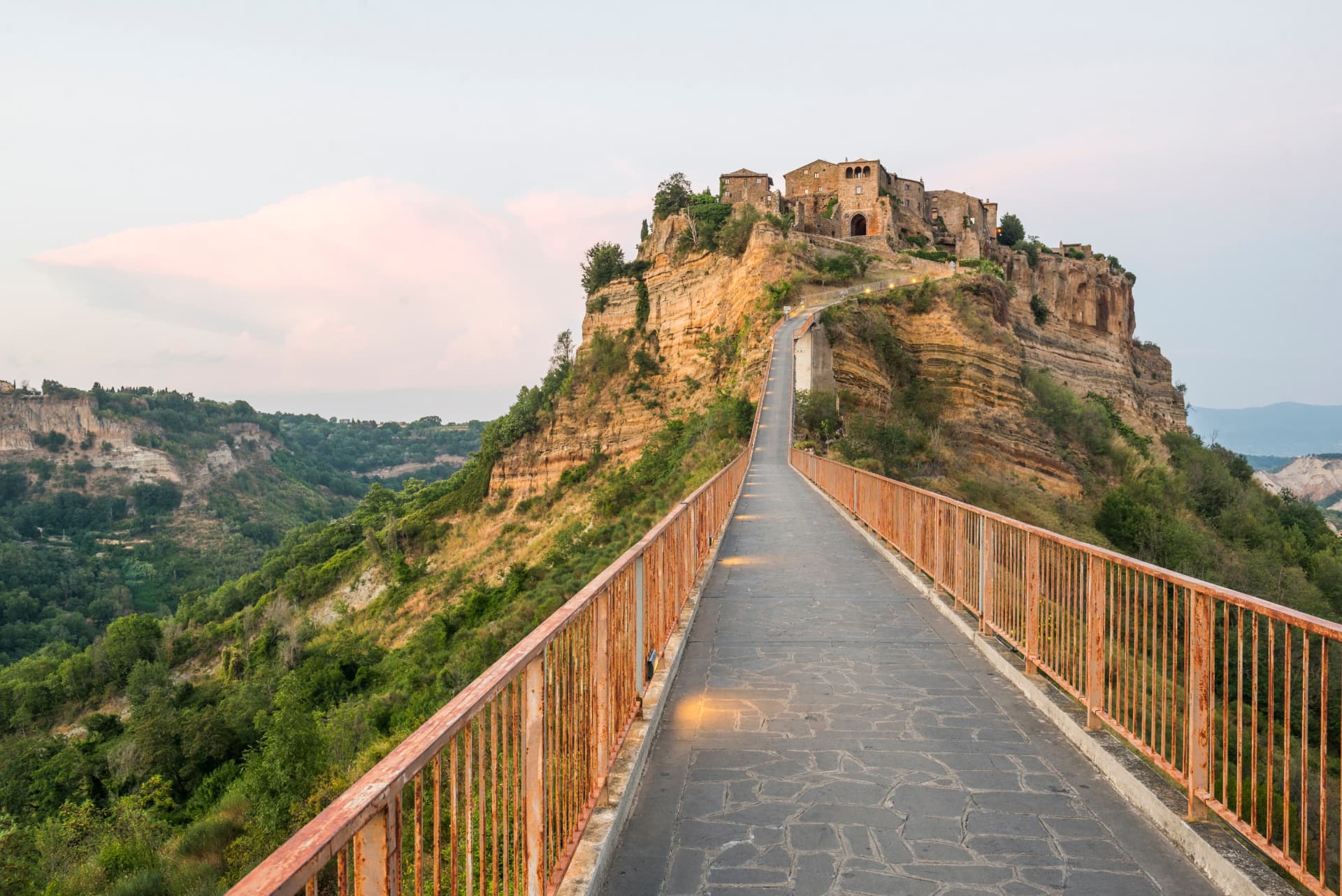
- The pedestrian bridge. Around 300 metres of exposed concrete ramp, climbing steadily to the village gate — 10–15 minutes, longer with stops for photographs. Admission is collected near the bridge (see below).
- The return. Reverse the whole chain, and start from the bus you must catch rather than the time you would like to leave.
Total door to door: roughly two and a half to three hours each way from central Rome, assuming the connections align. They do not always align.
Plan the day in this order
The return Cotral service is the first booking decision, not the Rome train.
- Search Roma Termini → Orvieto on Trenitalia to see what the day could look like.
- Search Orvieto → Bagnoregio on Cotral for your exact date.
- Search Bagnoregio → Orvieto before confirming anything.
- Confirm the exact stop names at both ends, in both directions.
- Check the urban shuttle between Piazzale Battaglini and the Belvedere.
- Add at least 45–60 minutes between leaving Civita and the Cotral departure.
- Only then buy the Rome–Orvieto train.
Why the return journey matters more than the outbound
Getting there is easy to arrange: pick an early train, take the first bus, arrive. Getting back is where trips fail. The Bagnoregio–Orvieto bus runs only a few times a day, the last useful departure is often mid or late afternoon rather than early evening. Miss it and there is no fallback except an expensive taxi.
Plan backwards. Find the last Bagnoregio departure that connects with a train you are happy to take from Orvieto, then leave Civita at least 45–60 minutes before that bus. That allows for the bridge, the uphill and downhill sections, the walk or shuttle through Bagnoregio and locating the correct return stop. For an important final bus, an hour is safer. Whatever is left is your time in Civita — usually two to three hours, which is enough.
Two extra habits: photograph the printed timetable at the stop when you arrive, and confirm the bus stop for the return with the driver or a local, because the outbound drop-off and the return stop are not always the same place.
Best Civita di Bagnoregio tours from Rome
Civita with Orvieto, Montepulciano or a wine stop
The fullest version of the day and the one that solves the transport problem completely: a village with no station, a hill town above a cliff and a Tuscan wine town, none of which link well by bus. Expect roughly two hours in Civita, with the rest split between the other stops and lunch or a tasting. Itineraries vary by operator and date, so check which towns are actually included.
Civita and Orvieto combinations
A shorter, cheaper coach day covering the two places that can also work independently on a weekday. Typically around two hours in Civita and two to three in Orvieto. Worth it mainly for the guaranteed connections and the guide — and the simplest option on a Sunday if you have no car.
Tours with lunch or wine included
Umbria and southern Tuscany excursions often bundle a set lunch or a cellar tasting. Check whether that time is additional or comes out of the sightseeing stops — in Civita, an hour makes a real difference.
Affiliate link. You pay the same price and we may earn a small commission, which funds this site's research.
Best for the easiest day, and the simplest car-free option on a Sunday
Compare full-day tours that combine Civita with Orvieto, Montepulciano or a wine-country stop, with live prices and departure dates.
Compare Civita di Bagnoregio tours from RomeFor each tour, check before you book:
- Whether Civita admission is included or excluded
- How long the coach actually stops in Civita
- Whether Orvieto Cathedral admission is included
- Lunch versus a tasting, and whether it replaces sightseeing time
- Whether the guide accompanies visitors at every stop
- Total walking, and whether the bridge is suitable for everyone in your group
- The departure location in central Rome


 1234+− Leaflet | © OpenStreetMap contributors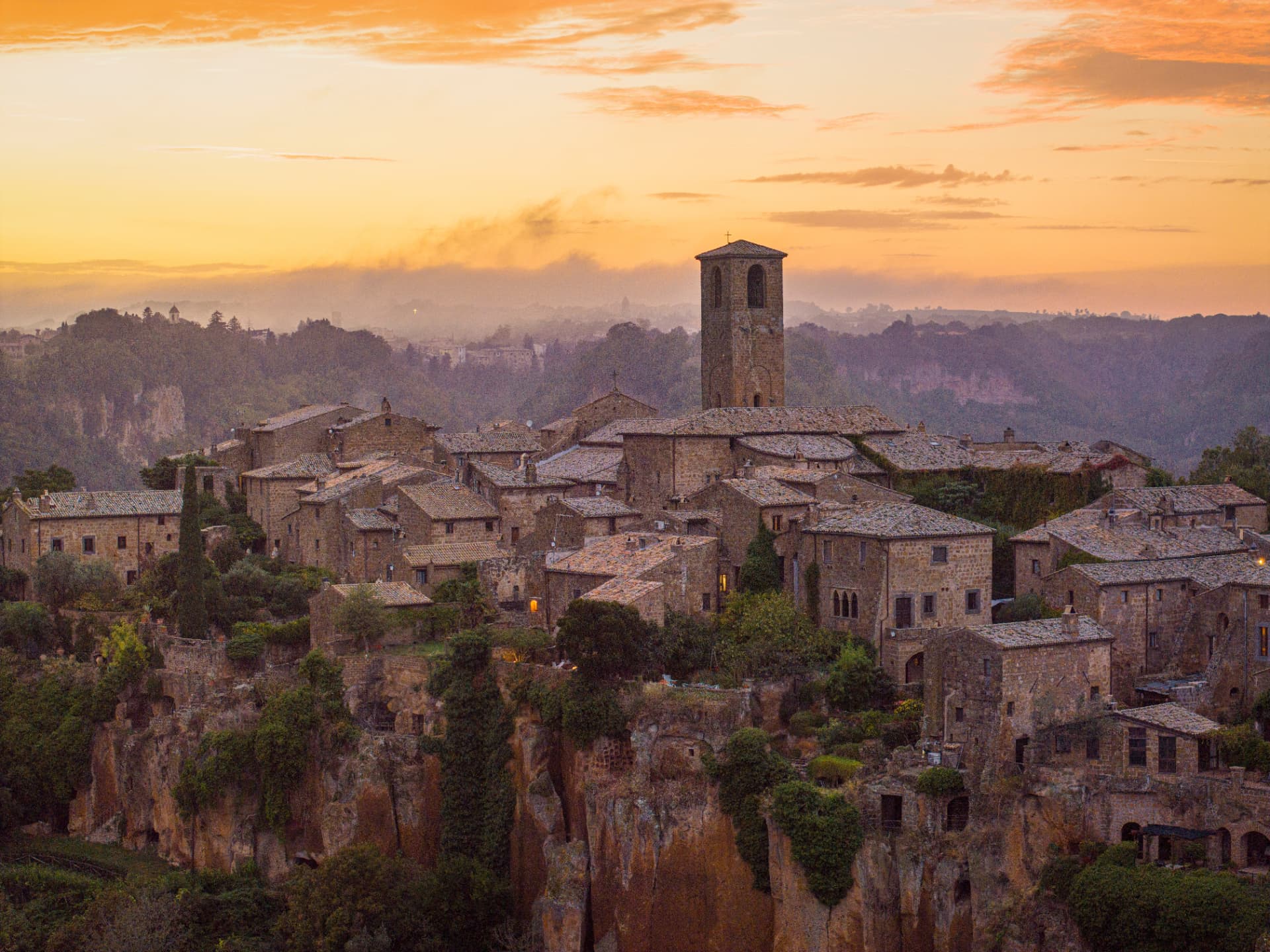
The Civita entrance fee, and what tours include
General admission to Civita di Bagnoregio currently costs €5. Tickets can be purchased online or at the ticket office near the bridge — holders of online tickets can go straight to the bridge entrance. Check the official ticket page for current exemptions and any temporary changes.
If travelling with a tour, check whether admission is included; it is the item most often omitted from tour descriptions.
Before booking any tour, check what is actually included:
- Village admission — stated explicitly rather than implied.
- Transport — round-trip coach, and whether the pick-up point is central.
- Lunch — included set menu, a tasting, or free time to buy your own.
- Guide — a licensed guide throughout, or an escort who leaves you free on site.
- Additional tickets — Orvieto Cathedral, the underground tour or a winery visit are often extra.
Prices and inclusions change; verify at the time of booking — checked September 2026.
What to do in Civita di Bagnoregio
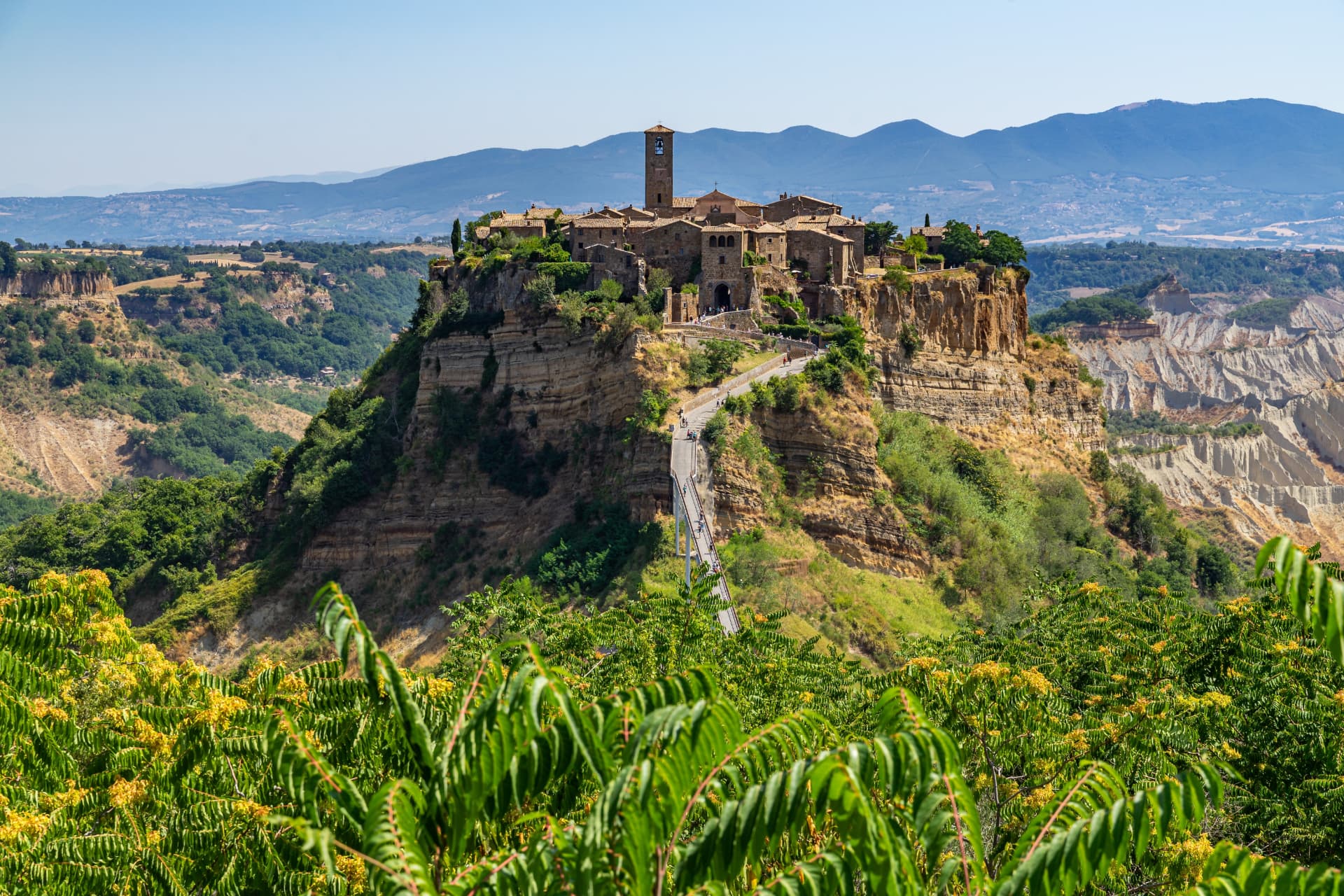
Be clear about the scale: Civita is a few streets on a rock, home to a very small number of permanent residents. You are not going for a list of attractions — you are going for a place and a landscape.
- The pedestrian bridge. The approach is the experience; stop halfway and look back.
- Piazza San Donato. The main square, unpaved in parts, with the church of San Donato on one side.
- The church. Simple, cool and quiet, with a handful of frescoes and a wooden crucifix.
- Viewpoints at the village edge. Terraces looking straight down into the eroded calanchi valleys — the best of them are at the far end, past the square.
- The lanes and gardens. Ten minutes end to end, with cellars, a small museum or two and craft shops in old stables.
- The geology. The tufa pillar is slowly eroding, which is why Civita is called "the dying town" — the crumbling edges are visible from every terrace.
How much time do you need?
Two to three hours in the village area is plenty for most visitors: the bridge in both directions, a slow loop of the lanes, the viewpoints, and lunch or a coffee. Photographers and anyone wanting to linger over the calanchi could use four.
The honest arithmetic is that transport takes longer than the visit — five to six hours travelling for two or three on site. That is not a reason to skip it, but it is a reason to pair Civita with Orvieto rather than treat it as a standalone destination.
Is Civita suitable for children or limited mobility?
With children
Many school-age children can manage the bridge, but suitability depends on heat, fitness and comfort with the exposed crossing, and carrying a tired child back uphill can be difficult. With toddlers it is harder still: the bridge is long, pushchairs are heavy going on the ramp and on cobbles, and there is no shade en route.
With limited mobility
Difficult. The bridge is the only visitor access, no visitor vehicles enter the village, and the ramp climbs continuously before you reach steps and steep lanes inside. The urban shuttle can reduce the walk through Bagnoregio, but it does not eliminate the steep pedestrian bridge into Civita. Many travellers with mobility limits enjoy the view from the Belvedere in Bagnoregio instead — which is, in fairness, the famous view.
In July and August, heat is the main constraint for everyone. Cross before 11:00, or late afternoon only if your return bus and train still leave time, carry water, and remember there is no shelter on the bridge. The local visitor operator advises people with heart conditions or significant health limitations to avoid the bridge, particularly during the hottest hours.
Civita or Orvieto?
| Factor | Civita | Orvieto |
|---|---|---|
| Ease from Rome | Train plus a sparse Monday–Saturday bus, then a walk | Direct train, short ride up |
| Things to see | One square, a church, viewpoints | Cathedral, underground city, St Patrick's Well, museums |
| Visual impact | One of northern Lazio's most distinctive views | Beautiful, but more conventional |
| Comfortable visit | 2–3 hours including the bridge | Half day to full day |
| Verdict | Go for the approach and the landscape | Go if you want a complete day out |
Combining the two independently can work on selected Monday–Saturday dates. Build the day around the Cotral bus first; the timetable will determine whether Civita or Orvieto must come first. Our Orvieto day trip guide covers the second half.
Frequently asked questions
Can I visit Civita di Bagnoregio on Sunday without a car?
Do not assume so. The Orvieto–Bagnoregio Cotral route may not operate on Sundays. Check both directions for your exact date before purchasing train tickets; otherwise use a tour, rental car or private transfer.
Can you take a direct train to Civita di Bagnoregio?
No. Civita has no railway station, and ordinary visitor access is on foot across the pedestrian bridge — authorised service or emergency arrangements should not be treated as visitor transport. The nearest useful railway station is Orvieto, from where a Cotral bus runs to Bagnoregio, the modern town next door.
How much does it cost to enter Civita di Bagnoregio?
General admission currently costs €5. Tickets can be purchased online or at the ticket office near the bridge. Check the official ticket page for current exemptions and any temporary changes.
How long is the bridge to Civita?
Around 300 metres, rising steadily to the village gate. It is concrete, fully exposed with no shade, and open to the wind. Most people cross it in 10–15 minutes at an unhurried pace; in July and August, do it early or late rather than at midday.
Is Civita crowded?
It can be. The village has only a handful of permanent residents but receives a large number of visitors, concentrated on weekends, holidays and the middle of the day when coach groups arrive. Early morning and late afternoon are noticeably quieter.
Is Civita worth the transport effort?
For the view, yes — the approach across the bridge to a village standing alone on an eroding pillar of tufa is genuinely unlike anywhere else in Italy. For the village interior, expect a small, pretty place you can walk in an hour. Combine it with Orvieto or a tour and the day is well spent; spend five to six hours travelling for Civita alone and some visitors feel short-changed.
Can Civita and Orvieto be combined?
Sometimes, on selected Monday–Saturday dates: train to Orvieto, bus to Bagnoregio, a few hours in Civita, then back to Orvieto for the cathedral before your evening train. Build the day around the Cotral bus first — the timetable, not the sightseeing, decides whether it works and which town has to come first.
What happens in bad weather?
The bridge is exposed and unpleasant in heavy rain or strong wind, and access can be restricted in severe conditions. Fog is common in the valley in autumn and winter — which can be spectacular, since the village appears to float above the cloud, but it also hides the view entirely. Check the forecast; the trip is largely about the landscape.
Sources and further reading
- Cotral timetable search — Orvieto to Bagnoregio, both directions
- Civita di Bagnoregio official destination site — arrival and urban shuttle information
- Official Civita di Bagnoregio visitor information in English (€5 admission)
- Trenitalia journey planner — Rome to Orvieto
Fact-checked by the AllTrips Rome editorial team against official visitor and transport information. Bus timetables, shuttle schedules and admission prices change — confirm your exact date before travelling. Checked September 2026.