Tuscany Day Trip From Rome: Best Towns and Tours
Updated · 12 min read · By the AllTrips Rome editorial team
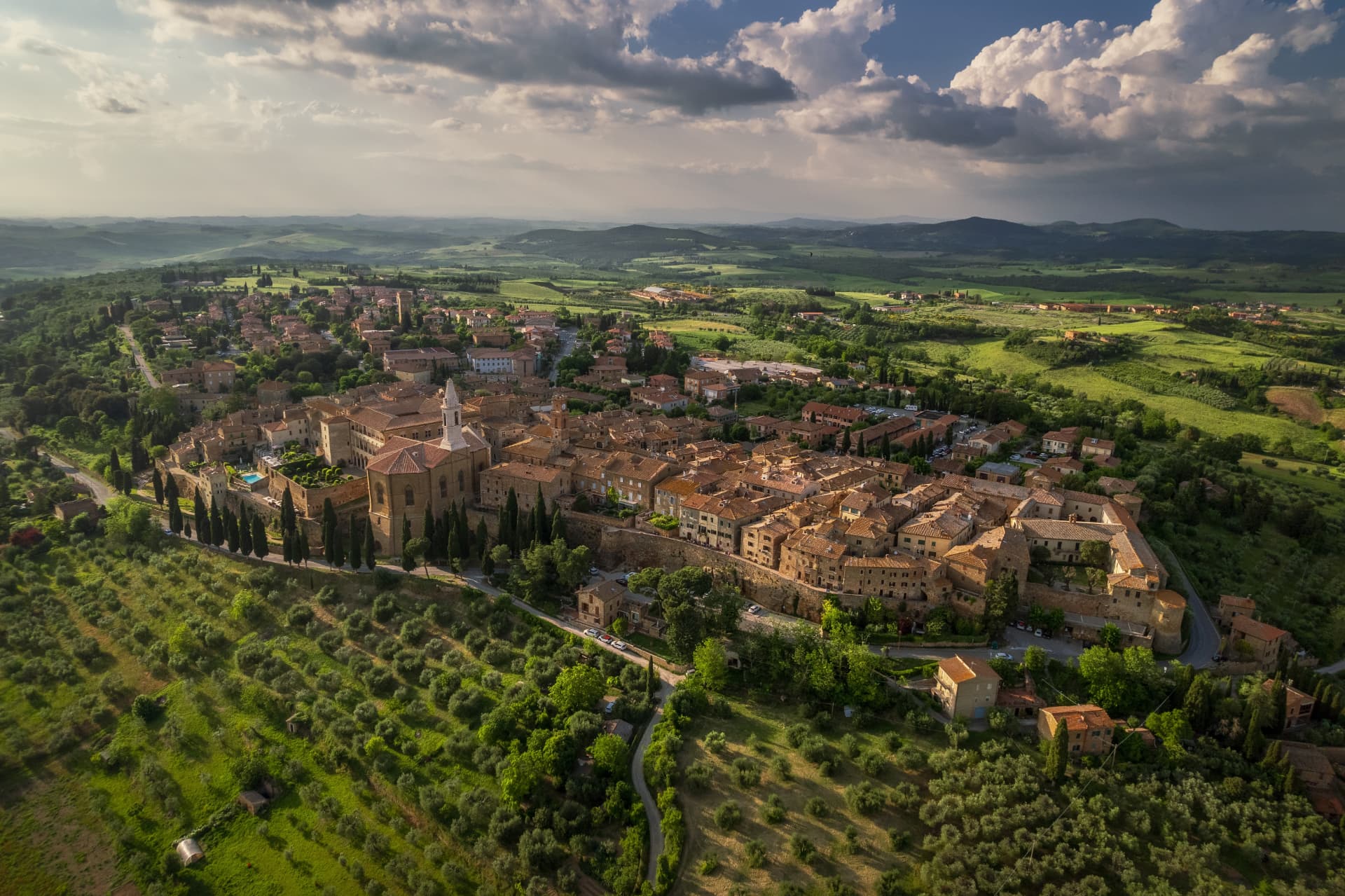
Tuscany is not an attraction, and that is the first thing to get straight. It is a region roughly the size of Wales, and from Rome you can reach a thin southern slice of it or one city at the end of a fast train. So the real question is not "can I do Tuscany in a day" but "which Tuscany". Florence by train, a hill town like Montepulciano by coach, or a countryside-and-wine day in the Val d'Orcia — three different trips, and choosing wrongly is what makes people come back disappointed.
Where these places actually are
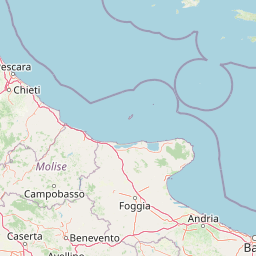
Florence sits far to the north on the high-speed rail line — a trip of its own. The hill towns and the Val d'Orcia lie much closer to Rome but off the fast lines, which is why they are usually done by tour or car. Chiusi–Chianciano Terme is the useful rail gateway for the southern hill towns.
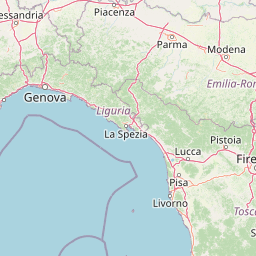
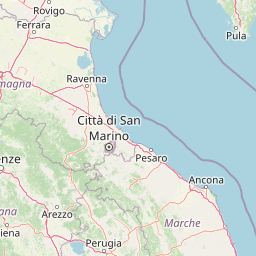
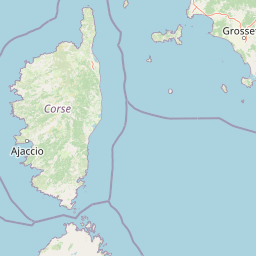
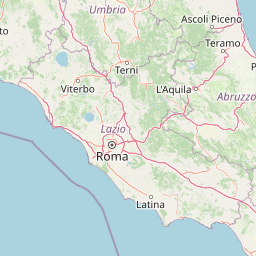
 123456+− Leaflet | © OpenStreetMap contributors
Pins are placed approximately, and the orange line only connects the pins in order — it is not a travel route. Florence is a separate rail day; the southern towns cluster together for a tour or driving day.
Can you visit Tuscany from Rome in one day?
Yes — a limited part of it. The southern border of Tuscany is about two hours' drive from Rome, which puts the Val d'Orcia and the nearby hill towns within reach of a long coach day. Pienza sits in the Val d'Orcia itself; Montepulciano stands on the ridge along its eastern edge, between the Val d'Orcia and the Valdichiana. They are close neighbours on a tour route rather than interchangeable Val d'Orcia towns. Florence, though further north, is the easiest destination of all because the high-speed line covers the distance in around 90 minutes.
What is not realistic in one day from Rome: Chianti and Florence together, several hill towns at a relaxed pace, Siena and San Gimignano without spending most of the day in a seat, or combining the Tuscan coast with Florence or the inland hill towns. The coast itself is not categorically out of reach — the southern Maremma, on the rail line towards Orbetello and Capalbio, is a separate kind of day and a different trip from the one this guide describes. Pick one shape of day and commit to it.
Best Tuscany day trips from Rome compared
| Destination | Best transport | One-way time | Complexity | Best for |
|---|---|---|---|---|
| Florence | High-speed train | About 1h30 | Low | Art, architecture, first-timers |
| Montepulciano | Organised tour | Roughly 2h–2h30 by road | High without a car | Hill-town atmosphere and Vino Nobile |
| Pienza | Organised tour or car | Roughly 2h30 by road | High without a car | Renaissance townscape, pecorino cheese, views |
| Siena | Tour, or train with a change | About 3h by rail | High | Travellers determined to see the Campo and Duomo |
| Val d'Orcia | Organised tour or car | Roughly 2h30 by road | Impractical by public transport in one day | Landscape, photography, slow scenery |
| Countryside wine tour | Organised tour | Roughly 2h–3h by road | Handled for you | Food and wine over sightseeing |
Journey times checked 25 September 2026 and vary with traffic and departure point.
Florence by train vs Tuscan countryside by tour
This is the decision the rest of the day hangs on. They are not variations of the same trip; they are opposites.
Florence by train gives you control and time: eight to ten hours in one place, no coach, no group, and you control the sightseeing schedule — though your train is tied to a departure, so check your fare's change conditions. What you get is urban — galleries, churches, streets, restaurants. What you do not get is a single field, cypress or vineyard. Full details are in our Florence day trip guide.
The countryside by tour gives you the Tuscany of the postcards, which is hard to reach by public transport: the core Val d'Orcia towns have no useful direct rail service. A rental car or a private driver are the alternatives. On a standard coach tour you accept five to six hours in a seat, fixed stop lengths (60 to 90 minutes is a common example, but it varies by tour) and a schedule set by someone else.
Rule of thumb: first visit to Italy, or interested in art — take the train to Florence. Been to Florence already, or here for the landscape and the wine — book the countryside tour.
Tour formats to compare
These are formats rather than named products. Stop lengths, towns visited, tastings and inclusions vary from operator to operator, so treat the times below as typical examples and confirm them on the specific product page before booking. If wine is your priority, read our Tuscany wine day trip from Rome comparison for the differences between Montepulciano, Pienza and Val d’Orcia tours, actual tasting arrangements and lunch inclusions. This broader guide focuses on choosing your destination.
Montepulciano and Pienza
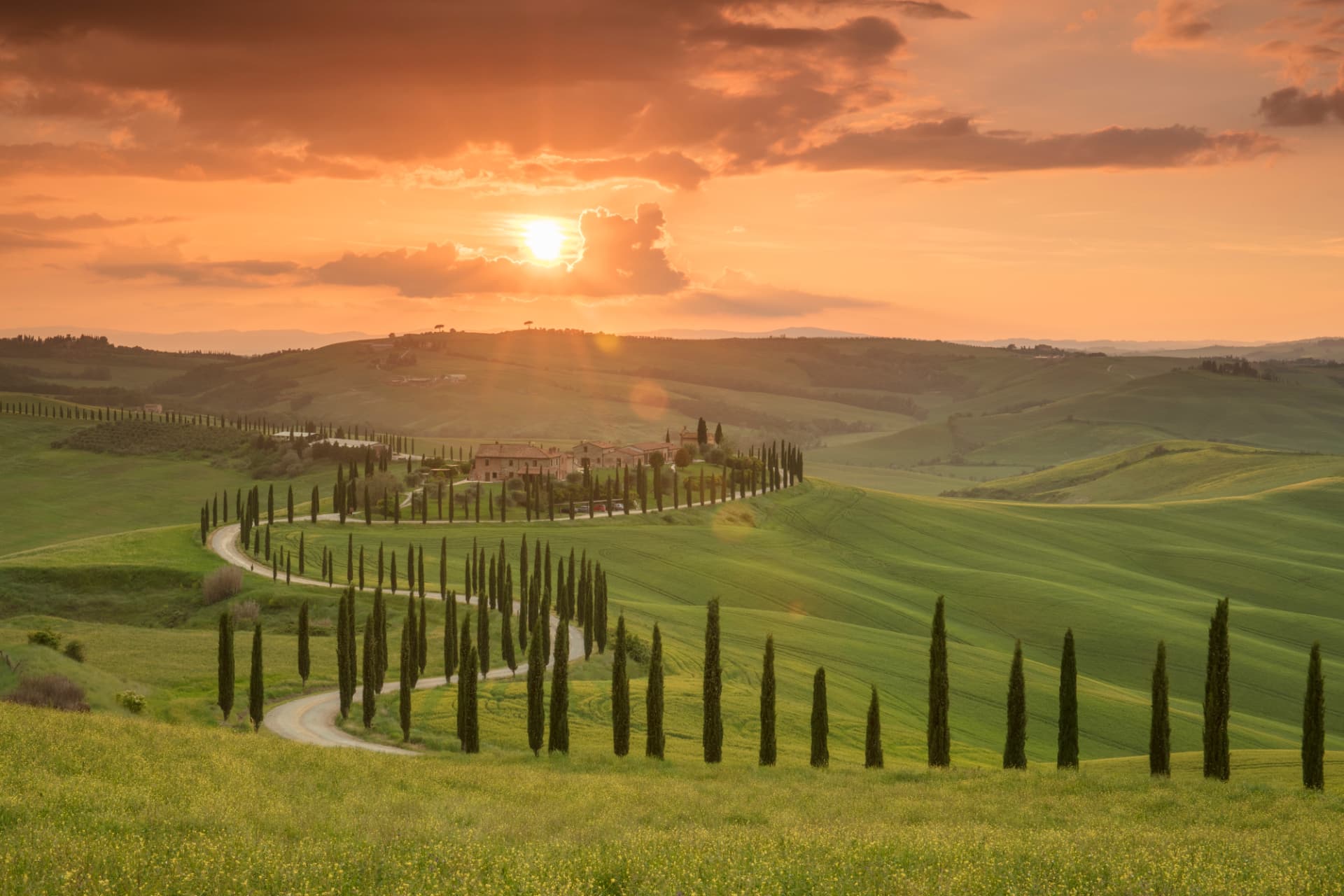
The most common southern Tuscany pairing. Two hill towns around 20–25 minutes apart by road, both walkable: Pienza in the Val d'Orcia, Montepulciano on the ridge at its eastern edge. Around 90 minutes in each is a common example — enough for the main square, a church and a shop, not enough to wander far.
Val d'Orcia landscape day
Built around the scenery itself: photo stops at the classic cypress rows and farmhouses, plus a stop in one or two villages. Best in late spring, when the hills are green, or September, when the light is long and the harvest is on.
Tours including lunch
Worth paying for in the countryside, where independent options are limited and a coach schedule leaves little time to find a restaurant. A farmhouse lunch with local pecorino, pici pasta and cured meats is often the best hour of the day.
Wine tasting tours
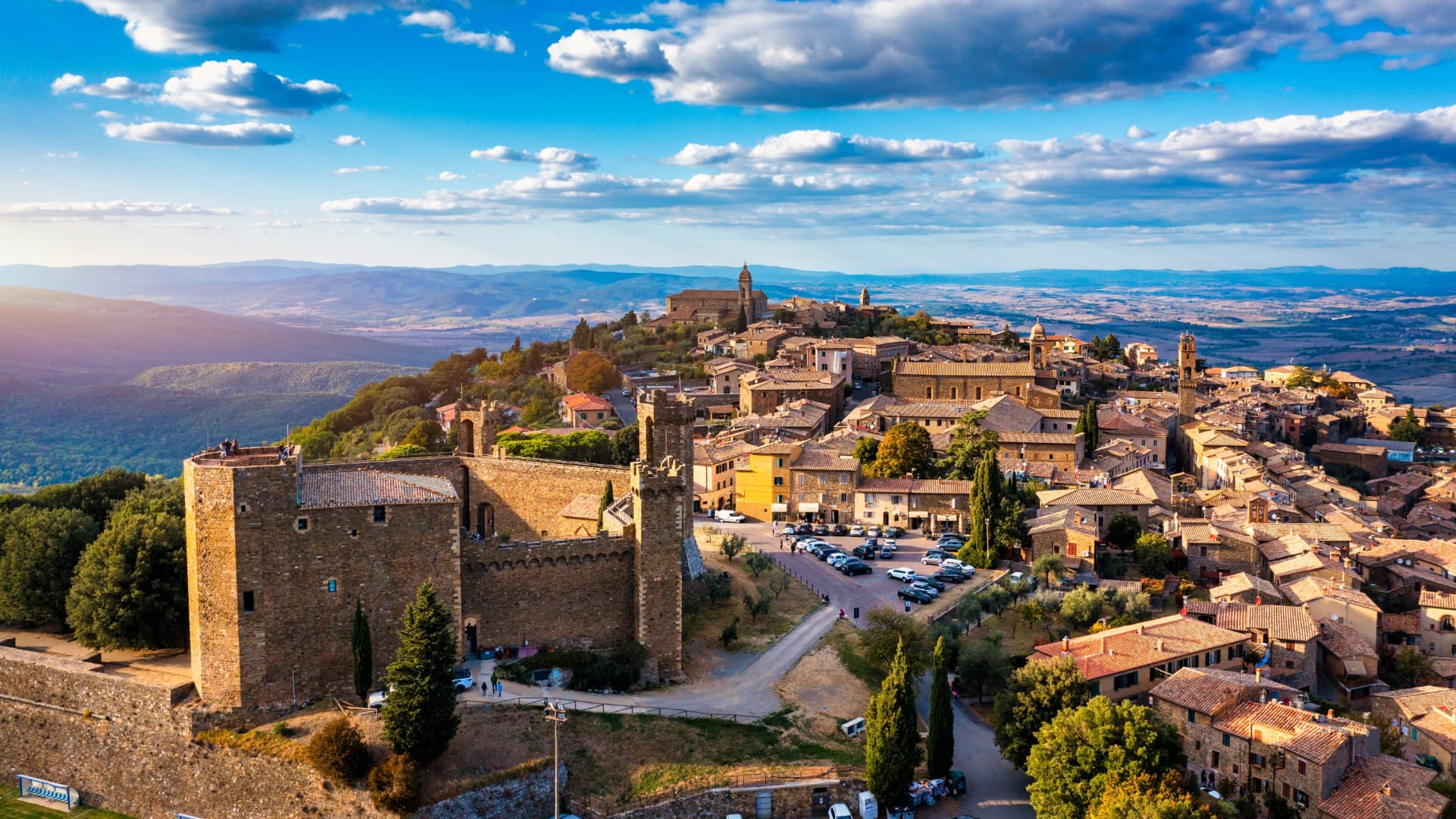
Vino Nobile di Montepulciano and Brunello di Montalcino are the two names to look for. Tastings are usually in a historic cellar or an estate outside town. Check how many wines are included and whether food is served with them.
Tuscany, Umbria and northern Lazio combinations
Some days add Orvieto or Assisi (in Umbria) or Civita di Bagnoregio (in northern Lazio) to a Tuscan stop. Efficient if you want to tick off several places, but stops shorten quickly. Before choosing one of these over a dedicated day, compare:
- Orvieto day trip from Rome by train
- Orvieto and Civita di Bagnoregio in one day
- Assisi and Orvieto day trip from Rome
What to check on any tour listing
- Which towns are actually visited, and how long the coach stops in each
- Whether lunch is included, and whether drinks are extra
- How many tastings are included, and whether food is served with them
- Whether any site admissions are included or paid on the day
- The pickup point and time, and where the tour drops you back in Rome
- Group size, whether a live guide travels with you, and the cancellation terms
Affiliate link. You pay the same price and we may earn a small commission, which funds this site's research.
Want the Tuscan countryside without hiring a car?
Compare Tuscany day tours from Rome — hill towns, Val d'Orcia, lunch and wine-tasting options — with live prices and dates.
Compare Tuscany tours from RomeTuscany from Rome without a car
What works by train: Florence, comfortably and often. Chiusi–Chianciano Terme, as a gateway to the southern hill towns if you are willing to add a bus. Arezzo and Cortona are also reachable, though Cortona's station is well below the town.
What does not work: the core Val d'Orcia towns, which have no useful direct rail service at all; Montepulciano and Pienza, where the nearest stations are kilometres away on thin bus timetables; and wineries, which are almost all rural. Siena is different: rail is slow, but there is a direct coach option (see the questions below), so it is possible independently if the timetables work for your date.
If you are not driving and the countryside is what you want, an organised tour is usually the easiest option in a single day; a private driver is the more flexible, more expensive alternative.
Suggested one-day itineraries
Version 1 — Florence independently
07:15 high-speed train from Termini; 09:00 Duomo square; 10:30 Piazza della Signoria; 11:00 one pre-booked museum; 13:15 lunch; 14:30 Ponte Vecchio and the Oltrarno; 17:00 Piazzale Michelangelo; 19:15 train home. Maximum time, one museum, no coach.
Version 2 — Montepulciano and Val d'Orcia tour
Early pick-up in central Rome; roughly two and a half hours north; late morning in Montepulciano; lunch at an estate or in Pienza; afternoon photo stops through the Val d'Orcia; back in Rome around 20:00. Around 12 hours, five to six of them travelling.
Version 3 — food and wine excursion
A smaller-group day built around two cellar visits with tastings and a long farmhouse lunch, with one hill-town stop for a walk between them. Fewer sights, more sitting, and the version most people remember fondly.
How much does a Tuscany day trip cost?
Independent city visit. Your spending is a return high-speed fare, one museum ticket and food. The fare is the swing factor: booked weeks ahead it can be a fraction of the walk-up price, and it is the single easiest saving on the whole day.
Organised countryside tour. One headline price covering coach transport and a guide. It looks expensive next to a train ticket, but it buys access to places with no public transport. What it does not always cover varies by product, so read the inclusions before you compare prices: lunch, drinks, the number of tastings, any site admissions, and whether pickup from your area costs extra.
Renting a car. Whether it costs less than a tour depends on the rental price, insurance, fuel, motorway tolls, parking outside the historic centres and the tour you compare it with. Italy's ZTL restricted-traffic zones also carry automatic fines. More sensible for a multi-day Tuscan stay than for one day out of Rome.
Build your budget in three lines (checked October 2026)
- Transport: return train fare, or the tour price, or rental plus fuel, tolls and parking.
- Admission: one Florence museum ticket, or any church, museum or tasting fees not included in the tour.
- Food: lunch and drinks — check whether a tour lunch or tasting is already included so you don't pay twice.
We avoid quoting fixed euro figures because train fares are dynamic and tour prices vary by season and group size. Check live prices when you book.
Who should not attempt Tuscany in one day?
- Anyone wanting several hill towns. Two stops is the honest maximum, and the second is always short.
- Serious wine travellers on a standard coach day. A relaxed cellar visit with time to talk, taste and buy rarely fits a multi-stop coach schedule — a focused private excursion can work better.
- Photographers on a standard coach day. The Val d'Orcia works best at dawn and dusk, outside most tour hours; a tailored private trip can be timed for the light.
- Families with small children. Ten to twelve hours with five in a coach seat is a hard day for everyone.
- Anyone with three days in Rome. You have not finished Rome yet; the region will still be there next time.
For all of the above the answer is one or two nights in Siena, Montepulciano or Florence, which turns a rushed sample into an actual visit.
Frequently asked questions
What part of Tuscany is closest to Rome?
The southern edge — including the Val d'Orcia and nearby Montepulciano, Pienza and Chiusi — is the nearest part of the region, roughly two to two and a half hours by road. Florence is further north but feels closer because the high-speed train covers the distance in about 90 minutes.
Can you visit Siena from Rome in a day?
Yes, but it is the least efficient of the options. There is no fast direct train: rail routes involve a change and take around three hours each way. Itabus also publishes a direct Rome–Siena coach route, so check both the outward and return departures for your date. Organised tours usually pair Siena with San Gimignano on a very long day. If Siena is the priority, it is better reached from Florence or as an overnight.
Is Montepulciano possible without a car?
Not comfortably. The nearest station, Montepulciano Stazione, is around 10 km from the hill town and connected by an infrequent bus. Chiusi–Chianciano Terme has better rail links from Rome but still needs a bus onward. For a day trip, an organised tour, a private driver or a rental car is the realistic way to reach it.
Are Tuscany wine tours suitable for children?
Some are, many are not. Winery visits often have a minimum age or simply expect adults, and a long coach day built around tastings is dull for children. Family groups do better with Florence by train, where museums, gelato and open squares break up the day.
Tuscany or Florence for one day?
Florence, if this is your first time in the region and you want a city, museums and architecture. The Tuscan countryside, if you have already seen Florence or you specifically want hill towns, landscape and wine. Trying to combine both in one day from Rome does neither justice.