Table of Contents
- 1. What they are
- 2. Why 'Borgia'?
- 3. What happened to the rooms
- 4. The painted rooms
- 5. The modern art collection inside
- 6. How to find them
Where to buy Vatican Museums tickets
Try the official Vatican Museums site first, then compare Tiqets, Klook, and Trip.com — trusted booking partners — if official slots are sold out.
OfficialVatican MuseumsFace-value timed tickets from the Vatican's official ticketing site.Official TicketsPartnerTiqetsSkip-the-line tickets and guided tours when official slots are gone.Check PricesPartnerKlookCheck alternative ticket and tour availability.Check PricesPartnerTrip.comBundle Vatican tickets with hotels and city passes.Check PricesWhat they are
A suite of rooms in the Vatican Palace decorated between 1492 and 1494 for Pope Alexander VI, head of the Borgia family. This guide covers the six principal decorated rooms that visitors normally walk through; the historic apartment formed part of a larger residence whose remaining private rooms are not publicly accessible. The painted decoration was carried out by Pinturicchio and his collaborators, and the rooms today also display works from the Vatican's Collection of Modern and Contemporary Art.
Why 'Borgia'?
Rodrigo Borgia was elected Pope Alexander VI in 1492. Simony was alleged by contemporaries and political bargaining around the conclave is not in doubt, but the exact weight of those allegations remains a matter for historians rather than for a visitor guide. He was the head of the Borgia dynasty and the father of Cesare and Lucrezia Borgia; Cesare was one of the contemporary figures Machiavelli discussed in The Prince, though the book draws on far more than a single example. After Alexander VI's death in 1503, his successor Julius II declined to occupy the apartment and moved to the floor above, where he commissioned the Raphael Rooms.
What happened to the rooms
The apartment was not simply sealed for centuries. After Julius II abandoned it, the rooms had a series of uses across the following centuries: accommodation for cardinal-nephews and other officials of the papal court, space for the early Pinacoteca assembled under Pius VII, and a library associated with Cardinal Angelo Mai. At the end of the nineteenth century Leo XIII had the rooms restored and opened them to the public, which is broadly the arrangement visitors encounter today.
The painted rooms
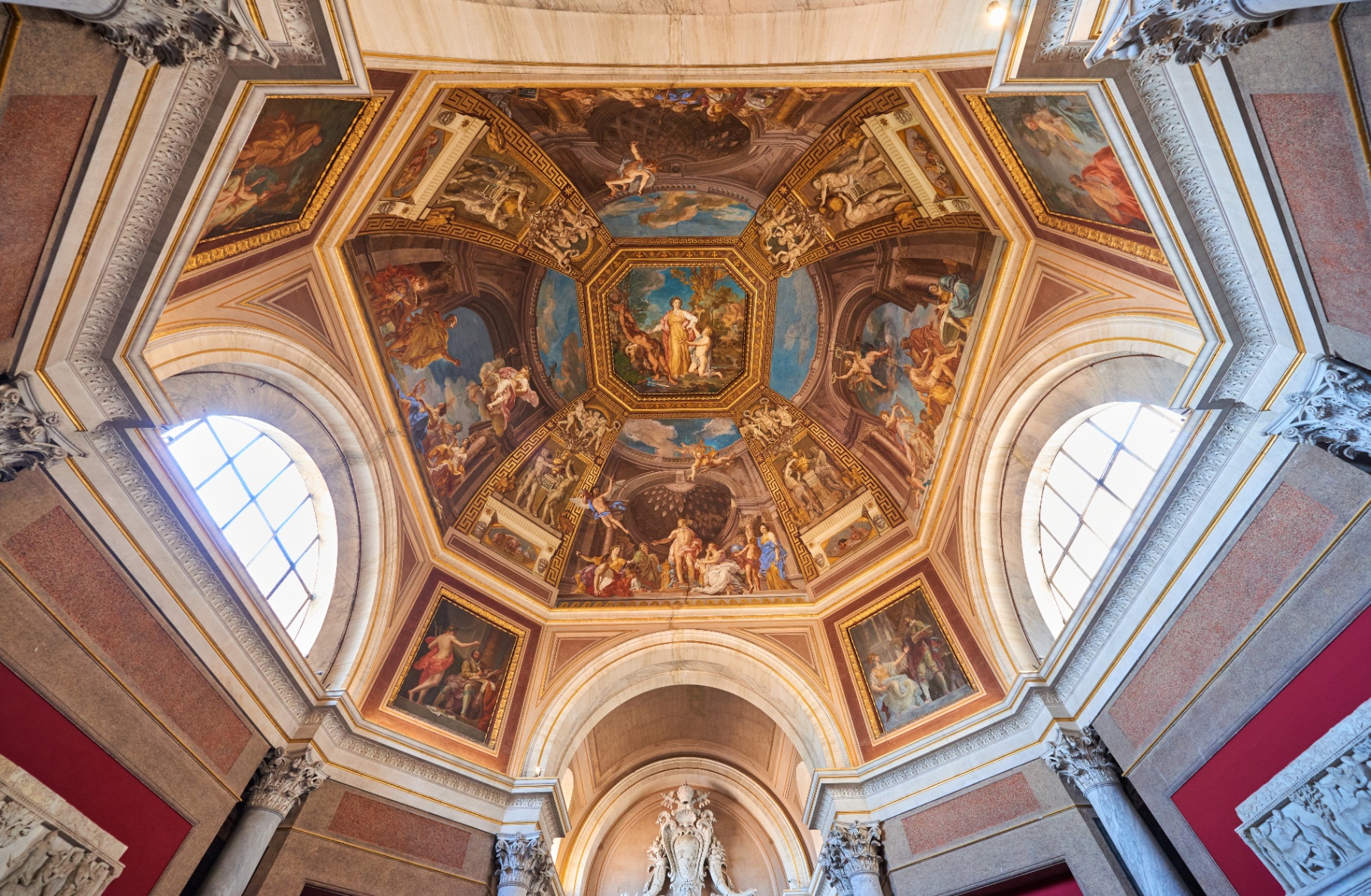
Pinturicchio (Bernardino di Betto) and his collaborators decorated the rooms between 1492 and 1494. Vatican conservation accounts note that much of the work was executed extensively a secco, on plaster with glue-based binders, rather than exclusively in true fresco — one reason the surfaces are fragile and heavily studied. The style is lavish: gilding, elaborate grotesques and dense compositions.
- • Sala dei Misteri della Fede: scenes from the life of the Virgin and of Christ.
- • Sala dei Santi: stories of saints, including the Disputation of St Catherine. The richly dressed St Catherine has traditionally been identified as Lucrezia Borgia, although the identification is disputed.
- • Sala delle Arti Liberali: the seven liberal arts personified.
- • Sala del Credo: apostles and prophets bearing scrolls.
- • Sala delle Sibille: prophets and pagan sibyls.
- • Sala dei Pontefici: a later ceiling associated with Perin del Vaga and Giovanni da Udine; Borgia heraldry survives in the decoration.
The modern art collection inside
Paul VI inaugurated the Vatican's collection of modern religious art in 1973; it is known today as the Collection of Modern and Contemporary Art. A rotating selection is displayed in and around the Borgia rooms and adjoining spaces. See our modern and contemporary art guide for what is normally on show.
How to find them
- Follow the Sistine Chapel signs from the entrance.
- After the Raphael Rooms, look for signage reading "Appartamento Borgia" or "Arte Contemporanea".
- The rooms are one floor below the Raphael Rooms, reached by a short staircase.
- Routing varies by day: on most itineraries you can rejoin the way to the Sistine Chapel from the far end, but sections can be closed or diverted.
Frequently Asked Questions
Are the Borgia Apartments open to the public?
They normally form part of the standard museum itinerary, but individual sections can close for restoration, exhibitions or operational reasons. Check the signage and the day's route notices at the entrance.Who was the Borgia pope?
Alexander VI (Rodrigo Borgia, pope 1492–1503), head of the Borgia family and father of Cesare and Lucrezia Borgia. His pontificate was marked by dynastic politics and contemporary scandal.Is this the whole Borgia residence?
No. The publicly visitable part covers the six principal decorated rooms. The wider papal residence contained further private rooms that are not open to visitors.Are they included in the standard ticket?
Yes — when open, no extra charge.How long does the visit take?
Roughly 20–30 minutes for the six principal rooms.Related Vatican guides
Modern and Contemporary Art
The collection displayed in and around the Borgia rooms.
Raphael Rooms
The papal apartments one floor above.
Vatican Hidden Gems
Other detours worth taking.
Vatican Route
Where the Borgia rooms fit.
Full Vatican Museums attraction guide See Rome attractions by area on the map