Table of Contents
- 1. Why they're worth it
- 2. The four rooms
- 3. The School of Athens decoded
- 4. What to look for
- 5. How long to spend
Where to buy Vatican Museums tickets
Try the official Vatican Museums site first, then compare Tiqets, Klook, and Trip.com — trusted booking partners — if official slots are sold out.
OfficialVatican MuseumsFace-value timed tickets from the Vatican's official ticketing site.Official TicketsPartnerTiqetsSkip-the-line tickets and guided tours when official slots are gone.Check PricesPartnerKlookCheck alternative ticket and tour availability.Check PricesPartnerTrip.comBundle Vatican tickets with hotels and city passes.Check PricesWhy they're worth it
Painted 1508–1524 by Raphael and his workshop, commissioned by Pope Julius II — the same pope who hired Michelangelo for the Chapel ceiling next door. Two of the greatest painters of the Renaissance were literally working walls apart.
The School of Athens alone is worth the visit. It's the most famous painting of the Renaissance after the Sistine ceiling and Mona Lisa.
The four rooms
Stanza di Costantino
Painted after Raphael's death by his workshop. Battle scenes and the vision of Constantine — dramatic but less refined.
Stanza di Eliodoro
Themes of divine protection. The Expulsion of Heliodorus, Deliverance of St. Peter, Meeting of Leo I and Attila.
Stanza della Segnatura
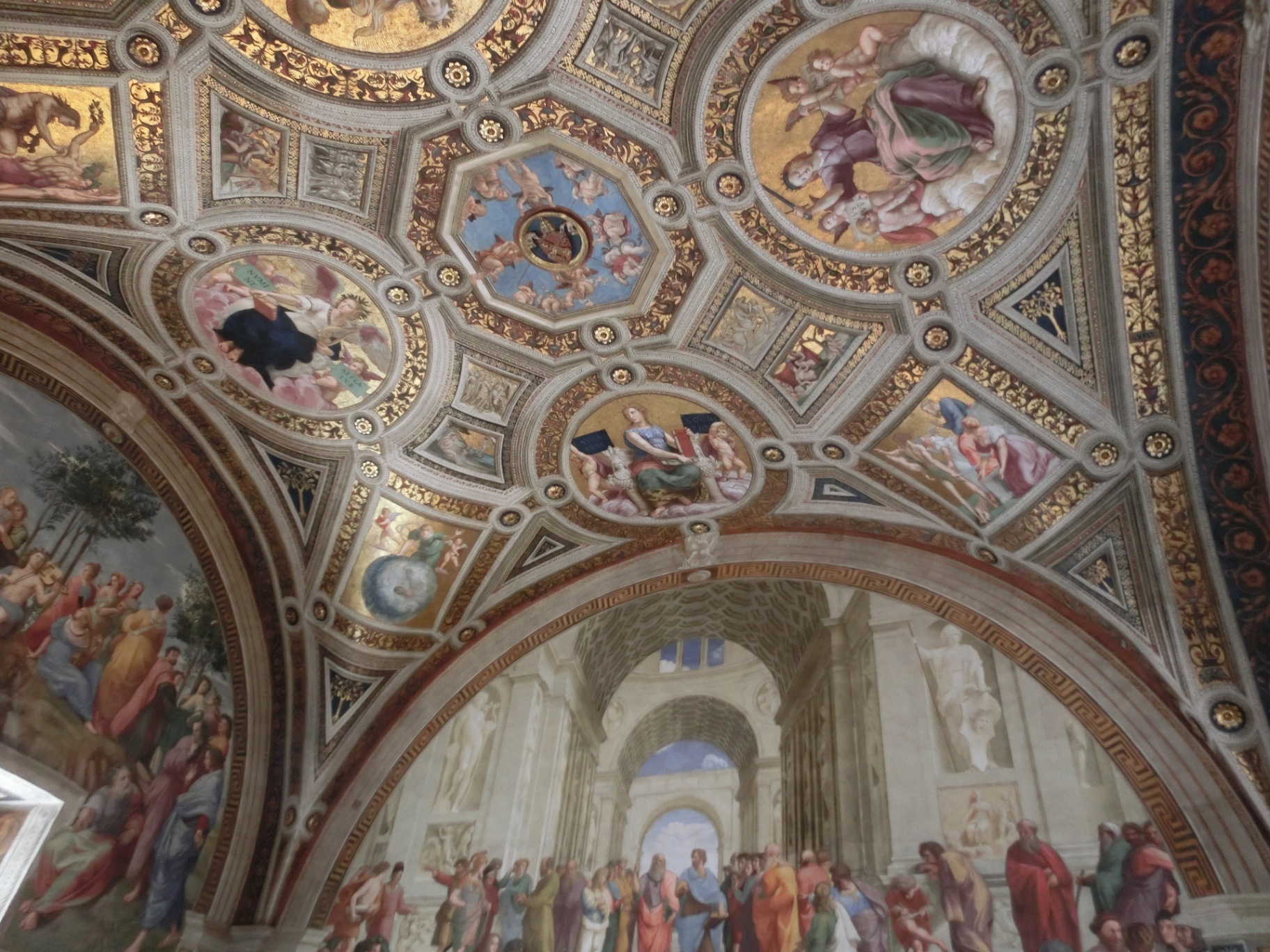
The masterpiece. Home of the School of Athens, Disputation of the Sacrament, Parnassus, and Cardinal Virtues.
Stanza dell'Incendio
Themes of papal power and providence. The Fire in the Borgo — dramatic composition of a burning neighborhood being calmed by the pope.
The School of Athens decoded
The most famous painting in the Rooms. It shows the great philosophers of antiquity gathered under a classical vault:
- • Center: Plato (pointing up, holding Timaeus) and Aristotle (hand outstretched, holding Ethics).
- • Left front: Pythagoras writing at a book.
- • Right front: Euclid (or Archimedes) demonstrating geometry — the face is Raphael's friend Bramante.
- • Steps center: Diogenes sprawled with a bowl.
- • Foreground left, brooding on a block: Heraclitus — the face is Michelangelo's, added late as a tribute.
- • Far right in a black cap: Raphael's own self-portrait, looking directly at you.
What to look for
- • The Disputation of the Sacrament directly opposite the School of Athens — they mirror each other (theology vs philosophy).
- • The Fire in the Borgo — figures fleeing a burning building, one of the most dynamic compositions of the Renaissance.
- • Signs of Raphael's workshop taking over in the later rooms — stiffer poses, weaker faces.
- • The ceiling frescoes — often overlooked, but part of the composition.
How long to spend
Minimum 15 minutes if you're rushing. 25–30 minutes for a proper visit. If you're an art lover, easily an hour. The Rooms empty out at the last afternoon slot — that's your window to study them.
Frequently Asked Questions
Are the Raphael Rooms included in the Vatican Museums ticket?
Yes — every ticket includes them. They're on the standard route just before the Sistine Chapel.Can you take photos in the Raphael Rooms?
Yes — photos are allowed without flash. This is one of the biggest differences from the Chapel next door.Which room is the School of Athens in?
The Stanza della Segnatura — the second of the four rooms on the standard route.Did Raphael paint them all himself?
The Stanza della Segnatura and most of the Stanza di Eliodoro are his; the last two rooms were completed by his workshop after his death in 1520.How long should I spend?
20–30 minutes for a proper visit. Any less and you're cheating yourself — some visitors spend an hour.Related Vatican guides
Sistine Chapel Art Guide
The room next door.
Vatican Masterpieces
The full don't-miss list.
Michelangelo at the Vatican
Raphael's contemporary rival.
2-Hour Highlights Route
Fit the Rooms into a fast visit.
Full Vatican Museums attraction guide See Rome attractions by area on the map