Table of Contents
- 1. There are actually two
- 2. The Momo staircase (1932)
- 3. Bramante's original ramp
- 4. Seeing the modern one
- 5. Access to the original
Where to buy Vatican Museums tickets
Try the official Vatican Museums site first, then compare Tiqets, Klook, and Trip.com — trusted booking partners — if official slots are sold out.
OfficialVatican MuseumsFace-value timed tickets from the Vatican's official ticketing site.Official TicketsPartnerTiqetsSkip-the-line tickets and guided tours when official slots are gone.Check PricesPartnerKlookCheck alternative ticket and tour availability.Check PricesPartnerTrip.comBundle Vatican tickets with hotels and city passes.Check PricesThere are actually two
The name "Bramante staircase" is used for two quite different structures:
1. The original — a broad spiral ramp associated with Donato Bramante, built in the early sixteenth century in the Belvedere area for Julius II. It is a continuous rising ramp around an open well, not an intertwined double helix. It is not on the ordinary visitor route.
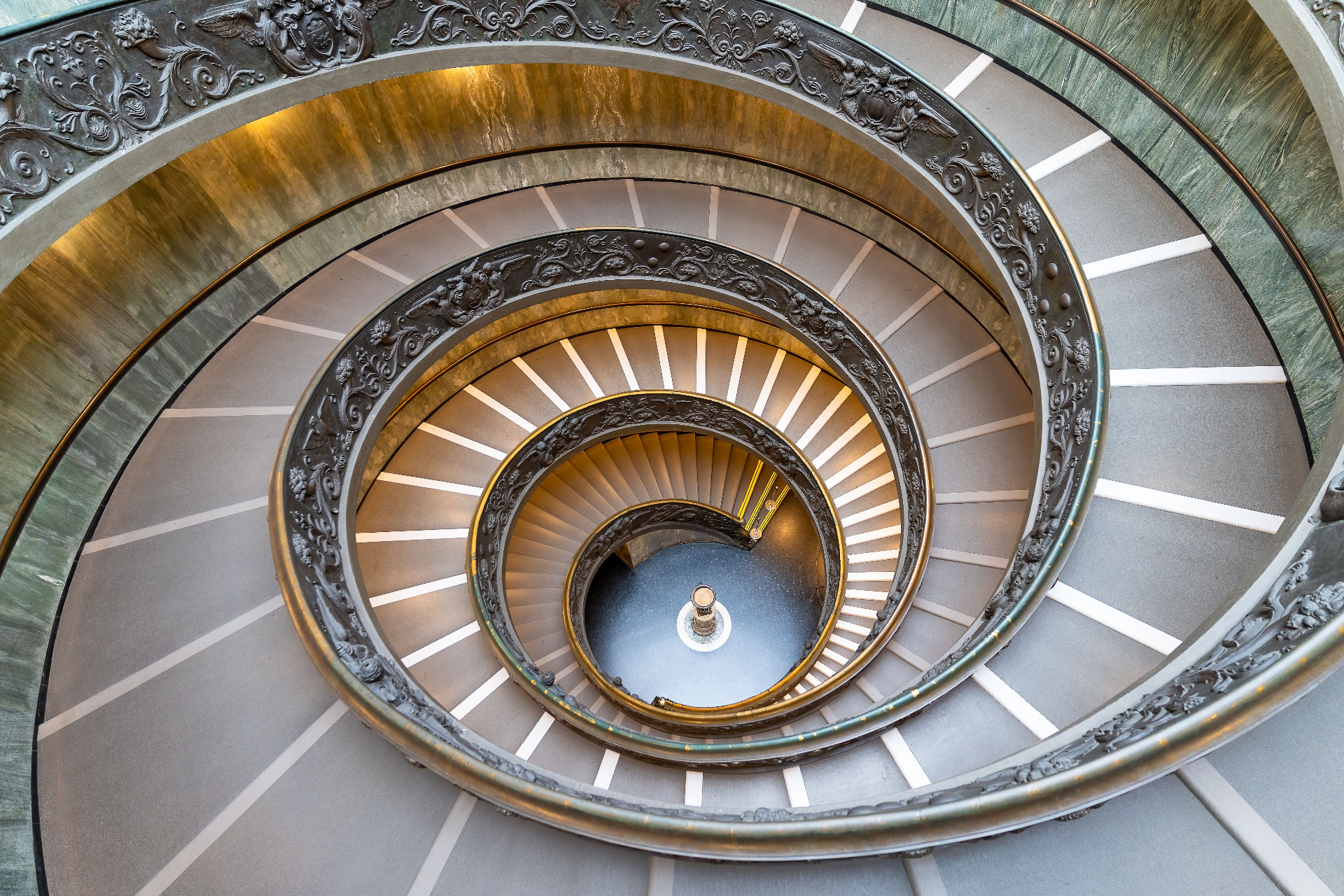
2. The Momo staircase — a much larger double-spiral structure designed by Giuseppe Momo in 1932 for the modern museum building, and the one almost every photograph shows.
The Momo staircase (1932)
Giuseppe Momo designed this staircase in 1932 for the modern Vatican Museums entrance and exit building. Two intertwined helical ramps wind around a central well so that ascending and descending traffic need not cross. It is one of the most photographed architectural features in Rome, usually shot looking straight down through the well. Guidebooks often call it the "Bramante staircase" because it echoes the earlier Vatican spiral, but the design and the date are Momo's.
Bramante's original ramp
Bramante's structure sits within the Belvedere complex and is not reachable from the standard itinerary. Its gradient is gentle and its width generous, which allowed mounted access and the movement of goods between the lower courtyard level and the papal apartments — a practical circulation route rather than a ceremonial staircase. Classical column orders are used in the surrounding colonnade as the ramp rises, and the sequence is often summarised in guidebooks as a textbook of the orders; the precise sequence is described differently in different sources, so treat any tidy four-stage list with caution.
Seeing the modern one
Most independent visitors pass the Momo staircase on the way out, so no planning is normally needed. It is not universal: accessible routes, group flows and operational changes can send visitors out a different way, and lifts are available for those who need them. If you want the classic photograph, take it from the upper walkway before you start down, keeping your equipment securely inside the railing and your body back from the void, and step aside afterwards so you are not standing in the exit flow.
Access to the original
Bramante's original sixteenth-century spiral ramp is not part of ordinary admission. Access is exceptional and should only be expected when a specific current Vatican product explicitly includes it in writing.
We do not list operators or events that "sometimes" include it. Tour descriptions using words such as "VIP", "private" or "secret" do not by themselves guarantee entry, and openings that happened in past years are not a reliable guide to 2026. If access matters to you, check the official Vatican Museums website for the current offer and confirm in writing before booking anything.
Frequently Asked Questions
Which staircase will I see?
Most independent visitors encounter Giuseppe Momo's 1932 double-spiral staircase near the museum exit, although operational, group and accessible routes may use another exit. Bramante's original ramp is not part of ordinary admission.Did Bramante design the famous spiral in the photos?
No. That structure was designed by Giuseppe Momo in 1932, drawing on the earlier Vatican spiral. It is commonly, if loosely, called the 'Bramante staircase'.Where is the original Bramante staircase?
In the Belvedere area of the Vatican Palace, away from the standard visitor route. Access is exceptional.Can I book a tour that includes the original?
Only if a specific, current Vatican or officially authorised product states explicitly that it includes it. Do not assume a 'VIP' or 'private' label covers it.Can I photograph the Momo staircase?
Photography is normally permitted in that area. Take your photo from the walkway without leaning out over the void, and keep moving so you do not block the flow.Related Vatican guides
Vatican Hidden Gems
Other things most visitors miss.
Route Guide
Where the staircase fits at the end.
2-Hour Route
A short route through the museums.
Pinecone Courtyard
The other Bramante-associated space.
Full Vatican Museums attraction guide See Rome attractions by area on the map