Table of Contents
- 1. What it is
- 2. The Pinecone (Pigna)
- 3. The bronze peacocks
- 4. The Sphere Within Sphere
- 5. Why it works as a break
- 6. Photo tips
Where to buy Vatican Museums tickets
Try the official Vatican Museums site first, then compare Tiqets, Klook, and Trip.com — trusted booking partners — if official slots are sold out.
OfficialVatican MuseumsFace-value timed tickets from the Vatican's official ticketing site.Official TicketsPartnerTiqetsSkip-the-line tickets and guided tours when official slots are gone.Check PricesPartnerKlookCheck alternative ticket and tour availability.Check PricesPartnerTrip.comBundle Vatican tickets with hotels and city passes.Check PricesWhat it is
The Cortile della Pigna is the upper section of the vast Belvedere Courtyard complex begun by Donato Bramante for Julius II in the early sixteenth century. Its present enclosed form is not Bramante's original space preserved intact: the great courtyard was subdivided by later building, above all by the construction of the Library wing, leaving the three courtyards visitors see today.
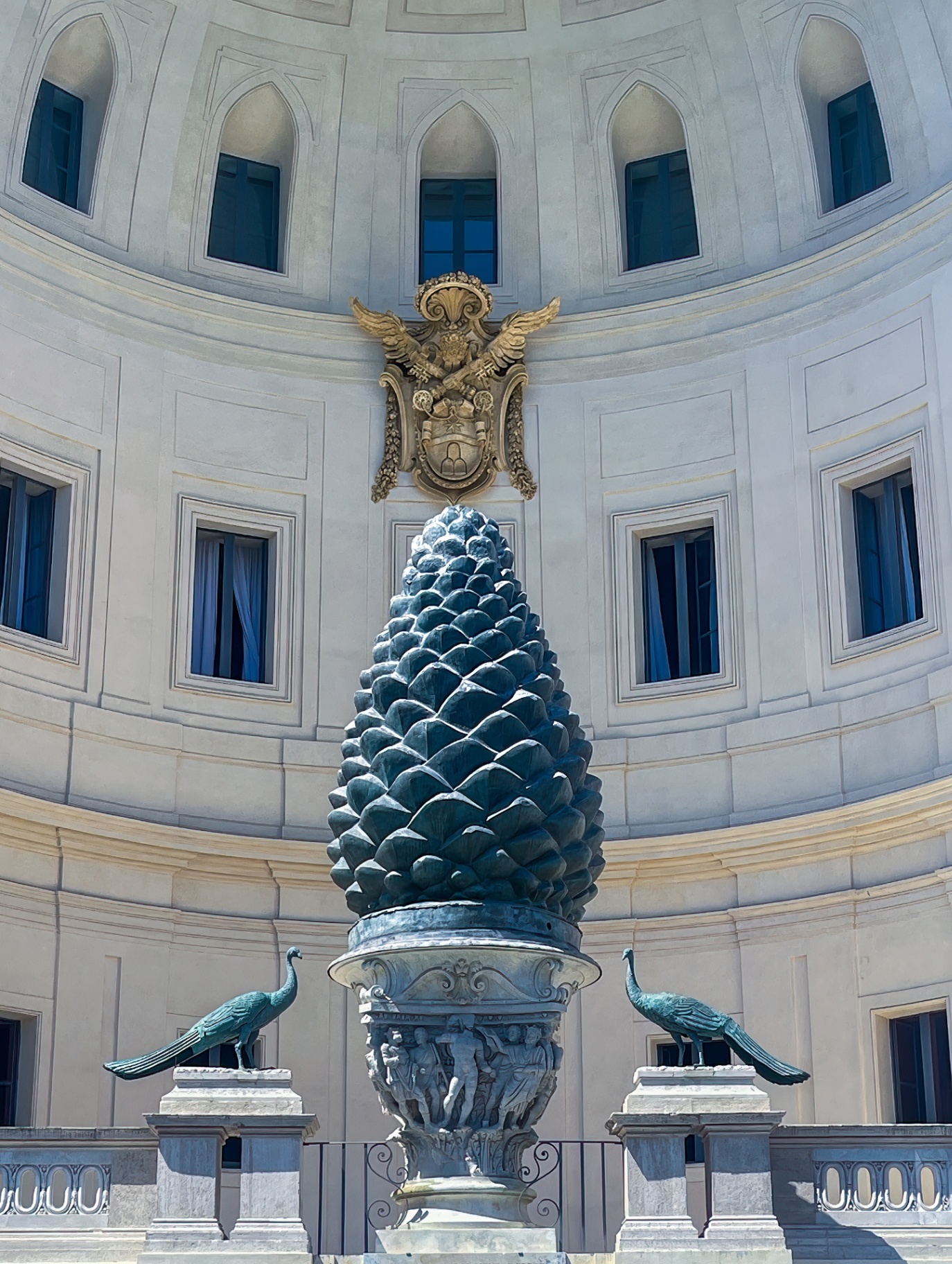
It sits between the entrance area and the main gallery sequence, and is one of the museums' designated relaxation areas. Two-storey loggias line the sides; the colossal ancient bronze pinecone stands in the exedra at one end, with Pomodoro's bronze sphere in the open space.
Source: the Vatican Museums' page for the courtyard.
The Pinecone (Pigna)
A monumental Roman bronze roughly four metres high. It probably functioned as a fountain element in antiquity — the exact original location and use are debated rather than settled — and it was later displayed in the atrium of Old St Peter's, familiar enough in medieval Rome to be referenced in Dante. It was moved to the Vatican courtyard in the early seventeenth century, where it has stood ever since.
The bronze peacocks
The two bronze peacocks flanking the pinecone are copies. The ancient bronze originals, associated with the Mausoleum of Hadrian, are conserved indoors within the museum collections, away from the weather. This is a common point of confusion, and it runs the opposite way to what many guides claim.
The Sphere Within Sphere
Arnaldo Pomodoro's Sfera con Sfera is a large polished bronze — not gilded — whose fractured outer shell opens onto a machined inner core. It was designed with a rotating mechanism, but do not promise anyone it will be turning when you arrive; treat that as something to check on the day. Pomodoro made versions of the piece for the United Nations, Trinity College Dublin and other institutions; the Vatican's sits in the courtyard, framed by the surrounding loggias. Look for the way the polished surface holds the sky and the surrounding façades.
Why it works as a break
The Vatican Museums are kilometres of enclosed galleries, and the courtyard is officially listed as a relaxation area — which is the strongest practical reason to use it. Take five or ten minutes here before starting the long gallery sequence rather than pushing through and paying for it later.
It is not the only outdoor option: the Courtyard of the Cuirasses, the Courtyard of the Pinacoteca, the Square Garden and the Courtyard of the Carriages are also designated relaxation areas, and the Octagonal Court is open to the sky. Café and restroom locations change with the current visitor layout, so check the museum map you are given at entry.
Photo tips
- • The pinecone photographs well straight on, framed by the exedra behind it.
- • Overcast light is kinder to the polished bronze of the sphere than hard midday sun, though this is a preference rather than a rule.
- • Walk a full circle around the sphere — the reflection changes completely with the angle.
- • Access to upper loggias is not generally open to visitors, so plan for ground-level compositions.
- • Photography without flash is permitted here, as elsewhere outside the Sistine Chapel.
Frequently Asked Questions
How big is the pinecone?
Roughly four metres high. It is an ancient Roman bronze that probably functioned as a fountain element, and was later displayed in the atrium of Old St Peter's before being installed in the Vatican courtyard in the early seventeenth century.Are the bronze peacocks originals?
No. The peacocks flanking the pinecone in the courtyard are copies. The ancient bronze originals, associated with the Mausoleum of Hadrian, are preserved indoors in the museum collections.What is the large bronze sphere?
Sphere Within Sphere (Sfera con Sfera) by Arnaldo Pomodoro — a polished bronze sculpture whose fractured outer shell reveals an inner core. It was designed with a rotating mechanism, but whether it is turning on a given day should not be assumed.Is the courtyard a required stop?
It is on the usual route and is one of the designated relaxation areas, but routing can vary, so it is not crossed on literally every visit. If you want to see it, look for it early rather than assuming you will pass through.Is the Pinecone Courtyard the only outdoor space?
No. The museums designate several open-air relaxation areas, including the Courtyard of the Cuirasses, the Courtyard of the Pinacoteca, the Square Garden, the Pinecone Courtyard and the Courtyard of the Carriages. The Octagonal Court is also open to the sky.Related Vatican guides
Vatican Route Guide
Where the courtyard fits.
Avoid Overwhelm
Why breaks like this matter.
Vatican with Kids
A kid-friendly stop.
2-Hour Highlights
Fitting the courtyard into a fast visit.
Full Vatican Museums attraction guide See Rome attractions by area on the map