Table of Contents
- 1. The 5-rule low-stress plan
- 2. Why the Vatican feels overwhelming
- 3. Before you go: tickets, food, Wi-Fi, clothing
- 4. What to prioritize — and what to skip
- 5. Choose your route by energy level
- 6. Where to sit, eat and take a real break
- 7. How to handle the Sistine Chapel
- 8. Summer, crowds and sensory overload
- 9. When museum fatigue hits
- 10. St. Peter's + food afterward
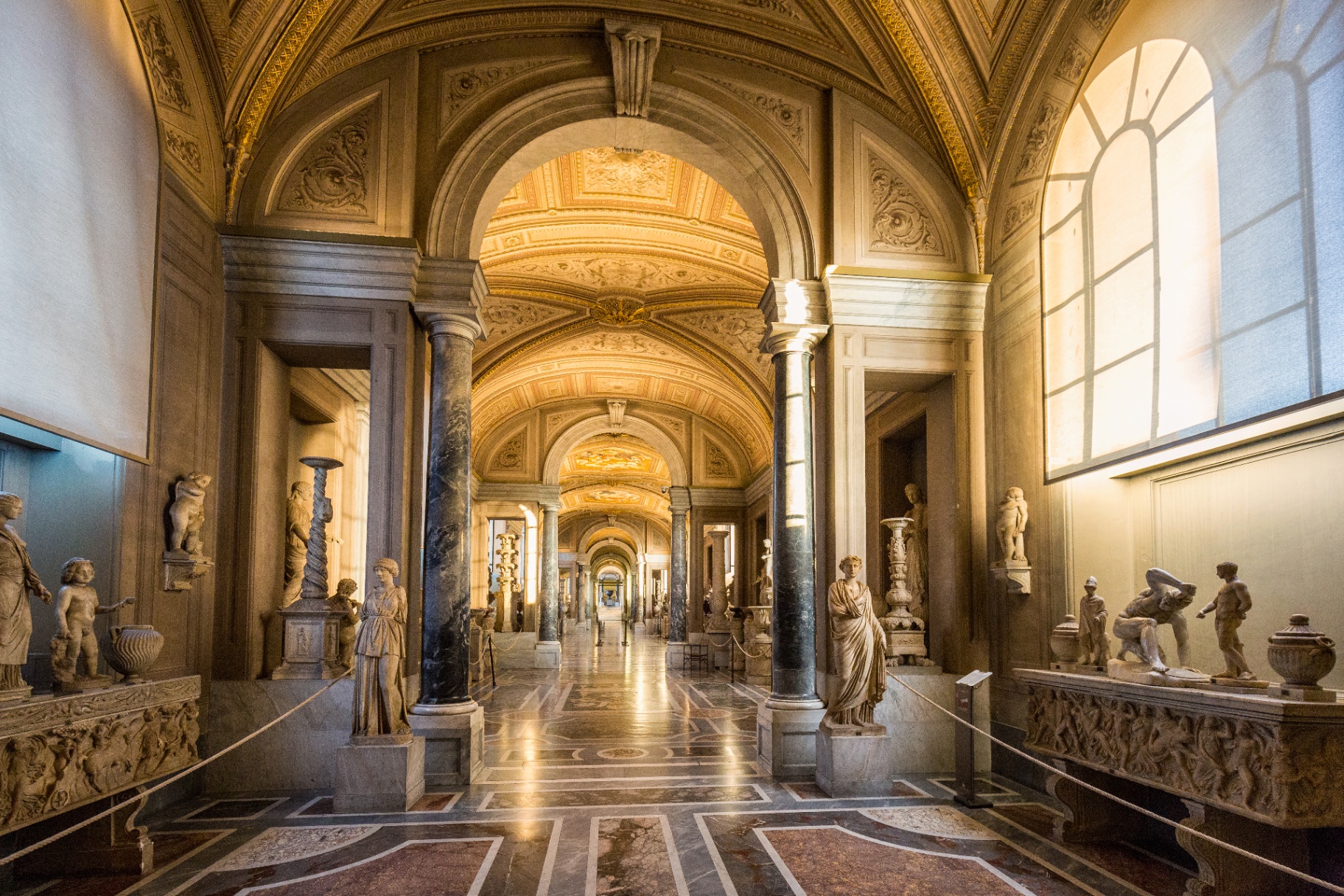
The Vatican Museums are incredible, but they can also be exhausting. The museum complex contains several kilometres of galleries, courtyards, sculpture halls, frescoed rooms and the Sistine Chapel, but a normal highlights visit covers only part of them.
Choose what matters before you enter. Take real breaks. Accept that you will skip things.
Need a ticket or tour?
A reserved ticket is the easiest way to reduce entry stress. Compare the three providers below to find the best price for your dates.
Vatican Museums Fast Track Entry
Best for: Independent visitors~2-3 hoursAvoid potentially long walk-up ticket queues with a reserved entry to the Vatican Museums and Sistine Chapel. Explore at your own pace through the Gallery of Maps, Raphael Rooms, and Michelangelo's ceiling.
- Skip-the-line entry
- Vatican Museums access
- Sistine Chapel included
- Self-paced exploration
Compare prices across trusted providers — each may have different availability and deals for your dates.
TiqetsKlookTrip.comThe 5-rule low-stress Vatican plan
1. Choose five priorities before entering
For a first visit: Sistine Chapel, Raphael Rooms, Gallery of Maps, Laocoön, Apollo Belvedere. Everything else is a bonus.
2. Start early or deliberately start late
The Museums publish Mon–Sat 08:00–20:00 with final admission at 18:00. Choose 08:00 if you want to begin as soon as the Museums open. For a 2–3 hour visit, 15:00–16:00 can also be a practical alternative. Galleries may begin clearing before the 20:00 close, so the published 18:00 final admission does not guarantee a full two hours inside. Check current hours and tariffs on the official Vatican Museums visitor information page.
3. Aim for 2–3 hours unless you genuinely love museums
Three focused hours are usually better than five increasingly tired ones.
4. Take one proper break
Don't wait until your legs hurt. Use one of the official relaxation courtyards: Cuirasses, Pinacoteca, Square Garden or Pinecone Courtyard.
5. Don't schedule the whole Vatican day without recovery time
A 30–60 minute meal or coffee between the Museums and St. Peter's can transform the second half of your day.
Why the Vatican Museums feel so overwhelming
It isn't only because the Museums are large. Several things happen at once.
Constant visual stimulation
Almost every surface demands attention — ancient sculpture, painted ceilings, huge tapestries, maps, frescoes. Eventually your brain stops distinguishing between something extraordinary and merely another beautiful ceiling. That is classic museum fatigue.
You're making decisions constantly
Should you enter this room? Read this panel? Photograph this? Deciding your priorities before entering removes most of that.
Backtracking is awkward
One-way visitor flows mean returning to something you skipped may be inconvenient. Treat the visit as a journey rather than a loop.
Summer can feel physically tiring
The Vatican itself warns that air-conditioning is limited in some heavily visited spaces during summer.
Before you go: tickets, food, Wi-Fi & clothing
Book an official 08:00 ticket if you want the earliest regular start
One official reservation from the Vatican Museums' own portal is enough — you don't need a stacked pass to enter calmly. The Vatican explicitly warns that its portal is the only official online ticket site.
Download or screenshot everything
The Vatican Museums have no visitor Wi-Fi anywhere in the complex for security reasons. Before leaving your hotel:
- screenshot your priorities;
- save your ticket offline;
- download the official museum map;
- save any route you plan to follow.
Eat before entering
Don't begin a three-hour museum visit hungry. Breakfast around Ottaviano is much easier than solving hunger from inside.
Shoes, clothes and bags
Wear shoes you can actually walk in. Cover your shoulders and avoid shorts or skirts above the knee. Large bags go in the free cloakroom.
What to prioritize — and what to skip
Decide before you enter. That single decision does more for a calm visit than anything else.
First-visit priorities
- • Sistine Chapel — Michelangelo's ceiling and The Last Judgment.
- • Raphael Rooms — especially the School of Athens.
- • Gallery of Maps — one of the most spectacular corridors.
- • Pio-Clementino — Laocoön, Apollo Belvedere.
- • One courtyard break — part of the plan, not an afterthought.
What to skip depends on you
Highlights-only visitor: move faster through secondary collections and spend your energy on the priorities above.
Renaissance-painting fan: do not automatically skip the Pinacoteca. It has major Raphael, Leonardo and Caravaggio works.
Ancient-history fan: spend more time in Pio-Clementino and the Egyptian/Etruscan collections.
Travelling with children or tire easily: cut the visit deliberately. Six memorable things beats sixty rooms.
Choose your visit by energy level
Three shapes that actually work for different travellers.
90 minutes — low-energy highlights
Pio-Clementino highlights → Gallery of Maps → Raphael Rooms → Sistine Chapel. Move steadily, no side collections.
2–3 hours — normal first visit
Same route + one courtyard break. The sweet spot for most first-time visitors.
4+ hours — art lover
Add Pinacoteca, extra Raphael Rooms time, longer sculpture stops. Take at least one proper seated break and food/coffee stop — don't turn the 3-hour plan into four uninterrupted standing hours.
Need the exact room-by-room path? See our 2-hour Vatican highlights route.
Where to sit, eat and take a real break
The Vatican Museums officially list several relaxation areas where visitors can sit:
- • Pinecone Courtyard — probably the most useful. Open air, plenty of space, and Bistrot La Pigna is right there.
- • Square Garden — another outdoor area where slowing down feels natural.
- • Courtyard of the Pinacoteca — useful if the picture gallery is on your itinerary.
- • Courtyard of the Cuirasses — another designated relaxation area.
- • Courtyard of the Carriages — listed among the family relaxation areas.
Route-safe rule: when your route passes one of these courtyards, stop before you're exhausted. Backtracking to reach a courtyard later can be awkward.
Food and coffee along the route
Refreshment options include:
- Self-service restaurant
- Bistrot La Pigna in the Pinecone Courtyard
- Pizzeria
- Caffetteria Il Forno after the Sistine Chapel
- Caffetteria Le Carrozze
- Caffetteria Centrale
Food and drink cannot be consumed inside exhibition halls — use the designated refreshment areas.
How to handle the Sistine Chapel
The Sistine Chapel is often the most anticipated part of the visit — and sometimes the most stressful. It can be busy, everyone looks upward, guards remind visitors of the rules, and photography is not allowed.
Know the rules before entering
Photography, video and mobile-phone use are forbidden inside the Sistine Chapel. Visitors are asked to maintain absolute silence — it remains a sacred space.
Don't try to decode the entire ceiling
Pick a few things to look for beforehand:
- Creation of Adam
- Separation of Light from Darkness
- The Flood
- Prophets and sibyls
- The Last Judgment behind the altar
Stay as long as it remains enjoyable
Ten focused minutes can be better than twenty-five uncomfortable ones. If it feels overwhelming, find a spot at the side, spend 10–15 minutes on your priorities, then move on. There is no prize for enduring the room longer.
Summer, crowds and sensory overload
Summer requires a slightly different strategy. The Vatican Museums warn that air-conditioning is restricted in some heavily visited historic areas because of conservation constraints.
- Choose breathable clothing that still respects Vatican dress requirements.
- Avoid arriving already dehydrated.
- Use outdoor courtyards for breaks.
- Don't plan five straight indoor hours.
- Book the earliest entry you're willing to wake up for.
If you're sensitive to crowds
You cannot guarantee an empty Vatican Museums visit — it's one of the world's major museums. Control what you can: start with fewer goals, choose 08:00 where possible, use courtyards as decompression points, and give yourself permission to stop after 2½ hours if you've seen your priorities.
When museum fatigue hits hard
There is usually a moment when artworks stop registering — another statue, another ceiling, another corridor. That is the signal. Do one of three things:
Break
Find one of the official relaxation courtyards. Sit for ten minutes. Drink water where permitted.
Skip ahead
Stop reading every label and move toward the one thing you still care about.
Finish
If you've seen your priorities, leave. Do not ruin a good 2½-hour visit by forcing another 90 minutes because an online guide told you the Vatican Museums "take four hours."
St. Peter's + food afterward
You can absolutely visit St. Peter's on the same day, but don't schedule the two back-to-back with zero recovery time if museum fatigue is a real risk. Give yourself lunch, coffee or 30–60 minutes outside first. The Basilica deserves fresh eyes.
Low-stress option
Vatican Museums → lunch or coffee near the exit → 30–60 minute break → St. Peter's Basilica.
Geography note: from the Vatican Museums exit, Borgo Pio and St. Peter's are farther around the Vatican walls than they look. The Prati/Cipro side has food much closer to the museum exit.
Hungry? See our best restaurants, cafés & gelato near the Vatican Museums — organized by which side of the walls you're on. For same-day pacing, see the Vatican Museums + St. Peter's same-day guide.
Common mistakes that make the Vatican Museums more exhausting
- • Trying to see everything. Impossible and unnecessary.
- • Arriving without knowing your priorities. Decision fatigue starts immediately.
- • Spending the first hour photographing everything. Your attention disappears faster than your phone battery.
- • Refusing to take a break. Ten minutes sitting outside is not wasted sightseeing time.
- • Visiting hungry. Everything becomes irritating when your blood sugar crashes.
- • Expecting strong air-conditioning everywhere in July. The Museums themselves warn that some areas have limited AC.
- • Depending on museum Wi-Fi. There isn't any.
- • Adding St. Peter's immediately afterward because "it's next." Rome will still be there in 45 minutes.
Frequently Asked Questions
Are the Vatican Museums always overwhelming?
Not necessarily. The Museums are enormous and can be crowded, but a focused 2–3 hour visit with five priorities and at least one break is far easier than trying to see every collection.What is the best entry time if I hate crowds?
The earliest regular entry is currently 08:00 Monday–Saturday — starting then gets you inside as soon as the Museums open. For a 2–3 hour visit, 15:00–16:00 can also be a practical alternative to starting at opening. Avoid the final 18:00 entry if you want a full three-hour visit, because the galleries begin clearing before the 20:00 close.Are there places to sit inside the Vatican Museums?
Yes. The Vatican Museums officially list seated relaxation areas including the Courtyard of the Cuirasses, Courtyard of the Pinacoteca, Square Garden and Pinecone Courtyard; family information also lists the Courtyard of the Carriages.Is there Wi-Fi inside the Vatican Museums?
No. The Vatican Museums state that no museum area has Wi-Fi coverage for security reasons. Download or screenshot tickets, routes and maps beforehand.Can I eat inside the Vatican Museums?
Yes, but not inside exhibition halls. There are designated cafés, vending areas, a self-service restaurant, pizzeria and other refreshment points along the museum route.How long should I spend in the Vatican Museums?
For a first visit, 2–3 focused hours is a good target. Stay longer when you genuinely want to explore additional collections such as the Pinacoteca or Egyptian Museum rather than because you feel obliged to 'get your money's worth.'Should I visit St. Peter's Basilica immediately afterward?
You can, but travellers who tire easily will often enjoy the Basilica more after lunch or a short break. There is no need to treat the Museums and Basilica as one uninterrupted attraction.Related Vatican guides
2-Hour Highlights Route
A pre-planned path so you don't have to decide.
Vatican + St. Peter's Same Day
Realistic pacing for both.
Best Restaurants Near the Vatican
Where to eat after the Museums.
Accessibility Guide
Elevators, quiet routes, sensory support.
Full Vatican Museums attraction guide See Rome attractions by area on the map