Table of Contents
- 1. TL;DR — is this for you?
- 2. The Egyptian collection
- 3. The most dramatic spaces
- 4. Unexpected and memorable
- 5. The two-hour route
- 6. Yes, still see the Sistine Chapel
Where to buy Vatican Museums tickets
Try the official Vatican Museums site first, then compare Tiqets, Klook, and Trip.com — trusted booking partners — if official slots are sold out.
OfficialVatican MuseumsFace-value timed tickets from the Vatican's official ticketing site.Official TicketsPartnerTiqetsSkip-the-line tickets and guided tours when official slots are gone.Check PricesPartnerKlookCheck alternative ticket and tour availability.Check PricesPartnerTrip.comBundle Vatican tickets with hotels and city passes.Check PricesTL;DR
Reframe: the Vatican Museums are less a picture gallery than a long sequence of extravagant rooms, courtyards and archaeological collections.
Chase: scale, archaeology, architecture and gold rather than wall labels.
Time budget: about two hours, including security and the walk to the exit.
Skip: the Pinacoteca picture gallery, unless someone in your group wants it.
The Egyptian collection
The Gregorian Egyptian Museum holds sarcophagi, funerary equipment, statuary and human remains from ancient Egypt, alongside Egyptian-style works made in Rome. Displays in this section rotate and individual objects are not permanently guaranteed, so treat it as a room to explore rather than a checklist of specific items. Fifteen minutes covers it comfortably.
The most dramatic spaces
- Sala Rotonda — a domed room modelled on the Pantheon, with a colossal porphyry basin at its centre. Pure theatre.
- Gallery of Candelabra — the first of the long connecting galleries, lined with antique sculpture under a painted vault.
- Gallery of Tapestries — wall-sized woven scenes, including the famous perspective effect in the Resurrection panel.
- Gallery of Maps — a 120-metre corridor of sixteenth-century frescoed cartography under a gilded vault.
- Momo's double-spiral staircase — Giuseppe Momo's 1932 helical ramp near the main exit. Not every visitor leaves this way, so ask staff if you want to see it.
- Sistine Chapel — the scale is the payoff, whatever your interest in fresco painting.
Unexpected and memorable
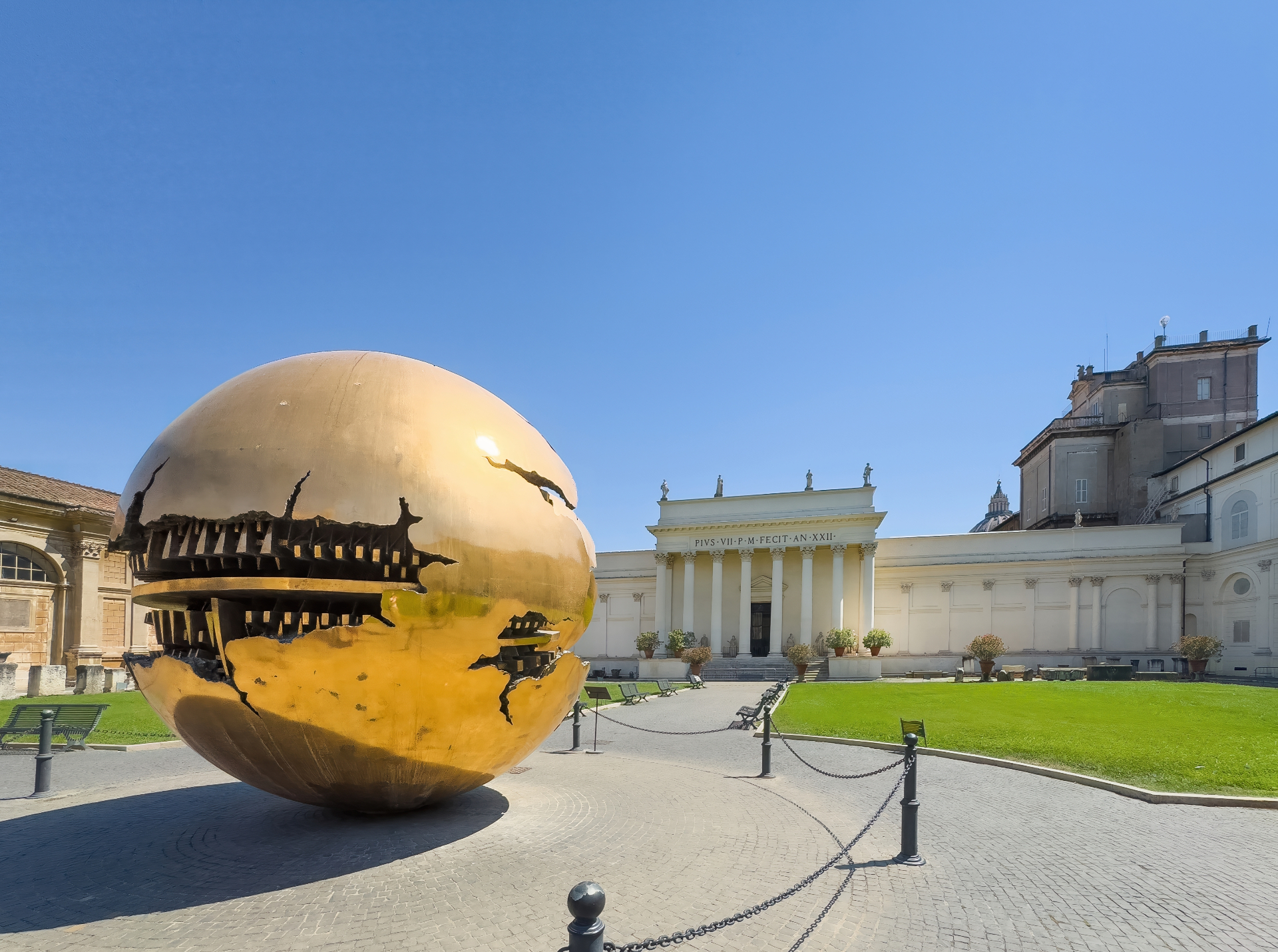
- Sphere Within Sphere — Arnaldo Pomodoro's cracked-open polished bronze globe in the Pinecone Courtyard. It was built with a rotating mechanism; whether it is turning on the day varies, so do not count on it.
- The bronze pinecone — an ancient Roman bronze roughly four metres high, later displayed in the atrium of Old St Peter's before reaching this courtyard.
- Laocoön — a Hellenistic-tradition marble of a father and two sons attacked by sea serpents. Nothing else in the museum matches its drama.
- Etruscan goldwork — extraordinarily fine granulated jewellery that raises the obvious question of how it was made without magnification.
- The Carriage Pavilion — papal carriages and early motor vehicles, in a separate section of the complex. Check the current opening arrangements before planning around it.
The two-hour route
Timings below cover time in each space. Add entry, security, the walk between sections and the exit — which is why this is a two-hour plan rather than a ninety-minute one.
- Pinecone Courtyard (10 min — bronze pinecone and the Sphere; also a designated rest area)
- Gregorian Egyptian Museum (15 min)
- Pio-Clementino: Sala Rotonda and the Laocoön (15 min — scale and drama)
- Gallery of Candelabra (5 min — walk through, look up)
- Gallery of Tapestries (5 min — the perspective effect)
- Gallery of Maps (10 min — the corridor and its gilded vault)
- Raphael Rooms (10 min — skim rather than study)
- Sistine Chapel (20 min)
- Exit
The three long galleries run in the order Candelabra → Tapestries → Maps, which is why they appear that way here. Routing and exits can vary on the day, so follow signage and staff direction.
Yes, still see the Sistine Chapel
Reluctant visitors regularly report that the Sistine Chapel is the moment that justifies the visit. The chapel is roughly 40 metres long and about 20.7 metres high, and the vault does not translate in photographs. Benches line the side walls but are limited and often full, so be ready to stand. Photography and filming are prohibited in the chapel, which — inconveniently or not — makes it easier to simply look up.
Frequently Asked Questions
Is the Vatican Museums worth it if you don't like art?
Yes, if you plan the visit around scale, archaeology and architecture rather than around paintings. The Egyptian collection, the colossal sculpture rooms and the sheer theatre of the interiors land regardless of art interest. You can skip the Pinacoteca picture gallery without missing the things this route is built on.Can I skip straight to the Sistine Chapel?
No. The Sistine Chapel sits at the end of the main visitor route and there is no shortcut to it, though the exact routing and exits can vary by day. Allow time to walk the full sequence rather than expecting a direct path.What is a realistic short visit?
About two hours from entering security to leaving, if you keep moving and skip the picture gallery. The route below is built for that. Ninety minutes is only realistic on a very quiet day with no queue.Does this route avoid paintings entirely?
No, and it should not. The Raphael Rooms and the Sistine Chapel are painted spaces, and they are two of the most impressive rooms in Europe. The difference is that you experience them as architecture rather than working through a gallery wall by wall.Should I book a guided tour?
Only if you want the storytelling. A standard guided tour normally runs longer than two hours and sets its own route, so it is an alternative to this itinerary rather than a way to speed it up.Related Vatican guides
Vatican Highlights in 2 Hours
The efficient route for anyone short on time.
Gregorian Egyptian Museum
The Egyptian rooms, in detail.
15 Vatican Masterpieces
The must-sees even non-art-lovers get.
Sistine Chapel Visitor Guide
Why the ceiling still lands, even for sceptics.
Full Vatican Museums attraction guide See Rome attractions by area on the map