 Hidden Gem
Garbatella
Rome's 1920s garden city — courtyards, Art Deco, street art and neighbourhood trattorias
2.5–3 hoursFree to exploreStreet artPiazza Brin, 00154 RomaOpen on MapPlan Your Visit
Compare tickets, tours and stays — booking ahead usually gives more choice
Book a TourHotels NearbyGarbatella is a 1920s "città giardino" of low-rise lotti arranged around shared courtyards, dominated by Innocenzo Sabbatini's Art Deco Teatro Palladium and dotted with contemporary murals. Less visited than Rome's historic centre, with neighbourhood trattorias serving Roman cooking, it offers a quieter half-day in Rome.
Why visit Garbatella?
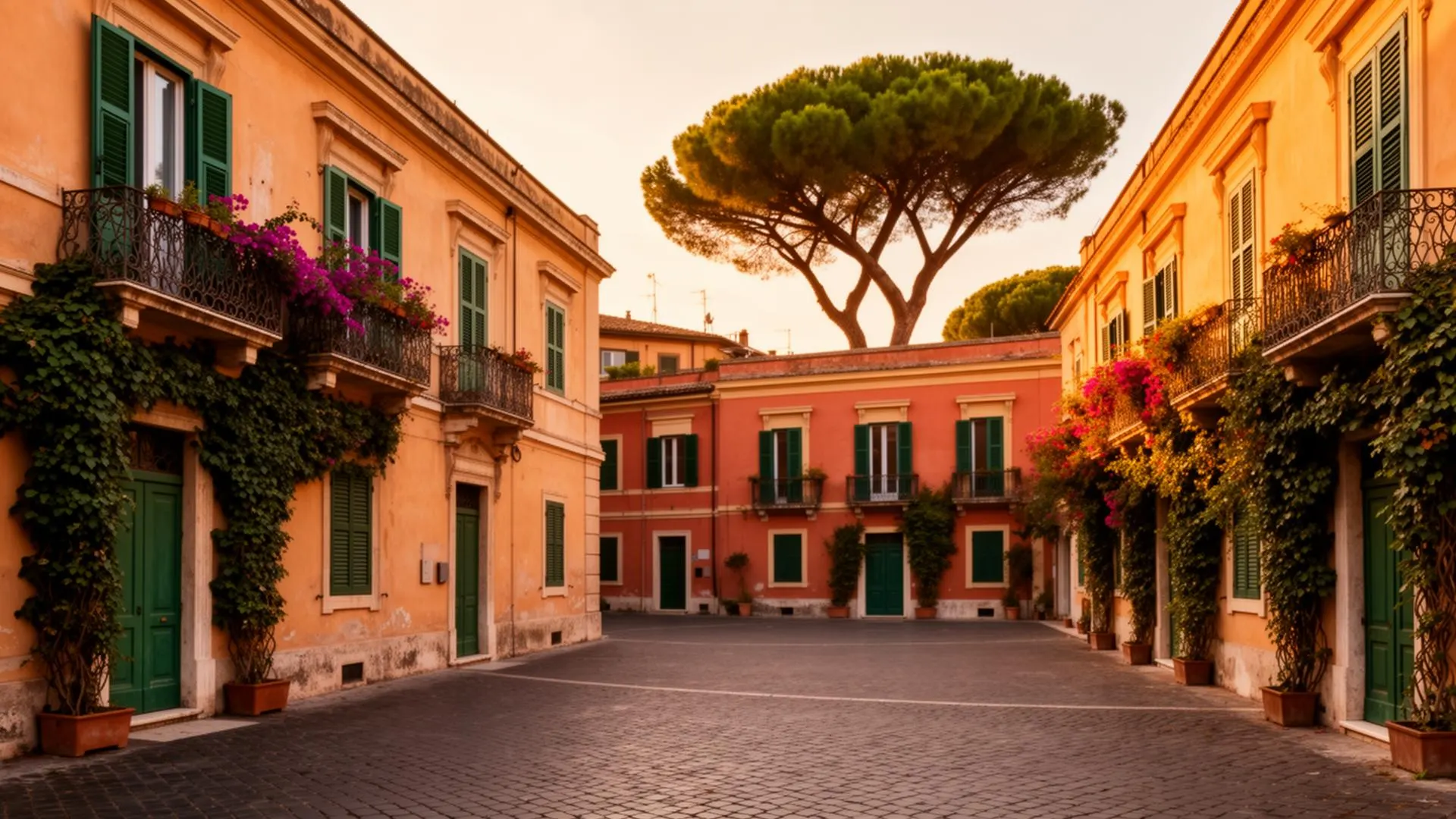
While millions cluster around the Trevi Fountain and the Spanish Steps, Garbatella remains a working residential quartiere — less visited than Rome's historic centre — where elderly women chat on benches, children play in the courtyards and neighbourhood trattorias serve local cooking.
- Unique architecture: 62 garden-city lotti and four Rationalist Alberghi Suburbani — nothing like it elsewhere in Rome.
- Street-art capital: 14+ large-scale murals by Diavù, Lucamaleonte, Solo and Mr Klevra.
- Neighbourhood trattorias: around Piazza Brin and Piazza Sauli — Roman cooking; check current opening hours and prices.
- Fewer tourists: less visited than Rome's historic centre — a quieter, residential atmosphere.
- Cinema legend: The set of Pasolini's Mamma Roma, Moretti's Caro Diario and the cult series I Cesaroni.
Quick facts
Founded
1920
Original lotti
62 housing blocks
Entry
Free, 24/7
Visit time
2.5–3 hours
Metro stop
Line B – Garbatella
Distance
3 km S of Colosseum
Table of Contents
Jump to any section of the itinerary
A brief history
Garbatella was born on 18 February 1920, when King Vittorio Emanuele III laid the foundation stone of a brand-new "borgata giardino" on the southern edge of Rome. Originally to be called Concordia, it was an explicit experiment in social housing: low-rise blocks arranged around shared courtyards, modelled on Ebenezer Howard's English Garden City movement and on the workers' districts of Vienna.
Across successive building phases, architects Gustavo Giovannoni, Massimo Piacentini, Innocenzo Sabbatini, Plinio Marconi and Camillo Palmerini helped shape roughly 62 lotti in a uniquely Roman style nicknamed barocchetto — playful Baroque-Revival façades with stuccoes, niches, mascarons and wrought-iron balconies, arranged around residential communal gardens.
From 1929 Sabbatini added the four monumental Alberghi Suburbani — Rosso, Bianco, Giallo and Azzurro — large Rationalist housing blocks with shared kitchens and bathrooms, originally meant as transitional shelter for families displaced by Mussolini's centre-clearance. Today they are still social housing, lived in by descendants of the original tenants.
Garbatella's working-class identity, its anti-Fascist Resistance during World War II, the arrival of Metro Line B in 1955, the take-over of Teatro Palladium by Roma Tre University in the 1990s and the street-art renaissance of the 2010s have all layered onto the 1920s plan without ever erasing it. In 2026 the quartiere celebrates 106 years — visibly intact.
Garbatella through the centuries
Roman eraVia delle Sette Chiese
An ancient pilgrim road linking Rome's seven principal basilicas already crosses the area — it remains the neighborhood's spine 2,000 years later.
Middle AgesThe legend of Carlotta
Tradition places a tavern run by 'Carlotta la Garbata' on the road, giving the future quartiere its nickname.
18 Feb 1920First stone laid
King Vittorio Emanuele III lays the foundation stone of the new 'borgata giardino' — initially named Concordia — designed by Gustavo Giovannoni and Massimo Piacentini for the Istituto Case Popolari.
1920s–1930sAround 62 lotti take shape
Successive phases produce roughly 62 numbered housing lots across Garbatella. Architects including Innocenzo Sabbatini, Plinio Marconi and Camillo Palmerini give many early blocks their distinctive Roman barocchetto character.
1927Teatro Palladium opens
Sabbatini's curved Art Deco theatre is inaugurated as the Cinema Garbatella — the cultural and architectural emblem of the quartiere.
1929–1932Alberghi Suburbani
Sabbatini designs the four monumental 'suburban hotels' (Albergo Rosso, Bianco, Giallo, Azzurro) as transitional housing for families displaced by Mussolini's centre-clearance.
1944WWII and the Resistance
Garbatella becomes a hotbed of anti-Fascist resistance; partisan brigades operate from the lotti. The neighborhood is bombed twice but its garden-city core survives intact.
1955Metro Line B arrives
The new Garbatella station on Line B (Rome's first metro line, built for the 1960 Olympics) connects the working-class quartiere to the city centre in 10 minutes.
1962Pasolini films Mamma Roma
Pier Paolo Pasolini films Mamma Roma, partly shot in Garbatella's public housing districts.
1990sUniversity arrives
Roma Tre University takes over Teatro Palladium and several adjacent buildings; the student presence brings new bars, bookshops and a creative energy.
2010sStreet-art renaissance
The MURo (Museo di Urban Art di Roma) project commissions large-scale murals from Diavù, Lucamaleonte, Solo and Mr Klevra, turning Garbatella into Rome's open-air gallery.
2026A living garden city
Garbatella passes its centenary as a lived-in residential quarter; Teatro Palladium continues its season of theatre, music and film — check its programme for dates.
Architecture: three styles in one quartiere
Barocchetto Romano (1920–1929)
The original lotti: low-rise, ochre-and-terracotta façades, stuccoed pilasters, wrought-iron balconies, internal courtyards with fountains. The most distinctive Rome-only style of the 20th century.
Art Deco (1927)
Concentrated in the Teatro Palladium and a handful of nearby façades — Sabbatini's curved geometries and vertical pilasters are a notable Rome example of the style.
Rationalism (1929–1932)
The four Alberghi Suburbani — monumental, communal, austere. A radical experiment in collective living that prefigured the post-war social housing of the rest of Europe.
What to see, lotto by lotto
The original lotti — 1920s garden-city housing
- Lotto 1 (Piazza Brin) — the very first block, begun in 1920, with Baroque-Revival 'barocchetto' façades visible from the street; the courtyard itself is private.
- Lotto 24 (Via Magnaghi) — a photogenic block with an arched entrance gate and climbing wisteria, seen from the public street.
- Lotto 41 & 42 (Piazza Sauli) — twin blocks designed by Plinio Marconi with stuccoes and niches visible from the surrounding streets.
- Lotto 8 (Piazza Eugenio Biffi) — a quieter, family-oriented block, viewable from the surrounding public streets.
The Alberghi Suburbani — Sabbatini's monumental Rationalism
- Albergo Rosso (Piazza Michele da Carbonara, 1929) — the most famous: terracotta façade, monumental staircase, and the unmistakable corner tower.
- Albergo Bianco (Piazza Ricoldo da Montecroce, 1930) — white travertine cladding, designed for 530 residents around a vast inner cloister.
- Albergo Giallo (1931) and Albergo Azzurro (1932) — the two smaller 'colour-coded' suburban hotels, today still social housing.
- All four were originally communal — shared kitchens, laundries and bathrooms — a radical experiment in Rationalist collective living.
Teatro Palladium
- Teatro Palladium, designed by Innocenzo Sabbatini and now managed by Roma Tre University, is one of Garbatella's principal cultural landmarks. Check its official history and programme for architectural and event details.
- Address: Piazza Bartolomeo Romano 8 — exterior viewable 24/7, interior on event nights only (check teatropalladium.uniroma3.it for tickets and prices).
Street art — Rome's open-air gallery
- Diavù — 'Nonna Betta' on Largo delle Sette Chiese: a 12-metre portrait of a Garbatella grandmother, the neighborhood's most iconic mural.
- Lucamaleonte — 'Hic Sunt Leones' on Via Caffaro: stylised heraldic lions in monochrome blue, commissioned by MURo in 2014.
- Solo & Diamond — joint 25-metre mural on Via delle Sette Chiese mixing Pop-Art and comic-book imagery.
- Mr Klevra — Byzantine-icon murals visible on courtyard walls around the neighborhood.
- Free Garbatella Walls map (PDF) at garbatella.it covers 14 works on a self-guided 90-minute walk.
Where the locals eat
- Neighbourhood trattorias and bars around Piazza Benedetto Brin and Piazza Damiano Sauli serve classic Roman cooking — check current opening hours and prices before you go.
- Da Sergio (Via Magnaghi) — pizza al taglio by the slice.
- Bar San Bartolomeo (Piazza Brin) — espresso al banco, a morning ritual for Garbatella locals.
Garbatella walking itinerary
A 2.5-hour, 7-stop walk covering all of Garbatella's highlights — from garden-city architecture to street art and an authentic Roman lunch. Total distance ~2 km, mostly flat.
Walking route map


 📍
📍
📍
📍
📍
📍
📍
+− Leaflet | © OpenStreetMap contributors
📍
📍
📍
📍
📍
📍
📍
+− Leaflet | © OpenStreetMap contributorsClick on markers for stop details. Numbers indicate the walking order.
1StartMetro Garbatella
Starting pointExit Metro B at Garbatella station and walk south towards Via delle Sette Chiese, a 2,000-year-old pilgrim road.
215 minPiazza Brin
Neighborhood heartThe heart of the original 1920 plan — surrounded by Lotto 1 and Lotto 2. Order an espresso al banco at a bar on the square.
325 minVia delle Sette Chiese street art
Street-art galleryHead east along Via delle Sette Chiese for the densest mural concentration — works by Diavù, Lucamaleonte and other Roman street artists.
415 minTeatro Palladium
Art Deco masterpieceWalk north-east to Piazza Bartolomeo Romano. Sabbatini's 1927 Art Deco façade is best in late-morning side light.
520 minLotto 24 from Via Magnaghi
Barocchetto façadesContinue east to Via Magnaghi for the wisteria-draped barocchetto façades of Lotto 24, seen from the street — the courtyards are private residential space.
620 minAlbergo Rosso & Alberghi Suburbani
Rationalist landmarkWalk north-east to Piazza Michele da Carbonara to see Sabbatini's terracotta-red Rationalist housing block (1929) — the most monumental of the four 'suburban hotels'.
775 minLunch at a local trattoria
Roman cuisineLoop back south to Piazza Sauli or west to Piazza Brin for a neighbourhood trattoria — check current opening hours and prices.
Garbatella vs Trastevere — which to choose?
| Feature | Garbatella | Trastevere |
|---|---|---|
| Era | 1920–1935 garden city | Medieval (12th–17th c.) |
| Tourist traffic | Less visited | Very busy |
| Residential character | Predominantly local residents | More mixed with visitors |
| Cobblestones | Some, mostly flat | Everywhere, uneven |
| Best for | Architecture, street art, real Roman food | Picturesque alleys, nightlife, Santa Maria church |
| Metro access | Direct (Line B) | None (tram only) |
Verdict: do both. Trastevere for medieval-alley charm and nightlife; Garbatella for architecture, real food and the chance to see how Romans actually live.
Best time to visit
Time of day
Morning (09:00–12:00)
Best for authentic local life — markets, espresso bars, residents on their morning rounds.
Afternoon (14:00–17:00)
Quiet siesta hours — ideal for street-art photography without people in the frame.
Evening (19:00–22:30)
Aperitivo and trattoria scene — the quartiere comes alive but stays neighborhood-friendly.
Best days
Sunday morning
Magical pace — families strolling, the open-air market on Largo delle Sette Chiese, Sunday lunch in trattorias.
Tuesday–Friday morning
Real working-day Garbatella — schools, shops, espresso bars in full swing.
Avoid Monday
Most family-run trattorias are closed; the quartiere feels half-empty at lunchtime.
Getting there
Metro
Line B (blue), station Garbatella. 10 minutes from Termini, €1.50. Direct exit onto Via delle Sette Chiese in the heart of the quartiere.
Bus
Lines 23, 769 and 792 stop at Piazza Brin. From Trastevere take the 23 along the Lungotevere (15 min).
On foot
15 minutes from Testaccio, 12 minutes from Centrale Montemartini, 25 minutes from the Pyramid of Cestius.
Common mistakes to avoid
Visiting on a Monday
Most trattorias close Mondays. If you come on Monday, plan a coffee-and-architecture morning only and lunch elsewhere.
Ignoring the lotti
First-timers walk straight down Via delle Sette Chiese and miss the garden-city blocks. Detour through the residential streets around Piazza Brin and Piazza Sauli — but remember the courtyards themselves are private homes.
Confusing Garbatella with Testaccio
They're neighbouring but different: Testaccio = food market and nightlife, Garbatella = architecture and quiet streets. Visit both, in that order.
Coming without a trattoria reservation on a weekend
Popular neighbourhood trattorias can fill up on Saturday and Sunday — book ahead, ideally by phone.
Photographing residents without asking
It's a residential neighborhood, not a photo set. Always ask before photographing locals or the inside of someone's courtyard.
Insider tips from locals
Combine with Centrale Montemartini
12-minute walk north-west takes you to one of Rome's most underrated museums — ancient sculpture displayed in a 1912 power station (€10, closed Mondays).
Sunday morning at the Mercato di Garbatella
Saturday and Sunday 08:00–14:00 the open-air market on Largo delle Sette Chiese sells produce, cheese, porchetta sandwiches (€4) and flowers — very local, no tourists.
Free guided walks on the third Saturday
The cultural association Carola Roma runs free architecture walks on the third Saturday of every month, 10:30, meet at Piazza Brin. Booking via carolaroma.it.
Aperitivo at Doppiozeroo
On Via Ostiense at the edge of Garbatella — buffet aperitivo €10 from 19:00, very popular with Roma Tre students. Lively and authentic.
Skip the metro on the way back
Walk 15 minutes to Centrale Montemartini and continue along Via Ostiense to Piramide — you'll see the Pyramid of Cestius and the Protestant Cemetery for free.
Where to Stay Near Garbatella
Looking for convenient accommodation near Garbatella? Stay within walking distance to make the most of your visit.
Hotels Near This AttractionTop Rated HotelsBudget-Friendly OptionsLuxury HotelsCentral locations with easy access to Garbatella and other attractionsFrequently Asked Questions
Related Attractions
Tiber Island
Ancient boat-shaped island with 2,500 years of history
Explore
Piazza Farnese
Elegant Renaissance square with Michelangelo's palazzo
Explore
Piazza del Popolo
Iconic square with twin churches and Pincio views
Explore
Venice Day Trip
Experience the magic of the floating city from Rome
Explore
Piazza della Rotonda
Elegant square fronting the Pantheon
Explore
Galleria Spada
Intimate gallery with Borromini's optical illusion corridor
ExploreQuick Planning Guide
⏱️ Time Needed
2.5–3 hours
💰 Cost
Free to explore
🎫 Reservation
Trattorias on weekends
♿ Accessibility
Mostly flat, some cobblestone
📅 Best Time
Weekday morning or Sunday
👨👩👧👦 Family Friendly
Yes — quiet, low traffic
Nearby Attractions
Centrale Montemartini12-minute walk
Testaccio15-minute walk
Pyramid of Cestius20-minute walk
Protestant Cemetery20-minute walk
Featured In These Itineraries
Local Rome ItineraryHidden Gems of RomeFree Rome 2 DaysEssential Tips
- ✓ Start at Piazza Brin, the original heart of the 1920 plan
- ✓ Admire the lotti from the street — courtyards are private
- ✓ Reserve trattorias on weekends — Da Enzo fills fast
- ✓ Avoid Monday — most family-run trattorias are closed