How Long Did It Take to Build the Colosseum?
•5 min readBuy Colosseum TicketsAffiliate link — we may earn a commission. Availability varies.The Colosseum's main structure was built in just 8 years — from groundbreaking in AD 72 to inauguration in AD 80. Domitian's later additions (the hypogeum and topmost gallery) added roughly 16 more years, bringing total construction time to about 24 years for the fully finished building.
By comparison, the modern Sagrada Familia has been under construction since 1882 and is still unfinished.
 Tiqets
Skip-the-line and last-minute tickets — resellers may still have availability; prices are usually higher.
Check prices Klook
KlookGuided tours with entry included — compare with official dates first; prices are usually higher.
Check prices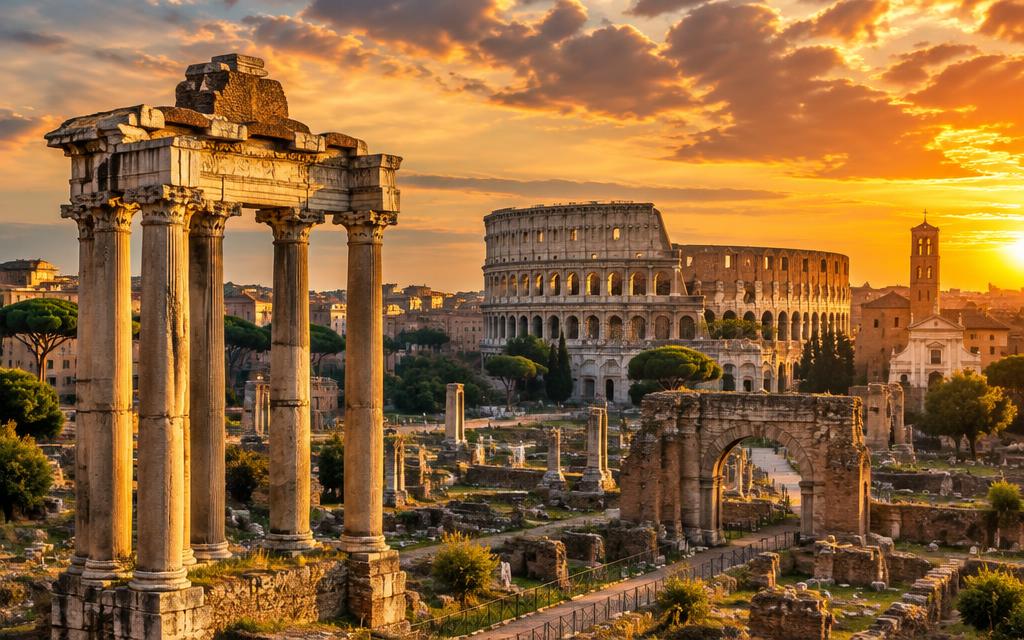 Trip.com
Compare bundles and combo tickets — Colosseum plus Forum, Vatican or hop-on buses in one booking.
Check pricesAffiliate links: we may earn a commission at no extra cost to you. Check each listing's cancellation terms before paying.
The 8-year answer
From the moment Vespasian's surveyors marked out the oval on the drained site of Nero's lake in AD 72, to Titus throwing open the doors for 100 days of games in AD 80 — eight years. For a building covering 24,000 m² with seating for 50,000 across four storeys, this is engineering legend.
Phases of construction
- AD 72–75 — foundations (up to 13 m deep) and outer ring
- AD 75–78 — tiers 1, 2 and 3 raised in parallel
- AD 78–80 — tier 4 attic and interior seating finished under Titus
- AD 80 — inauguration
- AD 81–96 — Domitian adds the hypogeum, the topmost wooden gallery, and the velarium (retractable awning) mast system
Where to buy Colosseum tickets
Start with the official Colosseum site, then compare Tiqets, Klook, and Trip.com — trusted booking partners — if official tickets are sold out.
OfficialColosseum SiteFace-value timed tickets from the official source.Official TicketsPartnerTiqetsTours and skip-the-line tickets when official slots are gone.Check PricesPartnerKlookAnother strong backup for sold-out dates and tours.Check PricesPartnerTrip.comUseful for comparing availability and bundles.Check PricesHow they built it so fast
Three factors made the speed possible:
- Roman concrete (opus caementicium): faster to pour than stone-by-stone masonry and cures harder underwater. The Pantheon's dome uses the same material 50 years later.
- Massive enslaved workforce: tens of thousands of Jewish prisoners from the AD 70 sack of Jerusalem, quarrying travertine at Tivoli (28 km away) and hauling it on a custom-built road.
- Modular design: 80 identical entrance arches around the perimeter meant construction crews could replicate the same template all the way round at once.
Why modern builders couldn't match it
A modern Colosseum built to ancient specifications would face safety regulations, environmental review, worker rights, complex procurement and zoning approvals — easily 15 to 20 years before a single block was laid. Roman builders had none of these constraints (and an unlimited supply of enslaved labour). Estimated cost in modern money: –1.5 billion.
Labour force: slaves, Jewish prisoners and Roman engineers
The construction of the Colosseum was an immense logistical undertaking that required a stratified workforce. At the base of this pyramid were an estimated 60,000 to 100,000 Jewish prisoners brought to Rome following the Siege of Jerusalem in AD 70. These individuals performed the backbreaking labor of quarrying over 100,000 cubic meters of travertine from Tivoli, transporting the massive blocks 20 miles to the construction site, and hauling materials to the upper tiers. However, the project wasn't just raw muscle. It required the sophisticated oversight of Roman engineers and architects who pioneered modular construction. Professional stonecutters, masons, and specialized builders worked alongside the enslaved population to ensure the structural integrity of the complex vaulted systems. This combination of brutal mass labor and advanced engineering management allowed the Flavian emperors to complete the "Flavian Amphitheatre" with a speed that still baffles modern project managers. By 2026, archaeological research continues to uncover how these different classes of workers interacted on-site, revealing a highly organized and disciplined hierarchy that kept the project moving.
Where to buy Colosseum tickets
Start with the official Colosseum site, then compare Tiqets, Klook, and Trip.com — trusted booking partners — if official tickets are sold out.
OfficialColosseum SiteFace-value timed tickets from the official source.Official TicketsPartnerTiqetsTours and skip-the-line tickets when official slots are gone.Check PricesPartnerKlookAnother strong backup for sold-out dates and tours.Check PricesPartnerTrip.comUseful for comparing availability and bundles.Check PricesWhy 8 years is staggering by ancient standards
To understand why an eight-year completion time is so remarkable, one must compare it to other monumental projects of the era. The Great Pyramid of Giza took approximately 20 to 27 years, and the Parthenon in Athens required 15 years—both for significantly smaller or less complex internal structures. The Colosseum was not just a shell; it was a functioning machine with 80 entrances, a complex network of corridors, and a sophisticated drainage system. Completing such a massive, multi-story structure in under a decade signaled the peak of Roman administrative and technical capability. It was a statement of power from the Flavian dynasty, proving they could mobilize resources and talent more efficiently than any previous regime. Even in the Middle Ages and Renaissance, cathedrals like Notre-Dame de Paris or St. Peter's Basilica took over a century to reach completion. The Flavian Amphitheatre’s rapid ascent from a drained lake to the world’s largest stadium remains a testament to what Roman society could achieve when focused on a single, massive propaganda goal for the citizens of Rome.
Continue reading about the Colosseum
ColosseumComplete History of the Colosseum
From inauguration in AD 80 to UNESCO World Heritage today.
ColosseumWhen Was the Colosseum Built? Full Timeline
AD 72 to AD 80 — emperor by emperor, year by year construction history.
ColosseumHow Big Is the Colosseum? Dimensions Explained
Length, width, capacity — and how it compares to modern stadiums.
ColosseumBest Photo Spots & Hidden Viewpoints
9 spots beyond the obvious shot from the metro exit — including hidden rooftop viewpoints most tourists miss.
Continuing to the Vatican?
- Doing both in one day? Colosseum and Vatican in one day
- Only time for one? Colosseum vs Vatican compared
- Heading over next? How to get to the Vatican Museums
- Haven't booked the Vatican yet? Can you buy Vatican tickets at the door?
- Packing for the visit? Vatican Museums security rules
Frequently Asked Questions
How many years did the Colosseum take to build?
About 8 years for the main structure (AD 72–80), and a further 16 years for Domitian's additions, totalling roughly 24 years.
How did the Romans build so quickly?
Massive workforce (an estimated 60,000+ Jewish slaves from Vespasian's wars), modular construction, opus caementicium (Roman concrete) that set faster than stone-by-stone masonry, and parallel work on all four sides simultaneously.
Who paid for the Colosseum?
The Flavian dynasty financed it with spoils from the Roman sack of Jerusalem in AD 70. An inscription reading 'EX MANUBIS' (from the spoils of war) was found on a reconstructed wall.
How long did it take to build St. Peter's Basilica in comparison?
120 years (1506–1626). The Sagrada Familia has been under construction since 1882. The Colosseum was built 15 times faster than St. Peter's.