Table of Contents
- 1. TL;DR — Key Facts at a Glance
- 2. Before the Colosseum: Nero's Lake
- 3. Construction: AD 72–80
- 4. The Golden Age: Games & Spectacles
- 5. Decline & Fall (5th–14th Century)
- 6. Why Is It Half-Destroyed?
- 7. Modern Era: From Ruin to Icon
- 8. Complete Timeline
- 9. FAQ
Where to buy Colosseum tickets
Start with the official Colosseum site, then compare Tiqets, Klook, and Trip.com — trusted booking partners — if official tickets are sold out.
OfficialColosseum SiteFace-value timed tickets from the official source.Official TicketsPartnerTiqetsTours and skip-the-line tickets when official slots are gone.Check PricesPartnerKlookAnother strong backup for sold-out dates and tours.Check PricesPartnerTrip.comUseful for comparing availability and bundles.Check PricesTL;DR — Key Facts at a Glance
Built
AD 72–80 (8 years)
Commissioned by
Emperor Vespasian (Flavian dynasty)
Capacity
50,000–80,000 spectators
Active use
~390 years of games
Estimated deaths
~400,000 humans, 1M+ animals
UNESCO Status
World Heritage Site since 1980
Before the Colosseum: Nero's Lake
The land where the Colosseum stands wasn't always public. Emperor Nero (r. AD 54–68) seized a vast area in the center of Rome after the Great Fire of AD 64 and built his extravagant personal palace — the Domus Aurea ("Golden House"). The grounds included gardens, pavilions, and an artificial lake right where the Colosseum sits today.
When Nero committed suicide in AD 68, the empire plunged into a brief civil war (the "Year of the Four Emperors"). The winner, Vespasian, needed to distance himself from Nero's excesses and win the people's loyalty.
His genius move: drain Nero's private lake and build the world's greatest public entertainment venue on top of it — giving back to the people what Nero had stolen.
Construction: AD 72–80
Construction probably began around AD 70–72 under Emperor Vespasian. The project was funded at least partly from the spoils of the Jewish War. Its workforce likely included enslaved labourers alongside skilled builders, craftsmen and engineers, but exact numbers are unknown. Its ancient name was the Flavian Amphitheatre; the name "Colosseum" became popular only much later. Domitian — not Vespasian or Titus — completed the major upper works and the permanent hypogeum. For dates and chronology in detail, see When Was the Colosseum Built?
Height
48 meters (157 ft) — 4 stories
Footprint
189m × 156m (620 × 512 ft)
Stone used
~100,000 cubic meters of travertine
Iron clamps
300 tonnes connecting stone blocks
Workforce
60,000–100,000 enslaved laborers
Arena floor
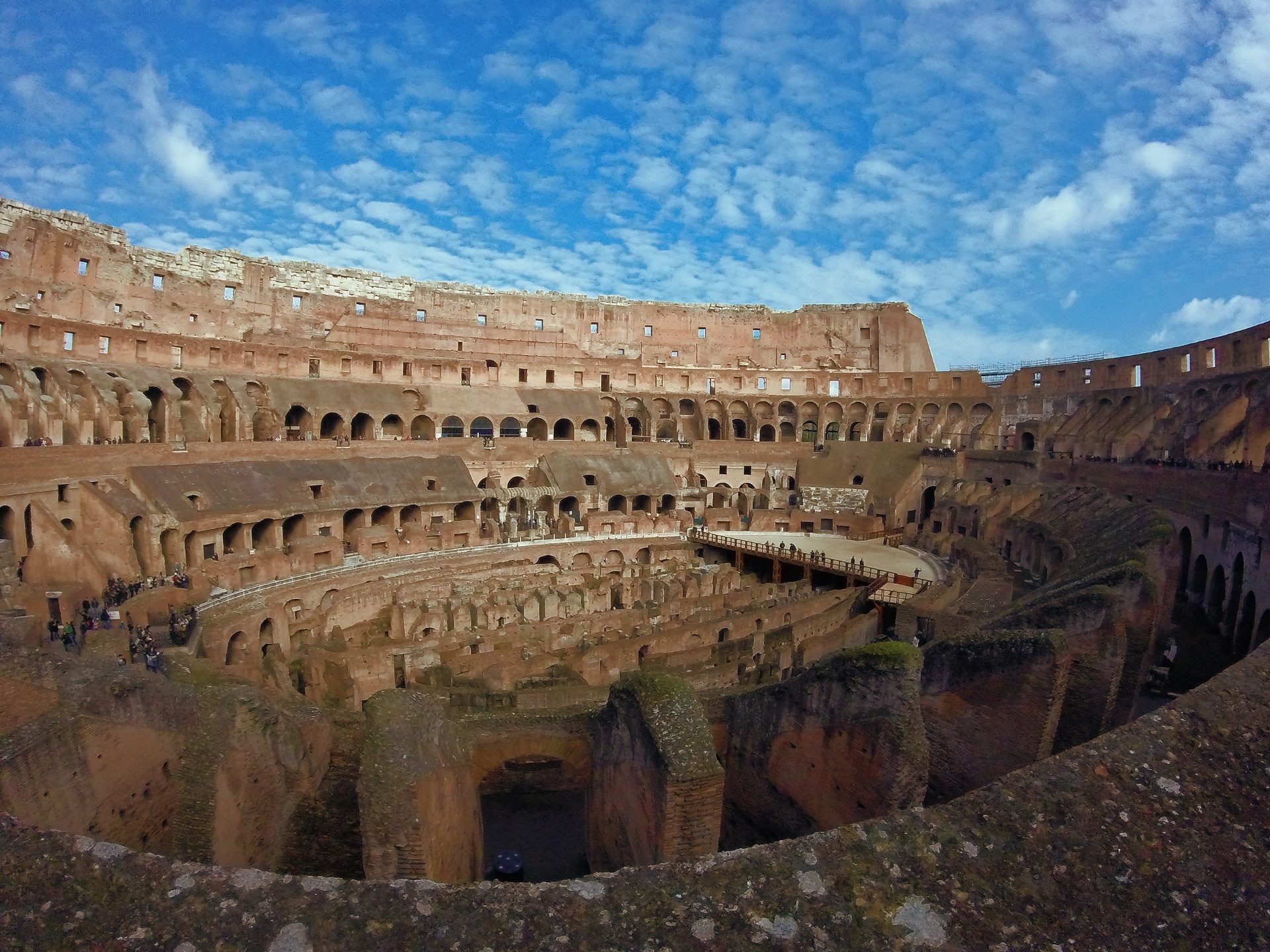
83m × 48m wooden floor covered in sand
Vespasian died in AD 79, just one year before completion. His son Titus inaugurated the Colosseum in AD 80 with 100 days of games — during which an estimated 9,000 animals were killed. Titus's brother Domitian later added the underground tunnels (hypogeum) and the top seating tier.
The official name was Amphitheatrum Flavium (Flavian Amphitheatre), after the Flavian dynasty. The name "Colosseum" came later, likely from the Colossus of Nero — a 30-meter bronze statue that once stood nearby.
The Golden Age: Games & Spectacles
For nearly 400 years, the Colosseum hosted the most spectacular public entertainment the ancient world had ever seen. Events were free for Roman citizens and served as a tool of political power — "bread and circuses."
Types of Events
Gladiatorial Combat (Munera)
Trained fighters — often slaves, prisoners, or volunteers — battled in pairs. Fights weren't always to the death; skilled gladiators were expensive and valuable. The crowd (and sponsor) decided the fate of the loser.
Animal Hunts (Venationes)
Exotic animals — lions, elephants, bears, rhinos, hippos, crocodiles — were shipped from across the empire. Hunters (venatores) fought them, or animals fought each other. Thousands of animals could be killed in a single day.
Public Executions (Noxii)
Condemned criminals were executed publicly, sometimes through elaborate mythological reenactments. This was considered the 'lowest' form of entertainment.
Water Spectacles (Naumachiae)
Ancient sources associate the early amphitheatre with water spectacles, although the scale and mechanics remain debated. Once the permanent hypogeum was constructed, flooding the main arena was no longer practical.
The human cost: Historians estimate roughly 400,000 people died in the Colosseum over its active lifespan. Over 1 million animals were killed. Emperor Trajan's 123-day festival in AD 107 alone involved 11,000 animals and 10,000 gladiators.
Decline & Fall (5th–14th Century)
As Christianity spread and the Roman Empire weakened, attitudes toward the games changed:
- AD 404Emperor Honorius officially banned gladiatorial combat after a monk named Telemachus was killed trying to stop a fight.
- AD 523The last recorded animal hunts took place — the end of 450 years of spectacles.
- AD 847A massive earthquake collapsed the Colosseum's entire south side.
- 1231Another major earthquake caused further structural damage.
- 13th–15th C.The Colosseum was repurposed as housing, workshops, a Christian shrine, and a quarry for building materials.
Why Is the Colosseum Half-Destroyed?
The Colosseum's missing outer wall isn't just from earthquakes. For centuries, it was used as a quarry. Rome's aristocracy and popes stripped its travertine, marble, and iron clamps to build:
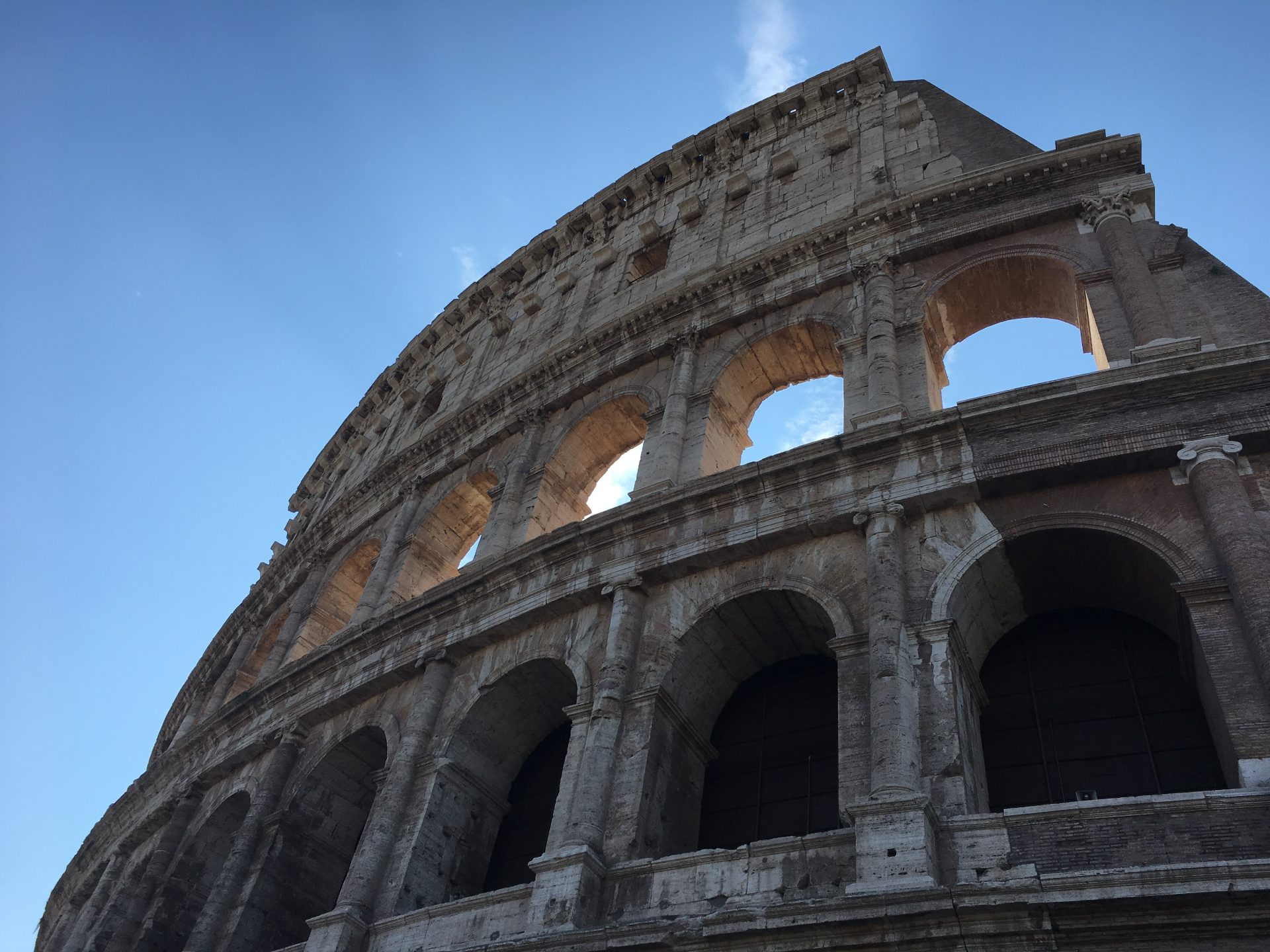
St. Peter's BasilicaPalazzo VeneziaPalazzo BarberiniPalazzo CancelleriaThe Tiber River embankmentsVarious Roman churchesThe holes you see pockmarking the outer wall are where medieval workers chiseled out the iron clamps holding the stones together — the 300 tonnes of iron were worth a fortune.
Modern Era: From Ruin to Icon
- 1749Pope Benedict XIV declared the Colosseum a sacred Christian site, halting further looting.
- 1807Systematic preservation and restoration began under Pope Pius VII.
- 1980UNESCO inscribed the Colosseum as part of the Historic Centre of Rome World Heritage Site.
- 2007Voted one of the New Seven Wonders of the World.
- 2013–2016€25 million restoration funded by Tod's luxury brand — cleaned the exterior walls for the first time.
- 2023–2026Ongoing project to rebuild a retractable arena floor, giving visitors a gladiator's-eye view.
Today, the Colosseum receives approximately 7 million visitors per year, making it Italy's most visited monument and one of the world's top tourist attractions.
Complete Timeline
AD 64Great Fire of Rome — Nero seizes land for Domus AureaAD 68Nero commits suicide; Year of the Four EmperorsAD 72Vespasian begins construction on Nero's drained lakeAD 79Vespasian dies; his son Titus continues the projectAD 80Titus inaugurates the Colosseum with 100 days of gamesAD 81–96Domitian adds the hypogeum and top levelAD 107Trajan's 123-day festival (11,000 animals, 10,000 gladiators)AD 217Lightning fire damages upper levels; repairs take 20+ yearsAD 404Gladiatorial combat officially bannedAD 523Last recorded animal huntsAD 847Major earthquake collapses south wall1231Second major earthquake1349Black Death devastates Rome; Colosseum further neglected1749Pope declares it a sacred site, ending looting1980UNESCO World Heritage Site designation2007Named one of the New Seven Wonders of the World🏨 Staying Near the Colosseum?
We researched and ranked the 10 best hotels within walking distance of the Colosseum — from luxury boutiques to affordable gems, all rated 9.0+ by guests.
All rated 9.0+ Within 200m–1.8kmRead: 10 Best Hotels Near the ColosseumWhat Happened to the Colosseum After Rome Fell?
The Colosseum's most fascinating chapter is not the 400 years of gladiatorial games — it is the 1,500 years afterwards. After the last recorded animal hunt in AD 523, the structure was abandoned by the imperial state and adopted by ordinary Romans for whatever they needed: a quarry for building stone, a fortified residence for the Frangipani family who turned the southern end into a private castle in the 1100s, and a hub of small workshops, stables, and even fishmongers' stalls operating between the arches.
From the 14th century onward, popes systematically dismantled the outer ring to build the new Christian Rome — the Palazzo Venezia, Palazzo Barberini, and parts of St. Peter's Basilica all contain Colosseum travertine. The looting only ended in 1749 when Pope Benedict XIV declared the arena floor a sacred site of early Christian martyrdom, planted a cross, and banned further demolition. Archaeological excavation began in the 1810s under Napoleon's administration, the underground hypogeum was finally cleared in 1874, and the Arena Floor reconstruction visible to visitors in 2026 dates from a 2023 €22 million project. The ruin you see today is the result of two millennia of continuous reuse, neglect, looting, and finally protection.
Frequently Asked Questions
How old is the Colosseum?
Nearly 2,000 years old. Construction began in AD 72 and was completed in AD 80. The inaugural games lasted 100 days.
Why was the Colosseum built?
Emperor Vespasian built it as a public entertainment venue to replace Nero's private palace — a political move to win the people's favor and establish the Flavian dynasty.
How many people died in the Colosseum?
Historians estimate roughly 400,000 people and over 1 million animals died over approximately 390 years of active use.
When did the Colosseum stop being used?
Gladiatorial combat was banned in AD 404. The last animal hunts occurred in AD 523. After that, it was repurposed as housing, workshops, and a quarry.
Why is the Colosseum partially destroyed?
Earthquakes (AD 847, 1231) caused major damage, and for centuries its stone was quarried to build palaces and churches — including parts of St. Peter's Basilica.
Is the Colosseum a UNESCO World Heritage Site?
Yes, since 1980. It's also one of the New Seven Wonders of the World (2007).
What was the Colosseum used for after gladiator games were banned?
After gladiatorial combat was banned in AD 404 and the last animal hunts ended around AD 523, the Colosseum was repurposed continuously for over a thousand years: a Christian cemetery in the 6th century, fortified housing and workshops for the Frangipani noble family in the 12th century, a quarry for popes building St. Peter's Basilica from the 14th–17th centuries, and finally a consecrated Christian shrine after Pope Benedict XIV halted the looting in 1749.
Who saved the Colosseum from being completely destroyed?
Pope Benedict XIV in 1749. By the mid-18th century roughly two-thirds of the outer wall had already been quarried and the rest was scheduled to follow. Benedict XIV consecrated the arena floor as a site of Christian martyrdom (planting the wooden cross still visible today at the eastern end) and forbade further removal of stone. Without that single 1749 decree, the Colosseum we visit in 2026 would not exist — the remaining travertine would have ended up in baroque palaces.
Explore each chapter in depth
- Construction dates and chronology → When Was the Colosseum Built?
- Purpose and politics → Why it was built (this timeline)
- Spectacles and events → What Was the Colosseum Used For?
- Gladiators → Gladiators of the Colosseum
- Construction techniques → Engineering Secrets of the Colosseum
- Original appearance → What Did the Colosseum Look Like?
Continue Reading
What Happened Inside? Gladiators ExplainedHow It Was Built: Engineering SecretsWhen Was the Colosseum Built? Full TimelineWhat to See: Every Level & HighlightColosseum Tickets Guide 2026Colosseum Attraction PageWhere to buy Colosseum tickets
Start with the official Colosseum site, then compare Tiqets, Klook, and Trip.com — trusted booking partners — if official tickets are sold out.
OfficialColosseum SiteFace-value timed tickets from the official source.Official TicketsPartnerTiqetsTours and skip-the-line tickets when official slots are gone.Check PricesPartnerKlookAnother strong backup for sold-out dates and tours.Check PricesPartnerTrip.comUseful for comparing availability and bundles.Check PricesMore Colosseum Stories & Practical Tips
Keep exploring — the full AllTrips Colosseum visitor library.
Before You Visit the Colosseum
The 10-minute checklist that prevents 90% of mistakes.
Best Way to Visit the Colosseum
Routes and timing by traveler type, layover, and budget.
Colosseum Engineering Secrets
How Romans built it — and what modern stadiums copied.
Gladiators of the Colosseum
Training, daily life, and the truth behind the myths.
Missed Your Entry Slot?
What to do in the first 15 minutes — and what not to.
Visiting the Colosseum in the Rain
Why bad weather can be the best visit you'll have.
Colosseum Tickets Guide
Every ticket type, price and what's actually included.