Pompeii Day Trip From Rome: By Train or Tour?
Updated · 11 min read · By the AllTrips Rome editorial team
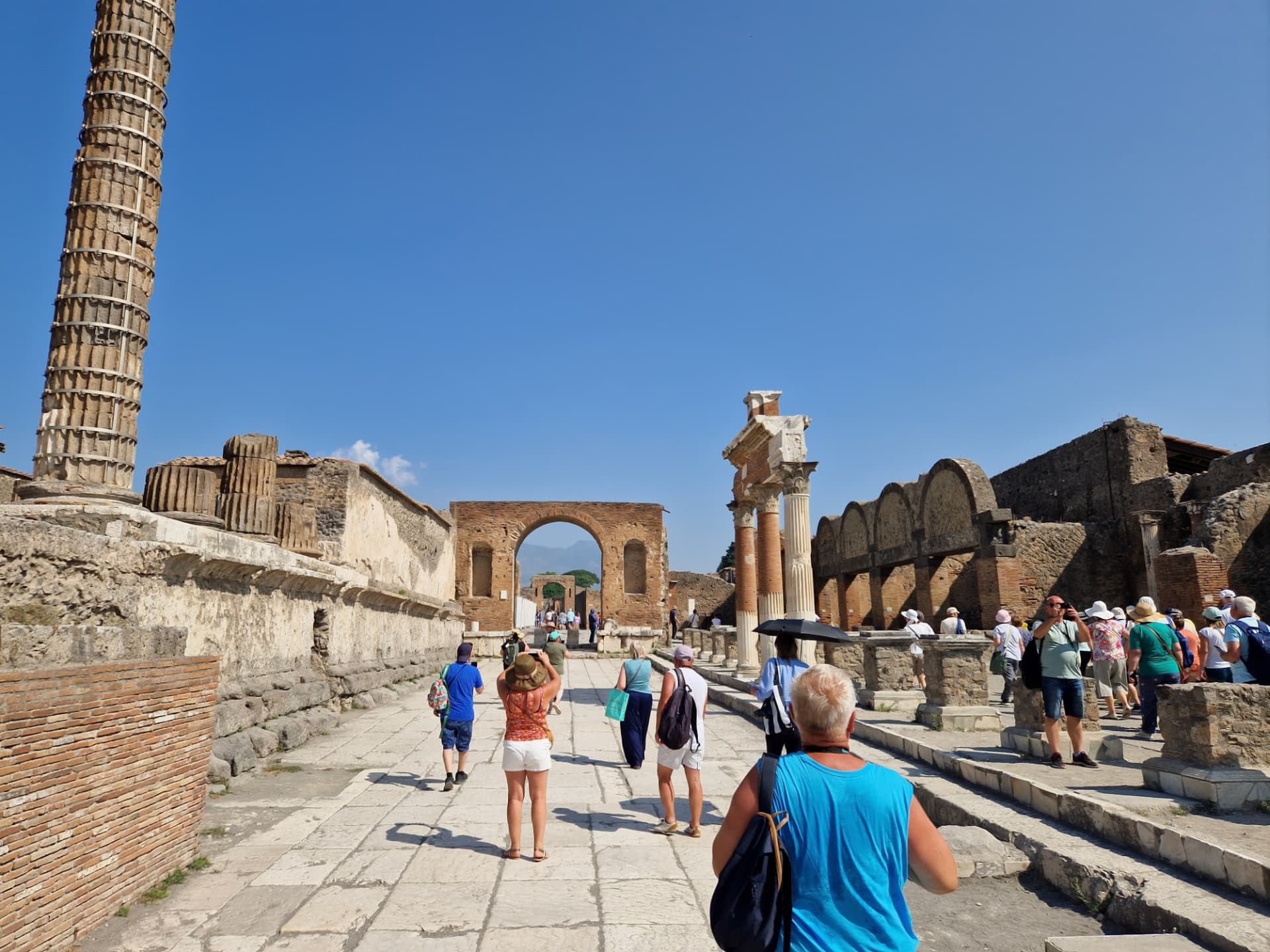
Yes, you can visit Pompeii from Rome in one day, but whether you should depends on the journey time, one awkward transport change in Naples and how much of the site you actually want to see. Travelling independently by high-speed train is faster and cheaper than most people expect and leaves you free to spend longer inside within opening hours. Allow a 10–12-hour day from your Rome accommodation. A transport-included tour manages the Naples connection and may avoid ticket-office queues, but not security or gate congestion, at the cost of a fixed schedule. Here is how the two options compare.
Pompeii from Rome at a glance
| Option | One-way travel | Whole day | Changes | Flexibility | Best for |
|---|---|---|---|---|---|
| Independent train | About 2½–3 hours from Termini to the gate, plus travel to Termini | 10–12 hours, with 3–4 hours in Pompeii | Usually one, at Naples | High | Confident travellers who want time inside the site |
| Guided tour | Product-dependent; coach legs are often longer than the train | Often 11–13 hours; time in Pompeii varies by product | None for the traveller | Lower | Easiest planning and built-in commentary |
| Pompeii plus another destination | Tour-dependent | Commonly 12 to 14 hours, with shorter time in Pompeii | Tour-dependent | Low | Travellers with one day and two must-sees |
Times are indicative. Rail schedules change seasonally — check Trenitalia or Italo for the Rome–Naples leg and the EAV site for Circumvesuviana and Campania Express services before you commit. If you are choosing between options, see Naples and Pompeii in one day or Pompeii and the Amalfi Coast in one day.
Choose the train or a tour?
| Choose train if… | Choose a tour if… |
|---|---|
| You want flexibility and longer inside Pompeii | You accept a fixed schedule |
| You can book trains early | You want a simpler departure from Rome |
| You are comfortable navigating Naples | You dislike managing connections |
| You will arrange commentary separately | You want a guide included — check the product |
Is Pompeii worth visiting from Rome for one day?
For most people with a spare day in Rome, yes. The high-speed line makes Naples closer to Rome than many Italian regions, and no other site within reach gives you a whole Roman city — streets, shopfronts, painted dining rooms, a stadium-sized amphitheatre — rather than isolated monuments. Three to four hours inside is enough to feel you have seen Pompeii rather than sampled it.
It is not the right choice for everyone. Skip it if you have fewer than three full days in Rome and have not yet seen the Colosseum, the Forum and the Vatican; if you are travelling with under-fives or anyone who cannot manage two hours of uneven ancient paving; or if you are visiting in July or August and heat is already a problem, because much of the archaeological route is exposed, with limited shade. Skip it, too, if a fixed evening commitment in Rome would be ruined by a delayed return train — that risk is real and worth pricing in.
The honest summary: it is a rewarding day, but it is a travel day. You will spend roughly five to six hours travelling and making connections for three to four hours on site. If that ratio bothers you, Ostia Antica is the closer alternative and needs no long-distance train at all.
How to get from Rome to Pompeii by train
The independent route has three legs, and only the middle one catches people out.
1. Roma Termini to Napoli Centrale
High-speed trains — Trenitalia Frecciarossa and Italo — run frequently through the morning and take roughly 70 minutes on the fastest services, a little over two hours on cheaper Intercity trains. A few high-speed departures also leave from Roma Tiburtina, which is handy if you are staying east of the centre. Book as soon as your date is firm for the best chance of a low fare; late and walk-up fares on the fast trains are usually the expensive ones.
2. Walk down to the local platforms
The Circumvesuviana runs from the lower level of Napoli Piazza Garibaldi, directly beneath Napoli Centrale — follow signs for Circumvesuviana or EAV rather than leaving the building. Walking down, buying a ticket and finding the platform can take 15–25 minutes if the station is new to you, plus waiting for the next suitable train — so allow 30–45 minutes for the whole connection. Trains towards Sorrento are the ones you want; those towards Sarno or Poggiomarino do not serve the site entrance.
3. Circumvesuviana or Campania Express to the site
The Sorrento line reaches Pompei Scavi–Villa dei Misteri in roughly 35 to 40 minutes. Ordinary Circumvesuviana trains are cheap, frequent and basic: old rolling stock, no air conditioning worth the name in summer, and standing room at peak times. The Campania Express is the same route with limited stops, guaranteed seating and a higher fare, running only a handful of times a day. EAV has announced that the service will be suspended from 1 October 2026 until further notice, so do not assume it will operate on your date — check the official EAV schedule before booking.
Pompei Scavi is not the same as Pompei
Two different stations carry almost the same name. Pompei Scavi–Villa dei Misteri, on the Circumvesuviana from Naples, sits a couple of minutes from the Porta Marina entrance to the archaeological park. Pompei, on the Trenitalia regional line, serves the modern town and leaves you a walk of roughly 10 to 15 minutes from the Piazza Anfiteatro entrance. Neither is wrong, but they are different gates — check which one your ticket or tour meeting point refers to. PompeiLink train-and-bus availability, stops and ticket arrangements must be checked on Trenitalia for your intended date; do not assume it serves the same entrance.
Coming back, reverse the sequence and build in a buffer. The Circumvesuviana is the weak link: it is prone to delays, occasional strike days and crowding, and missing your reserved high-speed seat at Naples may mean paying a change fee or buying a new ticket, depending on your fare’s conditions. Leaving Pompeii around 90 minutes before your booked departure from Napoli Centrale is comfortable; 45 minutes is not. If you would rather not carry that risk at all, a changeable rail fare may help, subject to its conditions; a transport-included tour handles the connection but cannot eliminate delays.
Pompeii tickets: official booking and entry rules
Checked September 14, 2026: tickets are personalised and the park limits admission to 20,000 visitors daily. Book in each visitor’s name, carry matching ID and follow the entry period printed on your ticket. The authorised online seller is Vivaticket, linked from the official Pompeii tickets and opening-hours page.
Pompeii Express (€20 full price) covers the ancient city but not the suburban villas. Pompeii Plus (€25 full price) also includes the Villa of the Mysteries, Villa of Diomedes and Villa Regina with the Boscoreale Antiquarium, plus the shuttle. Broader products cover additional sites; compare inclusions rather than assuming every ticket is the same. Prices and access can change.
Express and Plus permit one entry: you cannot leave for lunch and re-enter on the same ticket. Houses and villas can close for conservation or have earlier afternoon cut-offs than the main park. Check the official building-opening list before choosing your route.
Rome to Pompeii train costs
Treat all of these as approximate ranges rather than fixed prices. Italian high-speed fares are dynamic: they open low weeks ahead and climb as the train fills, so the same Frecciarossa seat can be around €20 booked early and two or three times that on the morning of travel. Italo prices the same route competitively, and it is worth checking both.
- Rome to Naples, high speed: roughly €20–€60 each way, depending how far ahead you book.
- Rome to Naples, Intercity: often €15–€30 each way, slower but far less volatile.
- Naples to Pompei Scavi, Circumvesuviana: a few euros each way.
- Campania Express: noticeably more than the ordinary train, in the region of €15 each way, with a reserved seat — but EAV has announced the service is suspended from 1 October 2026 until further notice.
- Pompeii entry: standard Pompeii Express admission is €20, and broader park products cost more. Visitors under 18 enter free with valid identification; the €2 reduced ticket applies to eligible EU citizens aged 18–25. Verify the current tariff on the official park website before you travel.
Advance-booking example: a solo traveller who books the high-speed trains well ahead may do the whole day for roughly €70–€90 including entry. This is not a guaranteed figure — booking in the last few days, or on the morning of travel, can cost considerably more. A transport-included guided tour typically costs more than that, and buys you the removal of the Naples transfer plus commentary on site.
A realistic Pompeii day-trip itinerary
This is the shape of a comfortable independent day rather than a specific set of departures. Adjust it to whatever trains are actually running on your date.
07:00Leave your Rome accommodation. Allow time for security and platform hunting at Termini — it is a big, busy station.
07:45High-speed train to Naples. Eat breakfast on board rather than losing time later.
09:00Arrive Napoli Centrale. Walk down to the Circumvesuviana platforms at Piazza Garibaldi.
09:20Local train towards Sorrento, alighting at Pompei Scavi–Villa dei Misteri.
10:00Enter at Porta Marina. Collect a map or load the official park app before you lose signal in the crowd.
10:00–13:30Three and a half hours inside the site, following the route below.
13:30Lunch. Use permitted on-site food/rest areas if continuing your visit. Leaving the park for lunch ends your visit: the same ticket does not allow re-entry.
14:30Optional extra hour — the amphitheatre and the Great Palaestra at the far end, or the Villa of the Mysteries if your ticket includes suburban villas and access is still open.
15:30Circumvesuviana back to Naples, arriving with time in hand.
16:45High-speed train from Napoli Centrale.
18:15Back in Rome, tired but with the evening intact.
That is an eleven-hour day door to door. It can be compressed by an hour at each end, but the compressed version is the one that goes wrong when a local train is late.
What to see in Pompeii in three to four hours
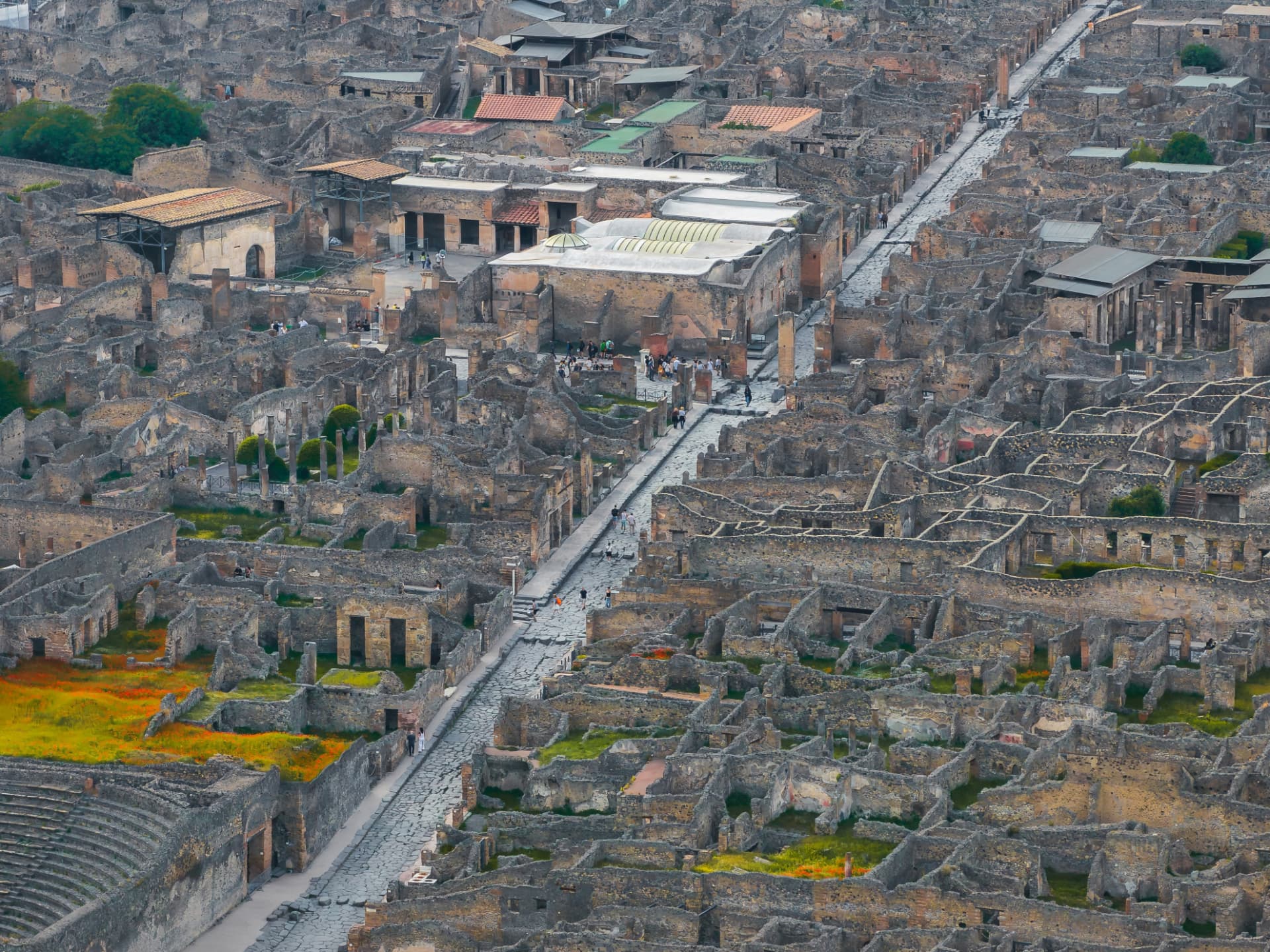
The excavated city covers around 44 hectares and you will not walk all of it. Individual houses also rotate in and out of access for conservation, so treat any list as a plan rather than a guarantee. This set of stops is a menu of highlights rather than a single fixed walking order. Open the official park map (or the MyPompeii app) on arrival, check which buildings are open that day, and link your chosen stops without doubling back.
Core stops near the Porta Marina entrance
- The Forum. The civic heart, with Vesuvius framed at the end of the square — the one view everyone recognises.
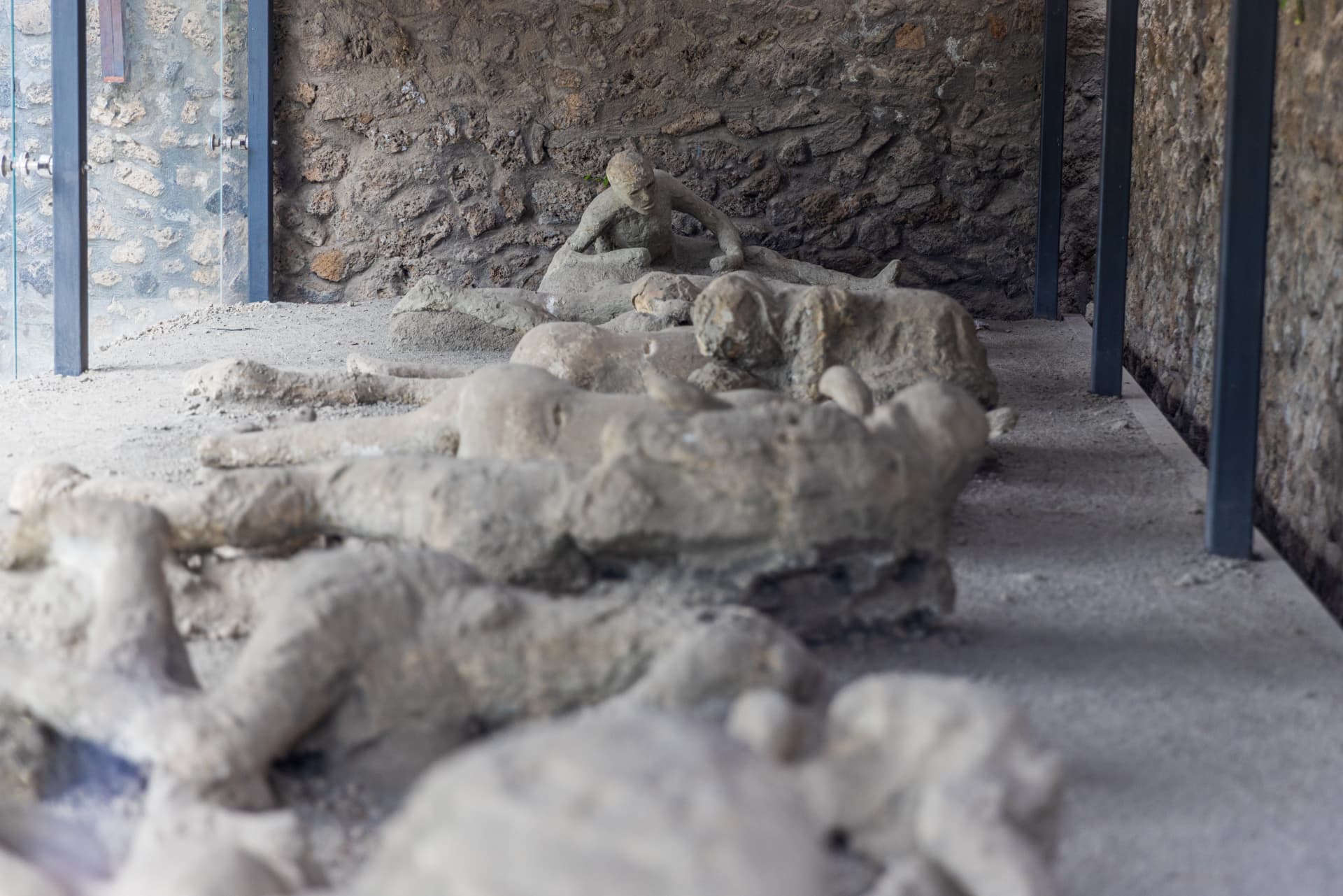
- The Forum Granary. Storerooms stacked with amphorae and some of the plaster casts of victims, visible through railings.
- House of the Vettii or House of the Faun. North of the Forum; choose whichever is open — these hold the wall paintings and mosaics.
- The Stabian Baths and the Lupanar. Close together just east of the Forum; the Lupanar is small and often queued.
- The theatre district. The Large Theatre and the covered Odeon, south of Via dell'Abbondanza.
- Via dell'Abbondanza. The main commercial street, with bars, laundries and election graffiti still legible on the walls.
Alternative extensions at opposite ends of the site — usually choose one
- East: the Amphitheatre and Great Palaestra. At the far end of Via dell'Abbondanza, included with the standard ticket.
- West: the Villa of the Mysteries. Outside the walls near the Scavi station; requires a ticket covering the suburban villas and entry before its cut-off.
Pompeii core route and extensions


 📍
📍
📍
📍
📍
📍
📍
📍
+− Leaflet | © OpenStreetMap contributors
📍
📍
📍
📍
📍
📍
📍
📍
+− Leaflet | © OpenStreetMap contributorsMap data © OpenStreetMap contributors. Core stops sit near Porta Marina; the Amphitheatre (east) and Villa of the Mysteries (west) are at opposite ends, so most day-trippers pick one. Pins are approximate.
Best Pompeii tours from Rome
Our booking link below opens a comparison of Pompeii day trips from Rome, not a single recommended product. Listings differ in meeting point, Naples transfer, admission and whether the guide accompanies you inside the park. Organised departures fall into four types, and the differences matter more than the price:
- Train-based day trips. High-speed rail to Naples with the onward transfer and site entry handled. Often the best-balanced option, but inclusions vary — check whether the guide stays with you inside Pompeii and how many hours you get on site.
- Coach day trips. Cheaper and door-to-door from a central Rome meeting point, but the drive is roughly three hours each way, which turns the day into twelve or thirteen hours with less time inside.
- Pompeii plus Vesuvius or Herculaneum. A genuinely full day, and hot work in summer — the Vesuvius crater path is loose gravel with no shade. Suited to fit travellers starting early.
- Entry with a guide or audio guide only. Cheapest way to solve the real problem, if you are happy to arrange your own trains. Pompeii rewards commentary more than almost any site in Italy.
Whichever type you choose, check these points on the listing before booking: transport (and whether the Naples transfer is included), whether park entry is included or bought separately, whether the guide accompanies you inside and for how long, the hours on site, and where the tour ends — some coach returns drop you at Termini rather than the original meeting point.
Affiliate link. You pay the same price and we may earn a small commission, which funds this site's research.
Want the simplest option?
Compare Pompeii day tours from Rome, including transport-included departures and guided-entry options, with live prices and availability for your date.
Compare Pompeii day tours from RomeTrain or tour: which should you choose?
First-time visitors: either works, but take commentary in some form. If you are comfortable with Italian rail, book your own trains and add a guided entry; if not, a train-based tour costs more and handles the main logistics — but compare meeting points, the Naples transfer, entry and guiding on the specific listing.
Families: a tour, if the children are old enough for the walking. Fixed timings and a guide who knows which streets hold attention beat managing a Circumvesuviana change with tired kids. Families with under-fives should consider a closer option in Rome instead.
Travellers with limited mobility: think carefully. Pompeii has a marked accessible route of a few kilometres on modern surfaces, but much of the city is original basalt paving with high kerbs and stepping stones. Check the park's current accessible itinerary and visitor information before you go. Getting to the gate and getting around inside are separate problems: the Circumvesuviana has limited step-free access, a private accessible transfer may be easier, and a standard group coach can itself have boarding limitations — confirm vehicle accessibility directly with the operator before booking.
Budget travellers: independent, booking the high-speed train several weeks ahead or taking an Intercity, then the ordinary Circumvesuviana. It is often the cheapest route, especially with early rail bookings — but last-minute fares or a discounted tour can change the comparison, so price both.
Anyone anxious about train changes: take the tour. The Naples transfer is not difficult, but it is busy, poorly signed in places and the one part of the day with a real failure mode.
Travellers who also want the Amalfi Coast: only a tour makes that combination realistic in a day — see the next section and our Pompeii and Amalfi Coast guide for why it may still be a bad idea.
Pompeii and Amalfi Coast in one day: is it too much?
It is possible, and organised tours sell the combination all summer. It is also a 12 to 14-hour day that usually starts before 07:00 and returns to Rome after 21:00. The arithmetic is unforgiving: around six hours of driving, roughly two hours in Pompeii, and the coast seen largely through a coach window with one stop in Positano or Amalfi.
Two hours is enough for selected highlights with a guide, not a broad visit. The coastal road is also slow and prone to summer congestion, so delays eat into the stop rather than the driving.
If Pompeii is the priority, do it on its own by train and allow 10–12 hours door to door. If the coast is the priority, give it its own day — ideally by train to Salerno and ferry along the coast, which is pleasanter than the road. Combine the two only if this is your single free day and you accept that you are sampling both.
Essential Pompeii day-trip tips
- Footwear decides your day. Original basalt paving, raised stepping stones and loose gravel. Trainers or walking shoes only — no sandals with thin soles.
- Heat is the main hazard. Much of the archaeological route is exposed, with limited shade. From June to early September, be inside by opening time, take a hat, and plan the amphitheatre for late afternoon rather than midday.
- Water is free. Drinking fountains are dotted around the site; bring a refillable bottle rather than buying at the gate.
- Travel light. Bags larger than 30 × 30 × 15 cm are not permitted inside and must be left in storage, which costs you queue time in both directions. Travel with a small daypack and check the current storage arrangements before arriving.
- Book entry ahead in high season. Personalised tickets and daily entry limits apply; walk-up purchase may still be possible, but capacity limits and queues make advance booking strongly advisable on summer weekends.
- Check strike days. Italian rail strikes are announced in advance. Check both Trenitalia and EAV service notices the day before.
- Download the official park map. Mobile signal inside the site is patchy and the free paper map runs out.
- Accessibility. The park publishes an accessible itinerary on modern walkways; check its current extent before travelling, as sections close for works.
Frequently asked questions
Can you take a direct train from Rome to Pompeii?
No. There is no direct service from Roma Termini to the archaeological site. The standard route is a high-speed train to Napoli Centrale followed by the Circumvesuviana to Pompei Scavi–Villa dei Misteri. Campania Express follows the same corridor with reserved seating, but EAV has announced its suspension from October 1, 2026, until further notice. Some regional trains on the Naples–Salerno line stop at Pompei, but that station serves the modern town rather than the main entrance.
How many hours do you need in Pompeii?
Three to four hours inside the site is the realistic figure for a day trip from Rome. That is enough for the Forum, the theatre district, the amphitheatre and two or three houses at a steady pace. Seeing most of the excavated area properly takes a full day or two visits, which is not compatible with returning to Rome the same evening.
Can you combine Naples and Pompeii in one day from Rome?
You can, but something gets squeezed. A workable version is about three hours in Pompeii and two hours in Naples for the Archaeological Museum, which holds the mosaics and frescoes removed from the site. Adding a Naples walking tour or a pizza sit-down on top usually means leaving Pompeii before you have finished it. The museum normally closes on Tuesdays (with holiday exceptions), so check museoarcheologiconapoli.it before choosing that day.
Is Pompeii better than Ostia Antica?
Pompeii is the more complete and more famous city, and the frescoes and plaster casts have no equivalent near Rome. Ostia Antica is around 45 minutes from central Rome on one urban train line, costs a fraction of the day and is far less crowded. If you have one spare day and want the landmark, go to Pompeii. If you have half a day, or the group includes small children or anyone who tires easily, Ostia is the better use of the time.
Is a Pompeii guided tour worth it?
For most first-time visitors, yes — but for the commentary rather than the queue. Pompeii without context is street after street of low walls, and the site signage is uneven. A guide or a good audio guide turns those walls back into bakeries, laundries and dining rooms. A full transport-included tour is worth the premium mainly if the Naples transfer is the part you want removed.