Table of Contents
- 1. The big-picture context
- 2. The ceiling in plain English
- 3. The Last Judgment in plain English
- 4. The side walls (everyone forgets)
- 5. The corner pendentives
- 6. How to 'read' the whole Chapel
Where to buy Vatican Museums tickets
Try the official Vatican Museums site first, then compare Tiqets, Klook, and Trip.com — trusted booking partners — if official slots are sold out.
OfficialVatican MuseumsFace-value timed tickets from the Vatican's official ticketing site.Official TicketsPartnerTiqetsSkip-the-line tickets and guided tours when official slots are gone.Check PricesPartnerKlookCheck alternative ticket and tour availability.Check PricesPartnerTrip.comBundle Vatican tickets with hotels and city passes.Check PricesThe big-picture context
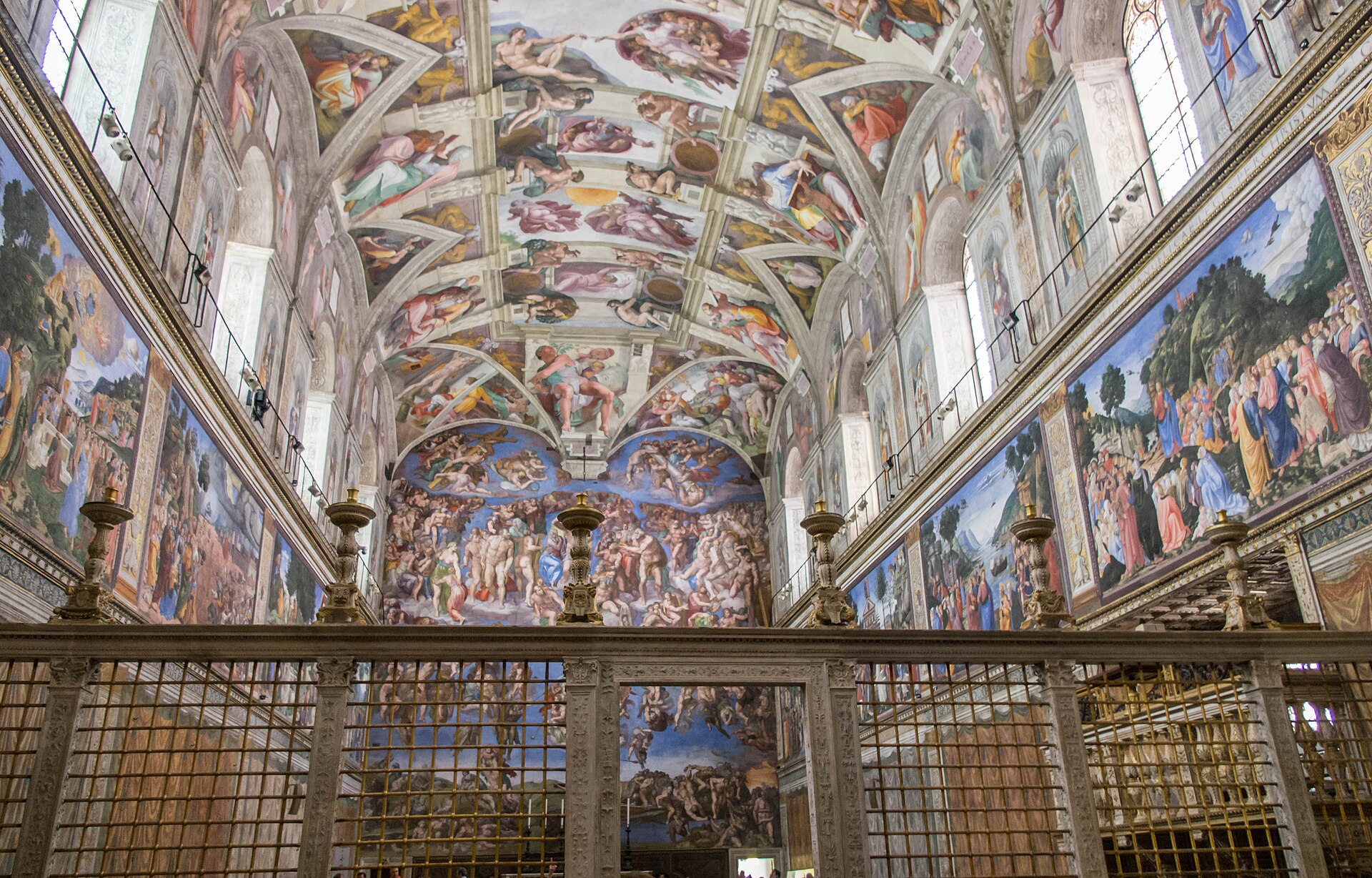
The Sistine Chapel is one visual sermon in three parts: ceiling (creation and the Old Testament), altar wall (the end of the world / Christ's judgment), and side walls (parallel stories of Moses and Jesus).
The whole design says: God made us, we failed, prophets predicted a savior, Jesus came, and one day he'll return to judge everyone. You can read the whole Chapel in that arc without knowing any specific figure.
The ceiling in plain English
Nine rectangular panels running altar-to-entrance. Read them like a comic strip from the altar end backwards:
- God separates light from darkness.
- God creates the sun, moon, and plants.
- God separates land from sea.
- God gives life to Adam (the famous fingertip scene).
- God creates Eve from Adam's rib.
- Adam and Eve eat the fruit and are exiled.
- Noah offers a sacrifice after the flood.
- The great flood destroys humanity.
- Noah gets drunk and shamed.
Around them: 12 huge figures (prophets and pagan sibyls) who predicted a savior would come. Between them: 20 naked youths (Ignudi) holding decorative garlands. Their precise symbolic meaning remains debated.
The Last Judgment in plain English
The huge altar wall. It shows the second coming of Christ at the end of the world.
- • Center top: Christ, muscular and beardless, raising his right hand as judgment is delivered.
- • Uppermost lunettes: Angels carrying the instruments of the Passion — the cross, the column, the crown of thorns.
- • Below and to Christ's right — your left: The resurrected rise and are drawn toward heaven.
- • Lower right area: The damned are dragged down into hell.
- • Bottom right: Charon the boatman ferries the damned across a river.
- • Just below Christ and slightly to the viewer's right: St. Bartholomew holds his own flayed skin. The face on the skin is widely read as Michelangelo's self-portrait.
- • Corner detail: A figure with donkey ears is traditionally identified as Biagio da Cesena, a Vatican official Michelangelo painted in after he complained about the nudity.
The side walls (everyone forgets)
The twelve surviving principal narrative scenes were painted about 25 years before Michelangelo touched the ceiling. (The entrance-wall scenes you see today are later replacements: the originals were destroyed when the doorway collapsed in 1522.) Facing the altar, the Stories of Christ run along the left-hand wall and the Stories of Moses along the right-hand wall, paired scene by scene:
- • Moses' journey to Egypt / Jesus' baptism
- • Trials of Moses / Temptations of Christ
- • Crossing the Red Sea / Calling of the Apostles
- • Moses receives the Law / Sermon on the Mount
- • Punishment of Korah / Christ gives keys to Peter (Perugino)
- • Testament and death of Moses / Last Supper
Painted by Botticelli, Perugino, Ghirlandaio, Rosselli, and Signorelli — top names in the 1480s, all now overshadowed by Michelangelo.
The corner pendentives
Four dramatic Old Testament rescue scenes fill the corner pendentives: David beheading Goliath, Judith carrying Holofernes' head, the Brazen Serpent (Moses lifts up a snake to heal the Israelites), and Esther saving her people from Haman. Each one prefigures Christ's salvation of humanity. (The smaller triangular compartments around the ceiling — the spandrels — hold the ancestors of Christ, which is a different set of images.)
How to 'read' the whole Chapel
- Enter and pause at the back. Look up — this is the story of creation ending in the flood.
- Walk toward the altar, still looking up. You're moving backwards through time toward the creation of the world.
- Turn to the altar wall — this is the end of that world.
- Now turn to the side walls. Facing the altar, the Stories of Christ run along the left-hand wall and the Stories of Moses along the right-hand wall, telling parallel stories of God's chosen leaders.
- Sit on a bench and let it settle. The whole room is one continuous narrative.
Frequently Asked Questions
Are the side walls painted?
Yes — with the twelve surviving principal narrative frescoes by Botticelli, Perugino, Ghirlandaio and others (1480s). Beautiful but overshadowed by Michelangelo's ceiling.What's the main story?
Genesis on the ceiling, the second coming of Christ on the altar wall, and parallel lives of Moses and Christ on the side walls.Are all the paintings by Michelangelo?
Only the ceiling and the altar wall. The side walls are by earlier Renaissance masters — Botticelli, Perugino, Rosselli, Ghirlandaio, Signorelli.Why are there naked people?
Michelangelo used the nude human body to convey spiritual truth — a common Renaissance idea. It caused huge controversy; loincloths were added to some figures beginning in the 1560s, in a campaign that continued over time rather than in a single moment.What language is the Chapel 'in'?
Latin inscriptions on the side walls, but the paintings themselves are visual — you don't need to read anything to follow the story.Related Vatican guides
Sistine Chapel Art Guide
The deeper decode.
Ceiling Explained for First-Timers
Ceiling-only, simpler.
Michelangelo at the Vatican
All his works in one visit.
Why Is the Chapel So Famous?
The context behind the fame.
Full Vatican Museums attraction guide See Rome attractions by area on the map