 Ticket Required
MACRO Museum
Rome's most experimental contemporary museum — €6 ticketed exhibitions, a changing programme of free performances and events, dramatic Odile Decq architecture and a rooftop restaurant terrace, all inside a converted 19th-century Peroni brewery on Via Nizza.
1–1.5 hours€6 / €4ContemporaryOdile Decq, 2010Via Nizza 138, 00198 Roma RMOpen on MapPlan Your Visit
Compare tickets, tours and stays — booking ahead usually gives more choice
Get TicketsBook a TourHotels NearbyBy AllTrips Editors••9 min readMACRO (Museo d'Arte Contemporanea Roma) is the City of Rome's museum of contemporary art, housed inside a converted late-19th-century Peroni beer factory on Via Nizza in the Salario-Nomentano district. Founded in 1999, it was radically expanded in 2010 with a striking black-and-red glass extension by Odile Decq. Since 2020 it has operated as a 'Museum for Preventive Imagination' — an experimental, programme-driven space with 6–8 rotating exhibitions a year. MACRO combines €6 ticketed exhibitions (€4 reduced) with a changing programme of free performances, talks and special events, plus a rooftop restaurant terrace, cinema and café-bistro. Closed Mondays.
📋 In This Guide
Founded
1999
Decq extension
2010
Focus
Contemporary
Entry
€6 / €4
Visit time
1–1.5 hr
Bus
38, 80, 89, 92
Why Visit MACRO?
Most visitors to Rome see no contemporary art at all — they assume the city ends, culturally, around 1700. MACRO is the quickest and affordable cure. €6 ticketed exhibitions combine with a changing programme of free performances and talks, one of the most ambitious pieces of contemporary architecture in Italy by Odile Decq, a rooftop restaurant terrace, and almost no other tourists. If you only have one hour for the present tense in Rome, spend it here.
Affordable Tickets in 2026
Regular exhibitions cost €6 full price / €4 reduced. Since 2020 the city's 'Museum for Preventive Imagination' programme has also brought a changing schedule of free performances, talks and special events — one of the best-value cultural visits in Rome.
Odile Decq Architecture
The 2010 black-and-red glass extension by Pritzker-shortlisted French architect Odile Decq is itself a reason to visit — Rome's boldest contemporary building alongside MAXXI.
Rooftop Terrace
A panoramic rooftop with rotating outdoor sculpture, operated as a restaurant/terrace — access depends on its own opening hours, so check ahead if the view is a priority.
Quiet & Local
In an elegant residential district off the tourist trail. You'll share the museum with Roman art students and Salario locals — the perfect break from the centre.
What to See at MACRO
MACRO has no fixed permanent collection on display — what you see depends entirely on the current programme. But the architecture and the spaces are constants, and a visit always includes the same key elements.
The Red Atrium
Odile Decq's flowing 'piazza' atrium — a fluid red interior public space that connects the original brewery to the new extension. The single most photographed contemporary interior in Rome.
Cantilevered Auditorium
A small red auditorium suspended in the central void of the atrium — used for talks, lectures and live performances, but worth seeing as architectural sculpture even when empty.
First-Floor Galleries
Large white-cube exhibition rooms inside the original brick brewery — the main spaces for the museum's rotating programme. Soaring industrial ceilings, original cast-iron columns, contemporary lighting.
Rooftop Terrace
A rooftop restaurant/terrace accessible by lift or stairs, with rotating outdoor sculpture installations and views over the Salario rooftops. Access depends on the terrace's own opening hours, which can differ from the museum's.
Cinema
A small basement cinema running art-house, experimental and documentary screenings on an irregular schedule. Tickets sold separately; check the website for the current programme.
Café-Bistro & Bookshop
The ground-floor café inside the red atrium — coffee, breakfast pastries and a short lunch menu, no museum ticket required. The adjoining bookshop is one of central Rome's better contemporary-art bookshops.
Original Brewery Brick
The exposed late-19th-century red-brick walls of the original Peroni factory — kept visible throughout the conversion as a deliberate dialogue between industrial heritage and contemporary intervention.
Rotating Programme
6–8 exhibitions a year — from major international solo shows to small experimental projects by emerging Italian artists. The programme refreshes roughly every six weeks.
The Odile Decq Extension — A Closer Look
In 2007 the City of Rome ran an international competition to radically expand MACRO inside what remained of the original Peroni complex. The winner was the Paris-based French architect Odile Decq (b. 1955), already celebrated for the Banque Populaire de l'Ouest in Rennes and shortlisted multiple times for the Pritzker Prize. Her MACRO project opened on 30 May 2010.
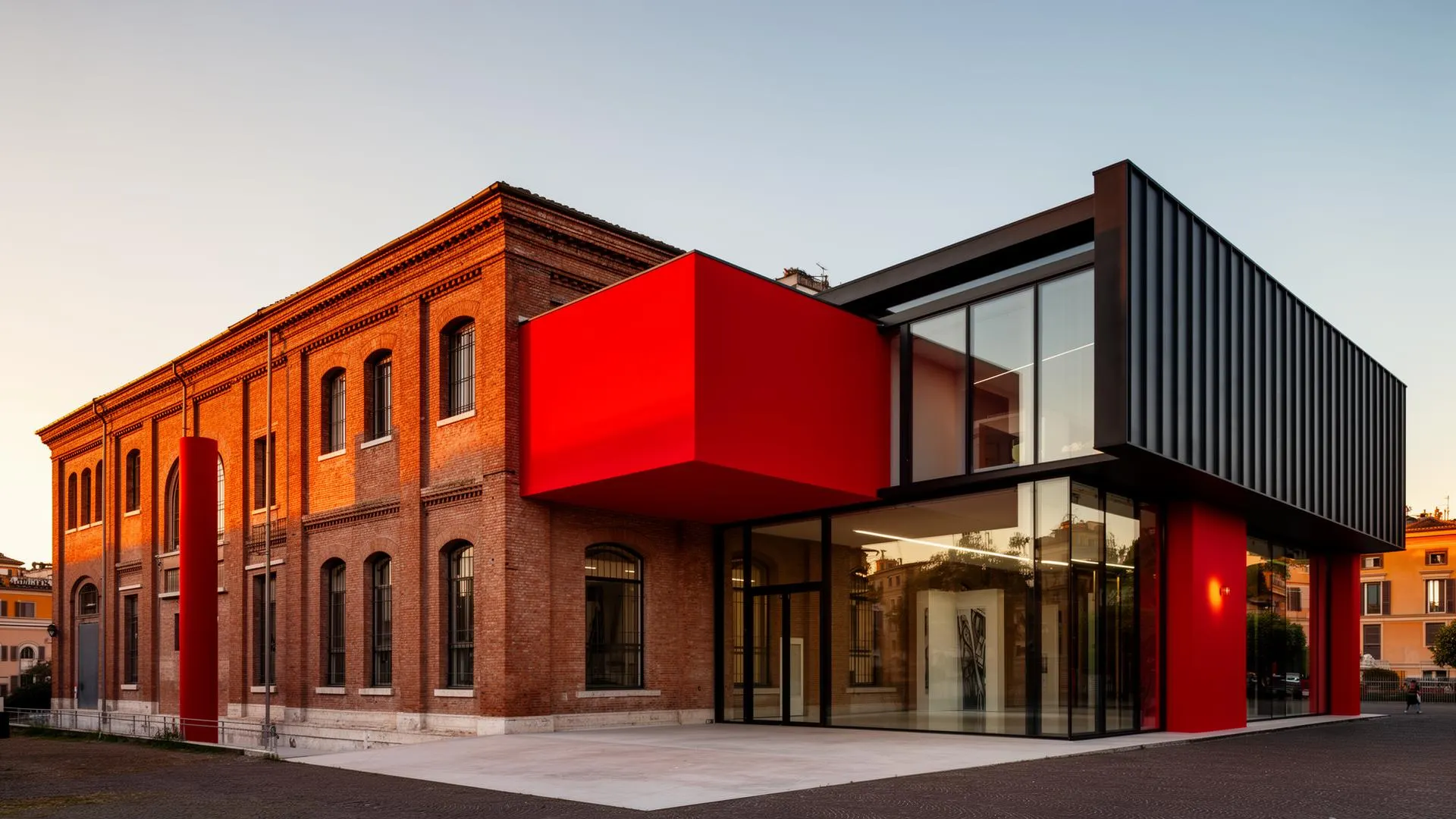
Decq's intervention is a deliberately bold, almost violent dialogue with the historic brick. From the outside, a cantilevered black-steel-and-glass volume wrapped in her signature blood-red appears to hover above the original Peroni façade on Via Nizza. From inside, the visitor enters a flowing red 'piazza' atrium — an interior public space that connects the brewery's ground-floor halls to the new upper galleries via curving red ramps and a glass-floored lobby.
The architectural set-pieces are the cantilevered red auditorium suspended in the central void, the rooftop restaurant terrace (open according to its own hours), and the way Decq has refused to hide a single original column of Peroni cast-iron — every piece of late-19th-century industrial fabric is left exposed and lit theatrically.
Critics rank the MACRO extension alongside Zaha Hadid's MAXXI and Richard Meier's Ara Pacis as one of the three defining contemporary buildings of 21st-century Rome — and of the three, it is by far the cheapest to visit.
Programme & 'Museum for Preventive Imagination'
In 2020 MACRO was relaunched under a deliberately enigmatic new curatorial concept — the Museum for Preventive Imagination (MPI). Devised by then-artistic director Luca Lo Pinto, it effectively retired the old permanent collection model in favour of an entirely programme-driven, exhibition- based museum — closer to a contemporary kunsthalle than a traditional municipal art gallery.
In practice this means: 6–8 rotating exhibitions a year across all the spaces, ticketed at €6/€4 with a changing programme of free performances and events alongside them, and a refusal to display a fixed 'masterpieces' collection. The programme cycles through major international solo shows, monographic projects on under-recognised Italian artists, archival exhibitions, performance series, and the occasional collaboration with private foundations like the Cerasi (Palazzo Merulana) or Trussardi.
The model is divisive — some Romans wish MACRO would simply show its collection — but it has made the museum genuinely experimental again. Always check museomacro.it before visiting, since the active exhibitions can change every six weeks.
MACRO vs MAXXI — Don't Confuse Them
| Museum | Run by | Architect | Focus | Cost |
|---|---|---|---|---|
| MACRO (Via Nizza) | City of Rome | Odile Decq (2010) | Experimental, exhibition-driven | €6 / €4 |
| MAXXI (Flaminio) | Italian state | Zaha Hadid (2010) | 21st-C art & architecture, permanent collection | €12 |
The two museums are easy to confuse — both opened their major contemporary buildings in 2010, both are in Rome's modern districts. They are not competitors but complements: MACRO is experimental and affordably ticketed, MAXXI is canonical and ticketed. If you have one day for contemporary Rome, see both.
MACRO Through History
1880sPeroni Brewery Built
Industrialist Giovanni Peroni opens his Roman brewery on the new Via Nizza in the elegant late-19th-century Salario quarter, taking advantage of nearby aqueduct water and railway access. The building becomes one of the largest industrial complexes in central Rome.
1903Peak Production
By the early 1900s the Peroni Roman brewery is producing nearly half of all beer drunk in central Italy, with hundreds of workers employed on Via Nizza.
1971Brewery Closes
Peroni production is consolidated at the larger Bari plant in southern Italy. The Via Nizza brewery is decommissioned and the historic brick complex is bought by the City of Rome — but stands empty for nearly 30 years.
1999MACRO Founded
The City of Rome formally founds MACRO – Museo d'Arte Contemporanea Roma in part of the empty Peroni complex, providing the city's first dedicated municipal museum of contemporary art.
2001First Permanent Display
MACRO opens to the public with a small permanent collection of post-1960 Italian art donated by collectors and the City of Rome's contemporary acquisitions.
2007Decq Project Awarded
After a competitive international architectural competition, the Paris-based studio of Odile Decq wins the commission to dramatically expand MACRO with a contemporary intervention into the historic brewery.
2010Decq Extension Opens
On 30 May 2010 the Odile Decq extension opens — a cantilevered black-steel-and-glass volume painted in signature blood-red, with a fluid red atrium piazza, cantilevered auditorium and public rooftop terrace. It instantly becomes one of Rome's defining contemporary buildings.
2014MAXXI Comparison Era
With MAXXI (opened 2010 across town) and MACRO operating in parallel, Rome briefly becomes one of the most ambitious contemporary-art capitals in southern Europe.
2020Museum for Preventive Imagination
Under new artistic direction, MACRO is relaunched as the 'Museum for Preventive Imagination' — an experimental, exhibition-driven model with no permanent collection on display, €6/€4 ticketed exhibitions alongside a changing programme of free performances and events, and a rolling programme of 6–8 exhibitions a year.
2022Cinema Programme Launches
MACRO inaugurates a regular cinema programme in the basement auditorium, focusing on art-house, experimental and documentary film — quickly becoming a fixture of Rome's alternative cultural calendar.
2024Decq Anniversary Show
A major retrospective marks 14 years since the Decq extension opened, with original drawings and models on display alongside an open lecture by Odile Decq herself.
2026Contemporary Art in the Salario
MACRO remains one of Rome's most ambitious contemporary museums — six to eight rotating ticketed shows a year, a changing programme of free performances and events, dramatic Decq architecture, and comparatively low crowds.
Tickets & Hours 2026
🕐 Opening Hours
- Tue–Fri: 12:00–19:00
- Sat–Sun: 10:00–19:00 (last entry 18:30)
- Closed: Mondays, 25 December, 1 January, 1 May
- Note the late opening Tue–Fri (12:00) — mornings on weekdays are not possible.
💶 Tickets
- Regular exhibitions: €6 standard / €4 reduced
- Free events: A changing programme of performances, talks and special events
- Cinema: €7 standard / €5 reduced (separate)
- Reduced: Ages 7–26, over 65, students, teachers
- Free: Under 6, ICOM, MIC card, disabled visitors with carer
- Roma Pass: Check current terms, as MACRO is not always included
MACRO combines €6 ticketed exhibitions (€4 reduced) with a changing programme of free performances, talks and special events under the 'Museum for Preventive Imagination' concept — always check museomacro.it before your visit.
Official Info
MACRO is a city-run experimental museum without a standardised ticketing platform. Always check the official site for current exhibitions, opening adjustments and any temporary closures before you go.
MACRO Museum — Tickets & Info
Admission: €6 (normal) / €4 (reduced) / Free for children under 6. Tickets can be purchased at the museum entrance or through the official website. Check for current exhibitions and any temporary closures before your visit.
Open Tue–Fri 12:00–19:00 · Sat–Sun 10:00–19:00 · Closed Mondays · Last entry 30 min before closing
Visit Official WebsiteBest Time to Visit
Best Time of Day
Tue–Fri at 12:00 (right at opening) — you may have the entire Decq atrium to yourself for the first half-hour. Saturday late afternoon (16:00–18:30) is also calm and golden.
Best Day
Tuesday to Friday are quietest. Weekend mornings see local families; weekend afternoons attract Roman art students. Closed Mondays — never plan a Monday visit.
Best Season
Year-round — perfect rainy-day stop in winter, and the rooftop terrace makes it especially rewarding in spring and autumn. August is quieter than central museums but the Salario can be very hot.
Visitor Tips
Always check the website first: MACRO has no permanent collection on display — what you see depends on the active programme. Check museomacro.it before you go.
Don't miss the rooftop: The rooftop restaurant/terrace is worth seeking out, but access depends on its own opening hours — check before you go. Take the lift to the top floor and follow the signs.
Visit the auditorium: Even when no event is on, the cantilevered red auditorium is one of the most striking interior architectural objects in Rome.
Photography: Allowed throughout without flash or tripod. The red atrium is wildly photogenic.
Combine with Quartiere Coppedè: 15 minutes' walk north — Rome's surreal 1920s Art Nouveau quarter is the perfect contrast.
Combine with MAXXI: Tram 19 connects the two — together they make a full contemporary-art day.
Café & bookshop: Open without a museum ticket — drop in for coffee in the red atrium even if you don't have time for the show.
Vs Other Modern & Contemporary Art Museums in Rome
| Museum | Focus | Cost | Time | Crowds |
|---|---|---|---|---|
| MACRO | Experimental contemporary, rotating | €6 / €4 | 1–1.5 hr | Very low |
| MAXXI | 21st-C art & architecture, Zaha Hadid | €12 | 2 hr | Medium |
| Palazzo Merulana | Italian 20th C — Cerasi Collection | €12 (GF normally free) | 1.5 hr | Very low |
| GNAM (Galleria Nazionale) | Italian 19th–20th C, large permanent | €10 | 2–3 hr | Low |
| Centrale Montemartini | Ancient marbles in 1912 power plant | €11 | 1.5–2 hr | Very low |
Common Mistakes to Avoid
Coming on a Monday
Closed Mondays. MACRO is part of Rome’s municipal cultural system. Tue–Sun only — no exceptions.
Confusing it with MAXXI
Different museum, different neighbourhood, different ticket. MACRO is Via Nizza (Salario), €6/€4 for regular exhibitions; MAXXI is Via Guido Reni (Flaminio) and €12.
Arriving on a Tue–Fri morning
The museum doesn't open until 12:00 on weekdays. If you want a morning visit, come on Saturday or Sunday (10:00 opening).
Not checking the programme first
There is no permanent collection — what you see depends entirely on the rotating shows. Always check museomacro.it before going.
Skipping the rooftop
Panoramic and often quiet, but access depends on the rooftop restaurant's own opening hours — many visitors don't realise they should check ahead. Take the lift to the top floor.
Expecting a quick centre visit
MACRO is in the Salario, a 25-min walk from Termini and well off the Colosseum trail. Plan it as a deliberate half-day with Quartiere Coppedè or Villa Torlonia.
Colosseum & Forum Tickets Nearby
MACRO is a perfect affordable contemporary contrast before or after the Colosseum and Forum. From Via Nizza, take Metro Line B at Castro Pretorio south to Colosseo (4 stops, 12 minutes). Both require advance booking in 2026.
Colosseum Priority Entrance
Best for: First-time visitors
~2 hoursSkip-the-line access to the Colosseum with entry to Roman Forum and Palatine Hill included. Perfect for first-time visitors.
- Skip-the-line entry
- Colosseum access
- Roman Forum included
- Palatine Hill included
🎟️ Compare Prices:
TiqetsKlookTrip.comColosseum Guided Tour
Best for: History enthusiasts
~3 hoursExpert-led tour with professional guide sharing gladiator history, architecture secrets, and ancient Roman stories.
- Professional English-speaking guide
- Skip-the-line entry
- In-depth historical commentary
- Small group experience
🎟️ Compare Prices:
TiqetsKlookTrip.comColosseum Arena & Underground
Best for: Unique experience seekers
~3.5 hoursWalk where gladiators fought on the arena floor and explore the underground chambers where they awaited their fate.
- Arena Floor access
- Underground chambers access
- Roman Forum & Palatine Hill
- Expert guided tour included
🎟️ Compare Prices:
TiqetsKlookTrip.comPair Your Visit With
Quartiere Coppedè
15-min walk north — Rome's surreal 1920s Art Nouveau quarter, with twisted columns, frescoed façades and the famous Fountain of the Frogs. The perfect contrast to MACRO's contemporary edge.
Villa Torlonia
15-min walk east — Mussolini's former residence, now a public park with the Casino Nobile museum and the eccentric Casina delle Civette stained-glass house.
Villa Borghese
25-min walk west — Rome's great public park, with the Borghese Gallery (Bernini's Apollo & Daphne) and the Galleria Nazionale d'Arte Moderna.
Highlights at a Glance
- €6 ticketed exhibitions with a changing programme of free events
- Odile Decq's dramatic 2010 black-and-red glass extension
- Cantilevered red auditorium suspended in the central void
- Rooftop restaurant terrace with rotating outdoor sculpture
- Converted late-19th-century Peroni beer factory
- 6–8 experimental contemporary shows per year
- Cinema with art-house and documentary programme
- Café-bistro in the red atrium — no ticket required
How to Get There
By Bus
- Bus 38, 80, 89: Stop on Via Nizza directly outside the museum
- Bus 92 from Termini: 10 minutes to Via Nizza — the easiest option from the centre
- Bus 60, 62: From the Colosseum / Piazza Venezia in 20–25 minutes
By Metro
Metro Line B → Policlinico (15-min walk east) or Castro Pretorio (15-min walk north). From the Colosseum, 4 stops north on Line B then walk.
By Tram
Tram 3 or 19 stops at Viale Regina Margherita / Nizza, a 5-minute walk south from MACRO. Tram 19 is also the easiest connection between MACRO and MAXXI.
On Foot
From Termini: 25 min north via Via Nizza (flat, residential, pleasant). From Villa Borghese: 25 min east via Corso d'Italia. From Quartiere Coppedè: 15 min south via Via Tagliamento.
By Taxi
From the historic centre: €12–€15, about 12 minutes outside rush hour. Ask for "MACRO, Via Nizza centotrentotto".
Where to Stay Near MACRO Museum
Looking for convenient accommodation near MACRO Museum? Stay within walking distance to make the most of your visit.
Hotels Near This AttractionTop Rated HotelsBudget-Friendly OptionsLuxury HotelsCentral locations with easy access to MACRO Museum and other attractionsFrequently Asked Questions
What is MACRO Museum in 2026?
MACRO (Museo d'Arte Contemporanea Roma) is the City of Rome's museum of contemporary art, housed inside a converted late-19th-century Peroni beer factory on Via Nizza in the Salario-Nomentano district. Founded in 1999, it was radically expanded in 2010 with a striking black-and-red glass extension by French architect Odile Decq. Since 2020 it has operated under the curatorial concept 'Museum for Preventive Imagination' — an experimental, programme-driven space with 6–8 rotating exhibitions a year. MACRO combines €6 ticketed exhibitions (€4 reduced) with a changing programme of free performances, talks and special events.
Is MACRO free in 2026?
No — regular admission to MACRO Via Nizza exhibitions costs €6 full price / €4 reduced. Free entry applies to specific categories: under-6s, ICOM and MIC cardholders, disabled visitors with carer, and on some occasions. MACRO also runs a changing programme of free performances, talks and special events as part of its 'Museum for Preventive Imagination' concept — check the museum website before your visit, since which parts are free can change with the current programme. The cinema is ticketed separately.
What are the opening hours?
Tuesday–Friday 12:00–19:00, Saturday–Sunday 10:00–19:00 (last admission 18:30). Closed Mondays, 25 December, 1 January and 1 May. The bookshop and café-bistro are open the same hours; access to the rooftop terrace depends on the opening hours of the rooftop restaurant operating there.
Is MACRO the same as MAXXI?
No — they are two completely different museums and easy to confuse. MACRO (Via Nizza, Salario district) is the city-run museum in a 19th-century brewery, with €6/€4 ticketed exhibitions and a changing programme of free events, focused on rotating experimental exhibitions. MAXXI (Via Guido Reni, Flaminio district) is the national museum of 21st-century art and architecture, designed by Zaha Hadid, with a permanent collection and standard ticket (€12). If you have time, see both — they complement each other perfectly.
How do I get to MACRO?
MACRO is in the Salario-Nomentano district, slightly off the standard tourist trail. Easiest: bus 38, 80 or 89 to Via Nizza (the museum is at the corner of Via Nizza and Via Reggio Emilia). Metro Line B to Policlinico (15-min walk) or Castro Pretorio (15-min walk). From Termini: bus 92 in 10 minutes, or a flat 25-minute walk through the Salario quarter.
What is the Odile Decq architecture?
In 2010 the French Pritzker-shortlisted architect Odile Decq completed a dramatic expansion of MACRO, adding a cantilevered black-steel-and-glass volume painted in her signature blood-red, suspended above the original brick brewery. The interiors include a fluid red 'piazza' atrium, a cantilevered red auditorium and a rooftop terrace operated as a restaurant/bar. It is one of the most important contemporary architectural interventions in Rome, frequently cited alongside MAXXI and the Ara Pacis.
Is photography allowed?
Yes — photography is permitted throughout the museum and the architecture without flash or tripod. The Odile Decq atrium and the rooftop terrace (when open) are among the most photographed contemporary spaces in Rome.
Is MACRO accessible?
Fully accessible. Lifts connect all floors including the rooftop terrace, accessible toilets are on every level, and disabled visitors with carer enter free at all times. Service dogs are welcome.
Is there a café or restaurant?
Yes — the ground-floor café-bistro inside the Decq atrium serves coffee, breakfast pastries and a short lunch menu. It is open the same hours as the museum and does not require a ticket. The cinema in the basement runs an irregular programme of art-house and documentary screenings.
Related Attractions
Villa Farnesina
Renaissance villa with Raphael's Triumph of Galatea frescoes
Explore
Castel Sant'Angelo
Ancient mausoleum turned papal fortress with panoramic city views
Explore
Ostia Antica
Rome’s ancient harbour city; €18 integrated park ticket valid eight days from first entry
Explore
Temple of Venus and Roma
Rome's largest ancient temple—Emperor Hadrian's masterpiece
Explore
Villa d'Este
Renaissance masterpiece with 500+ fountains in Tivoli
Explore
Santa Maria del Popolo
Renaissance church with two Caravaggio masterpieces
ExploreQuick Planning Guide
⏱️ Time Needed
1–1.5 hours
💰 Cost
€6 full / €4 reduced (some events free)
🎫 Reservation
Walk-up — no booking
♿ Accessibility
Fully accessible — lifts to all floors
📅 Best Time
Tue–Fri afternoons
👨👩👧👦 Family Friendly
Yes — engaging for teens and design-curious kids
🌡️ Weather
Mostly indoor — rooftop terrace subject to its own opening hours
Nearby Attractions
Quartiere Coppedè15-min walk
Villa Torlonia15-min walk
Catacombs of PriscillaMetro B + bus, 25 min
Villa Borghese25-min walk
MAXXI Museum30 min by tram
Termini Station25-min walk
Featured In These Itineraries
Hidden Gems of RomeRome Like a LocalRainy Day in RomeEssential Tips
- ✓ Closed Mondays — never plan a Monday visit
- ✓ Regular exhibitions cost €6 full / €4 reduced
- ✓ Always check the website for current shows
- ✓ Don't confuse with MAXXI (different museum)
- ✓ Pair with Quartiere Coppedè for a perfect afternoon