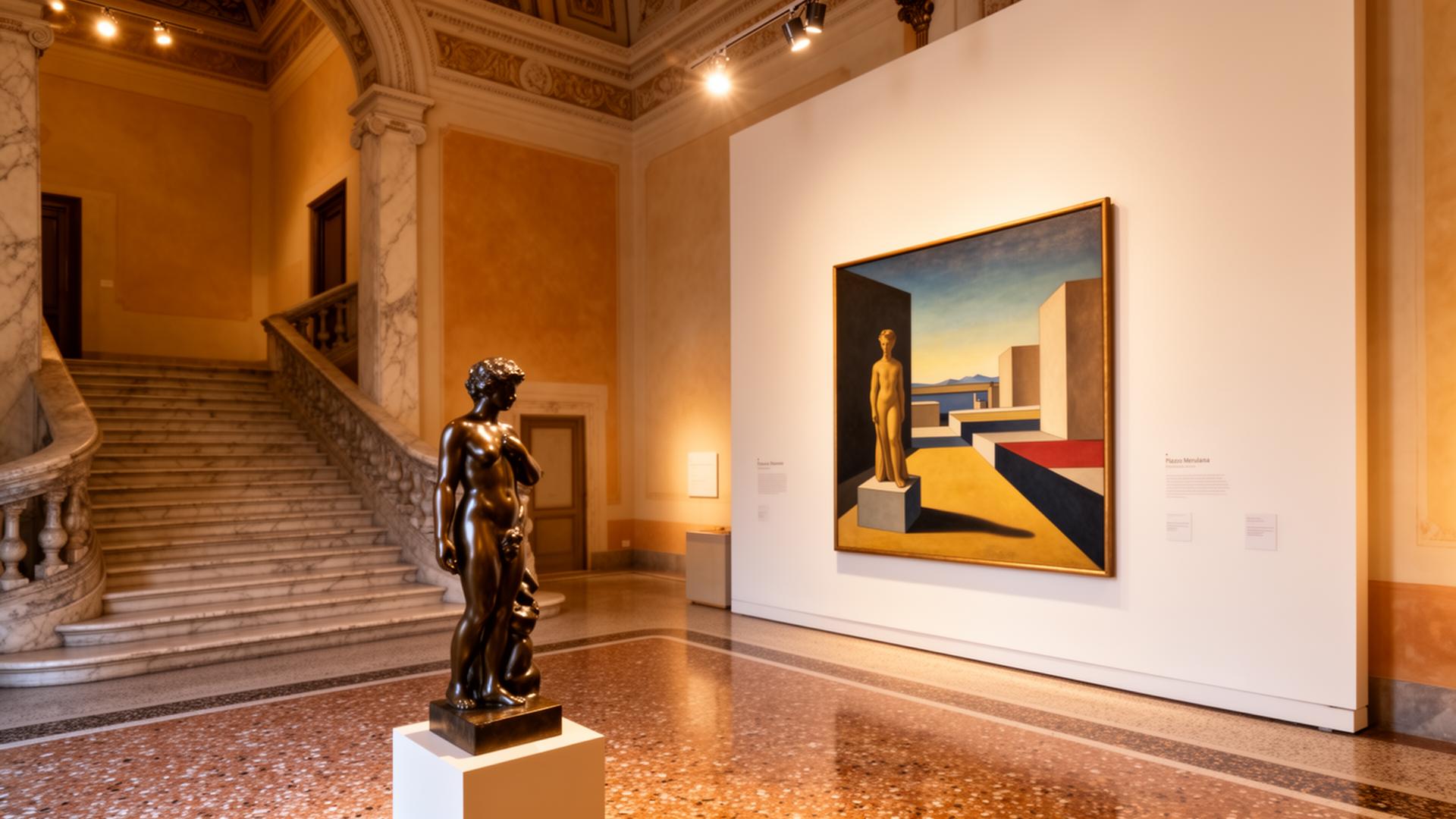
 Private Foundation Museum
Palazzo Merulana
The Cerasi Collection of 20th-century Italian art inside a restored 1929 Umbertine palazzo on Via Merulana — Rome's most concentrated and least crowded modern-art museum.
1.5 hours€12 / GF normally freeCerasi CollectionCaféCulture & rooftopVia Merulana 121, 00185 Roma RMOpen on MapPlan Your Visit
Compare tickets, tours and stays — booking ahead usually gives more choice
Get TicketsBook a TourHotels NearbyBy AllTrips Editors••9 min readPalazzo Merulana is a private foundation art museum on Via Merulana 121, in Rome's Esquilino district, housed inside a restored 1929 Umbertine palazzo. Opened to the public in 2018 by the Fondazione Elena e Claudio Cerasi, it permanently displays the Cerasi Collection of over 90 works of 20th-century Italian art — including paintings by Giorgio De Chirico, Giacomo Balla, Mario Sironi, Felice Casorati and the entire Scuola Romana. Ground-floor spaces are normally free to enter, with café and bookshop; €12 full ticket, rooftop access depending on the programme, and almost no crowds — Rome's most sophisticated modern-art secret.
📋 In This Guide
Opened as museum
2018
Palazzo built
1929
Collection
90+ works
Entry
€12 / GF normally free
Visit time
1.5 hours
Metro
Vittorio Emanuele (A)
Why Visit Palazzo Merulana?
Most visitors to Rome see classical antiquity, then Baroque, then Renaissance — and then go home, convinced Italian art ended around 1700. Palazzo Merulana is the museum that puts that mistake right. In a single restored Umbertine palazzo on Via Merulana you walk through every major movement of Italian 20th-century art — Futurism, Metaphysics, Magic Realism, Novecento and the Scuola Romana — in 90 minutes, with almost no one else in the rooms. €12 full ticket. Ground-floor spaces are normally free to enter.
World-Class Italian 20th Century
90+ works covering every major Italian movement from 1900 to 1960 — De Chirico, Balla, Sironi, Casorati and the complete Scuola Romana, all under one roof.
Rome's Quietest Museum
Even on a Saturday afternoon you may have entire rooms to yourself. After the Vatican and Colosseum queues, the silence is a revelation.
Ground Floor & Café
The ground floor — restored marble staircase, bookshop, temporary installations and CaféCulture — is normally free to enter without a museum ticket, though private events and exceptional closures can apply.
Rooftop Esquilino View
A panoramic rooftop terrace with an unexpected sideways view of the apse of Santa Maria Maggiore — access depends on the programme/events, so check officially before visiting.
What to See at Palazzo Merulana
The museum occupies four floors, each dedicated to a different chapter of Italian modernism. Allow 1.5 hours for the full circuit — longer if you stop for lunch.
Ground Floor — Normally Free
The restored 1929 marble staircase, terrazzo floors, CaféCulture restaurant, bookshop and a rotating space for temporary installations and pop-up shows. Normally free to enter, though private events and exceptional closures can apply.
First Floor — Scuola Romana
The Roman School: Scipione's tormented street scenes, Mario Mafai's poetic still lifes ('flowers and demolitions'), Antonietta Raphaël's expressionist sculptures and Fausto Pirandello's heavy-bodied bathers.
Second Floor — Metaphysics & Novecento
The metaphysical and Novecento Italiano rooms: Giorgio De Chirico's mannequin paintings, Carlo Carrà's silent harbours, Mario Sironi's monumental urban landscapes and Massimo Campigli's frescoed female figures.
Third Floor — Futurism & Magic Realism
The most colourful and unexpected room: Giacomo Balla and Gerardo Dottori's Futurist canvases alongside the eerily quiet Magic Realism of Felice Casorati, Antonio Donghi and Cagnaccio di San Pietro.
De Chirico's Mannequins
The collection's signature pieces: two later metaphysical paintings by Giorgio De Chirico featuring his hallmark faceless mannequins in deserted Italian piazzas — instantly recognisable, hypnotically still.
Rooftop Terrace
A small but memorable rooftop with a panoramic view over the Esquilino quarter and a sideways look at the apse of Santa Maria Maggiore. Access depends on the programme and events — check officially.
Temporary Exhibitions
Two temporary shows a year, usually monographic deep-dives into a single Roman School or Novecento artist. Past highlights include Antonietta Raphaël (2023), Fausto Pirandello and Capogrossi.
CaféCulture Restaurant
The ground-floor restaurant by Roman chef Daniele Roppo — hours vary, so check officially before visiting. Roman cuisine with a Lazio-focused wine list. No museum ticket required.
The Cerasi Collection
The Cerasi Collection was built over thirty years by Elena and Claudio Cerasi — the husband-and-wife construction magnates who made their fortune through the Lamaro Appalti firm and who, in parallel, became among the most important private patrons of Italian 20th-century art. Long before opening Palazzo Merulana, they had been quiet donors behind much of MAXXI's modern collection.
The collection deliberately covers every major Italian movement from 1900 to 1960, with five strands running in parallel: Metaphysical art (De Chirico, Carrà), Futurism (Balla, Dottori, Prampolini), Italian Magic Realism (Casorati, Donghi, Cagnaccio di San Pietro), the Novecento Italiano (Sironi, Campigli, Funi), and the Scuola Romana (Scipione, Mafai, Raphaël, Pirandello, Guttuso). It is by some distance the most complete private collection of the Italian 20th century in the country.
Of the roughly 140 works in the collection, about 90 are on permanent display at any one time — the rest rotate, lend out to international exhibitions, or appear in the Palazzo's own temporary shows. The 2025 hang refresh brought several previously unseen drawings by Sironi out of storage, alongside a major Casorati portrait.
The Scuola Romana — A Closer Look
Although the collection is encyclopedic, its true heart — and the reason most Italian critics make the pilgrimage — is the Scuola Romana (Roman School) on the first floor. Born in the 1920s in studios on Via Cavour and around Piazza del Popolo, the Roman School was the most important non-Futurist Italian movement between the wars: a generation of painters who rejected Mussolini's official Novecento style in favour of an expressionist, melancholic vision of Rome itself.
Scipione (Gino Bonichi, 1904–1933) is the tragic genius of the group — dead of tuberculosis at 29, but not before painting some of the most haunted images of the Roman streets ever made. Palazzo Merulana holds several Scipione canvases, including a magnificent dark Cardinal portrait. Mario Mafai (1902–1965) painted his celebrated Demolizioni series — wreckers tearing down old Roman quarters under the Fascist regime — and quiet still lifes of flowers in tarnished vases. His wife Antonietta Raphaël (1895–1975), a Lithuanian Jewish sculptor in self-imposed exile, made some of the most modern Italian sculpture of her generation.
Fausto Pirandello (1899–1975) — son of the Nobel-winning playwright Luigi Pirandello — painted dense, heavy-bodied bathers and family scenes; Renato Guttuso would later carry the school's social-realist instinct into post-war Italy. Together they form the most fully represented single movement at Palazzo Merulana, and the best place in Rome to understand them.
The 1929 Umbertine Palazzo
The building itself is a small masterpiece of late-Umbertine Roman architecture. Built in 1929 as the Ufficio Municipale di Igiene (Municipal Office of Hygiene), it sits on Via Merulana — the great triumphal axis laid out after 1871 to connect Santa Maria Maggiore with San Giovanni in Laterano.
Inside, the monumental marble staircase, terrazzo veneziano floors and stuccoed ceilings have all been carefully restored — the Cerasi Foundation chose the Spanish-Italian architect María Margarita Segarra Lagunes precisely for her experience adapting historic interiors for contemporary museum use. The result is rare: a 1929 palazzo that feels entirely museum-modern without sacrificing a single original decorative detail.
Look up as you climb the stairs to see the original ceiling cartouches; look down to see the geometric terrazzo patterns repeating between rooms. The lift to the rooftop terrace, installed in 2017, is invisibly tucked into the back of the building.
Palazzo Merulana Through History
1888Esquilino Master Plan
After Rome becomes capital of unified Italy in 1871, the new Esquilino district is laid out with grand boulevards including Via Merulana — a triumphal axis from Santa Maria Maggiore to San Giovanni in Laterano.
1929Umbertine Palazzo Built
The palazzo at Via Merulana 121 is built as Rome's Municipal Office of Hygiene, in the late-Umbertine style with marble staircases, terrazzo floors and stuccoed ceilings — a model of public architecture under the Fascist regime.
1960sBureaucratic Decades
The building serves as a hub for various municipal health offices through the post-war decades, gradually losing its prestige as services move to suburban facilities.
1990sAbandonment
The last city offices vacate the palazzo in the late 1990s. The building stands empty for nearly 20 years, slowly deteriorating behind boarded-up windows on one of Rome's grandest streets.
2014Cerasi Family Acquisition
Construction magnates Elena and Claudio Cerasi — already the patrons behind much of MAXXI's modern collection — acquire the abandoned palazzo from the City of Rome with the explicit purpose of housing their private 20th-century art collection.
2016Foundation Established
The Fondazione Elena e Claudio Cerasi is formally constituted as a non-profit, and the palazzo restoration begins under architect Maria Margarita Segarra Lagunes — preserving Umbertine details while adapting interiors for museum use.
2018Museum Opens
On 24 May 2018, Palazzo Merulana opens to the public with the inaugural exhibition 'L'Arte di Roma'. The Cerasi Collection — 90+ works covering every major Italian 20th-century movement — goes on permanent display across three floors.
2019First Anniversary Programme
A full year of temporary exhibitions cements Palazzo Merulana's reputation as Rome's most ambitious private museum opening in a generation. CaféCulture and the rooftop terrace become local Esquilino fixtures.
2021Reopening After Lockdown
Following pandemic closures, the museum reopens with extended evening hours and a free first-Sunday programme to encourage neighbourhood visits.
2023Annetta Raphaël Retrospective
A major monographic show on the Lithuanian-born Roman School sculptor Antonietta Raphaël draws international press attention and confirms the museum's curatorial ambition.
2025Permanent Hang Refresh
After seven years, the permanent display is rotated for the first time. Lesser-known works from the Cerasi storerooms — including drawings by Sironi and a major Casorati portrait — go on view.
2026Quiet Capital of the Italian 20th Century
While the Vatican and Borghese queue, Palazzo Merulana remains Rome's most concentrated and least crowded modern-art museum. Ground-floor spaces normally free to enter, €12 ticket, almost no waiting.
Tickets & Hours 2026
🕐 Opening Hours
- Wed–Fri: 12:00–20:00 (last admission 19:00)
- Sat–Sun: 10:00–20:00 (last admission 19:00)
- Closed: Monday and Tuesday, 25 December, 1 January
- CaféCulture: Hours vary — check the official site
💶 Tickets
- Standard: €12
- Reduced: €10 (under 26, over 65, teachers, journalists)
- School groups: €6 per person
- Membership: Check the official site for membership options
- Free: Under 7, ICOM, MIC card, disabled visitors with carer
- Roma Pass: NOT included (private foundation)
- Ground floor + café: Normally free to enter, though private events and exceptional closures can apply
Palazzo Merulana is a private foundation, not a state museum — so the Roma Pass and the Italian state-museum free Sundays do not apply. €12 is the actual full ticket price you will pay at the door.
Best Time to Visit
Best Time of Day
Wed–Fri after 14:00 — the museum is genuinely empty and you can have entire rooms to yourself. Saturday mornings are the busiest slot, and even those are very calm by Rome standards.
Best Day
Wednesday to Friday are quietest. Saturday and Sunday see locals. Closed Monday and Tuesday — never plan a visit those days.
Best Season
Year-round — perfect rainy-day stop in winter, blissfully cool refuge in August. Spring and autumn pair best with aperitivo on the rooftop terrace.
CaféCulture & the Rooftop Terrace
The entire ground floor of Palazzo Merulana is occupied by CaféCulture, the in-house restaurant by Roman chef Daniele Roppo. It functions as a proper neighbourhood café, lunchroom and aperitivo bar — and it is normally accessible without a museum ticket.
Café hours vary by season and events — check the official site before visiting for current opening times. The interior keeps the original 1929 terrazzo floors and stucco — one of the most beautiful café interiors on the Esquilino.
The rooftop terrace, three floors up, is small but perfectly placed: a sideways panorama over the Esquilino rooftops, with the apse of Santa Maria Maggiore looming unexpectedly close. On clear days you can see the dome of St Peter's. Access depends on the current programme and events — check the official website before visiting.
Visitor Tips
Use the ground floor first: Even if you don't have a ticket, walk in for the staircase, café and bookshop. Many visitors only realise after coffee that they want to see upstairs.
Ask about membership if you stay 4+ nights: Check the official site for membership options — it may pay back if you visit more than once.
Photography: Allowed throughout without flash or tripod. Phone or hand-held cameras only.
Lift to all floors: Fully accessible — the lift reaches the rooftop terrace too.
Combine with Santa Maria Maggiore: The papal basilica is 7 minutes north — a perfect contrast of 5th-century mosaics after 20th-century painting.
Occasional family workshops: The Foundation runs family programming on some Sundays, ages 5–12, but it is not a permanent fixture — check the calendar on the official website before planning around it.
Bookshop: Excellent selection of Italian 20th-century catalogues, monographs and design objects — one of the better museum bookshops in central Rome.
Vs Other Modern Art Museums in Rome
| Museum | Focus | Cost | Time | Crowds |
|---|---|---|---|---|
| Palazzo Merulana | Italian 20th C — full sweep | €12 (GF normally free) | 1.5 hr | Very low |
| GNAM (Galleria Nazionale) | Italian 19th–20th C, large | €10 | 2–3 hr | Low |
| MAXXI | 21st-C art & architecture | €12 | 2 hr | Medium |
| MACRO | Contemporary, rotating | Free–€8 | 1.5 hr | Low |
| Centrale Montemartini | Ancient marbles in power plant | €11 | 1.5–2 hr | Very low |
Common Mistakes to Avoid
Coming on a Monday or Tuesday
Closed all day Monday and Tuesday — always check before you go.
Expecting Roma Pass coverage
It is a private foundation — Roma Pass and free state-museum Sundays don't apply. €12 always.
Skipping the ground floor
The ground floor — normally free to enter, staircase, café, bookshop — is one of the most beautiful interiors in the Esquilino. Even non-art-lovers should walk in.
Missing the rooftop
Access depends on the programme, but when open it's easy to forget — many visitors leave before checking. Ask at the desk or check officially.
Confusing it with MAXXI
Different museum, different neighbourhood. MAXXI (Flaminio) is 21st-century art and architecture; Palazzo Merulana is the Italian 20th century, smaller and quieter.
Trying to rush in 30 minutes
The collection is concentrated but rewards slow looking — 1.5 hours minimum if you want to do justice to all four floors and the rooftop.
Colosseum & Forum Tickets Nearby
Palazzo Merulana is a perfect calm 1.5 hours before (or after) the timed-entry giants — the Colosseum and Roman Forum are 10 minutes' walk south via Via Labicana. Both require advance booking in 2026.
Colosseum Priority Entrance
Best for: First-time visitors
~2 hoursSkip-the-line access to the Colosseum with entry to Roman Forum and Palatine Hill included. Perfect for first-time visitors.
- Skip-the-line entry
- Colosseum access
- Roman Forum included
- Palatine Hill included
🎟️ Compare Prices:
TiqetsKlookTrip.comColosseum Guided Tour
Best for: History enthusiasts
~3 hoursExpert-led tour with professional guide sharing gladiator history, architecture secrets, and ancient Roman stories.
- Professional English-speaking guide
- Skip-the-line entry
- In-depth historical commentary
- Small group experience
🎟️ Compare Prices:
TiqetsKlookTrip.comColosseum Arena & Underground
Best for: Unique experience seekers
~3.5 hoursWalk where gladiators fought on the arena floor and explore the underground chambers where they awaited their fate.
- Arena Floor access
- Underground chambers access
- Roman Forum & Palatine Hill
- Expert guided tour included
🎟️ Compare Prices:
TiqetsKlookTrip.comPair Your Visit With
Santa Maria Maggiore
7-min walk north along Via Merulana — one of Rome's four papal basilicas, with 5th-century gold mosaics. A stunning contrast to the modern art you've just seen.
San Giovanni in Laterano
10-min walk south along Via Merulana — the cathedral of Rome and the Pope's seat as Bishop of Rome. The opposite end of the great Umbertine boulevard.
Colosseum
10-min walk via Via Labicana — Rome's most famous monument, ideal for a timed-entry afternoon slot after a quiet morning at the museum.
Highlights at a Glance
- 90+ works of 20th-century Italian art on permanent display
- Giorgio De Chirico's metaphysical mannequin-pieces
- Giacomo Balla's Futurist canvases
- The complete Scuola Romana — Scipione, Mafai, Raphaël, Pirandello
- Mario Sironi's monumental Novecento figures
- Restored 1929 Umbertine staircase and terrazzo floors
- Ground-floor spaces normally free to enter, plus café, bookshop and temporary installations
- Rooftop terrace with apse view of Santa Maria Maggiore, access depending on the programme
How to Get There
By Metro
Metro Line A → Vittorio Emanuele (5-min walk north on Via Merulana) or Manzoni (5-min walk south). From Termini just one stop on Line A — easier than walking with luggage.
By Bus
- Bus 16, 75, 714: Stop directly outside on Via Merulana
- Bus 117 (electric): Stops at Via Merulana / Piazza Iside (3-min walk)
- From Termini: Bus 75 or 714 — 8 minutes
On Foot
From the Colosseum: 10 min via Via Labicana. From Santa Maria Maggiore: 7 min south on Via Merulana. From San Giovanni in Laterano: 10 min north on Via Merulana. From Termini: 12 min south via Via Cavour.
By Taxi
From the historic centre: €10–€12, about 10 minutes. Ask for "Palazzo Merulana, Via Merulana centoventuno".
Where to Stay Near Palazzo Merulana
Looking for convenient accommodation near Palazzo Merulana? Stay within walking distance to make the most of your visit.
Hotels Near This AttractionTop Rated HotelsBudget-Friendly OptionsLuxury HotelsCentral locations with easy access to Palazzo Merulana and other attractionsFrequently Asked Questions
What is Palazzo Merulana in 2026?
Palazzo Merulana is a private foundation art museum on Via Merulana 121 in Rome's Esquilino district, housed inside a restored 1929 Umbertine palazzo. Opened to the public in 2018 by the Fondazione Elena e Claudio Cerasi, it permanently displays the Cerasi Collection of over 90 works of 20th-century Italian art — including paintings by Giorgio De Chirico, Giacomo Balla, Mario Sironi, Felice Casorati and the entire Roman School (Scuola Romana) of Scipione, Mafai and Donghi. The museum is rarely crowded, ground-floor spaces are normally free to enter, and rooftop access depends on the programme; there is a café on site.
How much does it cost in 2026?
Ground-floor spaces (lobby, CaféCulture, bookshop, temporary installations) are normally free to enter, though private events and exceptional closures can apply. Full museum: €12 standard / €10 reduced (under 26, over 65, teachers, journalists). €6 for school groups. Free for under 7s, ICOM members, MIC card holders and disabled visitors with carer. Check the official site for membership options. The Roma Pass does NOT cover Palazzo Merulana — it is a private foundation.
What are the opening hours?
Wednesday–Friday 12:00–20:00; Saturday–Sunday 10:00–20:00 (last admission 19:00). Closed Monday and Tuesday, 25 December and 1 January. Café hours vary — check the official site before visiting.
What artists are in the Cerasi Collection?
The collection focuses on Italian 20th-century art with five main strands: (1) Metaphysical art — Giorgio De Chirico and Carlo Carrà; (2) Futurism — Giacomo Balla, Gerardo Dottori, Enrico Prampolini; (3) Italian Magic Realism — Felice Casorati, Antonio Donghi, Cagnaccio di San Pietro; (4) Novecento Italiano — Mario Sironi, Massimo Campigli, Achille Funi; and (5) the Scuola Romana (Roman School) — Scipione, Mario Mafai, Antonietta Raphaël, Fausto Pirandello, Renato Guttuso. Roughly 90 works are on permanent display, rotating with two temporary exhibitions a year.
How do I get to Palazzo Merulana?
Easiest: Metro Line A to Vittorio Emanuele (5-minute walk south on Via Merulana) or Manzoni (5-minute walk north). From the Colosseum: 10-minute walk via Via Labicana. Bus 16, 75, 714 stop on Via Merulana directly outside. From Termini: 12-minute walk south or one Metro stop on Line A.
Is photography allowed?
Yes — photography is permitted throughout the museum without flash or tripod. Unlike many state museums in Rome, the Cerasi Foundation actively welcomes social-media sharing of the collection.
Is Palazzo Merulana accessible?
Fully accessible. A lift connects all four floors including the rooftop terrace, accessible toilets are on every level, and reduced tickets are available for visitors with disabilities (carers enter free). Service dogs are welcome.
Is it suitable for children?
Yes — children under 7 enter free, and the Foundation occasionally runs a Sunday-morning family programme with workshops for ages 5–12 (check the calendar, as it is not guaranteed every week). The collection is small and concentrated enough that even non-art-loving children rarely tire out.
Is there a café or restaurant?
CaféCulture occupies the ground floor. Its hours vary — check the official site before visiting. The kitchen is run by Roman chef Daniele Roppo and the wine list focuses on Lazio producers. It is normally accessible without a museum ticket.
Related Attractions
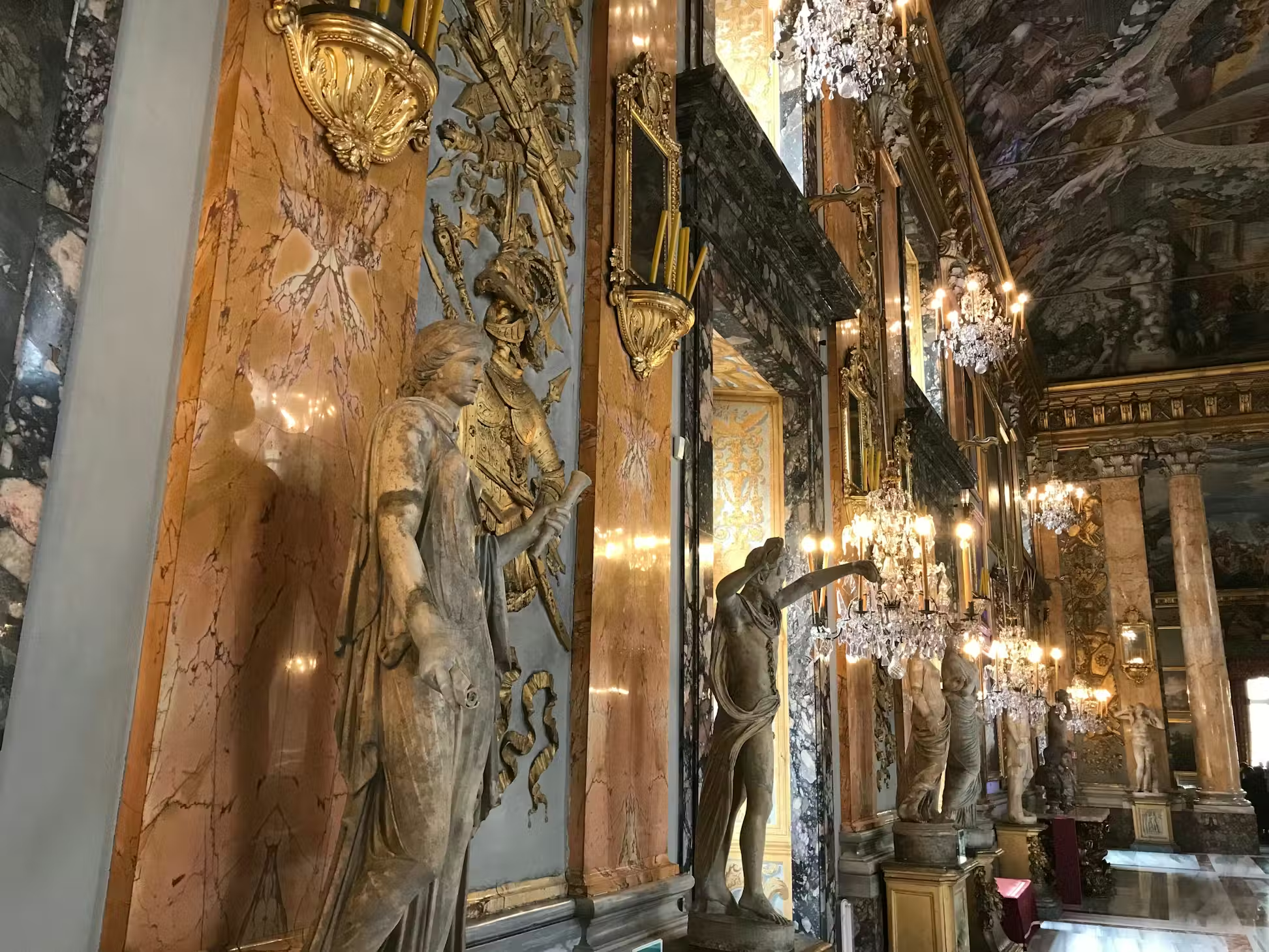
Galleria Colonna
Rome's most magnificent private Baroque gallery (open Friday and Saturday mornings; guided tour format)
Explore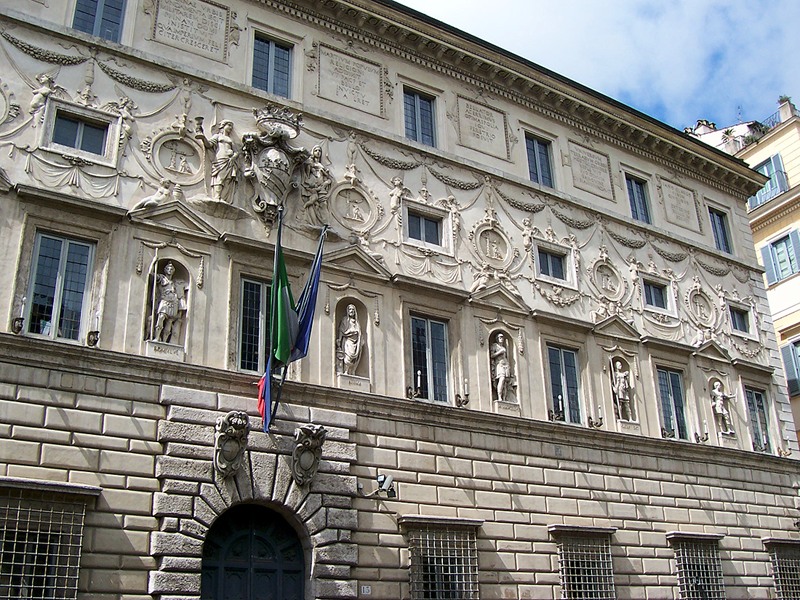
Galleria Spada
Intimate gallery with Borromini's optical illusion corridor
Explore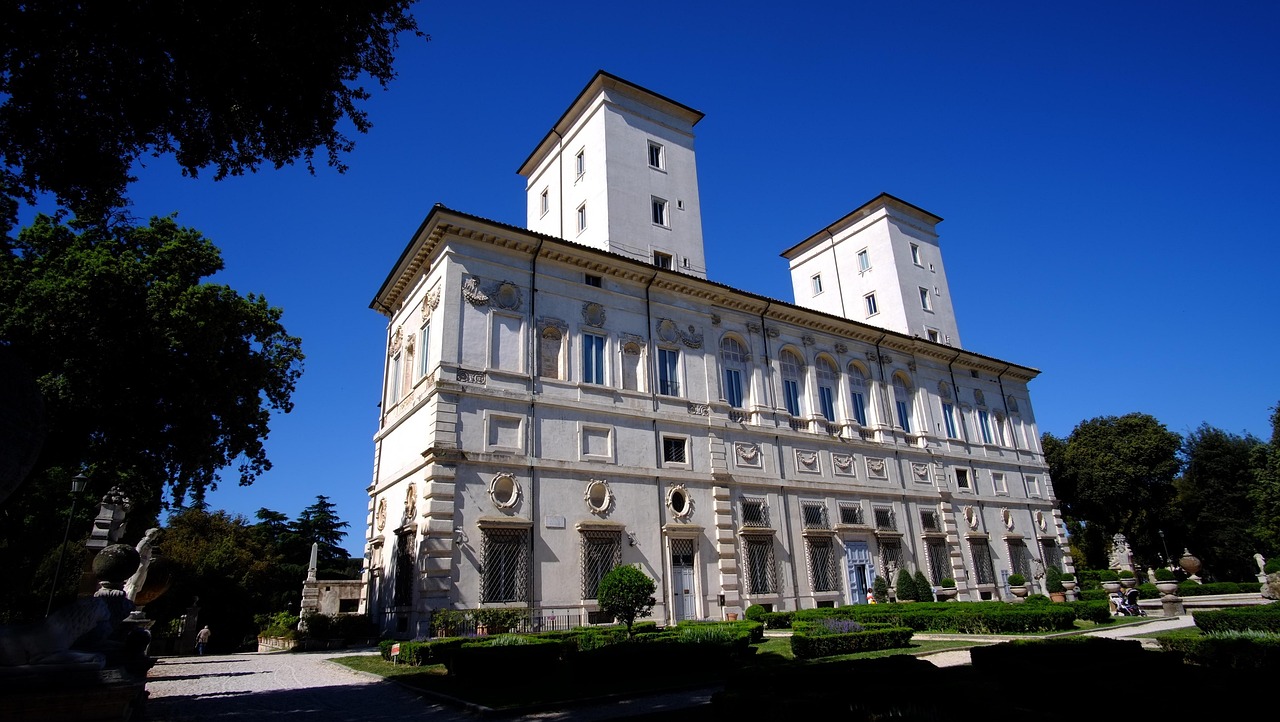
Borghese Gallery
World-class art with Bernini sculptures and Caravaggio paintings
Explore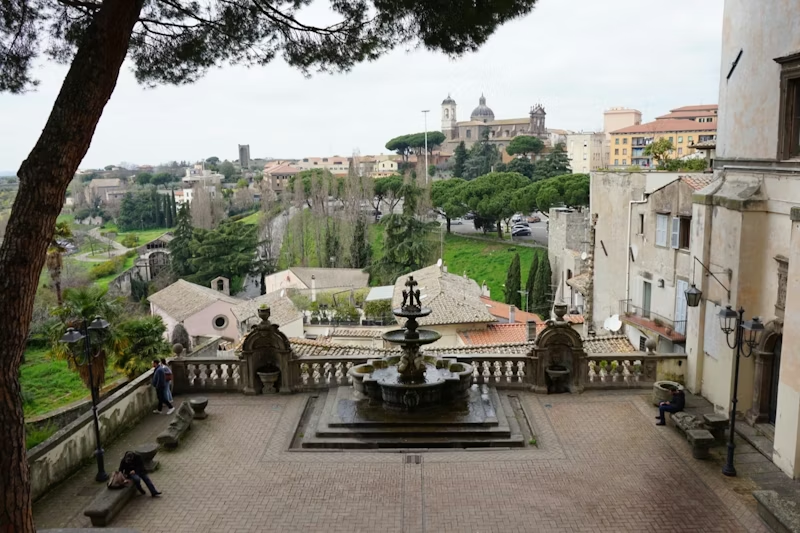
Palazzo dei Priori
Viterbo's Gothic town hall with Renaissance frescoes
Explore
Testaccio
Authentic working-class Rome with the best food
Explore
Venice Day Trip
Experience the magic of the floating city from Rome
ExploreQuick Planning Guide
⏱️ Time Needed
1.5 hours
💰 Cost
€12 (ground floor normally free)
🎫 Reservation
Walk-up usually fine
♿ Accessibility
Fully accessible — lift to all 4 floors
📅 Best Time
Wed–Fri afternoons
👨👩👧👦 Family Friendly
Yes — under 7 free; occasional Sunday workshops, check the calendar
🌡️ Weather
Indoor — perfect rainy-day stop
Nearby Attractions
Santa Maria Maggiore7-min walk
San Giovanni in Laterano10-min walk
Colosseum10-min walk
San Pietro in Vincoli — Michelangelo's Moses8-min walk
Domus Aurea10-min walk
Termini Station12-min walk
Featured In These Itineraries
Hidden Gems of RomeRainy Day in RomeRome Like a LocalEssential Tips
- ✓ Closed Monday and Tuesday — never plan a visit those days
- ✓ Ground-floor spaces normally free without a ticket
- ✓ Photography allowed throughout (no flash)
- ✓ Rooftop access depends on the programme — check officially
- ✓ Check the official site for membership options