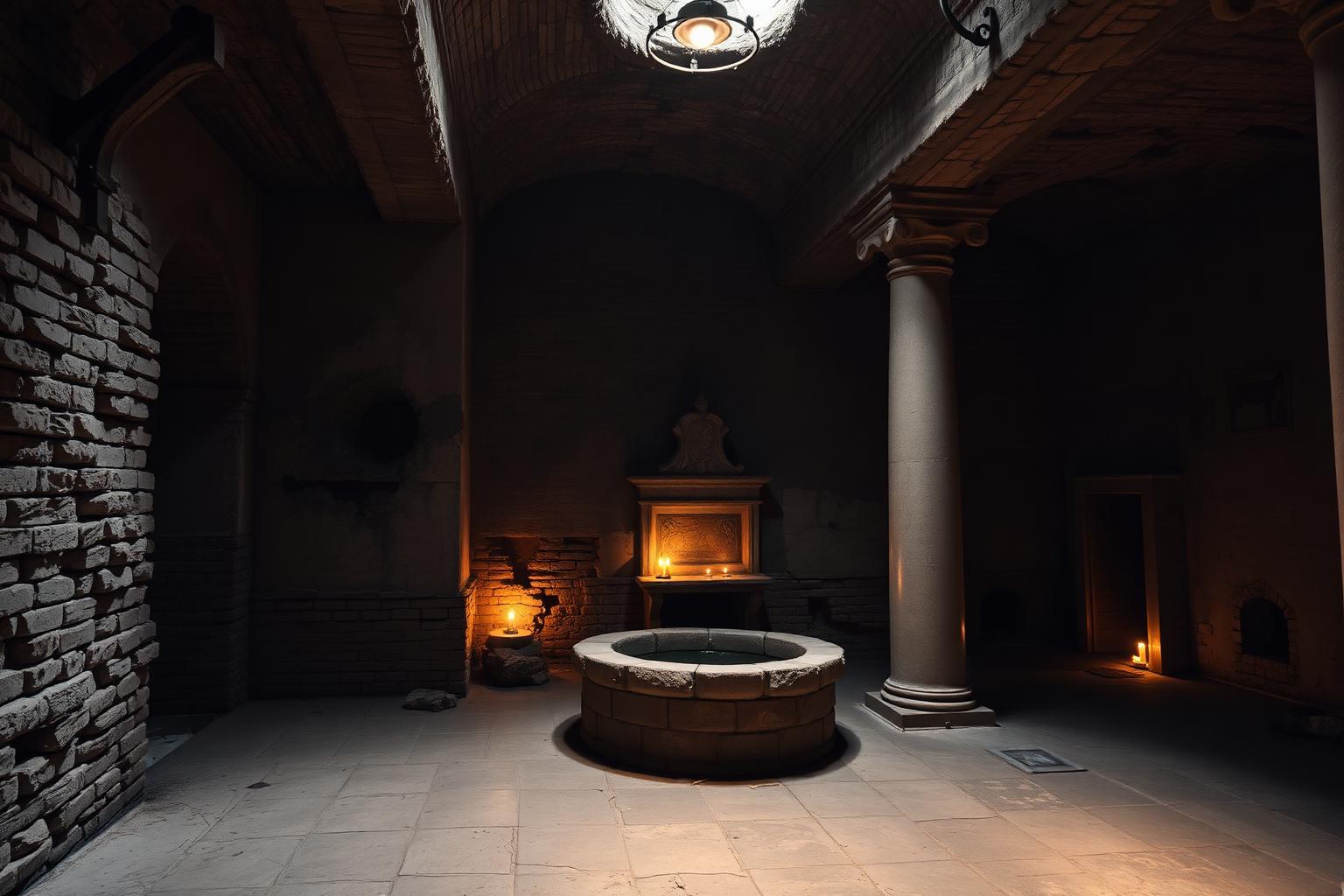
 Limited & Irregular Access
Santa Maria in Via Lata Underground
Beneath Via del Corso lies a 1st-century Roman warehouse complex with a later Christian oratory, long associated by tradition with Saint Paul and Saint Luke. Access is limited and irregular — confirm opening times and admission with the church before visiting.
30–45 minLimited access1st c. ADVia del CorsoVia del Corso 306, 00186 RomaOpen on MapPlan Your Visit
Compare tickets, tours and stays — booking ahead usually gives more choice
Get TicketsBook a TourHotels NearbyBy AllTrips Editors••8 min readThe Santa Maria in Via Lata Underground (Italian: Sotterranei di Santa Maria in Via Lata) is a 1st-century AD Roman warehouse complex preserved beneath the busy stretch of Via del Corso. The Roman rooms have long been associated by Christian tradition with Saint Paul and Saint Luke, although this identification is not archaeologically proven. Within the Roman brickwork, a Christian oratory was later adapted, including a well linked by tradition to Saint Paul. Access to the underground is limited and irregular, and available information on opening times and admission conflicts between sources — check the church's current notices or contact the parish directly before planning a visit.
📋 In This Guide
Duration
30–45 min
Cost
Confirm with church
Photos
No flash
Type
Roman rooms / Christian tradition
Why Visit Santa Maria in Via Lata Underground?
On Via del Corso between the Vittoriano and the Trevi, thousands of people pass the door every week, and very few go down. Below the pavement is a 1st-century Roman complex that Christian tradition — not confirmed archaeology — has long associated with Saint Paul and Saint Luke, with a later Christian oratory adapted into the Roman brickwork. Because access is limited and irregular and sources disagree on hours and admission, treat a visit as an opportunistic add-on rather than a guaranteed stop, and check current details with the church before you go.
A Tradition Linked to Saint Paul
Christian tradition has long associated these Roman rooms with Saint Paul and Saint Luke, though this identification is not archaeologically proven — it is best understood as devotional tradition rather than documented history.
1st-Century Horrea
Original imperial-era warehouse architecture — brickwork, travertine column bases, doorway thresholds — preserved beneath the Christian church above.
A Well Linked to Saint Paul
A Roman-era well at the heart of the later Christian oratory, traditionally associated with Saint Paul and venerated by pilgrims in the Middle Ages — the healing claims are tradition, not established fact.
A Little-Known Site
Because access is limited and irregular, this archaeological visit on Via del Corso remains little-known compared with Rome's major sights — but that also means opening times can't be relied on without checking ahead.
What to See on the Visit
Roman Horrea Walls
Original 1st-century AD opus latericium brickwork from the imperial-era warehouses lining the ancient Via Lata — the road into Rome from the north.
Travertine Column Bases
In situ bases and capital fragments from the Roman colonnade that originally supported the upper floors — preserved exactly where they were 2,000 years ago.
Later Christian Oratory
A small chapel later adapted into the Roman walls, with an altar traditionally linked to Saint Paul and a small reliquary niche — the dating of these features is uncertain.
The Well of Saint Paul (Tradition)
A Roman-era well at the centre of the oratory, associated by tradition with Saint Paul and venerated in the Middle Ages — its healing reputation is devotional tradition rather than documented fact.
Medieval Fresco Fragments
Faint traces of wall paintings on the oratory walls, generally dated to the medieval period, though precise dating is uncertain.
Pietro da Cortona Façade (above)
The 1662 Baroque façade looking onto Via del Corso — a serene white-travertine icon by one of the great architects of Baroque Rome.
From Roman Warehouse to Apostolic Shrine
Two thousand years on the same plot of Via del Corso — Roman commercial complex, later Christian devotion traditionally linked to Saint Paul, medieval church, Baroque masterpiece. The Pauline connection is tradition, not documented history.
c. 50 ADImperial Horrea Built
A complex of Roman warehouses (horrea) and residences is built along Via Lata — the ancient road that became Via del Corso — to serve the booming traffic into the Campus Martius.
61–63 ADTradition of Saint Paul's Captivity
Christian tradition holds that Saint Paul spent part of his Roman house arrest in this area, with Saint Luke nearby, but this identification is not archaeologically confirmed.
5th CenturyFirst Christian Diaconia
An early Christian charitable diaconia is founded directly over the Roman building — evidence of Christian use of the site, though not proof of the Pauline association.
7th CenturyPope Sergius I Rebuilds
Pope Sergius I (687–701) rebuilds the church on a more monumental scale, integrating the Roman walls below into the foundations — preserving them by accident for the next 1,300 years.
1491Renaissance Renovation
Cardinal Pietro Riario commissions Renaissance-era renovations, redecorating the interior while leaving the Roman crypt below untouched.
1662Pietro da Cortona Façade
Pietro da Cortona designs the elegant white-travertine Baroque façade that survives unchanged today — one of the most-photographed and least-noticed church fronts on Via del Corso.
19th–20th c.Archaeological Excavation
Systematic study of the underground reveals the full extent of the Roman horrea, confirms continuous use from the 1st century, and stabilises the early Christian oratory and the well.
Present (2026)Limited, Irregular Access
Access to the underground today is limited and irregular, with conflicting reports about hours, admission and staffing. Visitors should check current notices or contact the parish before planning a trip.
Tickets & Visiting 2026
⚠️ Limited & Irregular Access
Available information about admission conflicts between sources, and arrangements appear to have changed over time. There is no confirmed fixed ticket price. Confirm current admission with the church before your visit.
📅 Opening Times Uncertain
Reported opening times vary and conflict between sources. Check the church's current notices or contact the parish directly for up-to-date information before travelling.
📞 Contact the Parish Directly
For groups, pilgrims, or anyone planning around a specific day, contact the parish in advance rather than relying on older published schedules.
⚡ Specialist Guided Tours
Some Christian-archaeology tour operators include Santa Maria in Via Lata in hidden-Rome itineraries. Confirm with the operator that current access has been arranged, since availability is not guaranteed.
Best Time to Visit
Time of Day
Timing is uncertain: Because access is limited and irregular, there is no reliably "best" time of day — check current notices before planning around a specific hour.
If access is available: Afternoons have historically been mentioned by some sources, but this cannot be relied on without confirming directly with the parish.
Avoid Mass times: The church above runs services, and underground visits (when possible) may pause around the daily liturgy.
Season
Spring & Autumn: Mild weather on Via del Corso makes either season pleasant for an opportunistic visit if access happens to be available.
Summer: Underground spaces are typically cooler, though closures around Ferragosto in mid-August are common in Rome — check ahead.
Winter: Bring a jacket, as underground spaces tend to feel cold. As with any season, confirm access before planning your visit.
Rules & What to Bring
📷 Photography Policy Unclear
Photography rules underground are unclear and may vary — ask on arrival if you are able to visit. The Baroque church above can generally be photographed without restriction.
🧥 Bring a Light Layer
Underground spaces in Rome are typically cool year-round. Bring a light jacket even in summer, if access is available.
👟 Flat Shoes
A narrow modern stairway leads down. Floors are uneven and damp in places. No heels, no flip-flops.
👗 Modest Dress (Church)
Cover shoulders and knees out of respect for the active church above. The volunteers are gracious but the rule is firm.
💶 Bring Some Cash
Some sources describe a cash donation system, though this is unconfirmed. There is no known online ticket — bring cash just in case.
🤫 Speak Quietly
The oratory is an active devotional space. Visitors may be praying at the well or the altar — keep voices low.
Via Lata vs Other Underground Rome
| Site | Cost | Booking | Highlight | Crowds |
|---|---|---|---|---|
| Santa Maria in Via Lata | Unclear | Irregular — confirm ahead | Roman rooms traditionally linked to Saint Paul | Very low |
| San Clemente Underground | €10 | Walk-up OK | Three layers — basilica, Mithraeum, Roman alley | Medium |
| Underground Basilica Porta Maggiore | Varies — check listing | Selected official dates; mandatory reservation | Debated sanctuary, likely Neo-Pythagorean or funerary | Very low |
| Mithraeum of Circus Maximus | €10 | Required, 2 weeks ahead | 2nd-century mystery cult sanctuary | Very low |
| Vicus Caprarius (Trevi) | €4 | Walk-up OK | Roman insula and aqueduct beneath the Trevi | Low |
Santa Maria in Via Lata offers a central location and a tradition-rich story, but its irregular access means it should be treated as an opportunistic add-on rather than a guaranteed stop — San Clemente is the more reliable underground visit.
Common Mistakes to Avoid
Assuming fixed opening hours
Reported hours conflict between sources and access is irregular. The church above is open daily, but the underground may not be accessible without prior confirmation.
Confusing it with Santa Maria Maggiore
Two completely different churches. Santa Maria in Via Lata is the small Baroque façade on Via del Corso — Santa Maria Maggiore is the major papal basilica near Termini.
Bringing only card
Some sources suggest cash may be needed. There is no confirmed online ticket, so bring small notes just in case.
Skipping the church above
Pietro da Cortona's 1662 façade is a Baroque masterpiece you walk past every time you cross Via del Corso. Take 5 minutes for the interior before descending.
Coming during a Mass
Underground visits pause for the daily liturgy. Avoid the half-hour around scheduled Masses — the volunteers will simply ask you to wait or come back.
Forgetting a donation
If access is available, consider leaving a donation to support the site's conservation, even if no formal amount is requested.
Nearby Colosseum & Forum Tickets
From Via del Corso it is a 15-minute walk to the Colosseum — pair a Saturday afternoon underground visit with a late-afternoon Forum stroll for a perfect ancient-Rome day.
Colosseum Priority Entrance
Best for: First-time visitors
~2 hoursSkip-the-line access to the Colosseum with entry to Roman Forum and Palatine Hill included. Perfect for first-time visitors.
- Skip-the-line entry
- Colosseum access
- Roman Forum included
- Palatine Hill included
🎟️ Compare Prices:
TiqetsKlookTrip.comColosseum Guided Tour
Best for: History enthusiasts
~3 hoursExpert-led tour with professional guide sharing gladiator history, architecture secrets, and ancient Roman stories.
- Professional English-speaking guide
- Skip-the-line entry
- In-depth historical commentary
- Small group experience
🎟️ Compare Prices:
TiqetsKlookTrip.comColosseum Arena & Underground
Best for: Unique experience seekers
~3.5 hoursWalk where gladiators fought on the arena floor and explore the underground chambers where they awaited their fate.
- Arena Floor access
- Underground chambers access
- Roman Forum & Palatine Hill
- Expert guided tour included
🎟️ Compare Prices:
TiqetsKlookTrip.comPair Your Visit With
Trevi Fountain5 minutes' walk north of Via del Corso 306 — perfect golden-hour pairing after a Saturday underground visit.
San Clemente UndergroundThe other essential underground site — three layers from a 1st-century Roman alley to the medieval basilica. 15-minute walk towards the Colosseum.
Pantheon8 minutes' walk west — the best-preserved monument of Imperial Rome and a perfect contrast to the modest Via Lata oratory.
Must-See Highlights
Roman rooms long associated by tradition with Saint Paul and Saint Luke, though this is not archaeologically provenA later Christian oratory adapted into the Roman walls, with devotional features of uncertain dateRoman horrea (warehouses) with original brickwork from c. 50 ADA well traditionally associated with Saint Paul, venerated by later Christian devotionFragments of medieval frescoes on the oratory walls, of uncertain datePietro da Cortona's 1662 Baroque façade above — a Roman icon in its own rightAccess has reportedly involved volunteer guides in the past, though current arrangements are unclearOn Via del Corso between Piazza Venezia and the Trevi — a little-known site due to its limited, irregular accessGetting There
🚶 On Foot (best)
Via del Corso 306 sits between Piazza Venezia (3 min south) and the Trevi Fountain (5 min north). 8 minutes from the Pantheon. The most central archaeological visit in Rome.
🚌 On Foot from Piazza Venezia
The site is on Via del Corso and is easily reached on foot from Piazza Venezia, a short and pleasant walk through central Rome.
🚇 Metro
Line A to Barberini — 10 minutes downhill via the Trevi. Line B to Colosseo — 15 minutes via Via dei Fori Imperiali. Both are pleasant approach walks.
Where to Stay Near Santa Maria in Via Lata Underground
Looking for convenient accommodation near Santa Maria in Via Lata Underground? Stay within walking distance to make the most of your visit.
Hotels Near This AttractionTop Rated HotelsBudget-Friendly OptionsLuxury HotelsCentral locations with easy access to Santa Maria in Via Lata Underground and other attractionsFrequently Asked Questions
What makes the Santa Maria in Via Lata underground special in 2026?
It preserves a 1st-century AD Roman commercial complex (horrea) beneath one of Rome's busiest streets, with a later Christian oratory adapted into the ancient walls. Christian tradition has long associated the site with Saint Paul and Saint Luke, though this identification is not archaeologically proven. Access is limited and irregular, so it remains little-known compared with Rome's major sights.
When is it open in 2026?
Reports on opening times and admission conflict, and arrangements appear to have changed over time. Access is limited and irregular. Check the church's current notices or contact the parish directly for the latest information before travelling.
How much does it cost?
Pricing information is unclear and sources disagree, with some describing a donation-based system and others a different arrangement. There is no confirmed online ticket. Confirm current admission details with the church before visiting.
Did Saint Paul really live here?
This is Christian tradition rather than an established historical fact. The Roman rooms beneath the church have long been associated with Saint Paul and Saint Luke, and an early Christian diaconia was later founded over the Roman building, but archaeology cannot confirm the identification. Visitors should treat the connection as a devotional tradition, not documented history.
Can I take photos?
Photography policy underground is unclear and may vary by visit — ask on arrival. The Baroque church above (Pietro da Cortona's 1662 façade) can generally be photographed without restriction.
Is the underground accessible for wheelchair users?
No. A narrow stairway leads down from the sacristy. The church above is fully accessible at street level.
How do I get to Santa Maria in Via Lata?
It sits on Via del Corso, easily reached on foot from Piazza Venezia and the Trevi Fountain — around 5 minutes' walk from either. Metro: line A to Barberini (10 min walk) or line B to Colosseo (15 min walk).
Should I visit before or after San Clemente?
San Clemente is a major three-layer site with reliable opening hours, requiring 60–90 minutes and around €10. Santa Maria in Via Lata is smaller and its access is irregular, so plan it as an optional add-on rather than a guaranteed stop — check ahead before building your day around it.
Related Attractions
Catacombs of San Pancrazio
Intimate catacombs beneath Janiculum Hill with fewer crowds
Explore
Catacombs of Priscilla
Rare early Christian frescoes including an early image identified as the Virgin and Child
Explore
Capuchin Crypt
Haunting ossuary with 3,700 friars' bones arranged artistically
Explore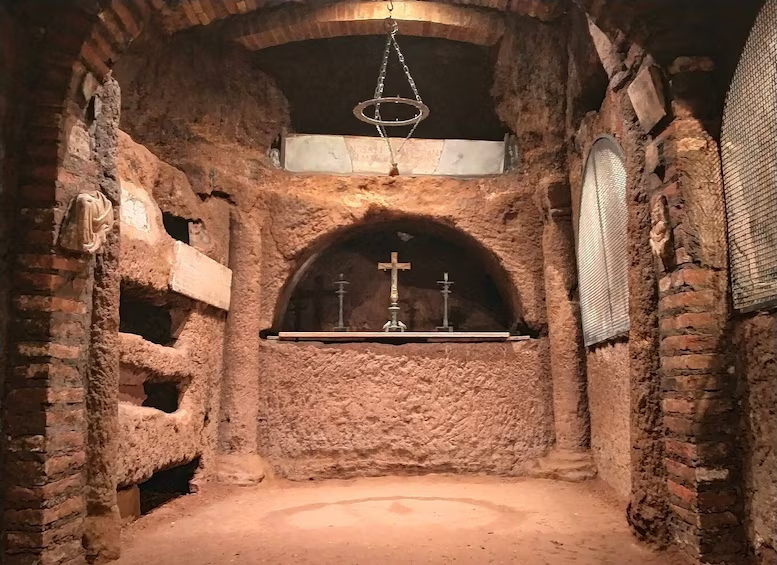
Catacombs of Sant'Agnese
Early Christian catacombs with Saint Agnes's tomb and 4th-century mosaics
Explore
Basilica di San Paolo fuori le Mura
Rome's second largest church over St. Paul's tomb
Explore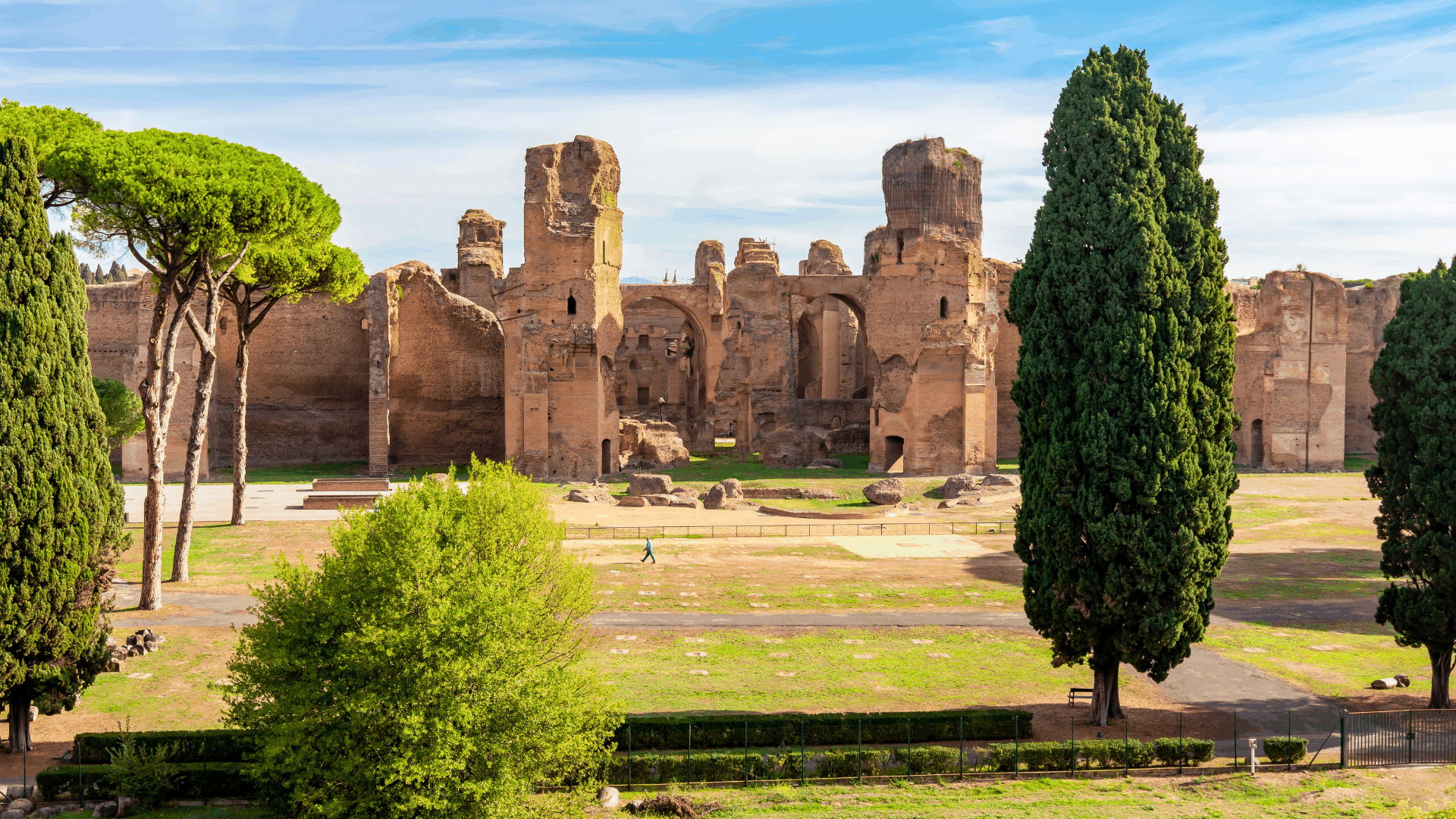
Baths of Caracalla
Ancient Rome's most magnificent public baths with towering ruins
ExploreQuick Planning Guide
⏱️ Time Needed
30–45 min
💰 Cost
Unclear — check with the church
🎫 Reservation
Access is irregular — confirm with the parish before visiting
♿ Accessibility
Underground not accessible; church fully accessible
📅 Best Time
Unclear — check current notices
👨👩👧👦 Family Friendly
Recommended 8+
🌡️ Weather
Cool underground — bring a light layer
Nearby Attractions
Trevi Fountain5-min walk
Piazza Venezia & Vittoriano3-min walk
Pantheon8-min walk
Galleria Doria Pamphiljnext door
Roman Forum & Colosseum15-min walk
Featured In These Itineraries
Hidden Gems of Rome5 Day Rome ItineraryClassic Rome ItineraryEssential Tips
- ✓ Access is limited and irregular — check current notices before visiting
- ✓ Bring some cash in case a donation is requested
- ✓ Bring a light layer for the cooler underground rooms
- ✓ Combine with the Trevi 5 minutes north as an optional add-on
- ✓ Confirm details with the parish rather than relying on older listings