 Ancient Roman Temple
Pantheon Rome: Complete Visitor Guide
Standard admission is €7 (from July 1, 2026). Entry is free for under-18s, Rome residents and everyone on the first Sunday of the month. Worshippers may enter free during Mass. Here's everything you need to know before you visit.
30–45 minutes€7 Entry (free 1st Sunday)World's Largest Unreinforced DomePiazza della Rotonda, 00186 Roma RMOpen on MapHotels NearbyPlan Your Visit
Compare tickets, tours and stays — booking ahead usually gives more choice
Get TicketsBook a TourHotels NearbyPantheon Location Map


 🏛
+− Leaflet | © OpenStreetMap contributors
🏛
+− Leaflet | © OpenStreetMap contributorsPiazza della Rotonda, 00186 Roma RM · Open in OpenStreetMap
Duration
30–45 min
Cost
€7
Built
126 AD
Dome
43.3m diameter
The Pantheon Rome (in Italian, Roma Pantheon) is the best-preserved building of ancient Rome — commissioned by Emperor Hadrian around 126 AD on the site of Marcus Agrippa's earlier temple. In 609 AD it was consecrated as the Christian basilica of Santa Maria ad Martyres, which is why it survived the Middle Ages intact while other ancient Roman temples were stripped for stone. Today the Pantheon is both a working Catholic church and one of Rome's most visited monuments, with guided tours covering its dome engineering, papal history and the tomb of Raphael. It's a short walk from Piazza Navona and the Trevi Fountain, and closer to St Peter's than most visitors realize (about 25 minutes on foot across the river).
Is the Pantheon Worth Visiting?
Yes — absolutely. The Pantheon is one of those rare places where the reality exceeds the hype. You walk through ancient Roman columns into a building that's nearly 2,000 years old, look up, and see the world's largest unreinforced concrete dome with an open hole in the center letting in rain, sunlight, and sky. No other building in Rome delivers that kind of "wow" moment so quickly and so powerfully.
Is the Pantheon free? Standard admission is €7 (from July 1, 2026). Eligible EU citizens aged 18–25 pay €2. Entry is free for under-18s, residents of the Municipality of Rome, and everyone on the first Sunday of each month. Worshippers may also enter free during Mass. At €7 and 30–45 minutes of your time, the Pantheon is still one of the best-value visits in Rome — compare it to the Colosseum (€18+, 1.5–2 hours) or Vatican Museums (€25+, 2–3 hours).
Who Should Visit
- • Anyone visiting Rome (it's unmissable)
- • Architecture and engineering enthusiasts
- • History lovers — from Roman gods to Renaissance tombs
- • Families with kids (quick, impressive, easy access)
- • Travelers on a budget (€7 — or free on the 1st Sunday)
What Surprised Us Most
- • The dome is much bigger than photos suggest
- • The light beam at noon is genuinely magical
- • Rain falling through the oculus is worth planning for
- • The original Roman floor is still intact
- • It's quieter than you'd expect inside
Pantheon Tours & Audio Guide Options
These are experiences bundled around official admission — guided tours, audio guides, and combo packages — not alternatives to the official Musei Italiani ticket.
Heads up: the Pantheon does not offer an official skip-the-line entrance. Everyone uses the same access procedure. Third-party products may bundle the official €7 admission with a guide or audio experience — check exactly what's included before booking.
Pantheon Entry + Audio Guide
Best for: Independent visitors
~30–45 minOfficial €7 admission with a digital audio guide covering the dome, Raphael's tomb and details most visitors miss. Timed entry, explored at your own pace.
- Timed entry + audio guide
- Self-paced exploration
- Raphael's tomb & oculus details
- Cancellable per vendor's terms
🎟️ Compare Prices:
TiqetsKlookTrip.comPantheon Guided Tour
Best for: History enthusiasts
~45 min – 1 hourSmall-group tour with a licensed guide who explains Hadrian's engineering, the Agrippa inscription and the artists and kings buried inside.
- Professional live guide
- Timed entry included
- In-depth commentary
- Multiple languages available
🎟️ Compare Prices:
TiqetsKlookTrip.comPantheon + Attraction Bundles
Best for: Full-day explorers
~2–3 hoursCombine Pantheon entry with Castel Sant'Angelo, Navona Underground or other nearby sights. May offer convenience, but compare the total price with booking separately.
- Pantheon timed entry
- Second attraction included
- Compare against separate bookings
- Flexible scheduling
🎟️ Compare Prices:
TiqetsKlookTrip.comHow to Visit the Pantheon (Step-by-Step)
Visiting the Pantheon is straightforward, but a few tips will save you time and frustration. Here's exactly what to expect:
1Book a timed-entry ticket
Book the official €7 timed-entry ticket online, especially from April to October. You'll choose a date and time slot rather than a fast-track — the Pantheon does not offer skip-the-line entry.
2Arrive within your slot
The Pantheon opens at 9:00 AM daily. Arrive close to your chosen entry time. First hour and after 4 PM are the quietest.
3Enter through the portico
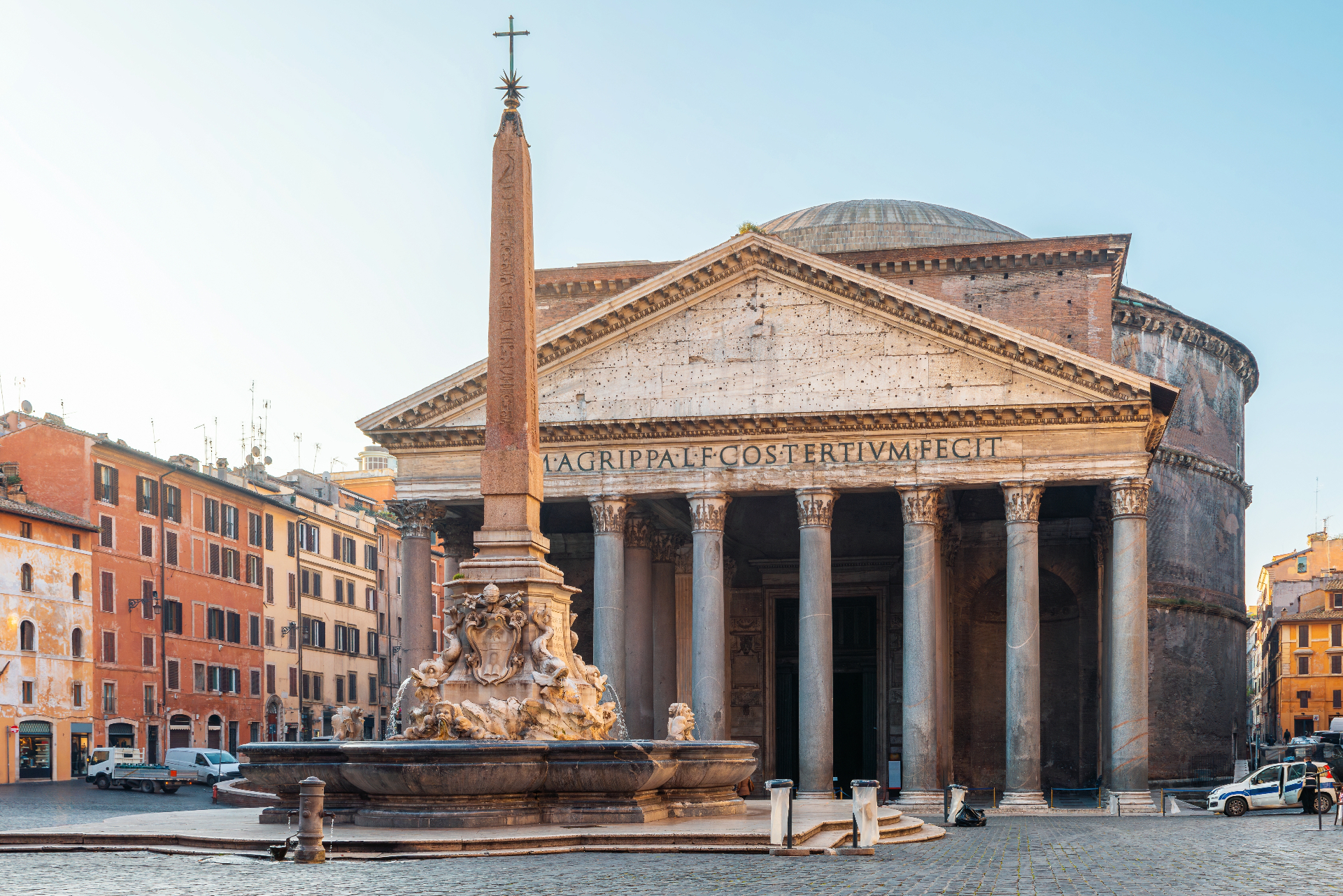
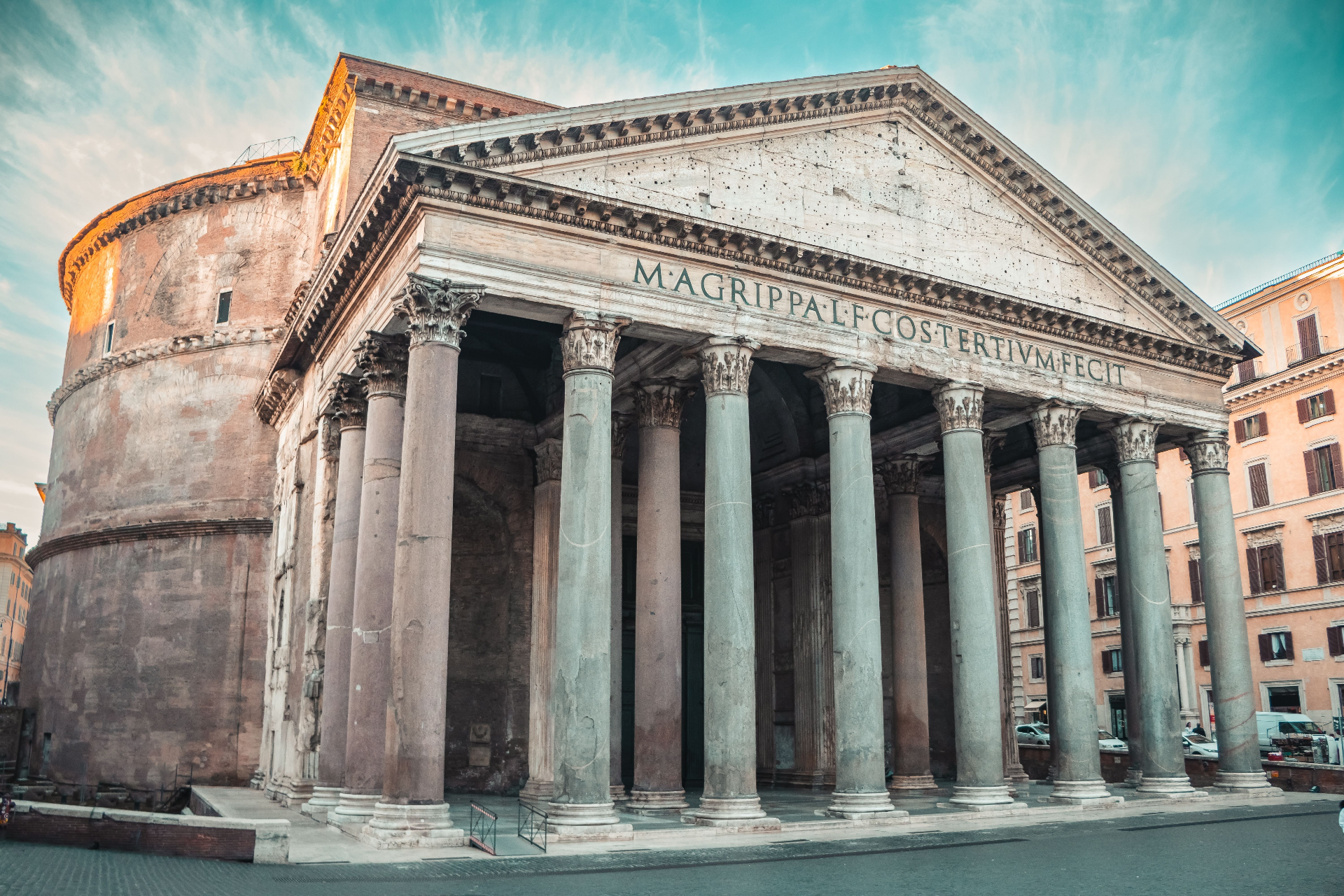
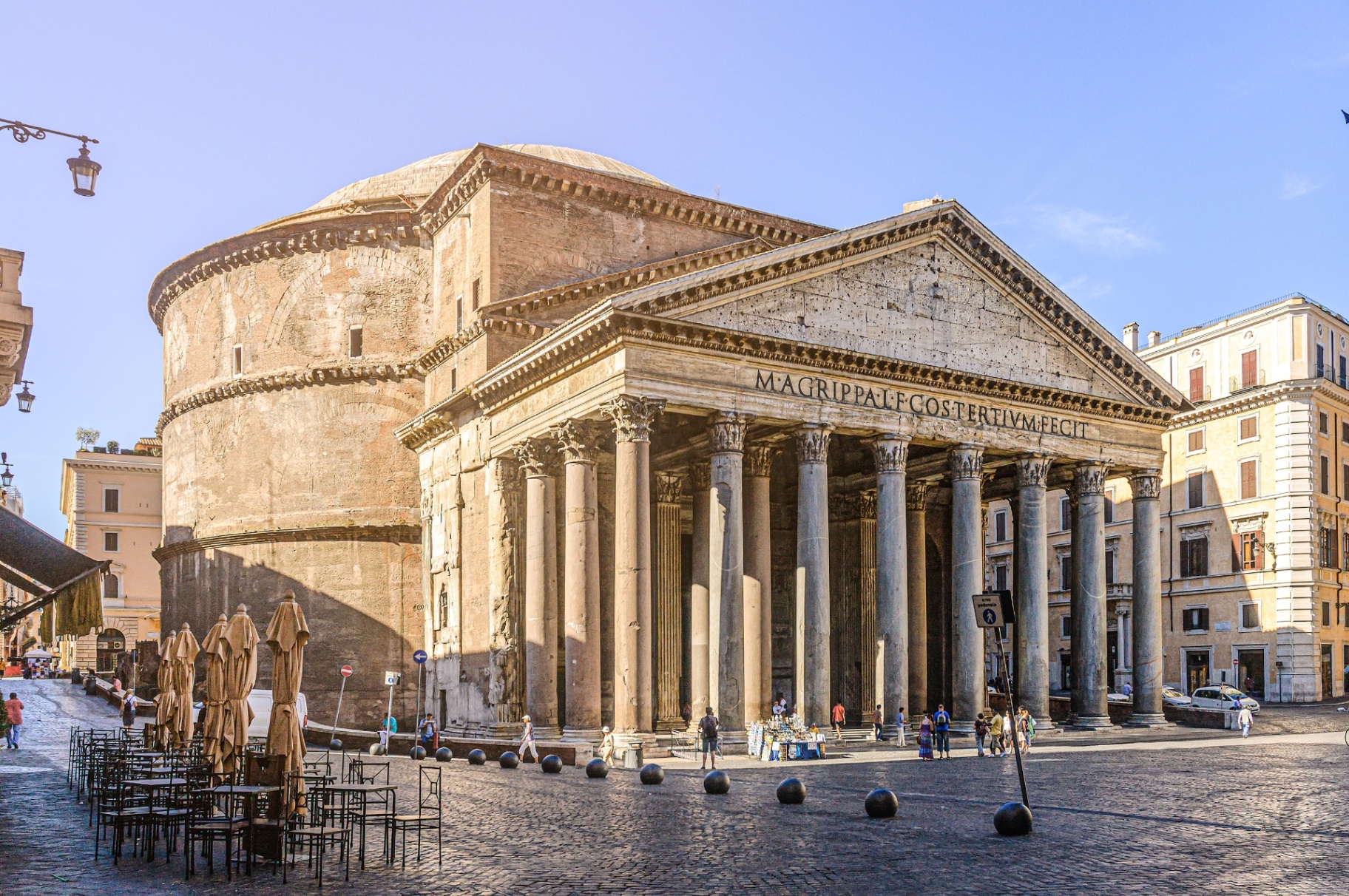
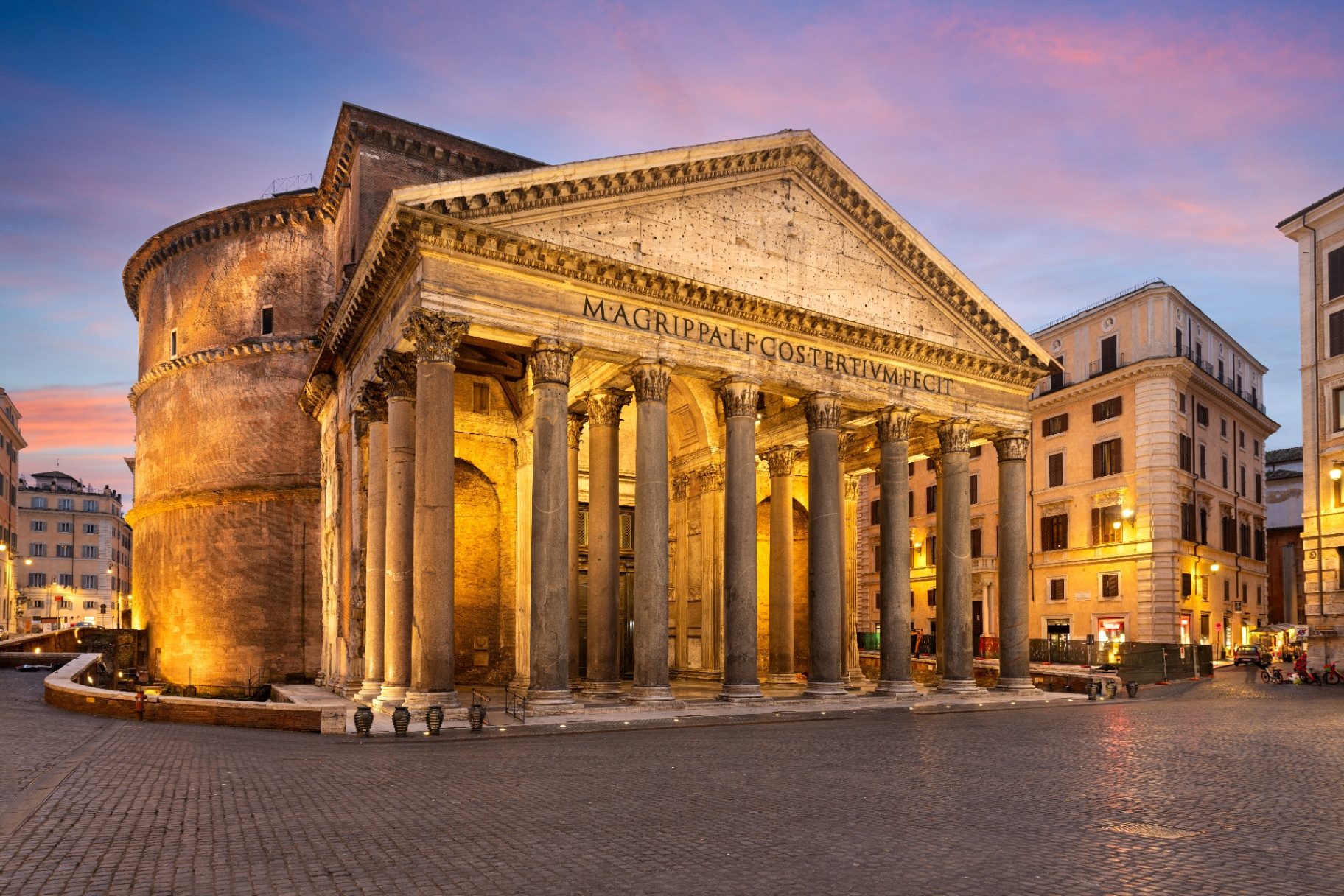
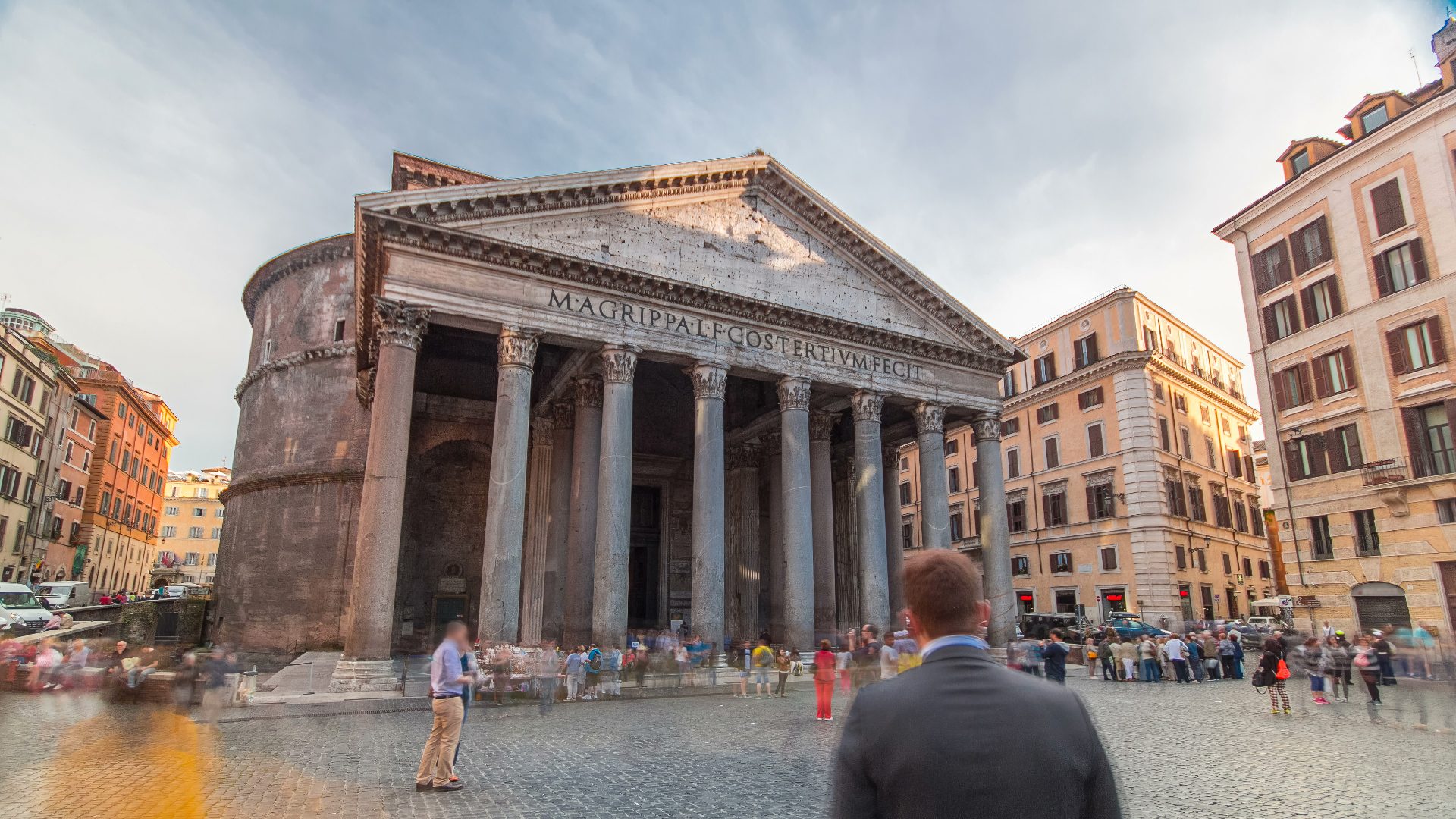
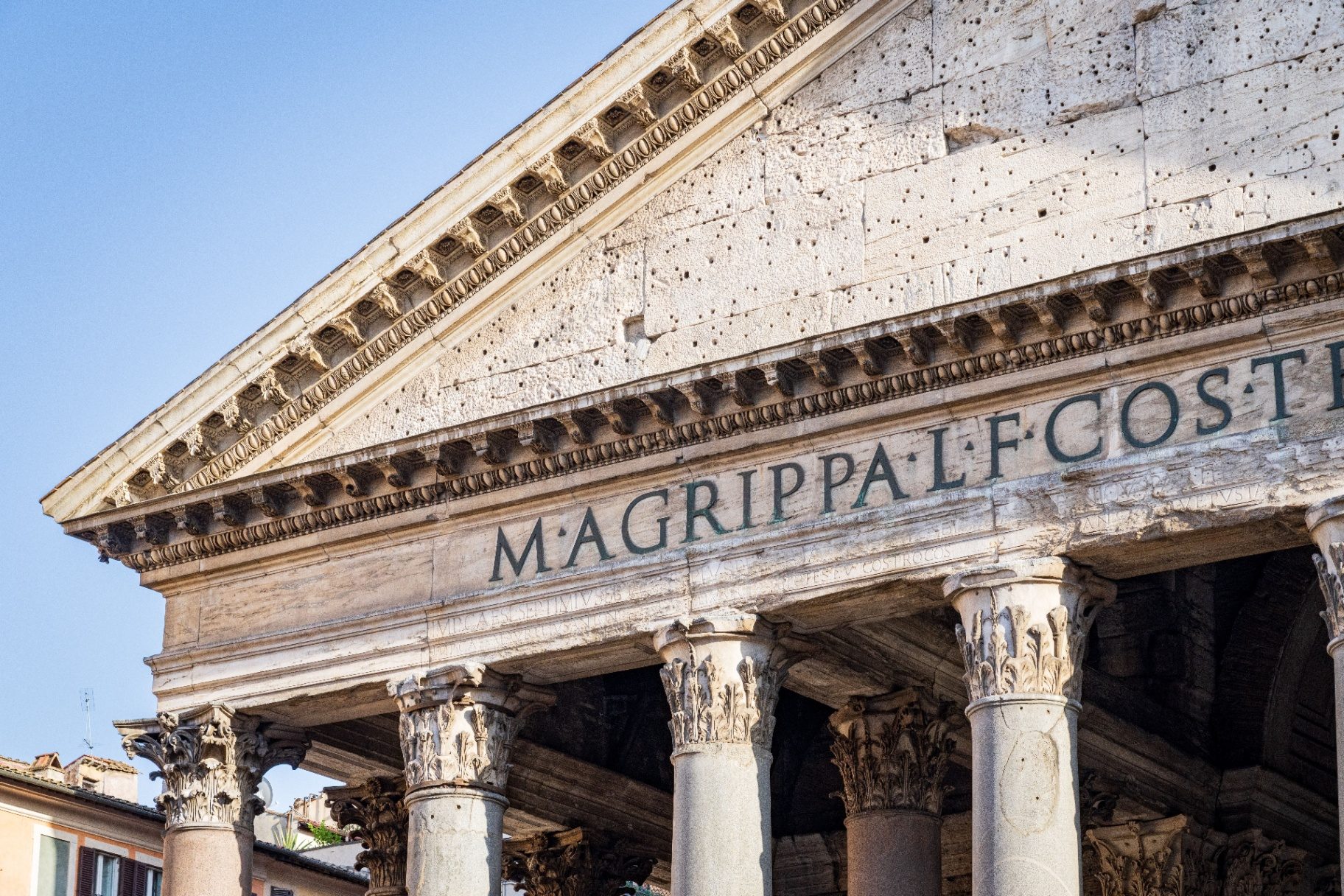
Walk through the 16 massive Corinthian columns. Look up at the original Roman inscription: 'M·AGRIPPA·L·F·COS·TERTIVM·FECIT' — Marcus Agrippa built this (well, the first version).
4Look up immediately
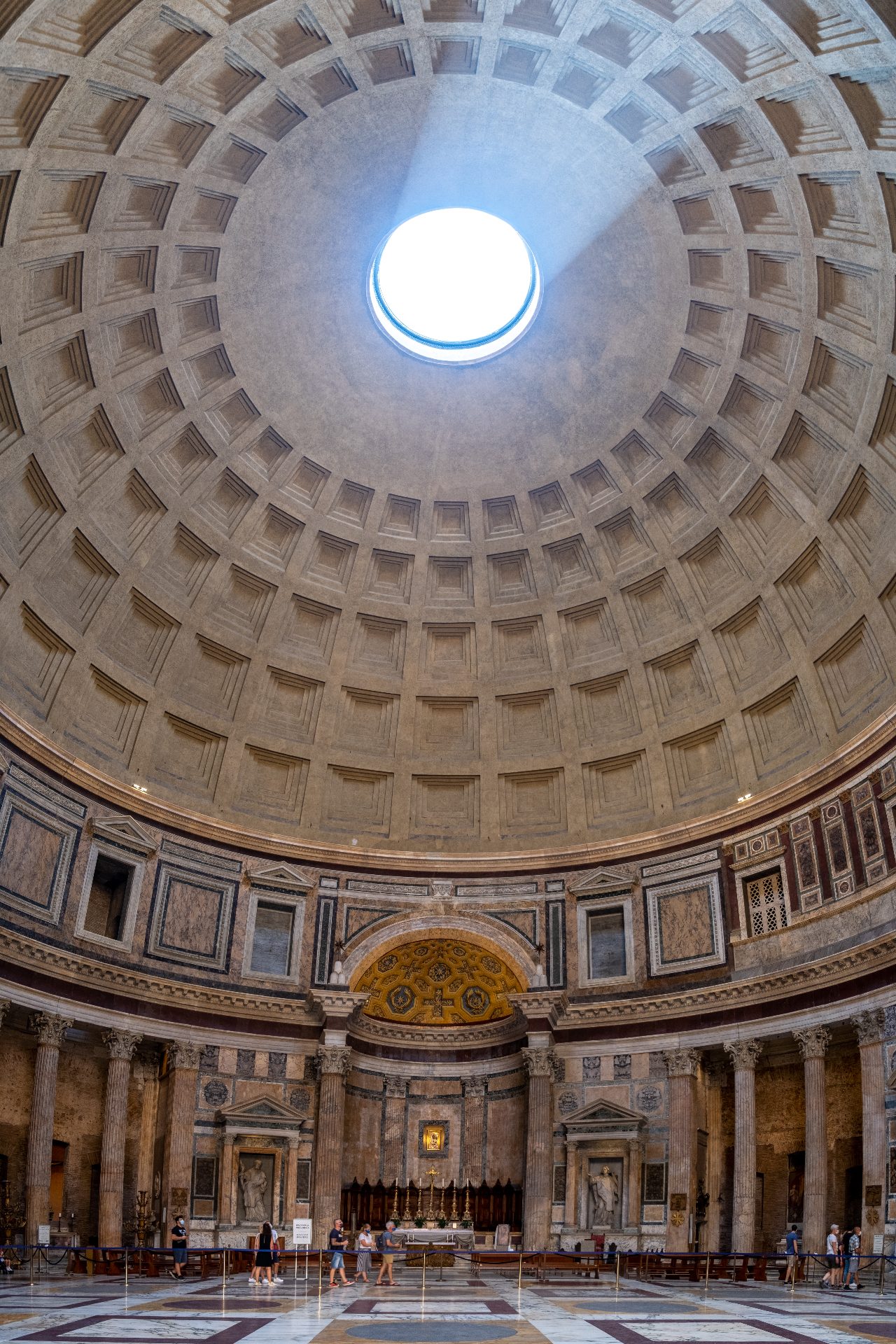
The dome is the star. Stand in the center and look straight up at the oculus — the ~9 metre hole open to the sky. If it's sunny, watch the light beam move across the walls.
5Walk the perimeter
Visit Raphael's tomb (left side), the tombs of Italian kings Victor Emmanuel II and Umberto I, and the seven chapels around the interior.
6Study the floor
The original Roman marble floor is still largely intact — 1,900 years old. Notice the slightly convex shape designed to drain rainwater from the oculus.
7Exit and enjoy the piazza
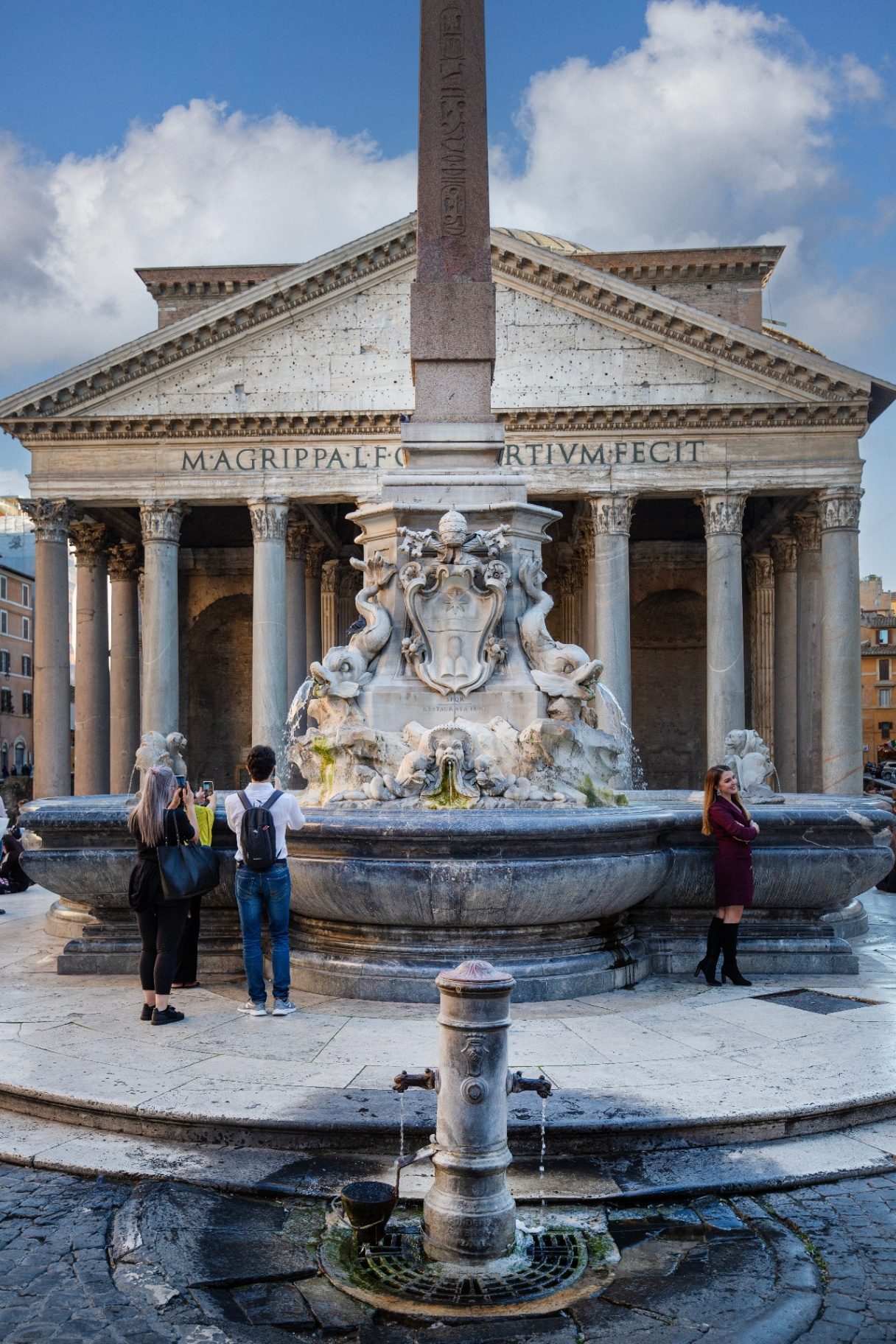
Piazza della Rotonda has cafés (overpriced but atmospheric) and a beautiful fountain. Then walk 5 minutes to Piazza Navona or 10 minutes to the Trevi Fountain.
Where to Stay Near the Pantheon
The Pantheon sits in the heart of Rome's historic center — one of the best areas to base yourself. You'll be within walking distance of Piazza Navona, the Trevi Fountain, and dozens of restaurants. Here are curated hotel options:
Walk to Pantheon, Navona & Trevi in under 10 minutesFamily rooms and apartments with kitchens availableHotels Near the PantheonRome Centre Family HotelsTop Rated in Historic CentreNear Termini StationBreakfast IncludedHotels with TerraceWhat to See Inside the Pantheon
Must-See Features
- The dome and oculus — look up from the center for the full effect. The dome is exactly 43.3 meters in both diameter and height, creating a perfect sphere
- Raphael's tomb — the Renaissance master chose to be buried here. His epitaph reads: 'Here lies Raphael, by whom Nature feared to be outdone while he lived, and when he died, feared that she herself would die'
- The original Roman floor — 1,900 years old, made of colored marble in geometric patterns, with a slight convex curve for rainwater drainage
- The 16 Corinthian columns — each one a single piece of Egyptian granite, shipped across the Mediterranean nearly 2,000 years ago
- The light beam — at noon, sunlight streams through the oculus creating a dramatic, moving spotlight on the interior walls
Details Most Visitors Miss
- The 22 drainage holes in the floor — nearly invisible but essential for managing rain through the open oculus
- The coffered ceiling pattern — the 5 rows of 28 coffers reduce the dome's weight while creating visual depth
- The bronze doors — monumental ancient bronze doors, extensively repaired and altered over time
- The crack patterns in the dome — deliberate 'relieving arches' built into the walls to distribute weight
Best Photo Spots at the Pantheon
Six shots that consistently outperform the standard "stand in front of the Pantheon" tourist photo. Time of day matters as much as angle.
The noon light beam
Around solar noon the oculus beam is at its most dramatic, but its position changes by season. In spring — especially near Rome's traditional April 21 birthday — the beam can reach the doorway area.
Portico from the fountain
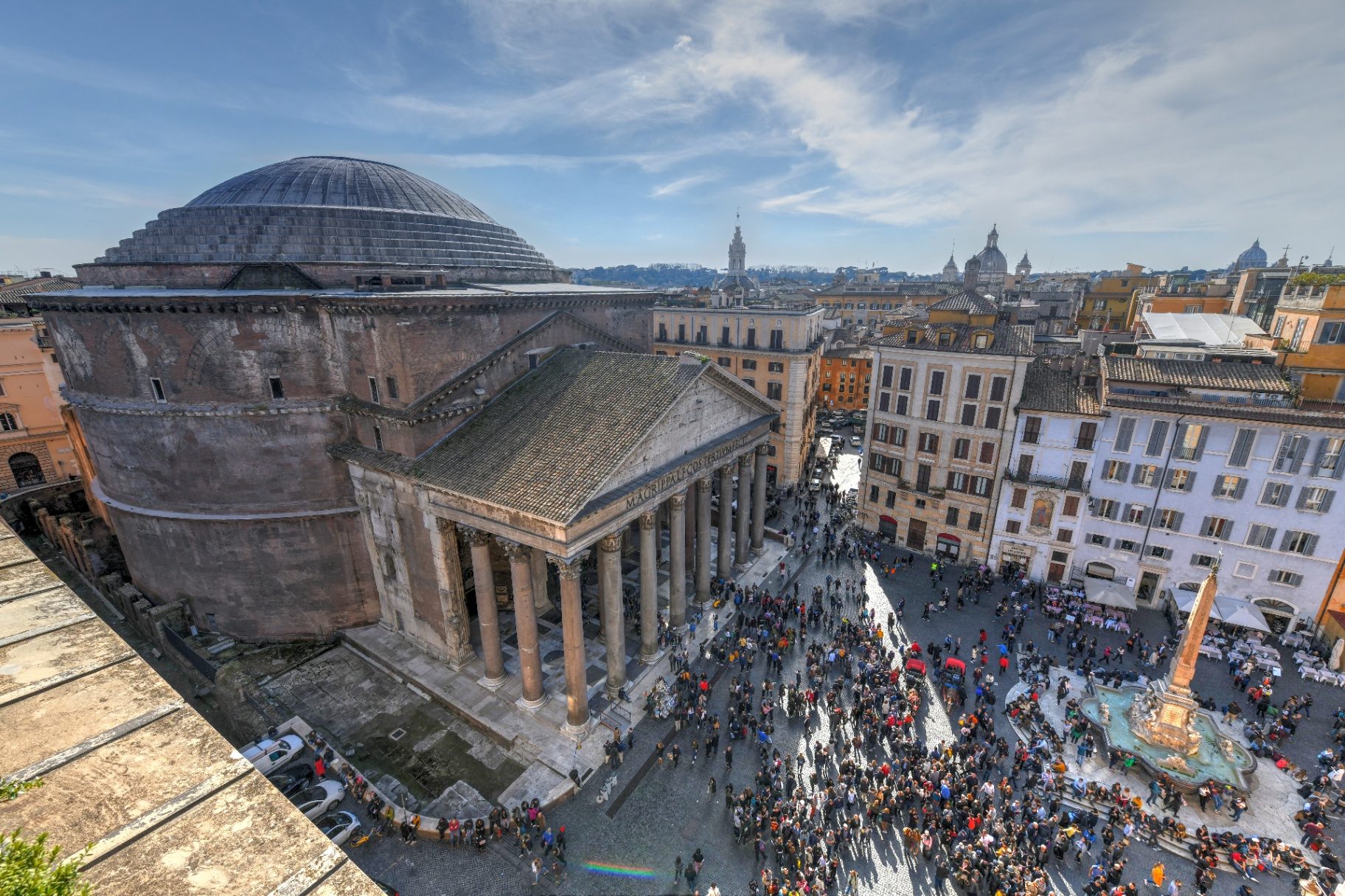
Cross to the far side of Piazza della Rotonda and shoot back across the fountain. The 16 Corinthian columns frame perfectly and you capture the obelisk in the foreground.
Rainy-day rain pillar
When it rains, water falls in a visible cylinder from the oculus to the marble floor. Shoot from the side with a slow shutter for an ethereal pillar effect.
Raphael's tomb close-up
Tight detail shot of the Madonna del Sasso statue above Raphael's sarcophagus. Soft side light from the oculus around 3:00 PM.
Dome coffers from below
Tilt your camera straight up from just off-centre for the classic geometric shot of the 5×28 coffers spiralling toward the oculus. Wide-angle lens works best.
Pantheon at blue hour
Just after sunset, the floodlit portico glows warm against a deep blue sky. Best from the south side of Piazza della Rotonda around 6:00–6:30 PM in winter, 8:30–9:00 PM in summer.
The Pantheon Throughout the Day
The Pantheon transforms hour by hour. If you can only visit once, pick the moment that matches what you came for.
Before 9 AM (closed)
The doors are shut, but Piazza della Rotonda is empty and golden — the best time to photograph the exterior portico without crowds.
9:00–10:30 AM (opening)
The quietest interior of the day. You can stand in the center alone for 20–30 seconds. Best for contemplation, photography, and architectural appreciation.
12:00 PM (noon light beam)
The signature moment. Sunlight pours through the oculus creating a dramatic moving spotlight. Crowded but worth it — go straight to the center, look up, then leave.
1:00–4:00 PM (peak crowds)
Tour group rush. Skip unless this is your only window — and if so, book a guided tour to be funneled in efficiently.
4:00–6:30 PM (golden hour)
Crowds thin, warm side-light fills the interior, and the marble glows. Excellent second-visit window or for first-timers who can't make morning.
After 7:00 PM (closed)
Floodlit exterior comes alive. The portico glows against the night sky and the piazza fills with locals — Rome's best free evening attraction.
Best Time to Visit the Pantheon
Early Morning (9:00–10:00 AM)
Fewest crowds. You might have 20–30 seconds alone in the space. Best for photos and quiet appreciation.
Noon (12:00 PM)
The famous light beam — sunlight pours directly through the oculus creating a dramatic spotlight. Worth timing your visit for this.
Late Afternoon (4:00–5:30 PM)
Tour groups leave, crowds thin. Warm golden light fills the interior. Great for a second visit.
Rainy Days
Don't skip the Pantheon in rain — watching water fall through the oculus and drain through the ancient floor is one of Rome's most unique experiences.
Pantheon by Season — When Should You Visit?
The Pantheon is open year-round, but conditions, crowds, and reservation requirements shift dramatically with the seasons.
| Season | Crowds | Reservation | Best For |
|---|---|---|---|
| Spring (Mar–May) | Heavy by mid-April | Strongly advised | Pleasant weather, Pentecost rose petal ceremony, blooming Piazza della Rotonda |
| Summer (Jun–Aug) | Peak — very heavy | Essential | Long daylight hours, blue-hour exterior photos, but oppressive midday heat |
| Autumn (Sep–Nov) | Moderate after mid-Oct | Recommended Sep, optional Nov | Best balance of weather, light, and manageable crowds |
| Winter (Dec–Feb) | Light (except Christmas week) | Not needed | Walk-up entry, dramatic low light through oculus, atmospheric rainy days |
Our pick: Late October or early November. Crowds drop sharply after the Italian holiday on November 1st, the weather is still mild, and the lower sun angle creates more dramatic light beams through the oculus around midday.
Pantheon Opening Hours (2026)
The Pantheon keeps a single daily schedule year-round. Religious services can temporarily change access on Saturdays and Sunday mornings.
| Day | Hours | Last Entry |
|---|---|---|
| Every day | 9:00 AM – 7:00 PM | 6:30 PM |
| Ticket office | closes 6:00 PM | — |
| Dec 25 / Jan 1 | Normally closed | Special openings may be announced |
Note: The Pantheon is an active church (Basilica di Santa Maria ad Martyres). It may close temporarily for Mass, weddings or funerals — especially Saturday afternoons and Sunday mornings.
Pantheon Tickets & Entry Information
Standard Pantheon admission is €7 (from July 1, 2026). The reduced ticket for eligible EU citizens aged 18–25 is €2. Under-18s, residents of the Municipality of Rome, and everyone on the first Sunday of the month enter free. Worshippers may enter free during Mass. The Pantheon is not included in the Roma Pass or Omnia Card.
RecommendedOfficial Pantheon Ticket — €7
Standard timed-entry admission booked via Musei Italiani (the official state platform) or on site. The Pantheon does not offer skip-the-line entry — everyone uses the same access procedure. Tickets are nominal and ID may be checked.
Book TicketsEntry + Audio Guide
Third-party product bundling the official €7 admission with a digital audio commentary in multiple languages. Covers the dome, Roman history and famous burials.
Book TicketsSmall-Group Guided Tour
Live guide (usually 45–50 minutes) explaining the dome engineering, the Agrippa inscription and the tombs. Bundles the standard admission ticket with the guide's fee.
Book TicketsFree entry — the rules
Free on the first Sunday of every month (not every Sunday). Free year-round for under-18s and Rome residents. Free during Mass for worshippers. Everyone else pays €7 — or €2 for eligible EU citizens aged 18–25.
Pantheon Rome Tours: Guided or Self-Guided?
The Pantheon is simple enough to visit on your own with a €7 ticket, but a live guide turns a 10-minute photo stop into a 45–50 minute story about the dome, Raphael's tomb and the Hadrian–Agrippa puzzle. For first-time visitors and architecture lovers, a small-group Pantheon Rome tour (€25–€45) is consistently one of the best-value experiences in the historic centre.
Most guided Pantheon tours last 45–50 minutes and run in English (Spanish and other languages available). Combo tours pair the Pantheon with Piazza Navona and the Trevi Fountain for a 2–3 hour historic-centre walk. Note: the Pantheon does not offer official skip-the-line entry — third-party tours bundle the standard timed-entry ticket with a guide or audio experience.
TiqetsGuided tours & audio guides
KlookGuided tours & audio options
Trip.comReward credits
For a full breakdown of tour types, prices and which one to pick, see our guide to best Pantheon Rome tours in 2026.
Budget Breakdown
The Pantheon is one of Rome's most affordable major attractions. Here's exactly what you'll spend:
| Expense | Budget | Standard | Comfort |
|---|---|---|---|
| Entry ticket | €7 | €7 | €7 |
| Audio guide / guided tour | — | €8–12 | €25–40 |
| Coffee at Piazza della Rotonda | — | €3–5 | €5–8 |
| Lunch nearby | €8–12 (pizza al taglio) | €15–25 (trattoria) | €30–50 (restaurant) |
| Transport | Walk (free) | Walk (free) | Taxi €10–15 |
| Total per person | €13–17 | €31–47 | €70–118 |
Pantheon Reservations & Time Slots
Since 2023, the Pantheon uses a timed-entry reservation system managed by the Italian Ministry of Culture. Here's how it actually works in 2026:
How far ahead can I book?
The visit calendar is opened one month at a time. Each month's slots typically go on sale on the official Musei Italiani platform in the middle of the previous month — so July slots are usually released around mid-June. There's no year-ahead booking.
Do I need a reservation?
Walk-up tickets are available, but queues can be significantly longer in peak season. A timed-entry ticket is the calm option.
How do time slots work?
You choose an available entry time when booking. Arrive before your booked slot and don't rely on a late-arrival grace period — the ticket is valid only for that time.
What if I'm late?
The official rules ask visitors to respect the time selected at purchase. Don't rely on a grace period; arrive before your booked entry time. If you miss the slot, you may need to buy a new ticket or join the walk-up queue.
Can I get a refund?
Official tickets on Musei Italiani are essentially non-refundable. Third-party cancellation terms vary by product; check the policy shown before payment.
How Long to Spend at the Pantheon
Most visitors spend 30–45 minutes inside. But the right amount of time depends on your style:
| Visit Style | Time Needed | What You'll Cover |
|---|---|---|
| Quick Look | 15–20 min | Walk in, see the dome and oculus, take photos, leave |
| Standard Visit | 30–45 min | Dome, oculus, Raphael's tomb, floor details, all chapels |
| Audio Guide | ~30 min | The official audio tour is about 30 minutes; budget 40–45 minutes total including the main space |
| Guided Tour | 45–50 min | Live guide explains the dome, tombs and history — bundled with the standard timed-entry ticket (no official skip-the-line exists) |
| With Kids | 20–30 min | Kids love the oculus (especially in rain). Keep it short — they'll get restless |
Mass & Church Services at the Pantheon
The Pantheon is officially the Basilica di Santa Maria ad Martyres — an active Catholic church. Regular services are held, and the building may close to tourists during Mass.
| Service | Day | Time |
|---|---|---|
| Mass (Italian) | Saturday | 5:00 PM |
| Mass (Italian) | Sunday & Holy Days | 10:30 AM |
| Pentecost Rose Petal Ceremony | Pentecost Sunday | After 10:30 AM Mass |
🌹 The Rose Petal Ceremony
On Pentecost Sunday (May/June), thousands of red rose petals are dropped through the oculus after Mass. It symbolises the descent of the Holy Spirit and is one of Rome's most magical events. Free to attend — arrive early for a good spot.
⛪ Visitor Etiquette
During Mass, tourists must remain quiet or leave. Current church instructions ask visitors not to photograph during services. Dress modestly — shoulders and knees should be covered (this is loosely enforced but respectful).
The Pentecost Rose Petal Ceremony
Once a year, on Pentecost Sunday (the seventh Sunday after Easter — late May or early June), thousands of red rose petals are released through the Pantheon's oculus to symbolize the descent of the Holy Spirit on the apostles. It's a longstanding church tradition and one of Rome's most photographed religious events.
When it happens
- • 2026 date: Sunday, May 24, 2026
- • 2027 date: Sunday, May 16, 2027
- • Mass starts at 10:30 AM
- • Petal release: immediately after Mass (~11:30 AM)
- • Total event: ~90 minutes
How to attend
- • Free — no ticket required
- • Arrive by 9:00 AM for a spot inside
- • The line forms in Piazza della Rotonda from 8:00 AM
- • Dress modestly (shoulders and knees covered)
- • You may stay for Mass or arrive just to watch the petals fall
- • Vatican firefighters drop the petals from the dome's exterior
History: The tradition dates back to the medieval period and was revived in modern form in 1995. The red of the petals symbolizes the tongues of fire that descended on the apostles at Pentecost. Around 200 kg of petals are used — sourced from Italian rose growers each spring.
Free Entry on the First Sunday of Every Month
The Pantheon waives its €7 entry fee on the first Sunday of every month (not every Sunday) — part of Italy's Domenica al Museo initiative. It's one of the easiest free wins in Rome, but plan accordingly: it gets crowded.
- ✓ Arrive by 8:30 AM — line starts forming before opening
- ✓ No reservation needed on free days (and reservations aren't accepted)
- ✓ Weekday alternative: Tuesday and Wednesday mornings are still €7 and far quieter
- ✗ Avoid arriving after 11 AM — wait can exceed 60 minutes
Insider Tips Most Guides Don't Mention
Visit on a rainy day
Watching rain fall through the oculus and drain through the ancient floor is one of Rome's most unique experiences. The floor's drainage still works perfectly after 1,900 years.
Stand exactly in the center at noon
A beam of sunlight moves across the interior walls like a spotlight. At noon it hits the entrance — this was intentional Roman engineering.
The Pentecost rose petal ceremony
On Pentecost Sunday (May/June), firefighters drop thousands of red rose petals through the oculus. Free to attend — arrive by 9:30 AM.
Free entry on first Sundays
The first Sunday of every month is free. Great for budget travelers, but arrive early — it gets packed.
The 22 hidden drain holes
Look carefully at the floor — 22 nearly invisible holes drain rainwater from the oculus. Most visitors never notice them.
Best photo angle
For the classic oculus shot, stand slightly off-center toward Raphael's tomb. The light and geometry are better than dead center.
Common Mistakes Visitors Make at the Pantheon
The Pantheon is straightforward to visit, but these mistakes waste your time or ruin the experience:
Coming between 11 AM – 2 PM without a plan
Instead: This is peak crowd time. If you come at noon for the light beam, go straight to the center, look up, then leave — don't try to explore during the crush.
Rushing through in 10 minutes
Instead: The Pantheon rewards slow observation. Spend at least 30 minutes. Walk the full perimeter. Study the floor. Watch the light change.
Not looking at the floor
Instead: Most visitors only look up. The original 1,900-year-old marble floor with its drainage system is just as impressive as the dome.
Wearing shorts or sleeveless tops
Instead: The Pantheon is an active Catholic church. Dress code is enforced: cover shoulders and knees. Carry a scarf in your bag.
Buying tickets at the door in summer
Instead: Walk-up tickets are available, but queues can be significantly longer in peak season. Book the €7 timed-entry ticket on Musei Italiani and walk straight to your slot.
Skipping the exterior
Instead: The 16 Corinthian columns and the inscription above are worth a few minutes. Most visitors rush inside without appreciating the entrance.
How Hadrian's Engineers Built the Dome
The Pantheon's dome has been the world's largest unreinforced concrete dome for nearly 1,900 years. No medieval cathedral, no Renaissance basilica, and no modern unreinforced structure has surpassed it. Here's how Roman engineers pulled it off without rebar, computers, or even the wheelbarrow.
Variable-density concrete
Roman builders mixed heavy basalt aggregate at the dome's base where compressive load is highest, then transitioned through travertine, brick, and finally lightweight pumice at the top. The dome literally gets lighter as it rises.
Coffered ceiling = weight reduction
The 5 rows of 28 sunken coffers aren't just decorative — each one carves out structural mass, reducing the dome's weight by an estimated 30% without compromising strength.
The oculus is structural
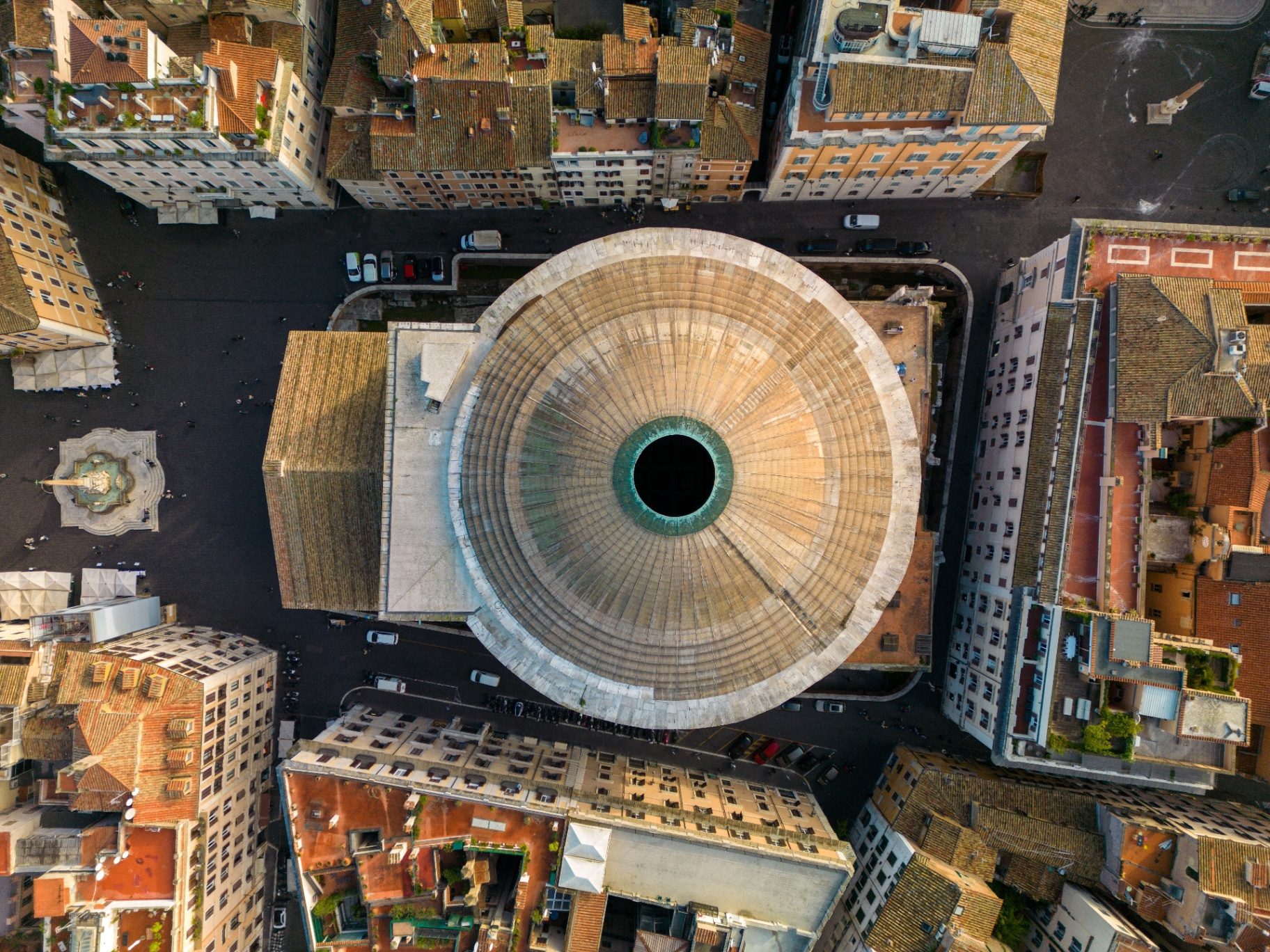
The 9-meter hole at the apex eliminates the heaviest part of any traditional dome — the keystone. Open at the top, the dome behaves like a series of arches in compression around the rim.
8 hidden relieving arches
Embedded in the rotunda walls (visible from the exterior brickwork), these arches redirect the dome's outward thrust into the ground rather than splitting the walls.
Wall thickness tapers
Walls are 6 meters thick at the base and only 1.5 meters at the dome's rim — matching where load decreases with height. This precision is calculated, not guessed.
Roman concrete chemistry
Volcanic ash (pozzolana) reacted with seawater-cured lime to form crystalline structures that grow stronger over centuries — the opposite of modern Portland cement, which decays.
The record still stands. St. Peter's dome (1590) is taller but smaller in diameter and reinforced with iron chains. Florence's Duomo (1436) is brick, double-shelled, and still 2 meters narrower. Modern concrete domes use steel rebar. The Pantheon, alone, did it with chemistry and geometry.
History of the Pantheon
The Pantheon you see today was built around 126 AD during the reign of Emperor Hadrian, replacing an earlier temple built by Marcus Agrippa in 27 BC. The name comes from the Greek words 'pan' (all) and 'theos' (gods). Its precise original function remains debated — the name suggests an association with 'all the gods,' but it may have served a more complex imperial and religious purpose.
Built
126 AD under Emperor Hadrian
Dome diameter
43.3 meters (142 ft) — still the world record
Original use
Debated — associated with 'all the gods'
Famous burial
Raphael (1520) — by his own request
In 609 AD, Byzantine Emperor Phocas gave the building to Pope Boniface IV, who consecrated it as a Christian church — Santa Maria ad Martyres. This conversion is often credited as one factor that helped protect the Pantheon from the destruction and plundering that befell many other ancient Roman buildings — alongside its continued use, structural durability, and ongoing maintenance over the centuries. It's been in continuous use for nearly 2,000 years.
The dome remains an engineering mystery. Roman builders used progressively lighter concrete as they built upward — heavy basalt aggregate at the base, lighter pumice near the top — but exactly how they constructed it without modern scaffolding techniques is still debated by engineers today.
Timeline of the Pantheon
Nearly 2,000 years of continuous use — from pagan temple to Christian church to national monument.
27 BCFirst Pantheon Built
Marcus Agrippa builds the original temple, associated with 'all the gods.' Destroyed by fire in 80 AD, then damaged again in 110 AD.
126 ADHadrian's Masterpiece
Emperor Hadrian completely rebuilds the Pantheon with its revolutionary concrete dome — the largest unreinforced dome ever built, a record that still stands today.
609 ADSaved by Christianity
Pope Boniface IV consecrates the building as Santa Maria ad Martyres. This single act saved the Pantheon while the Colosseum, Roman Forum, and nearly every other ancient building was stripped for materials.
1520Raphael's Tomb
Renaissance master Raphael is buried here at his own request — one of the highest honors for an artist of his era.
1870Royal Shrine
Italian kings Victor Emmanuel II and Umberto I are interred here, making the Pantheon both a church and a national monument.
2026€7 Entry Fee
The Pantheon admission is €7 (from July 1, 2026), with €2 for eligible EU citizens aged 18–25 and free entry for under-18s, Rome residents and the first Sunday of each month. Revenue funds conservation of the 2,000-year-old building.
Pantheon vs Colosseum vs St. Peter's Basilica
These are Rome's three most visited landmarks. Here's how they compare — and which to prioritize if you're short on time:
| Pantheon | Colosseum | St. Peter's | |
|---|---|---|---|
| Cost | €7 | €18+ | Free (Dome €17 stairs / €22 lift) |
| Time needed | 30–45 min | 1.5–2 hours | 1–2 hours |
| Best for | Architecture, quick wow | Roman history, gladiators | Art, faith, dome views |
| Crowds | Moderate | Heavy | Heavy |
| Advance booking | Recommended | Essential | Not needed (basilica) |
| Accessibility | Full wheelchair access | Partial | Full (ground level) |
| Dress code | Yes (church) | No | Yes (church) |
Our take: If you only have 2 hours, visit the Pantheon + Trevi Fountain — they're 10 minutes apart and give you two of Rome's most iconic experiences. If you have a full day, visit all three — check our One Day in Rome itinerary for the optimal route.
Pantheon Rome vs Pantheon Paris — Which Is Which?
Search results often confuse the two. They share a name and a domed silhouette but they are very different buildings, in different countries, built almost two millennia apart.
| Pantheon Rome | Panthéon Paris | |
|---|---|---|
| Built | 126 AD (Hadrian) | 1758–1790 (Soufflot) |
| Style | Ancient Roman | Neoclassical |
| Original purpose | Temple to all gods | Church of Saint Geneviève |
| Current use | Active Catholic basilica | Secular mausoleum |
| Famous burials | Raphael, Italian kings | Voltaire, Rousseau, Marie Curie, Victor Hugo |
| Dome | World's largest unreinforced concrete dome | Triple-shell stone dome |
| Entry fee | €7 (free first Sunday) | €13 |
| Location | Piazza della Rotonda, Rome | Place du Panthéon, Paris (Latin Quarter) |
The Paris Panthéon was directly inspired by the Roman one — Soufflot designed it after studying Hadrian's dome on a trip to Rome. So they're related, but the Roman original is nearly 1,700 years older.
Nearby Places Worth Visiting
The Pantheon sits in the heart of Rome's historic center. Everything below is walkable — no bus or metro needed.
Hungry after your visit? See our curated list of the best restaurants near the Pantheon in Rome — local trattorias, wine bars, and the tourist traps to skip on Piazza della Rotonda.
Piazza Navona
Rome's most beautiful baroque square with three fountains
5 min walkTrevi Fountain
Free to view; €2 open-dated ticket for the inner basin area
10 min walkCampo de' Fiori
Morning market, evening nightlife, great atmosphere
7 min walkLargo Argentina
Ancient temple ruins and Rome's famous cat sanctuary
5 min walkPiazza della Rotonda
The square in front of the Pantheon — fountain and cafés
Right outsideJewish Ghetto
Historic neighborhood with Rome's best Roman-Jewish cuisine
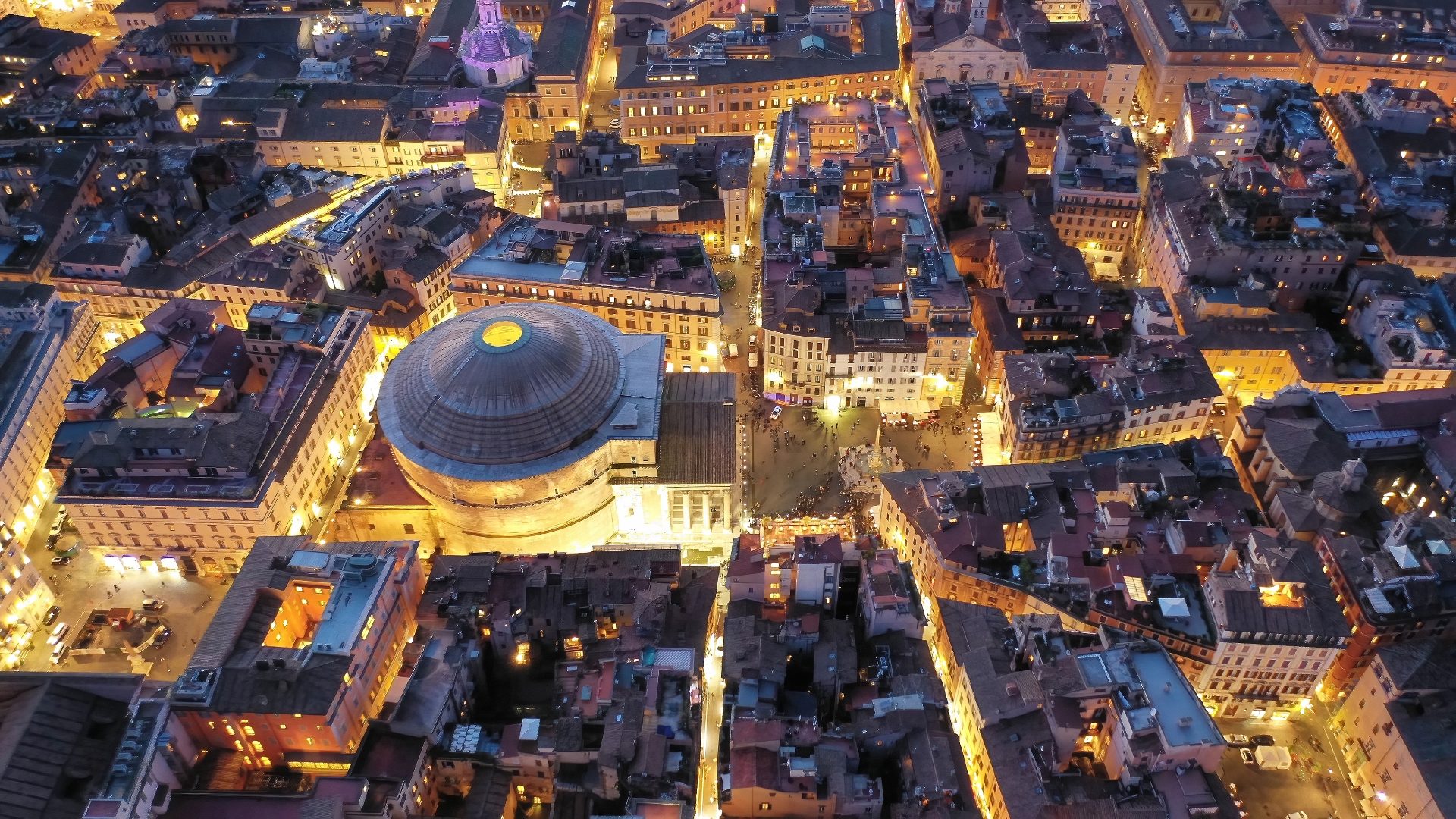
10 min walkPantheon in pictures
Where to Stay Near the Pantheon
Looking for convenient accommodation near the Pantheon? Stay within walking distance to make the most of your visit.
Hotels Near the PantheonCentral locations with easy access to the Pantheon and other attractionsFrequently Asked Questions
Is the Pantheon free to visit?
Standard admission is €7 (from July 1, 2026). Eligible EU citizens aged 18–25 pay €2. Under-18s, residents of the Municipality of Rome, and everyone on the first Sunday of the month enter free. Worshippers may also enter free during Mass.
How long does it take to visit the Pantheon?
30–45 minutes is enough for most visitors. The official audio tour lasts about 30 minutes; a guided visit typically runs 45–50 minutes. There's no upper floor or hidden rooms — what you see is the main space, tombs, and chapels.
Is the Pantheon worth visiting?
Absolutely. It's the best-preserved ancient Roman building in the world, nearly 2,000 years old, and the dome is still the largest unreinforced concrete dome ever built. Even if you're not into history, the sheer scale and the light through the oculus are unforgettable.
What is the best time to visit the Pantheon?
Early morning (9:00–10:00 AM) for the smallest crowds. If you want to see the famous light beam, visit around noon when sunlight streams directly through the oculus. Late afternoon (after 4 PM) is also quieter.
Can I take photos inside the Pantheon?
Yes, photography is allowed for personal use. Flash photography is not permitted. The natural light through the oculus creates stunning photo opportunities — no flash needed.
Is there a dress code for the Pantheon?
Yes. Shoulders and knees must be covered for both men and women. It's an active Catholic church (Santa Maria ad Martyres), and the dress code is enforced at the entrance. Carry a light scarf in your bag.
Does the Pantheon offer skip-the-line tickets?
No. The Pantheon does not offer an official skip-the-line entrance — all visitors use the same access procedure. Third-party products marketed as 'skip-the-line' usually bundle the standard timed-entry ticket with a guided or audio experience.
Is the Pantheon included in the Roma Pass or Omnia Card?
No. The Pantheon is not part of the Roma Pass or Omnia Card circuit. Official admission should be purchased through Musei Italiani or on site. Third-party guided experiences should be checked carefully to confirm what ticket is included.
What makes the Pantheon's dome special?
It's the world's largest unreinforced concrete dome — 43.3 meters in diameter — and it has stood for nearly 2,000 years. The central oculus (nearly 9 m opening) is the only source of light. No modern building has replicated this feat without reinforcement.
Pantheon vs Colosseum — which should I visit?
Both, if possible. The Colosseum is a larger, ticketed experience (1.5–2 hours). The Pantheon is quicker (30–45 min), cheaper (€7 vs €18+), and showcases Roman engineering at its finest. If you only have time for one, the Colosseum is more iconic, but the Pantheon is more awe-inspiring architecturally.
Do I need to book Pantheon tickets in advance?
Not strictly required, but recommended from April to October. Booking online lets you choose a date and time slot and avoid the ticket-desk queue. Walk-up tickets are available but the queue can be 20–40 minutes in peak season.
Related Attractions

Hadrian's Villa
Emperor's magnificent UNESCO estate in Tivoli—120 hectares
Explore
Porta Maggiore
Monumental 1st-century aqueduct arches later incorporated into the Aurelian Walls
Explore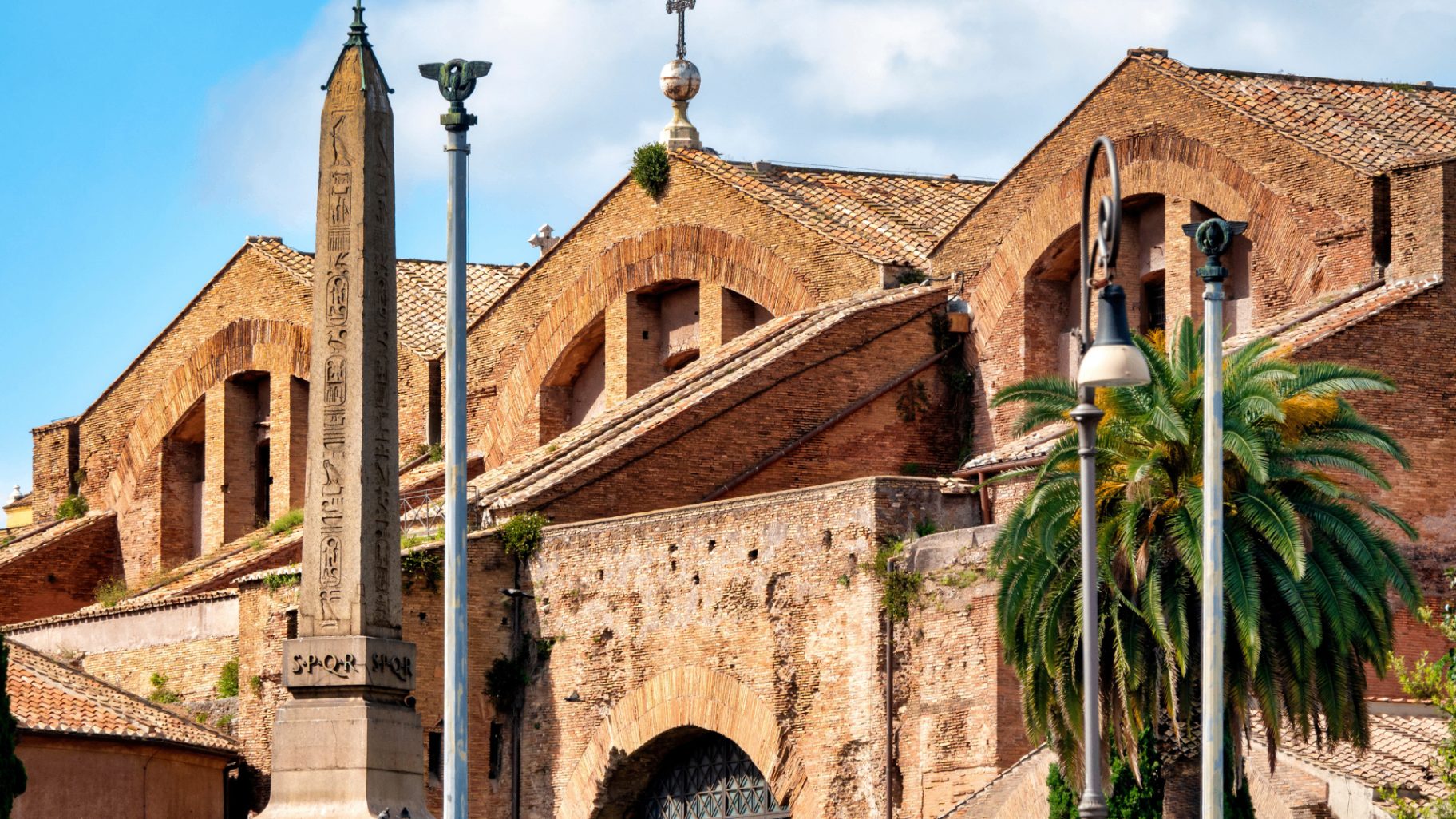
Baths of Diocletian
Ancient Rome's largest baths, now housing the National Roman Museum
Explore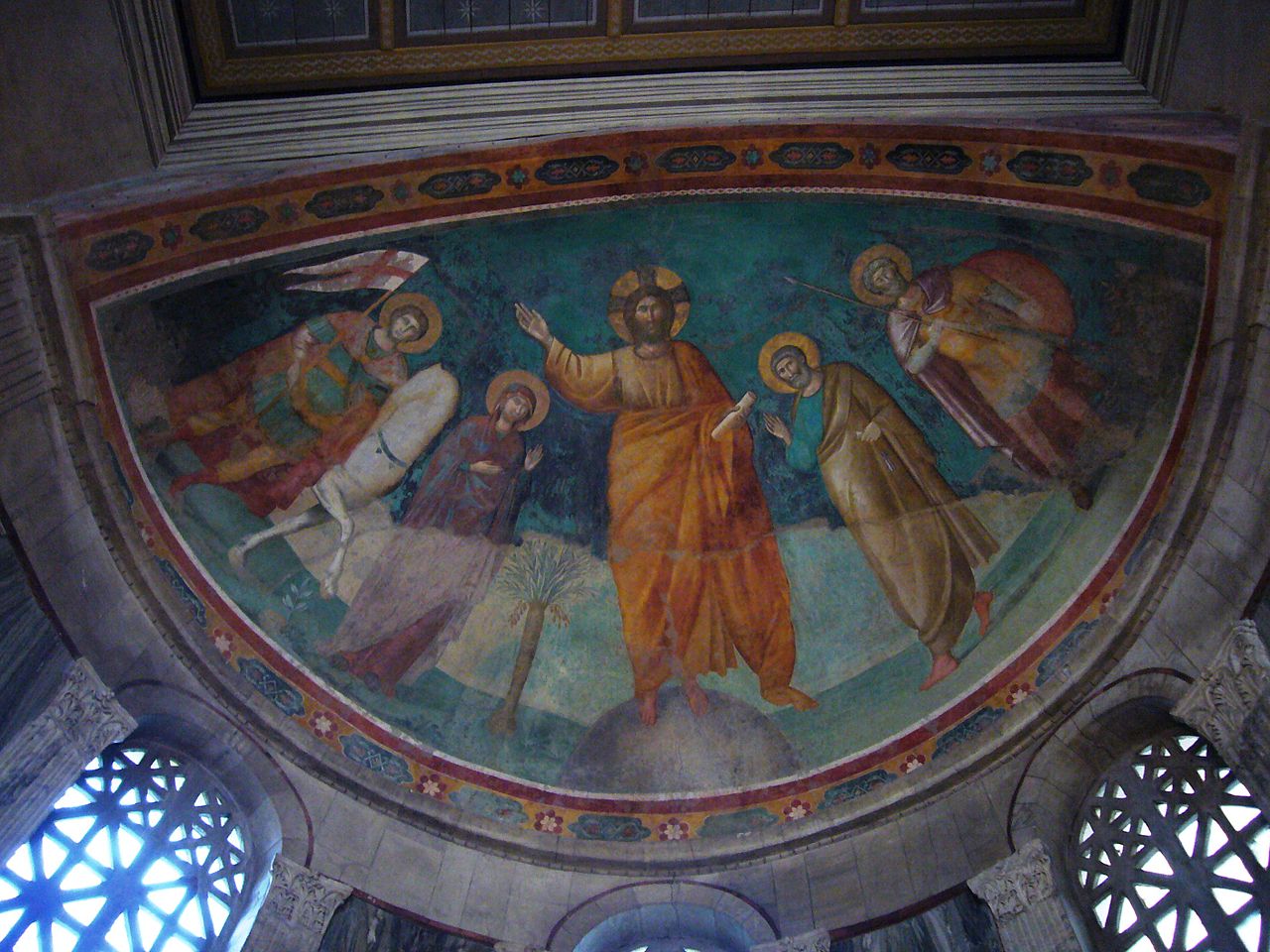
San Giorgio in Velabro
Early medieval church beside Rome's only surviving ancient quadrifrons arch
Explore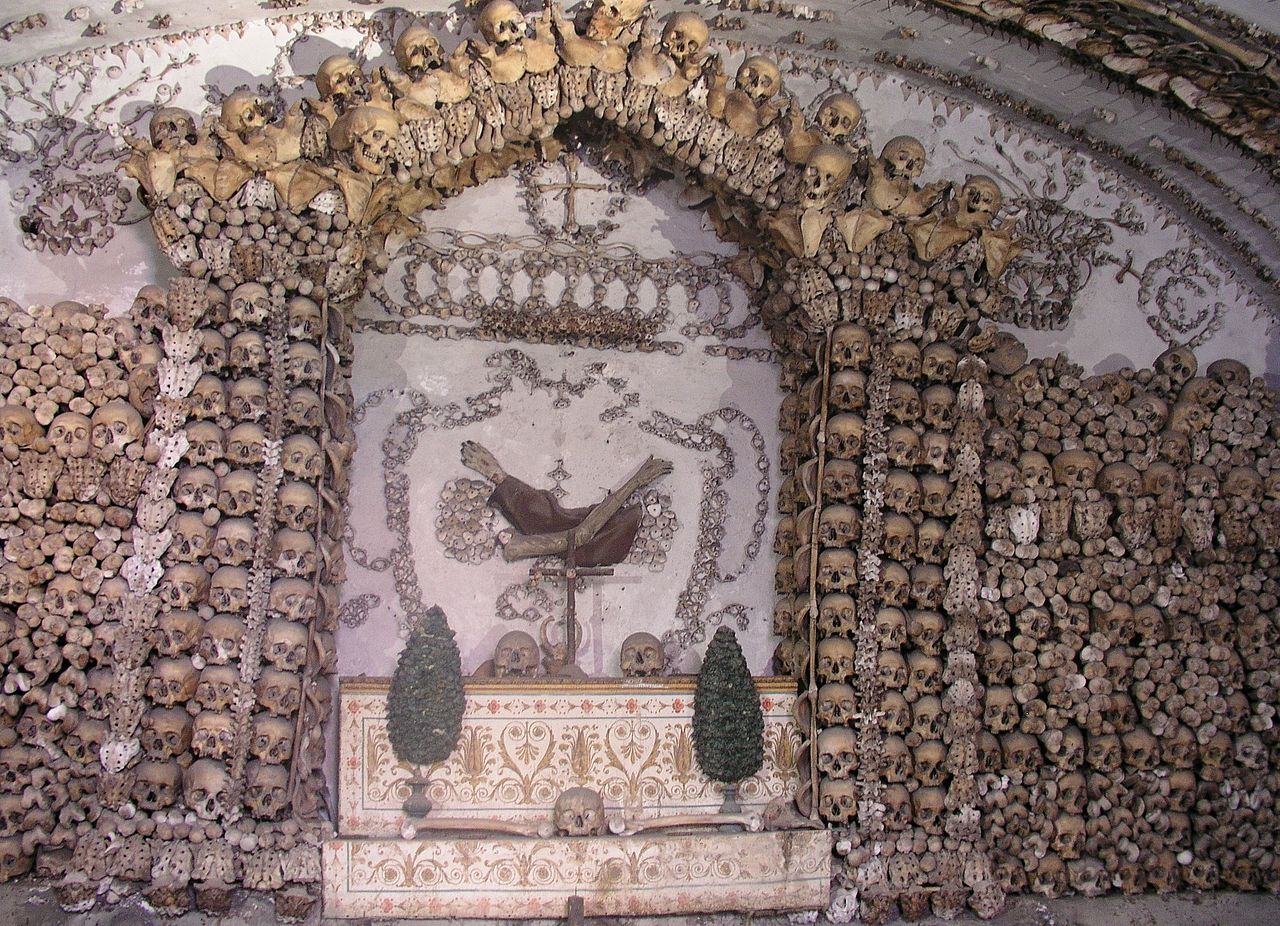
Capuchin Crypt
Haunting ossuary with 3,700 friars' bones arranged artistically
Explore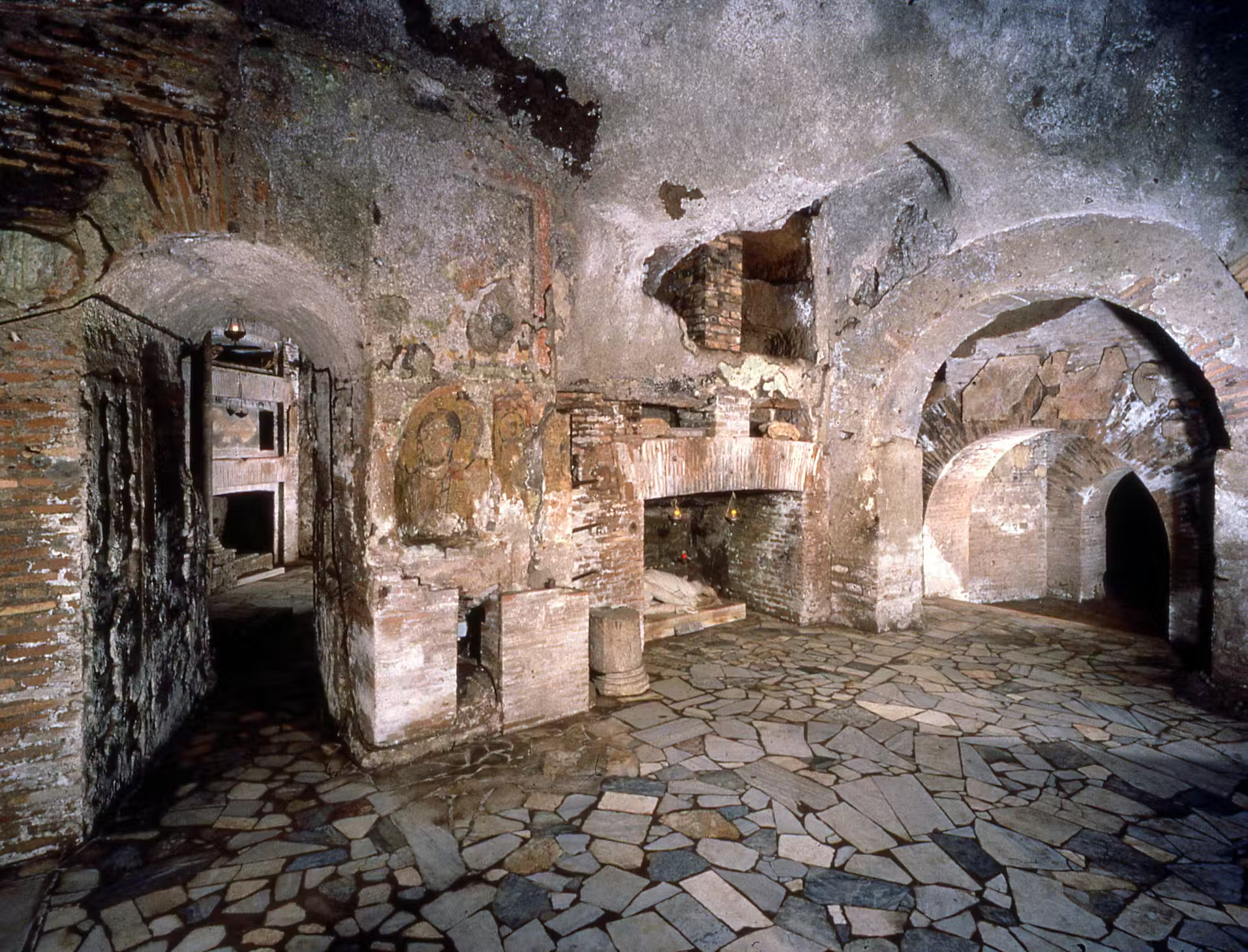
Catacombs of Saint Callixtus
Rome's largest Christian catacombs—20km of tunnels, 16 popes
ExploreQuick Planning Guide
⏱️ Time Needed
30–45 minutes
💰 Cost
€7 (free 1st Sunday, under-18s, Rome residents)
🎫 Reservation
Recommended April–October
♿ Accessibility
Wheelchair accessible (ground floor)
📅 Best Time
9:00 AM or after 4:00 PM
👨👩👧👦 Family Friendly
Yes — the dome fascinates all ages
Nearby Attractions
Piazza NavonaRome's most beautiful baroque square (5-minute walk)
Trevi Fountain — free to view; €2 open-dated ticket for the inner basin area10-minute walk
Largo ArgentinaAncient Roman temple ruins and cat sanctuary (5-minute walk)
Campo de' FioriLively market square with restaurants and nightlife (7-minute walk)
Castel Sant'AngeloHadrian's mausoleum, by the same emperor who built the Pantheon (15-minute walk)
Spanish StepsIconic baroque staircase and Piazza di Spagna (15-minute walk)
You May Also Like
Piazza della RotondaPiazza NavonaTrevi FountainSant'IgnazioFeatured In These Itineraries
One Day in RomeClassic Rome 3-DayFree Rome ItineraryRome with KidsEssential Tips
- ✓ Arrive by 9:00 AM to beat the crowds
- ✓ Visit at noon to see sunlight beam through the oculus
- ✓ Visit on a rainy day — rain falling through the oculus is unforgettable
- ✓ Dress code enforced: cover shoulders and knees
- ✓ Free entry on the first Sunday of each month (not every Sunday)