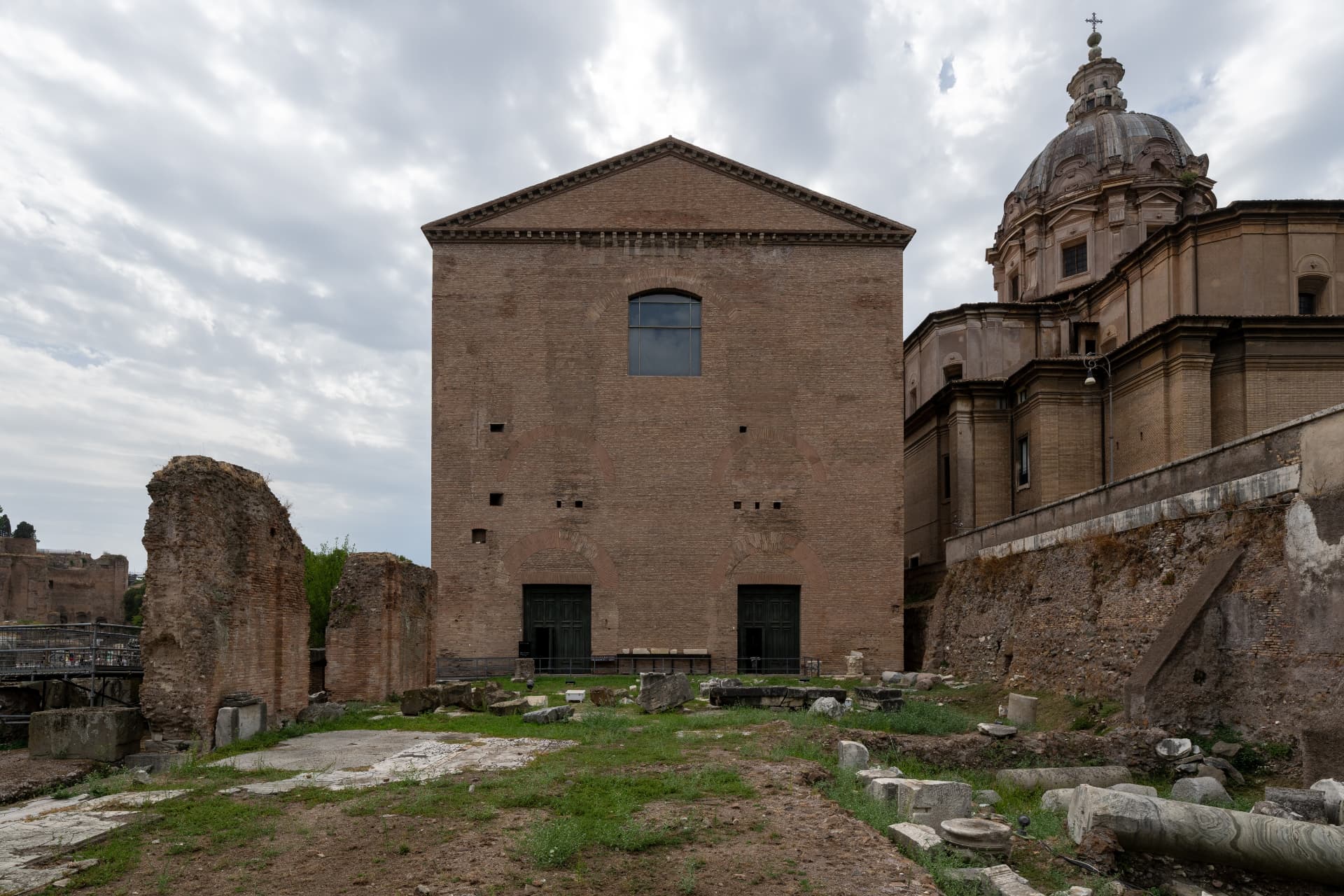
What is the Curia Julia?
The Curia Julia is the tall brick building at the north-west corner of the Roman Forum where the Roman Senate met. Julius Caesar began it to replace an older senate house, and Augustus finished it in 29 BC, which is why it carries the Julian family name.
The building you see today is a later rebuilding by Emperor Diocletian after a fire in the late 3rd century. It is one of the few Forum buildings standing almost complete, so it is the best place to picture how a large Roman public hall felt.


 12345+− Leaflet | © OpenStreetMap contributors
- 1. Curia Julia (Senate House)
- 2. Arch of Septimius Severus
- 3. Temple of Saturn
- 4. Temple of Caesar
- 5. Entrance: Largo della Salara Vecchia
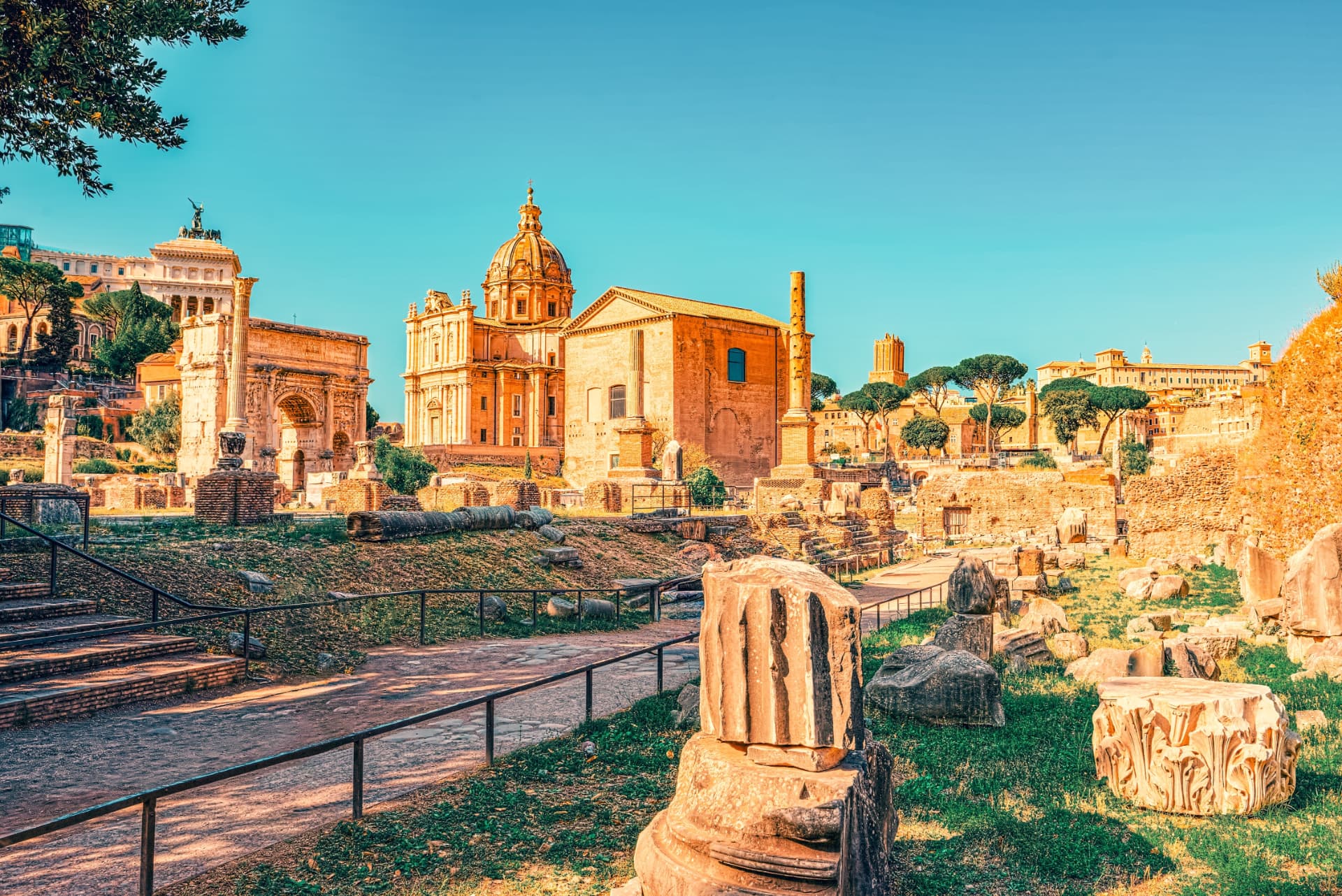
Why does the Senate House survive so well?
In the 7th century the Curia was converted into the church of Sant’Adriano, and buildings that stayed in use were rarely stripped for stone. In the 1930s the later church additions were removed and the hall was restored to its ancient form.
The bronze doors at the entrance are a copy. The original ancient doors were moved in the 17th century to the Archbasilica of St John Lateran, where they still serve as the main doors.
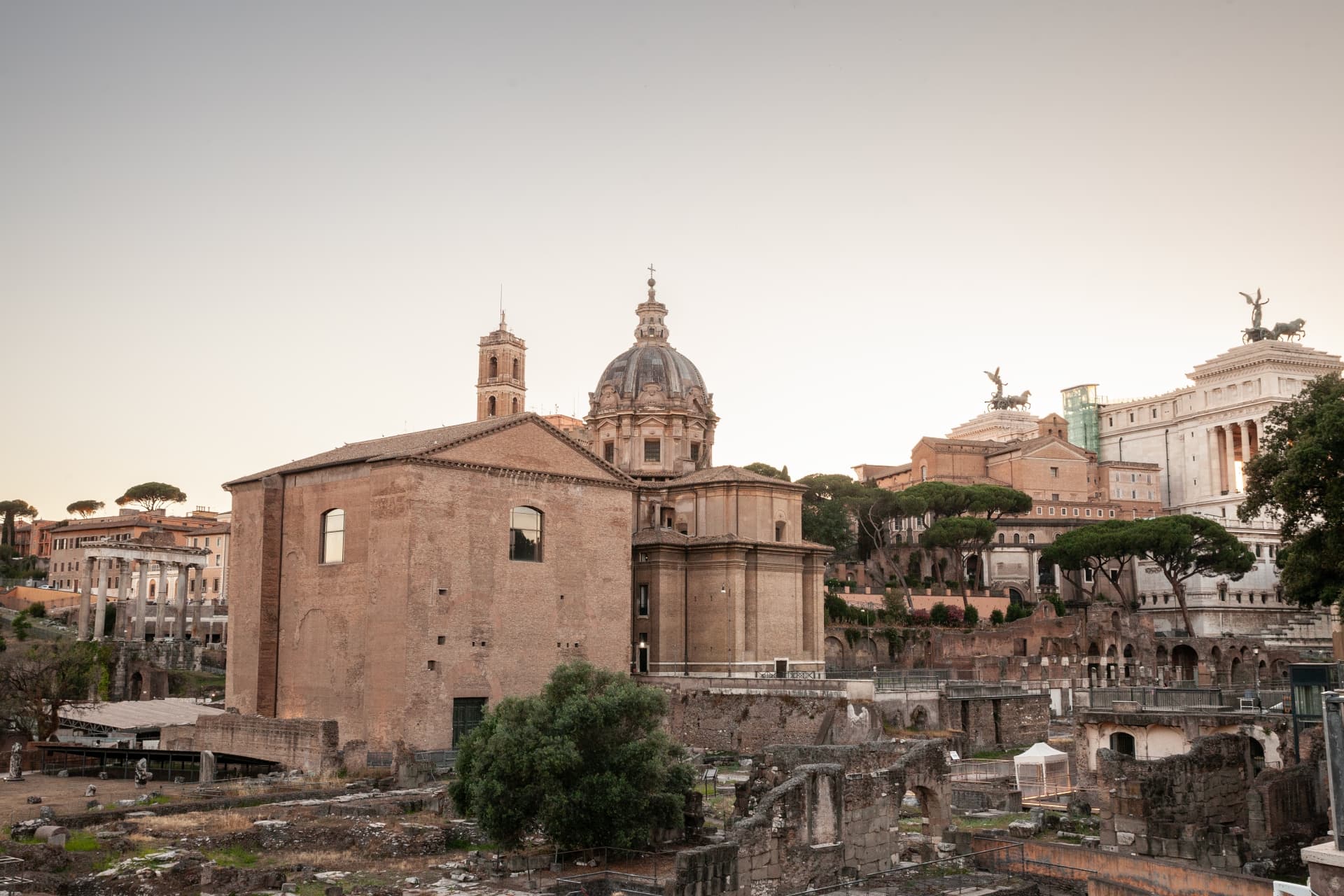
What can you see inside?
Inside is a single tall hall. Look down at the floor, a restored pattern of coloured marble in the late Roman style, and at the low steps along both long walls where senators’ seats were placed. At the far end is the base where the presiding magistrate sat.
The hall often displays the two carved marble panels known as the Plutei of Trajan, which show scenes of the emperor’s public acts in the Forum, and sometimes temporary exhibitions. What is on show can change, and the interior may close occasionally, so check the official park site.
What should you look for in a short stop?
| Where | Look for |
|---|---|
| Entrance | Copy of the bronze doors (originals at St John Lateran) |
| Floor | Restored coloured marble pattern |
| Long walls | Low steps where senators’ seats stood |
| Displays | The Plutei of Trajan reliefs, when shown |
| Outside | The Arch of Septimius Severus and the speakers’ platform nearby |
How does the Curia fit into a Forum visit?
The Curia is at the western end of the Forum, next to the Arch of Septimius Severus and a short walk from the Temple of Saturn. Allow fifteen to twenty minutes including the interior. It is inside the paid Forum and Palatine area; from Via dei Fori Imperiali you can only see its back and sides.
Prices, ticket names and time slots are set by the Parco archeologico del Colosseo and change; check the official ticket page before buying.
 Tiqets
Skip-the-line and last-minute Roman Forum tickets — resellers may still have availability; prices are usually higher.
Check prices Klook
Guided tours with entry included — compare with official dates first; prices are usually higher.
Check prices Trip.com
Compare bundles and combo tickets — Colosseum plus Forum, Vatican or hop-on buses in one booking.
Check pricesAffiliate links: we may earn a commission at no extra cost to you. Check each listing's cancellation terms before paying.
Official sources
Reviewed October 2026. Ticket names, prices, hours and open areas change — always confirm on the official pages.
Frequently asked questions
- Can you go inside the Curia Julia?
- Usually yes. The Senate House is normally open to visitors with a ticket covering the Roman Forum, and the interior hall, marble floor and carved panels are the main reasons to step inside. It can close for maintenance or exhibition changes, so check the official Parco archeologico del Colosseo website on the day of your visit.
- Is the Curia Julia where Julius Caesar was killed?
- No. Caesar was killed in 44 BC at a meeting held in the Curia of Pompey, part of the Theatre of Pompey complex near today’s Largo di Torre Argentina. The Curia Julia in the Forum was still being built at that time and was completed later by Augustus, so it is a different building.
- Are the doors of the Curia Julia original?
- The doors you see at the Curia today are a copy. The original ancient bronze doors were moved in the 17th century to the Archbasilica of St John Lateran, where they were adapted to fit and still form the main entrance. You can see both in one day if you visit the basilica as well.
- How long should you spend at the Curia Julia?
- Fifteen to twenty minutes is enough to walk through the hall, look at the floor and reliefs, and see the Arch of Septimius Severus and speakers’ platform outside. If a temporary exhibition is on, allow a little longer. It pairs naturally with the Temple of Saturn at the same western end of the Forum.
More Roman Forum guides
- Roman Forum in Rome: What to See, History and Visiting Tips
- Domus Tiberiana: Imperial Palace, Museum and Roman Forum Views
- Santa Maria Antiqua: Ancient Frescoes and How to Visit
- Arch of Septimius Severus: History and Reliefs Explained
- Temple of Antoninus and Faustina: The Roman Temple That Became a Church
- Temple of Vesta and House of the Vestals: History and Visiting Guide
- Temple of Saturn: The Roman Forum’s Famous Columns Explained
- Basilica of Maxentius: What to See at the Roman Forum’s Largest Basilica
- Arch of Titus: History, Reliefs and What to Look For
- Colosseum, Roman Forum and Palatine Hill in One Day: Best Order and Route
- Roman Forum vs Imperial Forums: What’s the Difference?
- Roman Forum Map: Main Sights and a Self-Guided Walking Route
- What to See in the Roman Forum: Highlights Explained for First-Time Visitors
- Roman Forum History: What It Was and Why It Became Ruins
- Roman Forum Tickets: Visiting With or Without the Colosseum
- Forum Pass SUPER: What It Includes and Is It Worth It?
- Roman Forum Guided Tour vs Self-Guided Visit: Which Should You Choose?
- Can You See the Roman Forum for Free? Viewpoints and Admission Explained
- Roman Forum Entrances: Where to Enter and Which Gate to Choose
- How Long to Spend at the Roman Forum and Palatine Hill?
- Best Time to Visit the Roman Forum: Weather, Crowds and Opening Hours
- Roman Forum with Kids: A Short Route and What to Look For
- Roman Forum Accessibility: Uneven Paths, Step-Free Routes and Visitor Facilities