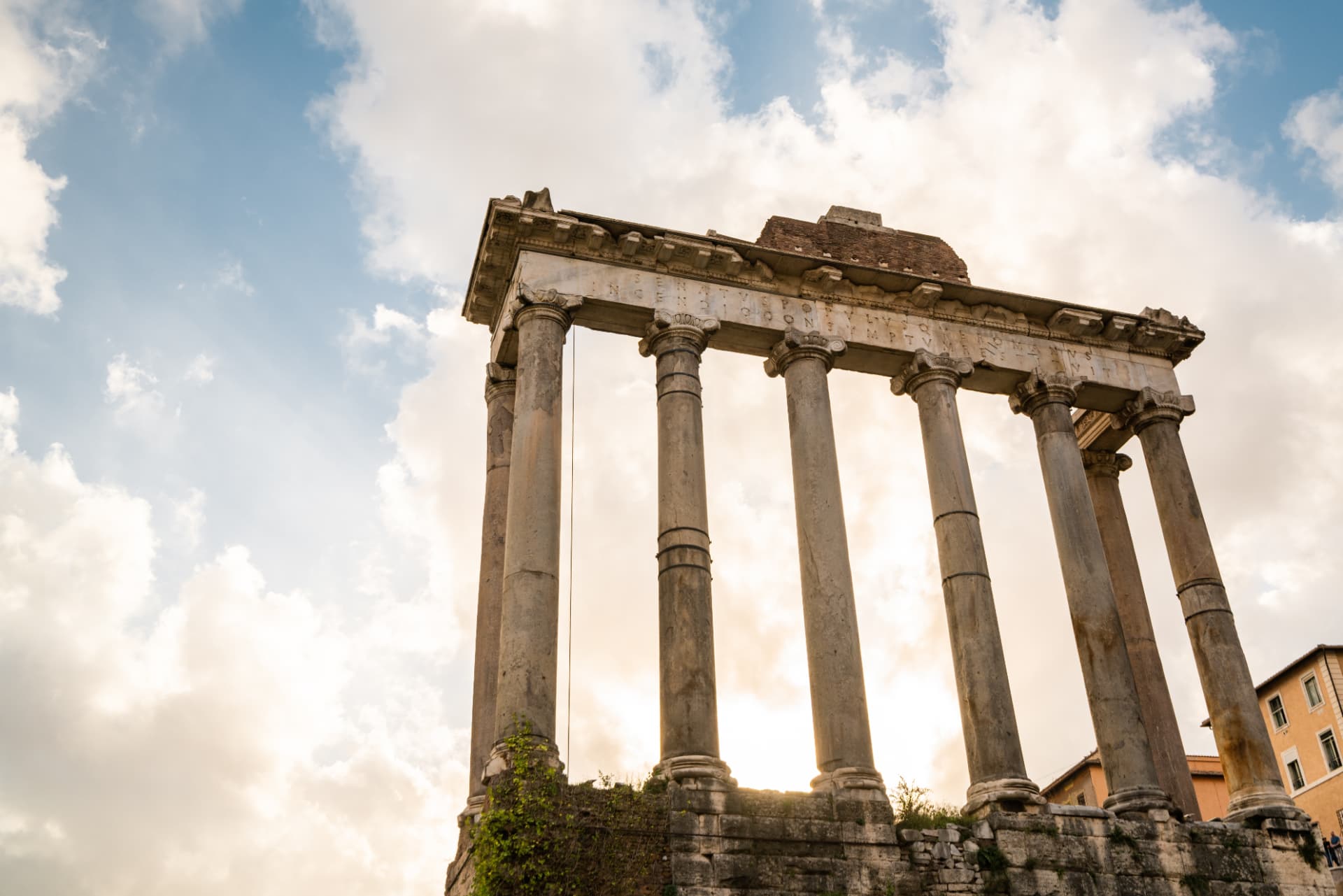
What is the Temple of Saturn?
The Temple of Saturn is the row of eight tall columns at the Capitoline end of the Roman Forum, the ones most people picture when they think of the Forum. It was one of Rome’s oldest temples, traditionally dedicated in the early years of the Republic to Saturn, the god linked with farming, wealth and the Saturnalia festival in December.
It also had a practical job: its high podium housed the state treasury, the aerarium, where public money and records were kept. What you see today is not the original building but a late rebuilding after a fire, which is why the columns and their bases do not all match.


 12345+− Leaflet | © OpenStreetMap contributors
- 1. Temple of Saturn
- 2. Arch of Septimius Severus
- 3. Curia Julia (Senate House)
- 4. Capitoline viewpoint (Via del Campidoglio)
- 5. Temple of Caesar
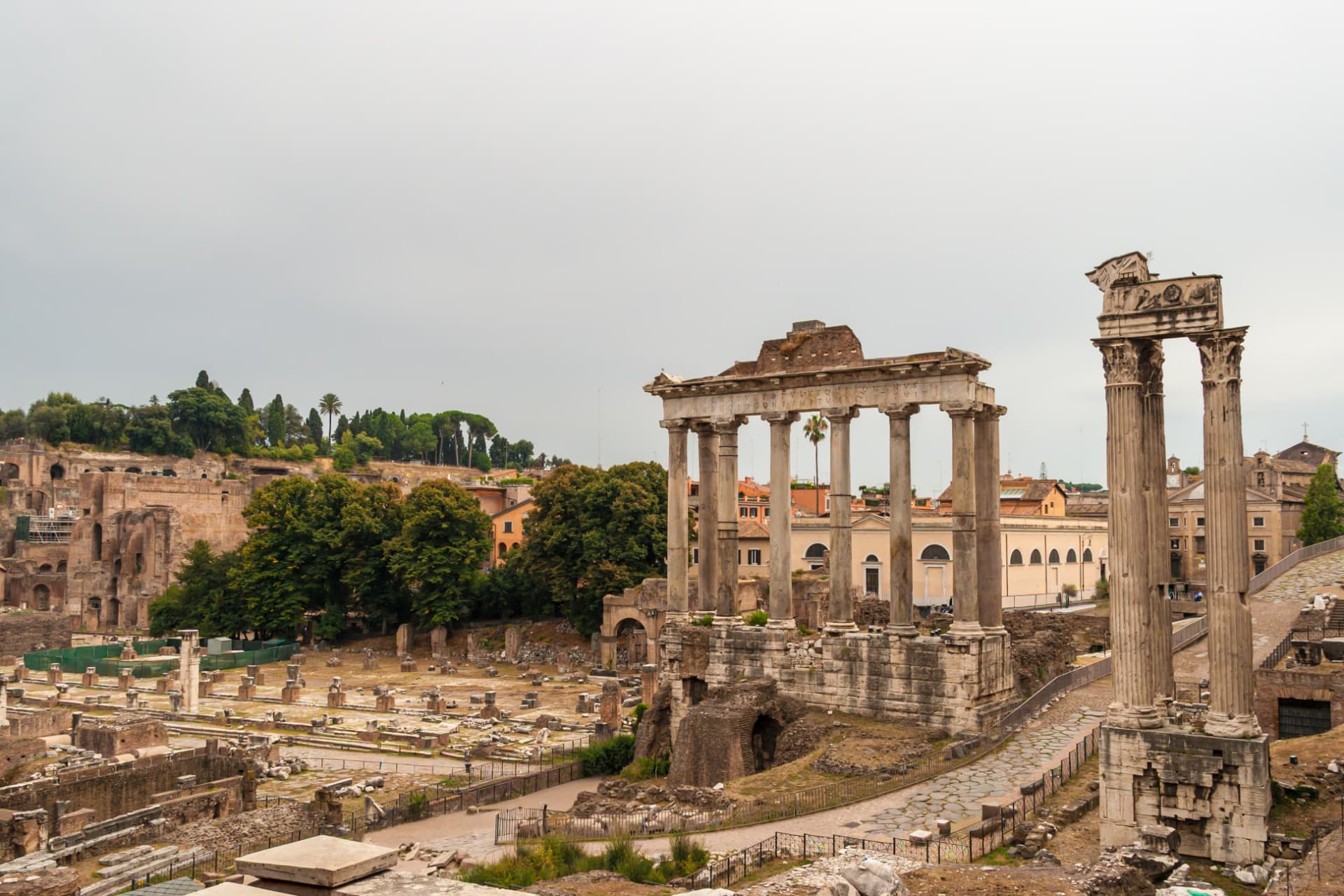
Why do only eight columns survive?
The eight columns are the front porch of the temple; the walls and side columns behind them were lost after antiquity, when much of the Forum was stripped for building stone. The columns are granite in two colours, and several are made of reused pieces, which is a sign the late rebuilding used whatever material was available.
The inscription on the entablature reads SENATUS POPULUSQUE ROMANUS INCENDIO CONSUMPTUM RESTITUIT: the Senate and People of Rome restored what fire had consumed. It records the rebuilding but does not name an emperor, so its exact date is still debated.
What should you look for in a short stop?
| Where | Look for |
|---|---|
| The entablature | The restoration inscription after a fire |
| The column bases | Mismatched and reused pieces |
| The podium | The high base that held the state treasury |
| Right next to it | Three corner columns of the Temple of Vespasian |
| Behind it | The Portico of the Dii Consentes and the Clivus Capitolinus road |
Where is the best view of the temple?
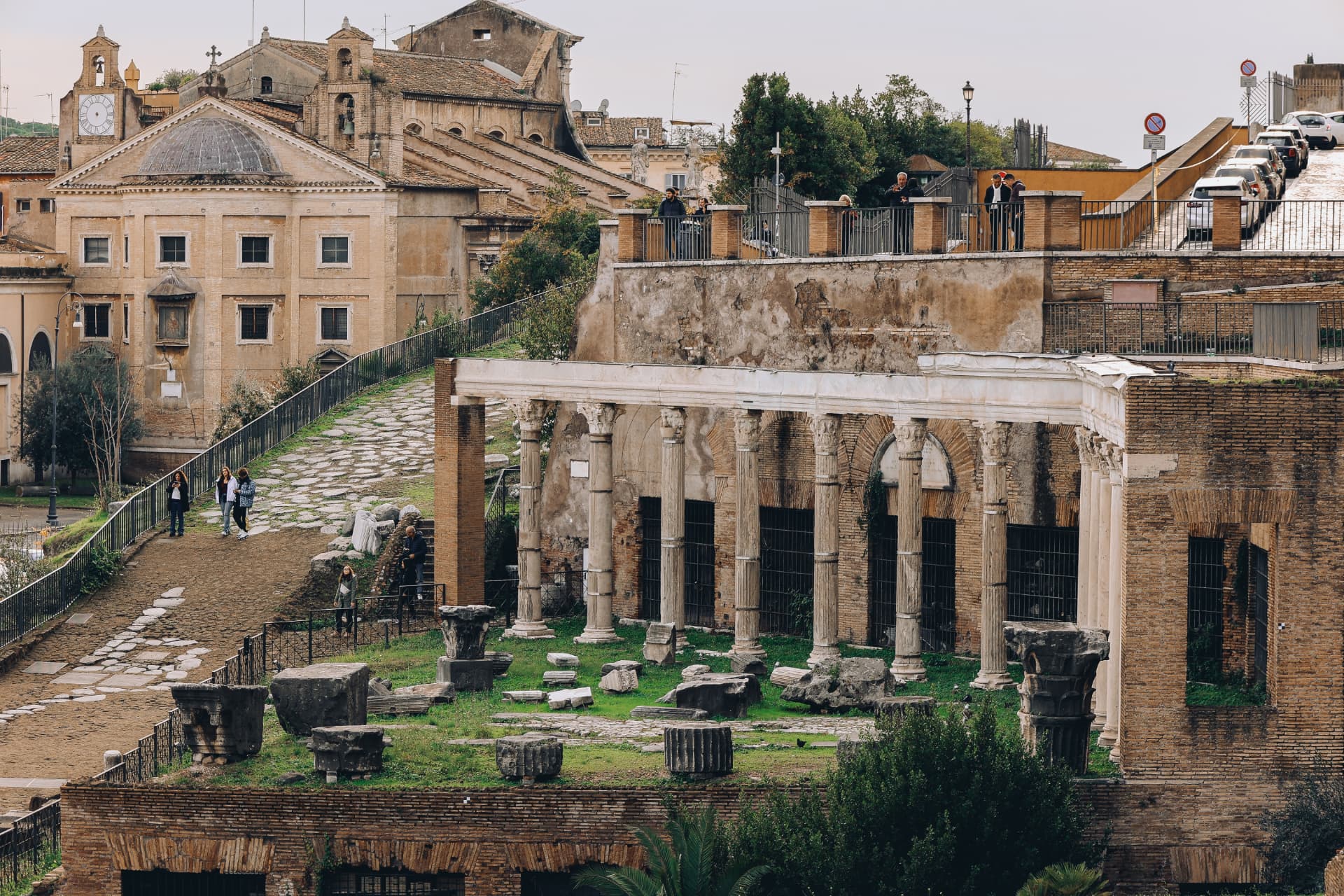
Inside the Forum, stand near the Arch of Septimius Severus and look up at the columns with the Capitoline behind them. For the classic overview, the terraces on the Capitoline side above the Forum show the temple, the Temple of Vespasian and the whole valley; you can see much of this view from outside the paid area. Late-afternoon light falls well on the columns.
Behind the temple, look for the Portico of the Dii Consentes, a small colonnade dedicated to twelve major gods, beside the old road that climbed to the Capitoline.
How does the temple fit into a Forum visit?
The Temple of Saturn sits at the western, Capitoline end of the Forum, so it is usually the last stop if you enter from the Via Sacra gate near the Colosseum, or the first if you start near the Capitoline. Allow ten to fifteen minutes. Close-up access is inside the paid Forum and Palatine area.
Prices, ticket names and time slots are set by the Parco archeologico del Colosseo and change; check the official ticket page before buying.
 Tiqets
Skip-the-line and last-minute Roman Forum tickets — resellers may still have availability; prices are usually higher.
Check prices Klook
Guided tours with entry included — compare with official dates first; prices are usually higher.
Check prices Trip.com
Compare bundles and combo tickets — Colosseum plus Forum, Vatican or hop-on buses in one booking.
Check pricesAffiliate links: we may earn a commission at no extra cost to you. Check each listing's cancellation terms before paying.
Official sources
Reviewed October 2026. Ticket names, prices, hours and open areas change — always confirm on the official pages.
Frequently asked questions
- Can you see the Temple of Saturn without a ticket?
- You can see it from outside. The terraces and streets on the Capitoline side look down on the temple and the western end of the Forum without a ticket. To stand beside the columns and read the inscription up close, you need a ticket covering the Roman Forum, such as the standard Colosseum combined ticket.
- What does the inscription on the Temple of Saturn say?
- It reads SENATUS POPULUSQUE ROMANUS INCENDIO CONSUMPTUM RESTITUIT, meaning the Senate and People of Rome restored what fire had consumed. It records a rebuilding after a fire, but no emperor is named, so historians still discuss exactly when the surviving porch was put up. Most place it in late antiquity.
- What was the Temple of Saturn used for?
- Besides worship of Saturn, the temple’s podium held the aerarium, the Roman state treasury, where public funds and official records were stored. It was also linked with Saturnalia, the December festival of feasting and gift-giving. So it was both a religious building and one of the Republic’s most important administrative places.
- How long should you spend at the Temple of Saturn?
- Ten to fifteen minutes is usually enough to see the columns, read the inscription and spot the Temple of Vespasian next to it. Add a few minutes for the Portico of the Dii Consentes behind it and a viewpoint from the Capitoline side, which gives the best overview of this end of the Forum.
More Roman Forum guides
- Roman Forum in Rome: What to See, History and Visiting Tips
- Domus Tiberiana: Imperial Palace, Museum and Roman Forum Views
- Santa Maria Antiqua: Ancient Frescoes and How to Visit
- Arch of Septimius Severus: History and Reliefs Explained
- Temple of Antoninus and Faustina: The Roman Temple That Became a Church
- Curia Julia: Inside the Senate House of Ancient Rome
- Temple of Vesta and House of the Vestals: History and Visiting Guide
- Basilica of Maxentius: What to See at the Roman Forum’s Largest Basilica
- Arch of Titus: History, Reliefs and What to Look For
- Colosseum, Roman Forum and Palatine Hill in One Day: Best Order and Route
- Roman Forum vs Imperial Forums: What’s the Difference?
- Roman Forum Map: Main Sights and a Self-Guided Walking Route
- What to See in the Roman Forum: Highlights Explained for First-Time Visitors
- Roman Forum History: What It Was and Why It Became Ruins
- Roman Forum Tickets: Visiting With or Without the Colosseum
- Forum Pass SUPER: What It Includes and Is It Worth It?
- Roman Forum Guided Tour vs Self-Guided Visit: Which Should You Choose?
- Can You See the Roman Forum for Free? Viewpoints and Admission Explained
- Roman Forum Entrances: Where to Enter and Which Gate to Choose
- How Long to Spend at the Roman Forum and Palatine Hill?
- Best Time to Visit the Roman Forum: Weather, Crowds and Opening Hours
- Roman Forum with Kids: A Short Route and What to Look For
- Roman Forum Accessibility: Uneven Paths, Step-Free Routes and Visitor Facilities