 Ancient Monument
Arch of Titus
The small arch with an outsized story — the menorah of Jerusalem carved in marble
5–10 minFreec. 81 ADVia Sacra, 00186 Roma RMOpen on MapPlan Your Visit
Compare tickets, tours and stays — booking ahead usually gives more choice
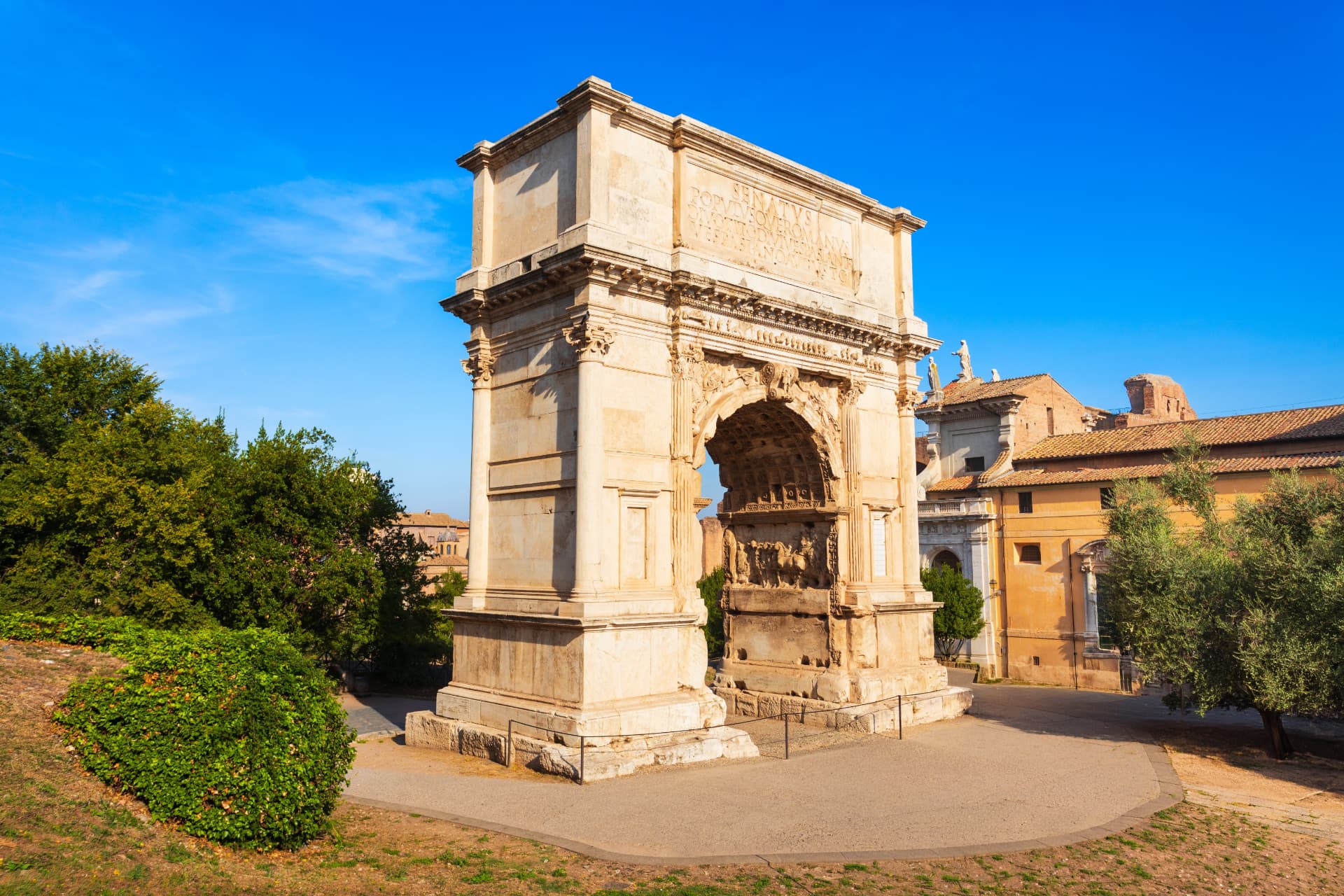
Get TicketsBook a TourHotels NearbyThe Arch of Titus is a Roman triumphal arch on the Via Sacra between the Colosseum and the Roman Forum, built around 81 AD by Emperor Domitian to honour his deified brother Titus. Its inner reliefs show the spoils of the Temple of Jerusalem — including the seven-branched menorah, later the model for the emblem of the State of Israel — and the apotheosis of Titus. The arch is free to visit and takes five to ten minutes.
Why visit the Arch of Titus?
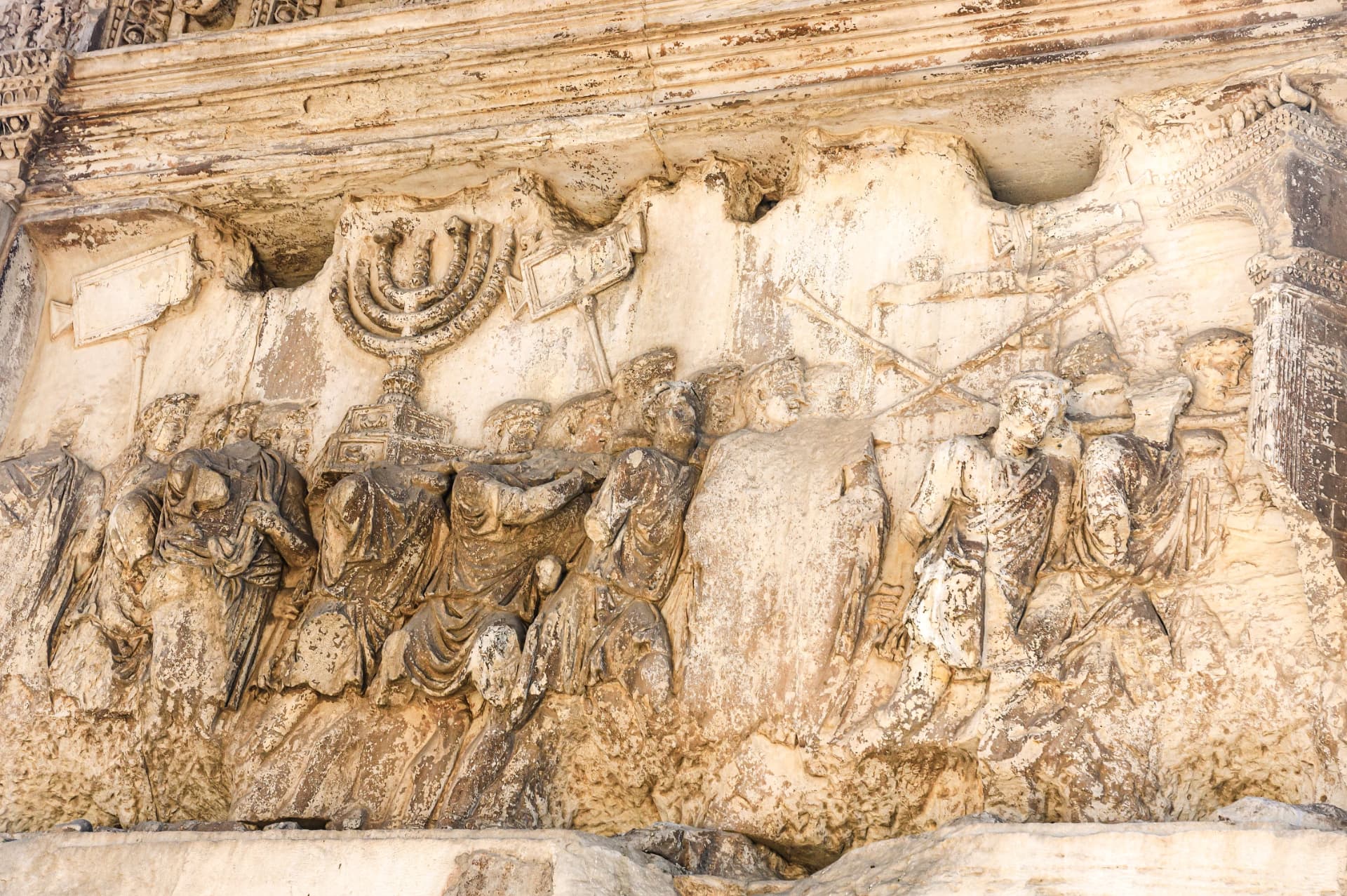
Thousands of people walk under this arch every day on their way from the Colosseum to the Roman Forum without ever looking up. That is a mistake. Inside its single passageway is one of the most consequential sculptures of the ancient world: the seven-branched menorah of the Temple of Jerusalem, carried through Rome in the triumph of 71 AD — the earliest known depiction of the object that, nearly nineteen centuries later, became the emblem of the State of Israel.
The arch takes five minutes to see and costs nothing. But those five minutes connect the siege of Jerusalem, the destruction of the Second Temple, the Flavian dynasty, the birth of restoration science in 1821, and modern Jewish history — all on one small marble monument at the top of the Via Sacra.
The menorah relief
The most detailed ancient image of the Temple of Jerusalem's treasures — and the model for Israel's national emblem since 1948.
Completely free
No ticket, no queue — it stands in the open on the walking route between the Colosseum and the Forum.
On everyone's route
You will pass it anyway between the Colosseum and the Forum — five informed minutes turn a walkway into a highlight.
A milestone of restoration
Valadier's 1819–1821 rebuild — new stone deliberately left distinguishable from old — changed how the world restores monuments.
Built
c. 81 AD
Honours
Emperor Titus
Height
15.4 m / 13.5 m wide
Entry
Free (no ticket)
Visit time
5–10 min
Location
Via Sacra, Roman Forum
Table of Contents
Jump to any section of the itinerary
The Arch of Titus in Photos
History & meaning
In 70 AD, after a siege of several months, the Roman army under Titus — son of the new emperor Vespasian — broke into Jerusalem. The Second Temple, the centre of Jewish worship for nearly six centuries, was burned and demolished. Its treasures, including the seven-branched golden menorah, the silver trumpets and the Table of the Shewbread, were shipped to Rome.
The following year, 71 AD, Vespasian and Titus celebrated a joint triumph — the ancient world's greatest military parade. The Jewish historian Josephus, who was almost certainly present, describes the Temple spoils passing through the packed streets: the menorah carried high, its branches arranged exactly as carved on this arch.
Titus became emperor in 79 AD and died unexpectedly in 81 AD, after a reign of barely two years. His brother and successor Domitian deified him and erected this arch on the highest point of the Via Sacra, where triumphal processions had entered the Forum for centuries. The inscription calls him DIVO TITO — 'the deified Titus' — and the vault shows him ascending to heaven on an eagle.
The arch survived the Middle Ages built into the fortifications of the Frangipane family. By the early 19th century it was half-ruined, and in 1819–1821 the architect Giuseppe Valadier took it down and rebuilt it. Crucially, he used plain travertine for the reconstructed parts, deliberately different from the original Pentelic marble — one of the first times a restorer made new work visibly distinguishable from old, a principle still followed worldwide today.
Arch of Titus through the centuries
70 ADThe Siege of Jerusalem
Titus, son of Emperor Vespasian, captures Jerusalem after a brutal siege. The Second Temple is destroyed and its treasures — including the seven-branched menorah — are carried to Rome.
71 ADThe Jewish Triumph
Vespasian and Titus celebrate a joint triumph in Rome. The Temple spoils are paraded through the streets — the scene later carved on the arch's south panel.
79 ADTitus becomes emperor
Vespasian dies and Titus succeeds him. His reign lasts barely two years, marked by the eruption of Vesuvius and the great fire of Rome in 80 AD.
81 ADDeath of Titus & the arch
Titus dies unexpectedly. His brother and successor Domitian erects the arch on the Via Sacra to honour the deified Titus and the Jerusalem victory.
Middle AgesFortified by the Frangipane
The arch is incorporated into the medieval fortifications of the Frangipane family, who controlled the Forum area. The passageway is partially walled up.
1819–1821Valadier's restoration
Architect Giuseppe Valadier dismantles and rebuilds the arch, replacing lost sections in travertine so the original Pentelic marble core stands out. It is one of the earliest examples of 'distinguishable' restoration.
1948The menorah becomes a national emblem
The State of Israel adopts the seven-branched menorah as its official emblem — modelled directly on the relief carved on this arch.
2026Free landmark on the Via Sacra
The arch stands at the highest point of the Via Sacra between the Colosseum and the Roman Forum. Approaching and walking under it from the Colosseum side is free; a Forum/Palatine ticket is only needed to continue into the Forum itself.
The reliefs in depth
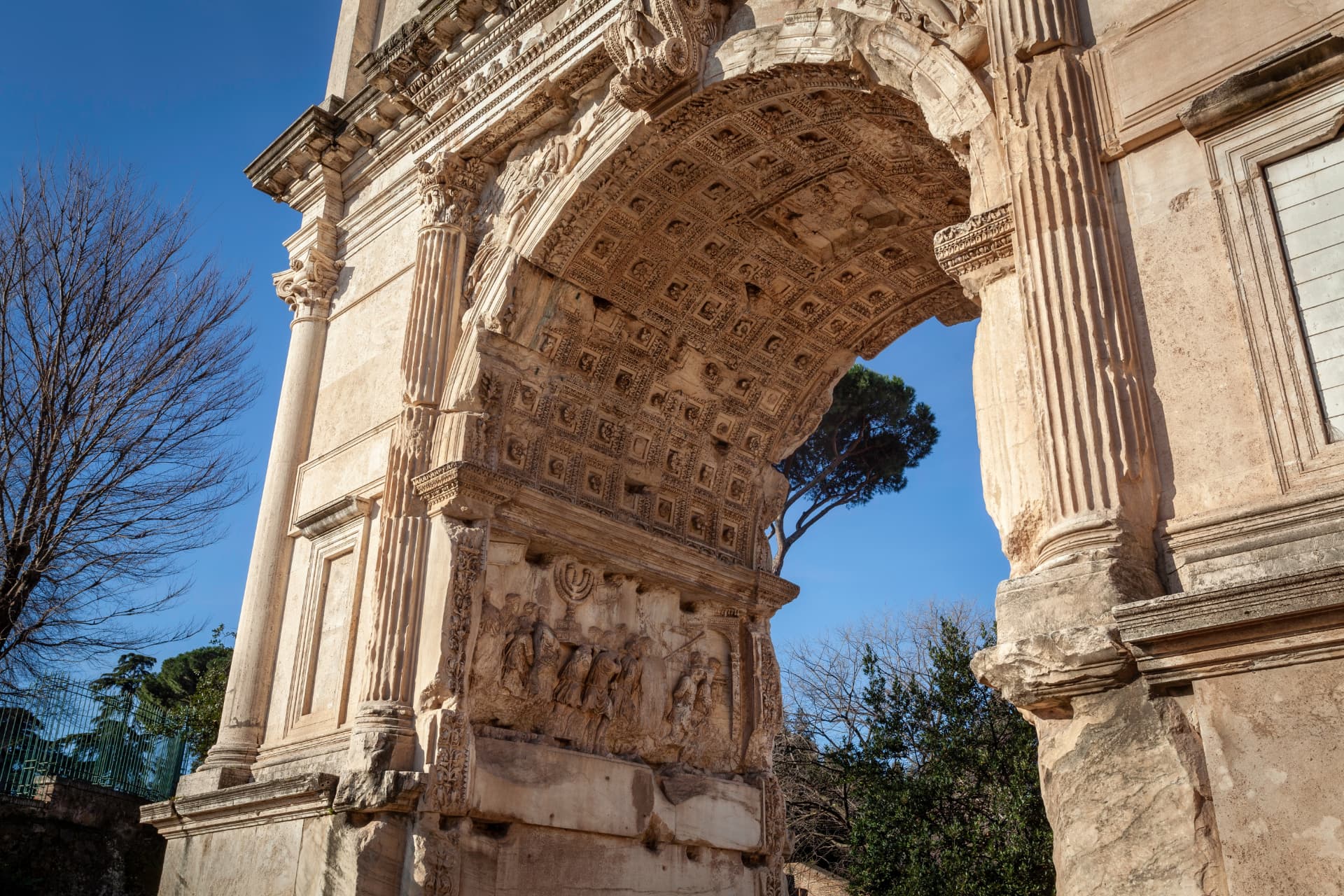
Three sculpted elements make this arch famous. All three are inside the passageway — step in and look at the walls and the ceiling.
South panel — the spoils of JerusalemThe menorah procession
Roman soldiers carry the Temple treasures through a triumphal gate: the seven-branched menorah on its decorated base, the silver trumpets, and the Table of the Shewbread. The figures are carved in deep relief with a remarkable sense of forward movement — one of the earliest attempts in Roman art to show a crowd turning a corner in space.
The menorah here is the most detailed ancient image of the object ever found. When the State of Israel needed an official emblem in 1948, it chose this very depiction.
North panel — the triumph of TitusTitus in the quadriga
Opposite the spoils, Titus rides in a four-horse chariot during the triumph of 71 AD. The goddess Victory stands behind him, placing a crown on his head, while personifications of the Roman people and the Senate lead the horses. The horses are shown in profile but the chariot turns toward the viewer — another bold experiment in perspective.
Vault centre — the apotheosisTitus becomes a god
In the middle of the coffered ceiling, a small relief shows Titus ascending to heaven on the back of an eagle — the visual statement of his deification, and the reason the inscription calls him DIVO, 'the deified'. It is easy to miss: stand directly under the centre of the vault and look straight up.
Visiting & cost
Free — no ticket
The arch stands on the boundary between the free Colosseum area and the paid Forum zone. Approaching it, walking under it and photographing it from the Colosseum side costs nothing.
When you do need a ticket
Only if you continue past the arch down into the Roman Forum and Palatine Hill — that combined ticket is €18 (checked 27 Sep 2026). The arch itself never requires it.
How long it takes
5–10 minutes: walk around it, step into the passageway, find the menorah panel on the inner south wall and the apotheosis in the vault.
Barriers & access
Circulation around the Colosseum–Forum area can change with crowd controls and events. The arch is outdoors and visible at all hours, though the immediate area may be closed off late at night.
Rome's three triumphal arches
Rome preserves three imperial triumphal arches, all within a ten-minute walk of each other. The Arch of Titus is the oldest and smallest — and the only one whose sculpture changed world history.
| Arch | Built | Height | Honours | Famous for |
|---|---|---|---|---|
| Arch of Titus | c. 81 AD | 15.4 m | Titus | The menorah relief — spoils of Jerusalem |
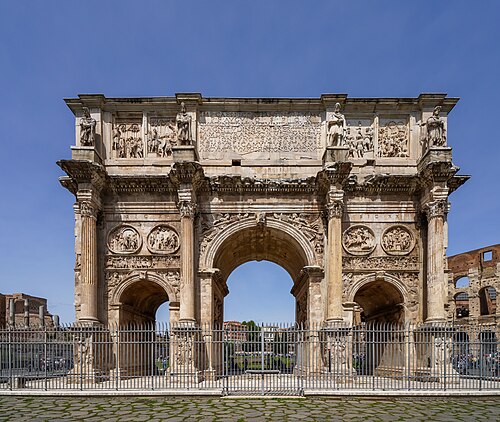
| Arch of Constantine | 315 AD | 21 m | Constantine I | Largest arch; reused 'spolia' sculpture |
| Arch of Septimius Severus | 203 AD | ~21 m | Septimius Severus & sons | Parthian campaign reliefs; inside the paid Forum zone |
Best time to visit & photograph
Early morning (before 09:00)
Warm light on the Forum-facing side, and the Via Sacra is nearly empty before the Forum opens and the crowds arrive.
For the reliefs
The menorah panel sits about 4 m up the inner south wall — use a zoom lens or phone zoom. Raking morning or late-afternoon light makes the carving read best; midday sun flattens it.
The classic framing
From just downhill on the Via Sacra, shoot through the arch's passageway toward the Forum — the Arch of Septimius Severus and the Capitoline appear framed inside the opening.
From the Colosseum's upper tiers
A Colosseum upper-level ticket gives you the arch from above, aligned with the Via Sacra — one of the best elevated views of the Forum area.
Getting there
Metro
Line B to Colosseo. From the station, walk around the Colosseum's north side to the Via Sacra and climb the slope — about 5 minutes to the arch.
Bus & tram
Buses 75, 81, 85, 87, 117, 118 and tram 3 stop near the Colosseum, a short walk from the Via Sacra.
On foot
From Piazza Venezia, walk down Via dei Fori Imperiali toward the Colosseum (10 minutes), then turn up the Via Sacra. The arch is directly on the Colosseum–Forum walking route.
Common mistakes
Walking under it without looking up
The famous reliefs are inside the passageway, not on the outside. Step in, face the south wall for the menorah, and look straight up for the apotheosis.
Thinking you need a Forum ticket
You don't. The arch is free from the Colosseum side. The €18 Forum/Palatine ticket is only for continuing into the Forum valley beyond it.
Confusing it with the Arch of Constantine
The big three-arched monument beside the Colosseum is Constantine's. The Arch of Titus is the smaller single arch up the Via Sacra slope, 300 m away.
Visiting at midday in summer
The slope is exposed, the light is flat for the reliefs, and the route is at its most crowded. Come early morning or late afternoon instead.
Insider tips
Spot the two kinds of stone
Valadier's 1821 restoration used plain travertine for the rebuilt parts — the original Pentelic marble is the warmer, honey-coloured stone. Once you see the difference, the whole restoration story is visible at a glance.
Read the inscription from the Forum side
The dedicatory inscription faces the Forum, not the Colosseum. You can read it for free from just past the arch without entering the paid zone.
Pair it with the Jewish Ghetto
For the full arc of Roman–Jewish history, continue to the Jewish Ghetto (15 minutes on foot past the Capitoline) — the community that lived with this arch's story for two millennia.
The menorah is at eye level in one place
If you visit the Colosseum's museum level, look for the cast and reconstructions related to the Forum monuments — a closer look at details that are 4 m up on the real arch.
Combine with the Colosseum & Forum
The arch itself is free, but it sits between Rome's two biggest ticketed sites. Booking the Colosseum and the Roman Forum/Palatine in advance is strongly recommended in 2026 — same-day tickets regularly sell out. These options include the sites on either side of the arch:
Colosseum Priority Entrance
Best for: First-time visitors
~2 hoursSkip-the-line access to the Colosseum with entry to Roman Forum and Palatine Hill included. Perfect for first-time visitors.
- Skip-the-line entry
- Colosseum access
- Roman Forum included
- Palatine Hill included
🎟️ Compare Prices:
TiqetsKlookTrip.comColosseum Guided Tour
Best for: History enthusiasts
~3 hoursExpert-led tour with professional guide sharing gladiator history, architecture secrets, and ancient Roman stories.
- Professional English-speaking guide
- Skip-the-line entry
- In-depth historical commentary
- Small group experience
🎟️ Compare Prices:
TiqetsKlookTrip.comColosseum Arena & Underground
Best for: Unique experience seekers
~3.5 hoursWalk where gladiators fought on the arena floor and explore the underground chambers where they awaited their fate.
- Arena Floor access
- Underground chambers access
- Roman Forum & Palatine Hill
- Expert guided tour included
🎟️ Compare Prices:
TiqetsKlookTrip.comWhere to Stay Near Arch of Titus
Looking for convenient accommodation near Arch of Titus? Stay within walking distance to make the most of your visit.
Hotels Near This AttractionTop Rated HotelsBudget-Friendly OptionsLuxury HotelsCentral locations with easy access to Arch of Titus and other attractionsArch of Titus — frequently asked questions
Related Attractions
Arch of Constantine
Rome's largest triumphal arch (315 AD) next to the Colosseum
Explore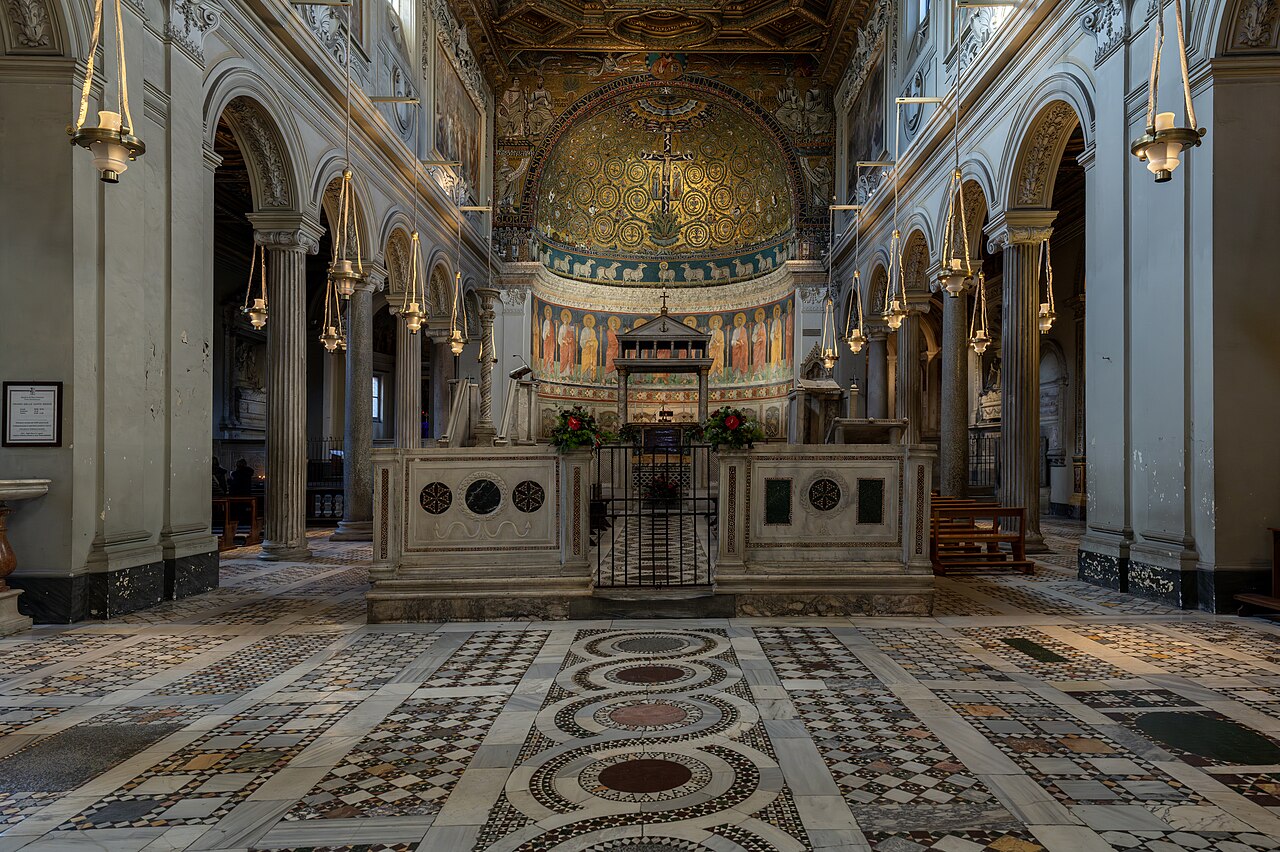
Basilica San Clemente
Descend through 2,000 years—medieval mosaics to Mithraic temple
Explore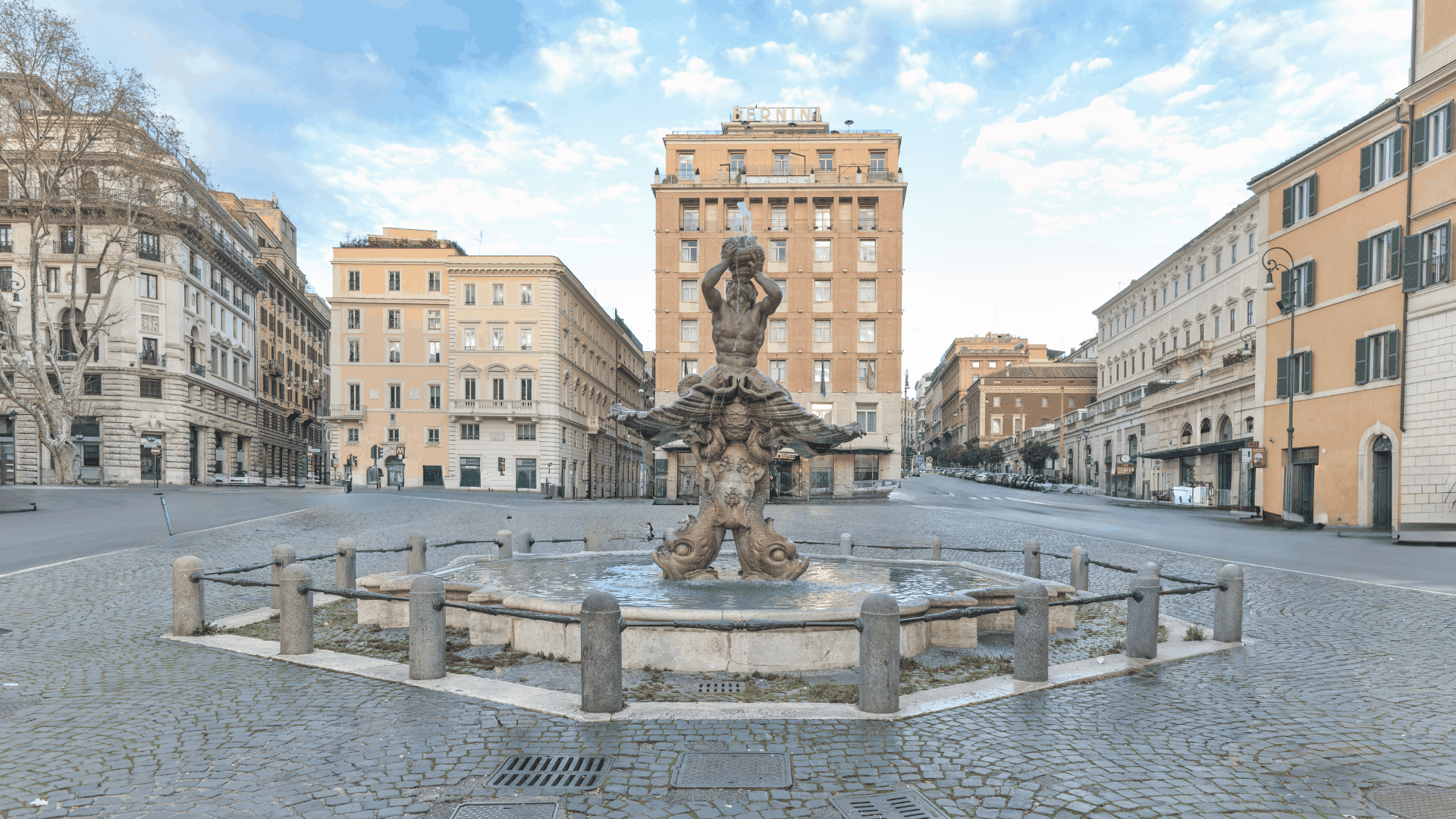
Piazza Barberini
Bernini's Triton Fountain—gateway to Via Veneto
Explore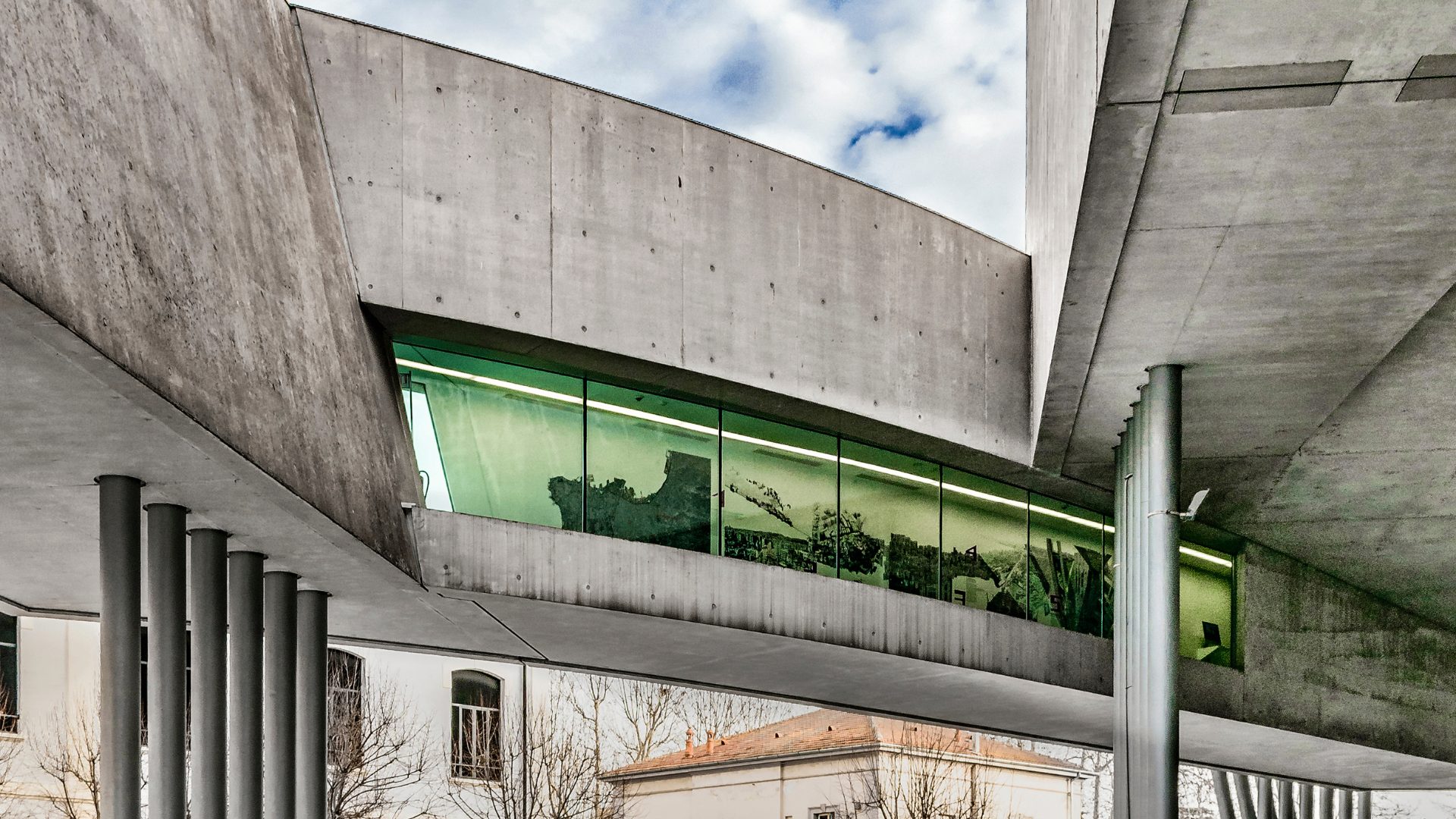
MAXXI Museum
Zaha Hadid's stunning contemporary art and architecture museum
Explore
San Giorgio in Velabro
Early medieval church beside Rome's only surviving ancient quadrifrons arch
Explore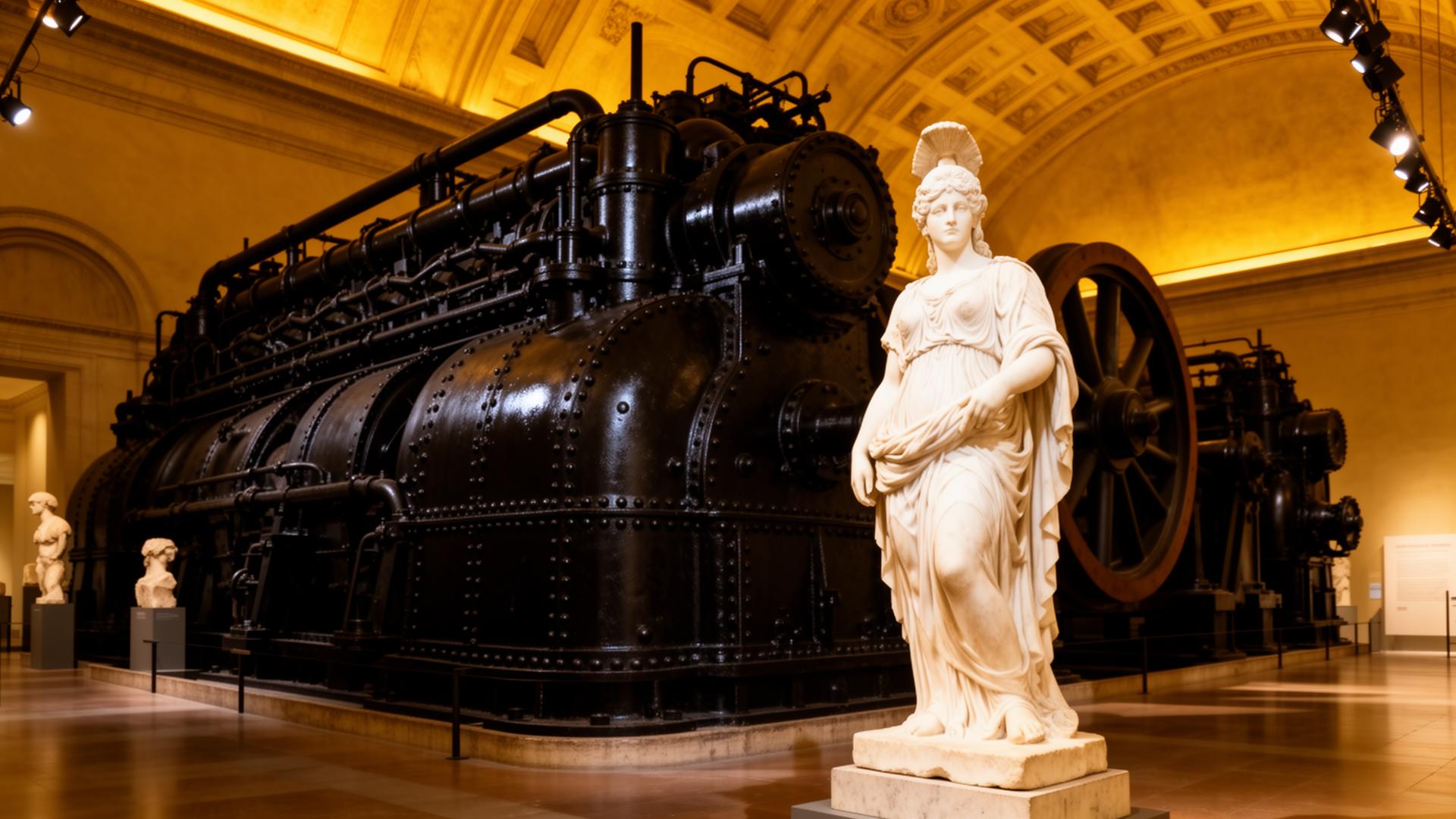
Centrale Montemartini
Ancient sculptures among industrial machinery—Rome's most unique museum
ExploreQuick Planning Guide
⏱️ Time Needed
5–10 minutes
💰 Cost
Free (no ticket)
🎫 Reservation
Not required
♿ Accessibility
Cobbled slope, manageable with assistance
📅 Best Time
Early morning for light & fewer crowds
👨👩👧👦 Family Friendly
Yes — quick open-air stop
Nearby Attractions
Colosseum5-min walk
Roman Forumat its entrance
Palatine Hill5-min walk
Arch of Constantine300 m
Domus Aurea10-min walk
Featured In These Itineraries
Classic Rome 3 Days5 Day Rome ItineraryOne Day in RomeEssential Tips
- ✓ Free — no ticket needed from the Colosseum side
- ✓ The menorah panel is on the inner south wall — bring a zoom lens
- ✓ Look up at the vault for the apotheosis of Titus
- ✓ Combine with the Colosseum and Forum on the same morning