Trevi Fountain Guide 2026: €2 Close-Up Fee, Best Time & Rules
Updated October 2026•15 min readTrevi Fountain ToursGuided tours & nearby tickets · affiliate link — we may earn a commission at no extra cost to you.The Trevi Fountain (Fontana di Trevi) is Rome's largest and most famous Baroque fountain—and arguably the world's most beautiful. Standing 26 meters tall and 50 meters wide, this masterpiece draws over 3.5 million visitors annually who come to admire its sculptural magnificence and participate in the legendary coin-throwing tradition.
This comprehensive Trevi Fountain guide covers everything you need to know: from its fascinating history and the meaning behind its statues, to practical visiting tips and the best times to experience this iconic Roman landmark.
Is the Trevi Fountain free?
Yes — viewing the Trevi Fountain from the piazza is free, 24 hours a day. Since 2 February 2026, only the close-up inner basin terrace charges non-residents €2 during opening hours; outside those hours the whole view is free again.
Tickets & tours: the fountain view itself is free — paid options are guided tours and the underground aqueduct site beneath it. Compare Trevi Fountain tours on Tiqets, the Vicus Caprarius "City of Water" underground, and Klook's bundle deals to find the best price for your dates. Affiliate links — we may earn a commission at no extra cost to you.
Watch: The Trevi Fountain in 60 seconds
History · highlights · €2 close-up access · best times alltrips.net
In This Trevi Fountain Guide
- Quick answers (worth it & how long?)
- What Is the Trevi Fountain?
- History of the Trevi Fountain
- Architecture & Statues Meaning
- Coin Tradition & Legends
- Best Time to Visit
- How to Avoid Crowds
- Photography Tips
- Practical Visiting Tips
- Walking routes from Trevi
- Hidden gems near Trevi
- What to See Nearby
- Where to stay near Trevi
- Frequently asked questions
Quick answers before you read on
- Is it worth visiting?
- Yes — the piazza is free and open 24/7, and even a 20-minute stop is worth it. A closer look from the basin edge costs €2 for a timed entry.
- How long should I stay?
- 20–30 minutes for the fountain itself; add 60–90 minutes if you continue to the Pantheon and Piazza Navona on foot.
- Best time to visit?
- Before 8 AM (empty photos) or after 10 PM (illuminated, atmospheric). Avoid 11 AM – 6 PM.
- Closest metro?
- Barberini (Line A), about a 7-minute walk.
Which situation are you in?
- Visiting with kids? Strollers, toilets and the coin ritual by age — the family guide.
- Caught in the rain? What changes and what's indoors nearby — the rain guide.
- On a Rome layover? The realistic minimum time from FCO and back — the layover guide.
- Need step-free access? Wheelchair routes and quiet times — the accessibility guide.
- Worried about pickpockets? The 4 common scams and 5 prevention habits — the safety guide.
Trevi Fountain at a Glance
| Location | Piazza di Trevi, Rome |
| Main view (piazza) | Free · open 24/7 |
| Close-up inner area | €2 for non-residents (from 2 Feb 2026) |
| Time needed | 20–40 minutes |
| Best time | Early morning · late evening |
| Nearest Metro | Barberini (Line A) · ~7 min walk |
| Famous for | Baroque architecture · coin toss |
| Nearby | Pantheon · Spanish Steps · Piazza Venezia |
Hours and fees checked against fontanaditrevi.roma.it (City of Rome), October 2026.
Visiting the Trevi Fountain in 2026: What's Changed?
New for 2026: Tourists and non-residents now pay €2 to enter the inner perimeter closest to the Trevi Fountain. You can still see the fountain from outside the monumental area for free. The ticketed system began on 2 February 2026.
The official Trevi Fountain site lists inner-area entry at €2, with Monday and Friday hours 11:30–22:00, Tuesday–Thursday and weekends 09:00–22:00, and last entry at 21:00. The fountain remains visible for free outside those visiting hours.
Source: fontanaditrevi.roma.it (City of Rome) — checked October 2026.
Do You Need a Ticket for the Trevi Fountain?
You do not need to pay to see the Trevi Fountain from outside the controlled inner area. Since February 2026, however, tourists and non-residents must pay €2 to enter the inner perimeter closest to the fountain.
The ticket gives you access to the monumental area near the basin, where visitors can get a closer view and perform the traditional coin toss. Tickets can be bought online or at authorised sales points; those bought at the entrance are payable by card.
Free entry for children under six, Rome and Metropolitan City residents, eligible visitors with disabilities and their companion, licensed guides, and MIC Card holders under the official rules.
How Long Do You Need at the Trevi Fountain?
Most visitors need 20–40 minutes at the Trevi Fountain. If you're simply stopping for photos, you may only need 15–20 minutes. Allow longer if you plan to enter the €2 inner area, wait during busy periods, toss a coin, or explore nearby underground remains such as Vicus Caprarius.
Best Time to Visit
Early morning is generally the easiest time to experience the Trevi Fountain with fewer people. Crowds increase significantly through the day, particularly during the main sightseeing hours. Evening visits are atmospheric but can still be busy.
Trevi Fountain Rules You Should Know
Visitors may not:
- sit on the fountain basin edge
- enter or wade into the water
- eat or drink inside the controlled inner area
- smoke inside the area
- throw objects other than the traditional coin
- climb on the monument
Per the official site, some violations can result in fines of €40–€240, while entering the water can lead to a fine starting at €450.
First-Time Visitor Essentials
What to expect on arrival
You approach through narrow shopping streets — Via delle Muratte from the Corso, Via dei Crociferi from the Pantheon side. The alley opens suddenly, the noise of running water hits, and the 26-metre travertine façade rises in front of you. The piazza is smaller than you expect and the fountain is larger — Salvi designed it in 1762 to overwhelm the tight medieval space. Take 30 seconds before reaching for the phone.
Best photo positions
- Centre upper step: the symmetrical postcard shot. Best at sunrise when empty.
- Right side by the wine bar: diagonal angle capturing Oceanus and the right Triton in profile.
- The rooftop bar of the hotel facing the fountain: elevated angle — the bar accepts walk-ins.
- Via della Stamperia corner: long-lens shot with the fountain framed by the alley.
- Camera tip: turn on HDR and tap-focus the brightest sculpture — auto-exposure blows out lit marble.
What to skip
- Restaurants directly on Piazza di Trevi — almost all are tourist traps with €30 spaghetti.
- Daytime visits in July and August — heat and crowds are brutal.
- "Photo with the gladiator" offers on the steps (€10–€20 demand after the shot).
- Group selfies on the basin rim — €450 fine each.
- Bracelet or rose "gifts" pushed on tourists — payment gets demanded immediately.
First-timer's checklist
- Arrive before 8 AM or after 10 PM for the best experience.
- Bring 1–3 coins for the toss (right hand, over left shoulder, back to fountain).
- Wear flat shoes with grip — the sampietrini cobblestones are slippery when wet.
- Cover shoulders and knees if the Pantheon or a church is in your day's plan.
- Zipped front pocket for your phone, bag in front of you in the crowd.
- Combine with the Pantheon, Spanish Steps and Piazza Navona in a single 1.8 km loop.
What Is the Trevi Fountain?
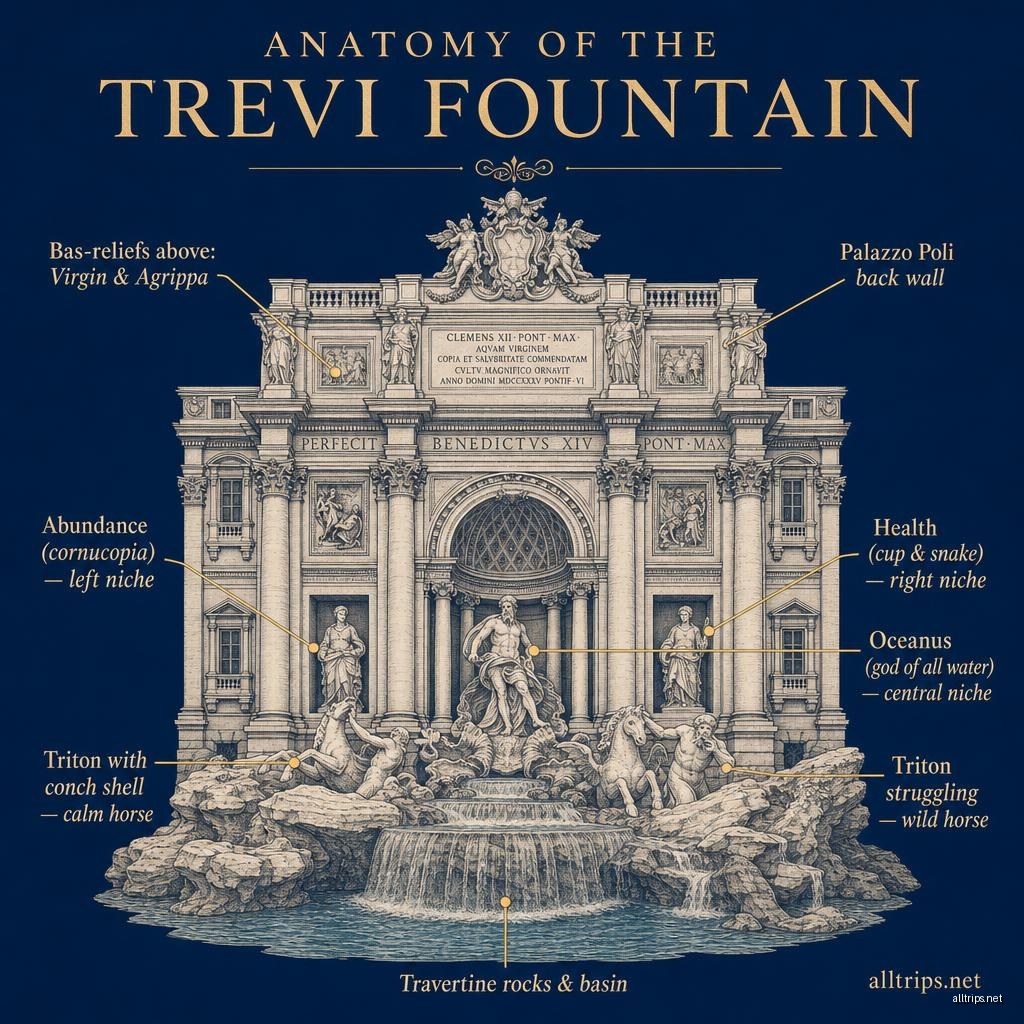
The Trevi Fountain is a monumental Baroque fountain located in the Trevi district of Rome, Italy. Designed by Italian architect Nicola Salvi, the fountain was completed in 1762 after 30 years of construction. It stands against the back wall of the Palazzo Poli and marks the terminal point of the ancient Acqua Vergine aqueduct.
The fountain's name comes from "tre vie" (three roads), as the piazza where it stands marks the junction of three streets. Every day, approximately €3,000 in coins are thrown into the fountain, all of which are donated to the Italian charity Caritas.
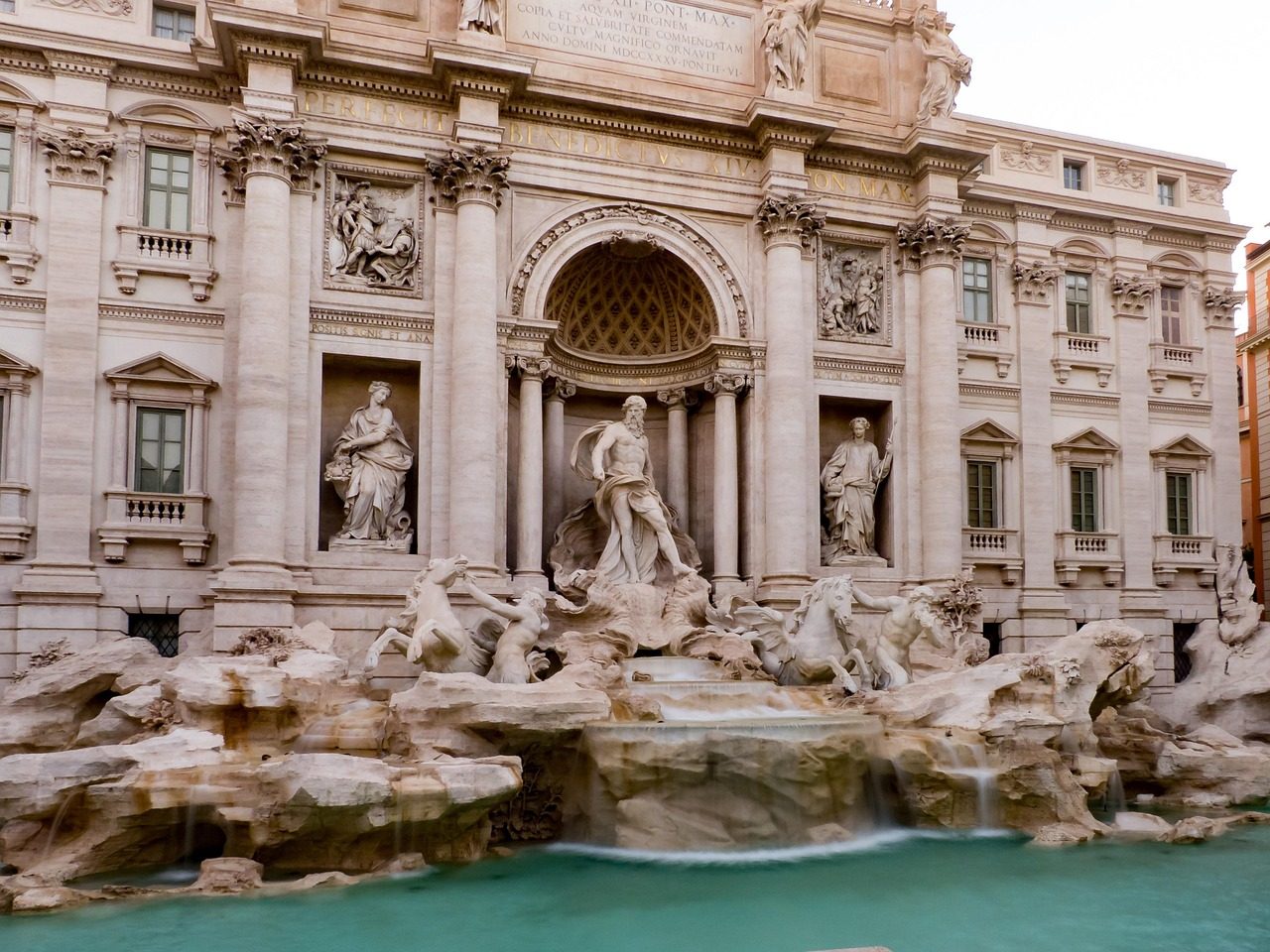
26m
Height
50m
Width
1762
Completed
€1M+
Coins/Year
History of the Trevi Fountain
Ancient origins
The site has been a water source since 19 BC when the Acqua Vergine aqueduct was built by Marcus Agrippa to supply water to the Roman baths. Legend says a young virgin girl showed thirsty Roman soldiers the source—hence "Virgin Water."
Medieval & Renaissance
The first fountain here was built in 1453 by Pope Nicholas V. In 1629, Pope Urban VIII commissioned Gian Lorenzo Bernini to redesign it, but he only completed preliminary sketches before funding ran out.
The modern fountain
Pope Clement XII held a competition in 1730. Nicola Salvi won and worked on it until his death in 1751. Giuseppe Pannini completed it in 1762. The fountain has been restored several times, most recently in 2015.
Trevi Fountain Architecture & Statues Meaning
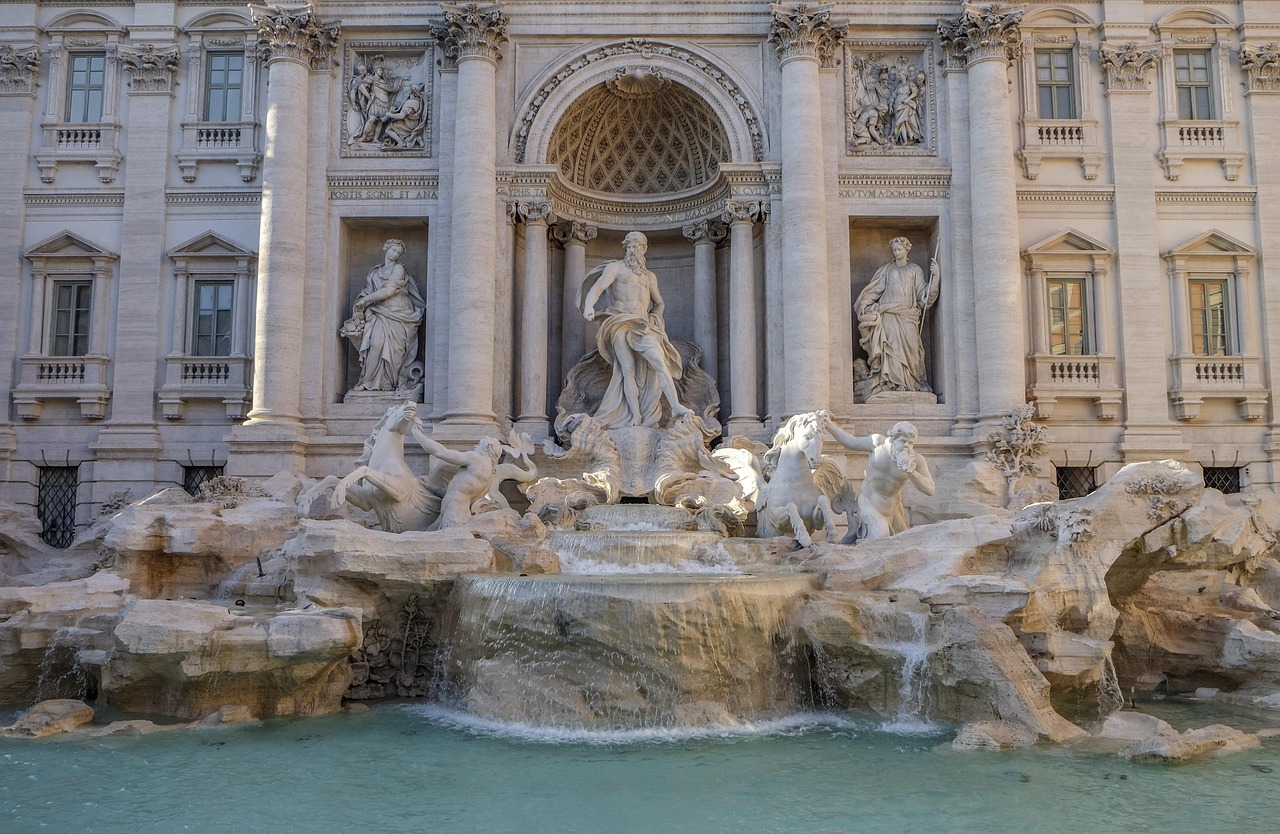
The Trevi Fountain is a masterpiece of Baroque art, combining theatrical architecture with dramatic sculptural elements. Understanding the symbolism enriches your visit immensely.
Central Figure: Neptune (Oceanus)
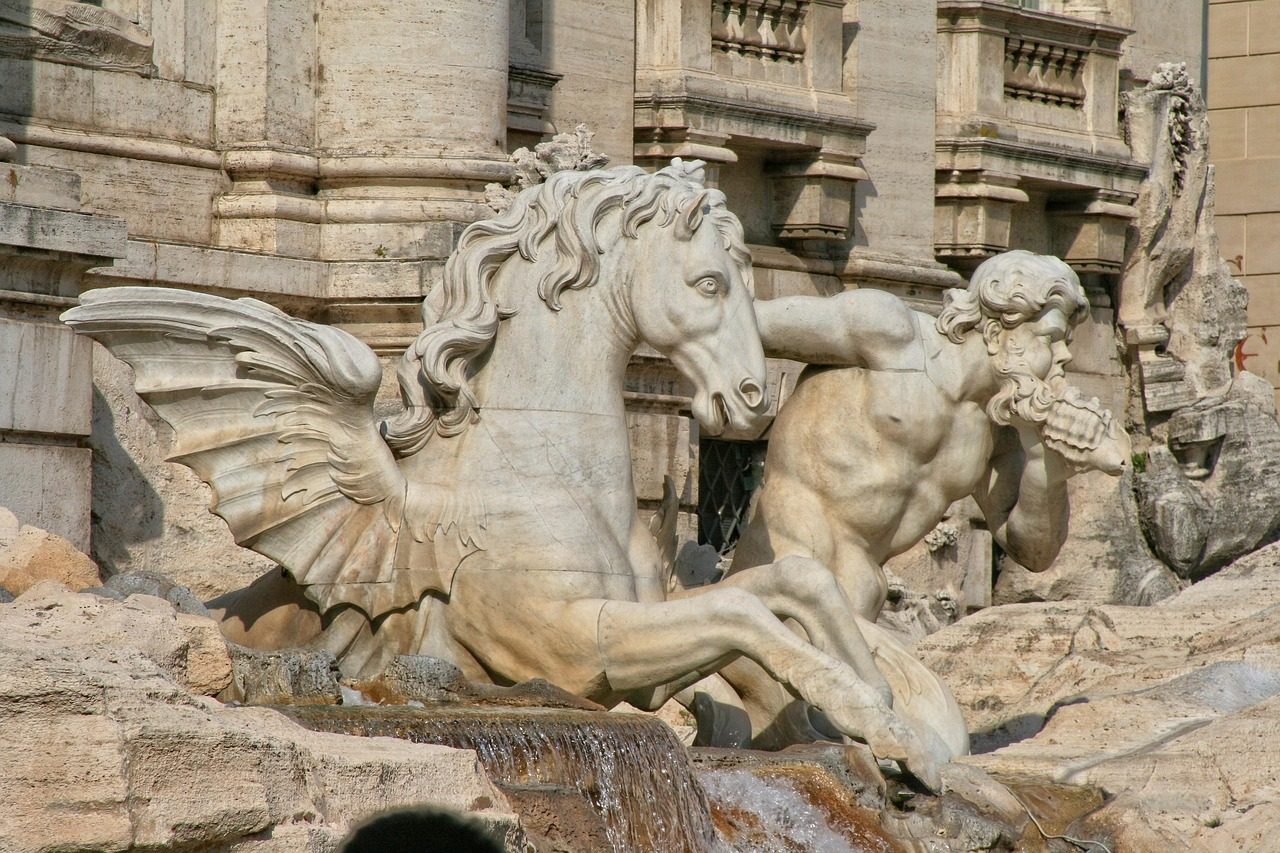
The commanding central figure is Oceanus, the god of all water, standing on a shell-shaped chariot drawn by two sea horses (hippocamps). One horse is calm, the other wild—representing the changing moods of the sea.
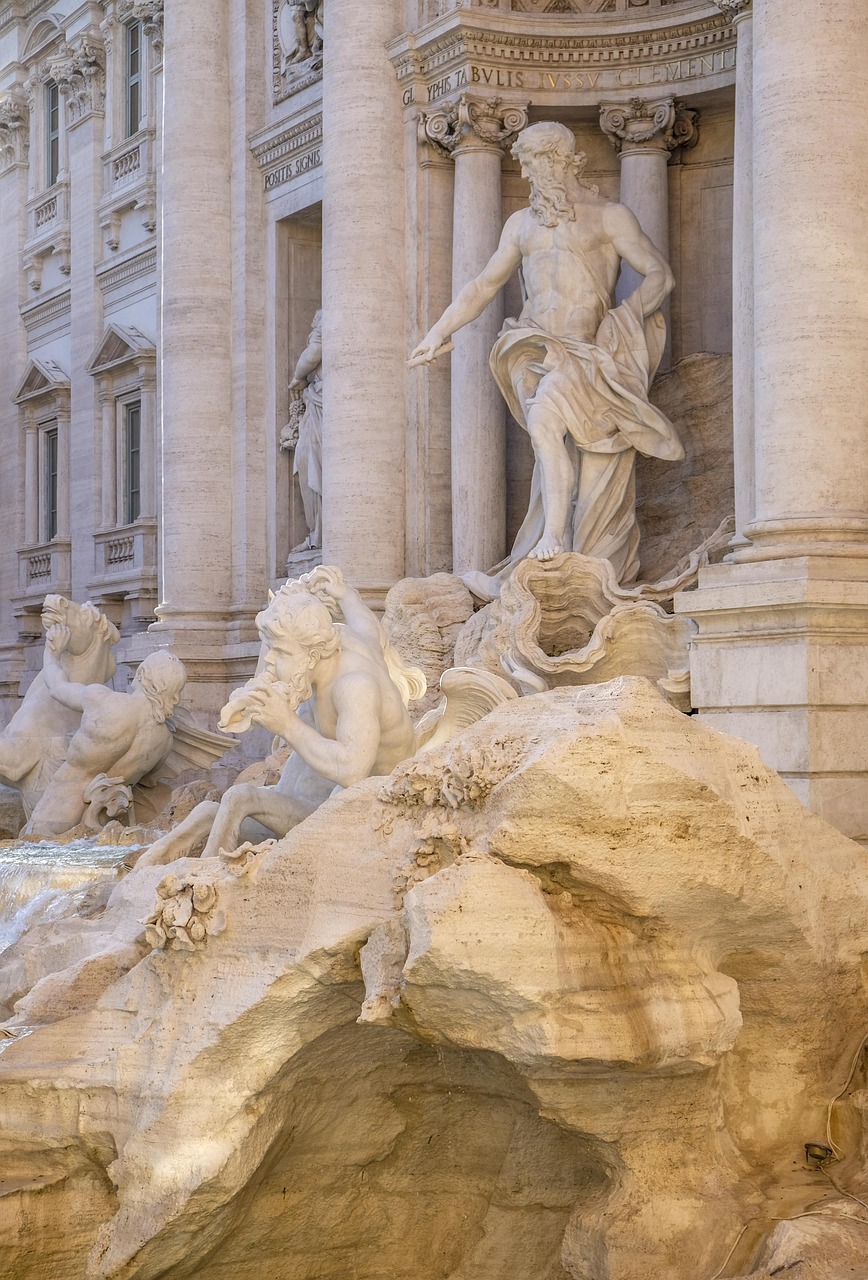
The Two Tritons
Flanking Neptune are two tritons guiding the horses. One blows a conch shell to announce the god's arrival, while the other struggles to control the wild horse.
The two female statues
In the niches flanking Neptune stand two female figures representing Abundance(left, holding a cornucopia) and Health (right, with a cup from which a snake drinks). Above them, bas-reliefs depict the legend of the virgin who discovered the water source and Agrippa approving the aqueduct plans.
 alltrips.net
Trevi Fountain Coin Tradition & Legends
The Trevi Fountain wish tradition
The tradition says you should stand with your back to the fountain, hold a coin in your right hand, and toss it over your left shoulder into the water. This guarantees your return to Rome!
- One coin: ensures your return to Rome
- Two coins: you'll fall in love with a Roman
- Three coins: you'll marry that Roman
Where do the coins go?
The coins are collected nightly and donated to Caritas, a Catholic charity that uses the funds to help Rome's poor. The fountain collects approximately €3,000 per day, totaling over €1 million annually. Attempting to steal coins is illegal and can result in fines up to €500.
 alltrips.net
Best Time to Visit the Trevi Fountain
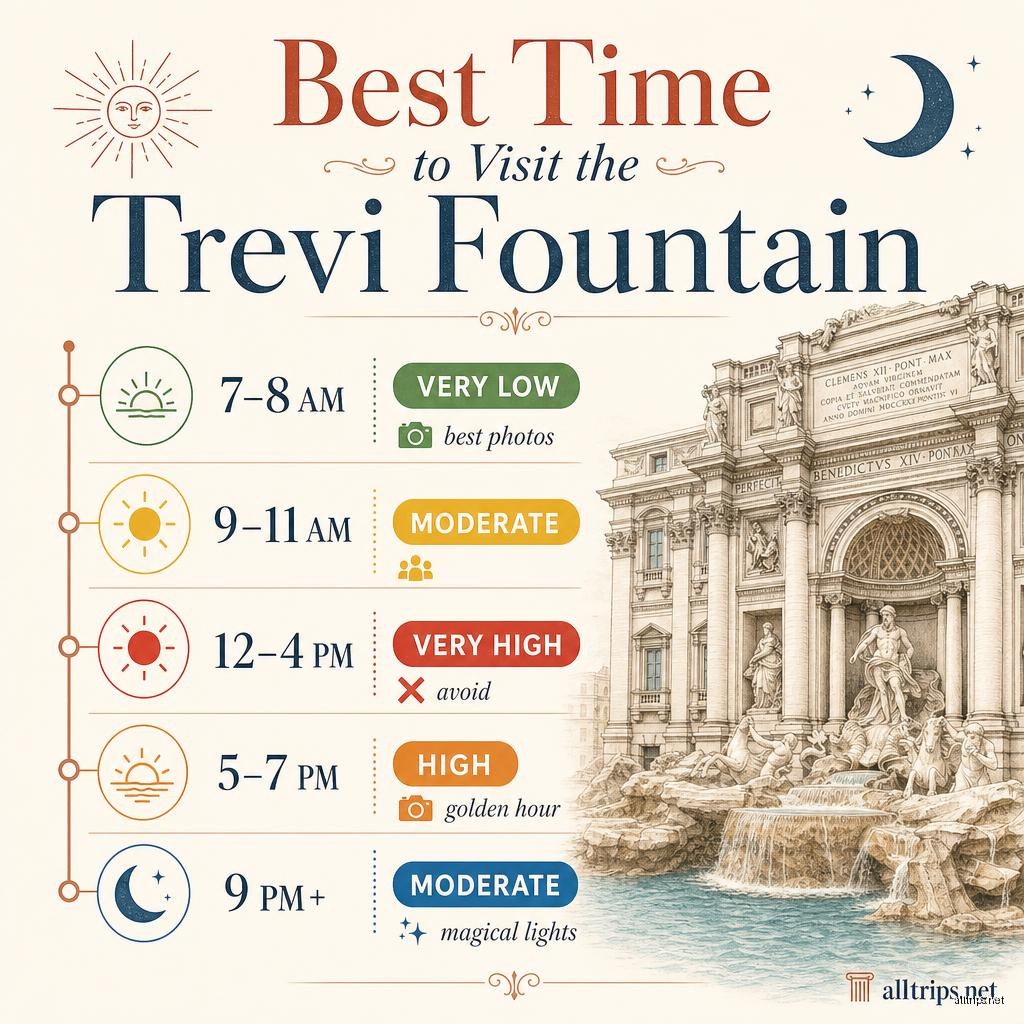
The Trevi Fountain is open 24/7, but timing your visit can dramatically impact your experience. Here's when to visit based on your priorities:
 alltrips.net
- Early Morning (7-8 AM) — Very Low crowds · Best for Photos (recommended). Arrive before 7 AM for near-empty shots. Soft morning light creates stunning photos.
- Morning (9-11 AM) — Moderate crowds · Pleasant Visit. Good balance of light and reasonable crowds. Cafés nearby are open.
- Midday (12-4 PM) — Very High crowds · Peak Crowds. Avoid if possible. Hot in summer, extremely crowded, and harsh light for photos.
- Sunset (5-7 PM) — High crowds · Golden Hour. Beautiful golden light but still crowded. Great for romantic atmosphere.
- Night (9 PM+) — Moderate crowds · Magical Illumination (recommended). The fountain is beautifully lit. Romantic atmosphere but watch for pickpockets.

Best month to visit
- November to February: fewer tourists, more intimate experience
- March & April: pleasant weather, moderate crowds
- May to September: peak season, very crowded
- October: great balance of weather and crowds
How to Avoid Crowds at Trevi Fountain
With over 3.5 million annual visitors, the Trevi Fountain is almost never empty. But these strategies will help you experience it with fewer crowds:
Early morning visit
Arrive before 7:30 AM for the quietest experience. At sunrise, you'll often find only a handful of other early risers and photographers. This is also the best time for photos without crowds in the background.
Late night visit
Visit after 10 PM when tour groups have left. The fountain is beautifully illuminated and the atmosphere is romantic. Stay alert for pickpockets — they target tourists at night.
Weekday vs weekend
Weekdays are generally less crowded than weekends, particularly Tuesday through Thursday. Avoid Sunday afternoons when local families join tourists.
Mealtime strategy
Visit during Italian lunch hours (1-3 PM) when Italians are eating. While still busy, there's a slight dip in tourist numbers.
Trevi Fountain Photography Tips
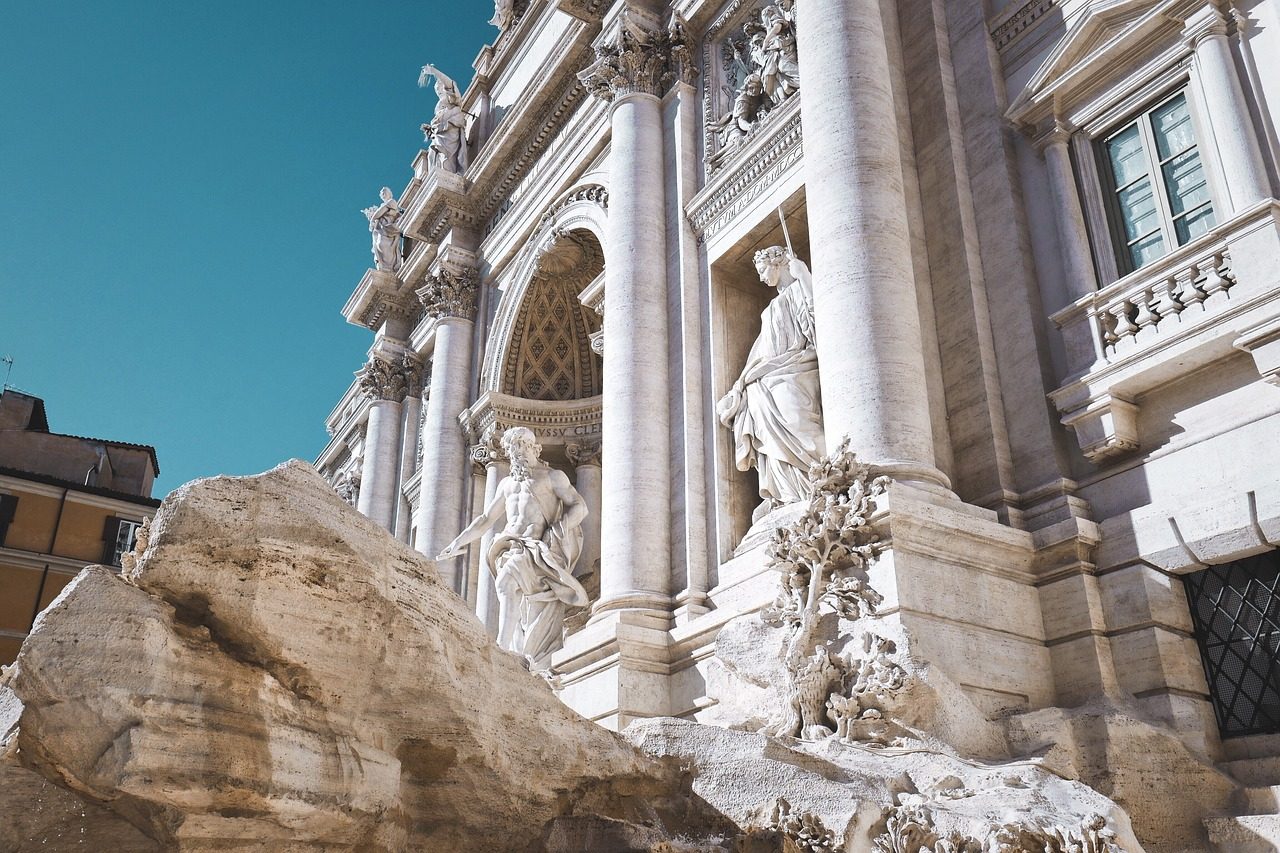
Detail shots of the sculptures work well from ground level
Best photo spots
- Center front for symmetrical shots
- Right side stairs for elevated view
- Nearby café terraces for overview
- Via delle Muratte for a "reveal" shot
Best light conditions
- Sunrise: soft, warm, no crowds
- Blue hour: 20 min after sunset
- Night: dramatic illumination
- Avoid midday harsh shadows
Pro tips
- Use a wide-angle lens (24mm or wider)
- Long exposure at night captures water blur
- Focus on details — statues, coins, water
- Capture the "coin throw" moment
Practical Visiting Tips
Is the Trevi Fountain Free? (2026 Update)
Viewing the Trevi Fountain from the surrounding piazza remains free 24/7. From 2 February 2026, non-residents pay €2 for close-up access to the inner basin terrace during opening hours (Tue–Sun 9:00–22:00, Mon & Fri 11:30–22:00, last entry 21:00). Rome and Metropolitan City residents enter free with ID; children under 5 and disabled visitors with a companion are also exempt. Outside opening hours the inner perimeter closes and the fountain is again free to view from the piazza. Source: fontanaditrevi.roma.it (City of Rome official site).
How Long to Visit?
Plan for 20-30 minutes to admire the fountain, take photos, and throw a coin. Add 15 minutes for nearby exploration.
Safety Tips
Watch for pickpockets, especially in crowds. Keep bags in front, don't flash expensive items, and stay aware of your surroundings.
Trevi Fountain Rules
Swimming, sitting on the fountain edge, and eating/drinking on the steps are prohibited. Fines can reach €450.
Walking routes from Trevi Fountain
The Trevi sits in the middle of Rome's most walkable cluster of landmarks. Here are the two routes that work best.
~2 hours · DayClassic historic-centre loop
The single best 2-hour walk in Rome — all car-free, all on cobblestones.
1. Trevi Fountain (20 min)
2. → Pantheon, 8-min walk (30 min inside)
3. → Piazza Navona, 5-min walk (20 min)
4. → Campo de' Fiori, 7-min walk (lunch / market)
See this in our 3-day Classic Rome itinerary →
~2.5 hours · EveningRomantic evening route
Cool air, illuminated monuments, far smaller crowds.
1. Spanish Steps at sunset (20 min)
2. → Trevi Fountain, 6-min walk (30 min)
3. → Pantheon at night, 8-min walk (15 min)
4. → Dinner in Trastevere (20-min walk over Ponte Sisto)
Browse evening-friendly itineraries →
From the Colosseum: a 20-minute walk through the Roman Forum and Piazza Venezia is more memorable than the metro. From the airport, the Leonardo Express + a short taxi or 15-minute walk from Termini is the fastest route.
What to See Near Trevi Fountain
Watch: 4 stops near the Trevi Fountain
Pantheon · Spanish Steps · Navona · Barberini alltrips.net
Nearby Attractions
Pantheon
Ancient Temple • 5-minute walk
Spanish Steps
Landmark • 10-minute walk
Piazza Navona
Square • 12-minute walk
Palazzo Barberini
Museum • 5-minute walk
How to spot good gelato near Trevi
- Look for covered stainless-steel tubs (pozzetti) — a sign the gelato is stored properly, not piled into bright mounds.
- Natural colours beat neon: pistachio should be muted green-brown, banana pale cream, not yellow.
- Walk 2–3 streets away from the piazza — prices drop and quality rises within a 5-minute radius.
Eating near the Trevi Fountain
Avoid the tourist traps directly facing the fountain. Walk 2-3 streets away for authentic Roman food at better prices — the side streets toward Via del Lavatore have local trattorias.
Where to stay near the Trevi Fountain
Sleeping near Trevi means you can step out for a 7 AM empty-fountain photo and a midnight illuminated stroll — both impossible from outer neighborhoods.
Best overallCentro Storico
Walk to Trevi, Pantheon and Piazza Navona in under 10 minutes. Best balance of charm and value.
Most centralTrevi / Quirinale
Step out the door to the fountain. Pricier and busier — worth it for short trips.
QuieterPantheon area
Equally walkable, slightly calmer evenings, often better-rated boutique hotels.
Compare hotels near Trevi FountainTrevi Fountain — Frequently Asked Questions
Is the Trevi Fountain worth visiting?
Yes — even with the crowds, the Trevi Fountain is one of Rome's must-see sights. It's the largest Baroque fountain in the world, free to admire, and surrounded by other top attractions (Pantheon, Spanish Steps, Piazza Navona) all within a 15-minute walk. Plan a 20–30-minute stop and pair it with the surrounding historic centre.
How long should you spend at the Trevi Fountain?
Most visitors spend 20–30 minutes: time to walk around the basin, take photos, throw a coin, and watch the sculptures. Add another 10–15 minutes if you want a gelato or coffee at a nearby café.
Is the Trevi Fountain free to visit?
Viewing from the piazza is free 24/7. From 2 February 2026, the City of Rome charges non-residents €2 for close-up access to the inner basin terrace during opening hours (Tue–Sun 9:00–22:00, Mon & Fri 11:30–22:00, last entry 21:00). Rome/Metropolitan City residents are free with ID, as are under-5s and disabled visitors with a companion. Outside opening hours, the inner perimeter closes and the fountain is again free to admire from the piazza. Official source: fontanaditrevi.roma.it.
Can you visit the Trevi Fountain at night?
Yes, and it's one of the best times. The fountain is dramatically illuminated until late, the air is cooler, and crowds thin noticeably after 10 PM. Watch for pickpockets, keep valuables zipped, and stick to the well-lit main square.
What is the closest metro stop to the Trevi Fountain?
Barberini (Line A) is the closest metro stop, about a 7-minute walk. Spagna (Line A) is also walkable in 10–12 minutes. There is no metro right at the fountain — the historic centre is intentionally pedestrianised.
What is the best time of day to visit the Trevi Fountain?
Before 8 AM for empty photos, or after 10 PM for atmosphere with manageable crowds. Avoid 11 AM to 6 PM in spring and summer — the piazza becomes shoulder-to-shoulder and the light is harsh.
Can you swim in or take coins from the Trevi Fountain?
No. Both are illegal. Swimming or wading carries fines up to €450, and the coins (about €1.4 million per year) are collected weekly by the City of Rome and donated to the Catholic charity Caritas.
How far is the Trevi Fountain from the Colosseum?
About a 20-minute walk (1.5 km) through the historic centre, or 3 stops on Metro Line B (Colosseo → Cavour → Termini → connect to Line A → Barberini). Most travellers walk it because the route passes Via dei Fori Imperiali and Trajan's Forum.
Do you need tickets for the Trevi Fountain in 2026?
Not for the piazza view — it's free 24/7. You only need a ticket for the €2 close-up basin platform introduced in 2025 (free for Rome residents with ID, under-5s, and disabled visitors with a companion). See our full breakdown at /blog/trevi-fountain-tickets.
How much are Trevi Fountain tickets?
€2 flat for non-residents accessing the inner basin terrace during opening hours. There is no fee to see the fountain from the surrounding piazza. Any 'Trevi ticket' priced above €2 is either a nearby attraction, a guided tour, or a third-party markup.
How do you book the €2 Trevi close-up slot?
Online at fontanaditrevi.roma.it (the official City of Rome portal) or at the on-site kiosk. In July–August online booking is essentially required; November–February you can usually walk on.
Are there scams to avoid at the Trevi Fountain?
Yes — bracelet and rose 'gifts', over-priced coperto at fountain-facing cafés, resold €2 slots at 10× markup, and street sellers claiming 'official' tickets. Say 'No, grazie', walk 2 blocks for coffee, and only buy the close-up slot from the official site.
Continue your Rome trip
Trevi is one stop. Most travellers continue to the Pantheon, Spanish Steps, the Vatican or the Colosseum — here's the fastest way to plan all of it.
Rome itinerariesPantheon guideColosseum ticketsAirport transferHow many days in Rome·3-day Classic Rome·Printable Rome maps & guidesEvery Trevi Fountain guide on AllTrips
The full 2026 Trevi library, grouped by topic. Bookmark this page as your Trevi hub — every article below links back here.
Planning your visit
- Trevi Fountain Tickets 2026: Do You Need One? — The main view is free. How the €2 controlled inner perimeter works, who pays and what to avoid.
- Is the Trevi Fountain Open 24 Hours? — Visible from the public square at any hour; the inner perimeter has set hours.
- How Long to Spend at the Trevi Fountain — Realistic time budgets, from a quick photo stop to a longer look.
- Visiting the Trevi Fountain on a Rome Layover — The realistic minimum time from FCO to the Trevi and back.
- Are There Public Toilets Near the Trevi Fountain? — None at the fountain itself — verified nearby options with walk times.
- Visiting the Trevi Fountain With Kids — Best times, stroller access, toilets, kid-friendly cafés and the coin ritual for every age.
- Trevi Fountain Accessibility Guide — Wheelchair access, step-free routes, accessible metro, free entry policy and quiet visiting times.
- Trevi Fountain Dress Code & Summer Heat Tips — What to wear, what's banned, and how to survive 38 °C at the piazza.
- Visiting the Trevi Fountain in the Rain — What rain really changes, and verified indoor options nearby.
- The Trevi Fountain at Christmas — Holiday atmosphere, seasonal events and what to verify before a Christmas visit.
- Trevi Fountain at Easter & Holy Week — How Easter changes the piazza — processions, closures and the best viewing window.
- Trevi Fountain on New Year's Eve — The midnight scene, safety, road closures and the calmest slot on Jan 1.
- Best Time to Visit the Trevi Fountain (Hour-by-Hour, 2026) — Exact hours, months and weekdays the piazza is calm vs heaving — plus the 20-minute secret window.
- Trevi Fountain Crowd Calendar by Month (2026) — Month-by-month forecast with the 5 calmest weeks of 2026 listed.
- Trevi Fountain Pickpockets & Safety Guide — Real risks, the 4 common scams, 5 prevention habits and what to do if you're targeted.
History & architecture
- Why Is the Trevi Fountain So Famous? — The five reasons the Trevi became one of the world's most photographed fountains.
- 25 Interesting Facts About the Trevi Fountain — Coin totals, hidden symbolism, scandals and surprising trivia.
- The Fascinating History of the Trevi Fountain — From the 19 BC Aqua Virgo aqueduct to Salvi's 1762 Baroque masterpiece.
- Who Built the Trevi Fountain? — Nicola Salvi, Pietro Bracci and the architects who created Rome's icon.
- When Was the Trevi Fountain Built? — 1732 competition, 1762 completion — the 30-year construction timeline.
- What Is the Trevi Fountain Made Of? — Travertine, Carrara marble and the Roman quarries that supplied Salvi.
- The Meaning of the Trevi Fountain Statues Explained — Oceanus, the Tritons, Abundance and Salubrity — the full iconography.
- The Aqua Virgo: The Aqueduct That Feeds the Trevi — Agrippa's 19 BC aqueduct still supplies the fountain — the 20 km ancient route.
- Trevi Fountain Restoration History — The 2014–15 Fendi restoration and every major clean-up since 1762.
- Trevi Fountain in Movies: La Dolce Vita to Today — From Fellini's 1960 scandal to Roman Holiday and modern cameos.
- Pope Clement XII: The Pope Who Commissioned the Trevi — The blind 79-year-old Corsini pope who launched the 1732 design competition.
The coin ritual
- The Trevi Fountain Coin Ritual — Right hand over left shoulder — the exact tradition and its Roman origins.
- What Happens to the Coins Thrown Into the Trevi Fountain? — How ACEA collects them and what Caritas does with the money.
- Can You Swim in the Trevi Fountain? — The official rules, the fine starting from €450, and the Fellini myth.
- Can You Drink the Water at the Trevi Fountain? — Not from the basin — here's what the rules say and which nasoni to use.
- Trevi Fountain Rules & Etiquette: Fines and Dos and Don'ts — €450 fines, the no-sitting rule, balcony rules and what locals expect.
Nearby, itineraries & maps
- How to Get to the Trevi Fountain — Metro, bus, taxi or walking — every way to reach the Trevi, ranked.
- Nearest Metro Station to the Trevi Fountain — Barberini vs Spagna — which Line A station is actually closest.
- Walking From the Pantheon to the Trevi Fountain — The 8-minute walk, step-by-step, with the prettiest detour.
- Walking From the Spanish Steps to the Trevi Fountain — The 9-minute walk with the perfect coffee stop halfway.
- Walking From the Trevi Fountain to the Vatican — The 25-minute walk via Pantheon, Navona and Ponte Sant'Angelo — step by step.
- Walking Route: Colosseum to Trevi Fountain — A 25-minute pedestrian route with 6 photo-worthy stops along the way.
- Perfect Walking Route: Trevi, Pantheon & Piazza Navona — 1.8 km one-way self-guided route with 8 stops, coffee breaks and 2026 tickets.
- Trevi Fountain Map & Nearby Attractions — Interactive map plus every must-see within a 10-minute walk.
- Best Hidden Gems Near the Trevi Fountain — 10 secret spots within 5 minutes — Galleria Sciarra, popes' hearts, rooftop bar.
- Vicus Caprarius: The Underground City Beneath the Trevi — €4 archaeological site 9 m below the fountain — Aqua Virgo cisterns and a Roman insula.
- Best Restaurants Near the Trevi Fountain — Grouped by honest walking distance, with signals worth noticing.
- Best Cafés & Gelato Near the Trevi Fountain — Coffee and gelato by area, with honest walking times.
- Best Rooftop Bars Near the Trevi Fountain — 5 rooftop bars within 8 minutes — with the domes and cupola views.
- Where to Stay Near the Trevi Fountain — How to choose in the Trevi radius: views, noise and live rates.
- A Half-Day Around the Trevi Fountain — 4-hour walking plan combining the Trevi with 5 nearby sights.
- Pantheon & Trevi in One Day — The optimal plan combining both icons on foot.
Tours & experiences
- Best Guided Tours Including the Trevi Fountain — 7 best 2026 tours: walking, evening, underground, food and private Baroque — pros and cons of each.
- Trevi Fountain Self-Guided Audio Tour (45 min) — Eight numbered stops decoding Salvi's design, Oceanus and the Aqua Virgo.
- Trevi Fountain Night Photography Guide — What is verifiable after dark: illumination, rules and precautions.
- Best Photo Spots at the Trevi Fountain — 9 angles beyond the front-row shot — including the balcony you can pay to enter.
- Trevi Fountain Live Webcam — Watch the piazza in real time — and see the crowd size before you leave your hotel.
- Proposing at the Trevi Fountain (2026 Guide) — Best times, photographer hire, ring safety and quieter alternative spots nearby.
- Trevi Fountain vs Spanish Steps: Which Should You Visit? — Side-by-side 2026 comparison: crowds, photos, time needed, accessibility and the winner by traveller type.
- Trevi Fountain vs Pantheon: Which Is Better? — Honest head-to-head: history, cost, crowds, photography — and which to prioritise on a half-day.
- Trevi Fountain vs Piazza Navona — Two Baroque icons 5 minutes apart — which deserves the longer visit.
- Trevi Fountain vs Bernini's Four Rivers Fountain — Salvi (1762) vs Bernini (1651): which Baroque masterpiece is greater?
- Trevi Fountain vs Colosseum at Night — Which of the two is actually better after dark — an honest verdict.
- Top Rome Attractions Ranked 2026: Where Does Trevi Place? — Our 2026 ranking of the top 15 Rome attractions and exactly where the Trevi Fountain lands.
Related Articles
AttractionsColosseum Tickets Guide 2026
Complete guide to skip-the-line tickets, tours, and best entrance options
Read ArticleTravel PlanningHow Many Days in Rome?
Find the perfect trip length based on your travel style
Read Article